
The great rock below Rainbow Falls is the body of Kuna, a giant moʻo (lizard) killed by the demigod Māui. The churning water at Boiling Pots upstream comes from the same story.
The legend of Hina and Kuna
Hina, mother of the demigod Māui, lived in the cave behind Rainbow Falls, where she and her women beat mulberry bark into kapa, a bark cloth. Upstream lived Kuna, a giant moʻo who sent torrents of water and logs over the falls to torment her. Her cave kept her safe, and so did her son.
One stormy night, while Hina slept, Kuna dammed the river with a boulder just below her cave. The rising water woke her, and she called across the sea: come quickly, Māui, come with your war club, save us from Kuna.
Māui heard her faintly and saw her small bright cloud above Hawaiʻi. From Haleakalā he paddled his canoe to Hilo, found the Wailuku dry, and knew it had been dammed. With his club he cut a channel around the boulder, and the water ran to the ocean again.
Kuna fled up the gorge. Māui struck the rocks until the earth shook, driving him into the deep potholes below Boiling Pots, then asked Pele for hot stones and threw them in until the river boiled.
Kuna ran downstream, and they fought above Rainbow Falls. One blow of Māui’s club sent the moʻo over the edge. He lies where he fell, a great rock beaten by stones and logs and flooded, just as he once beat and flooded Hina. The pools at Boiling Pots still bubble.
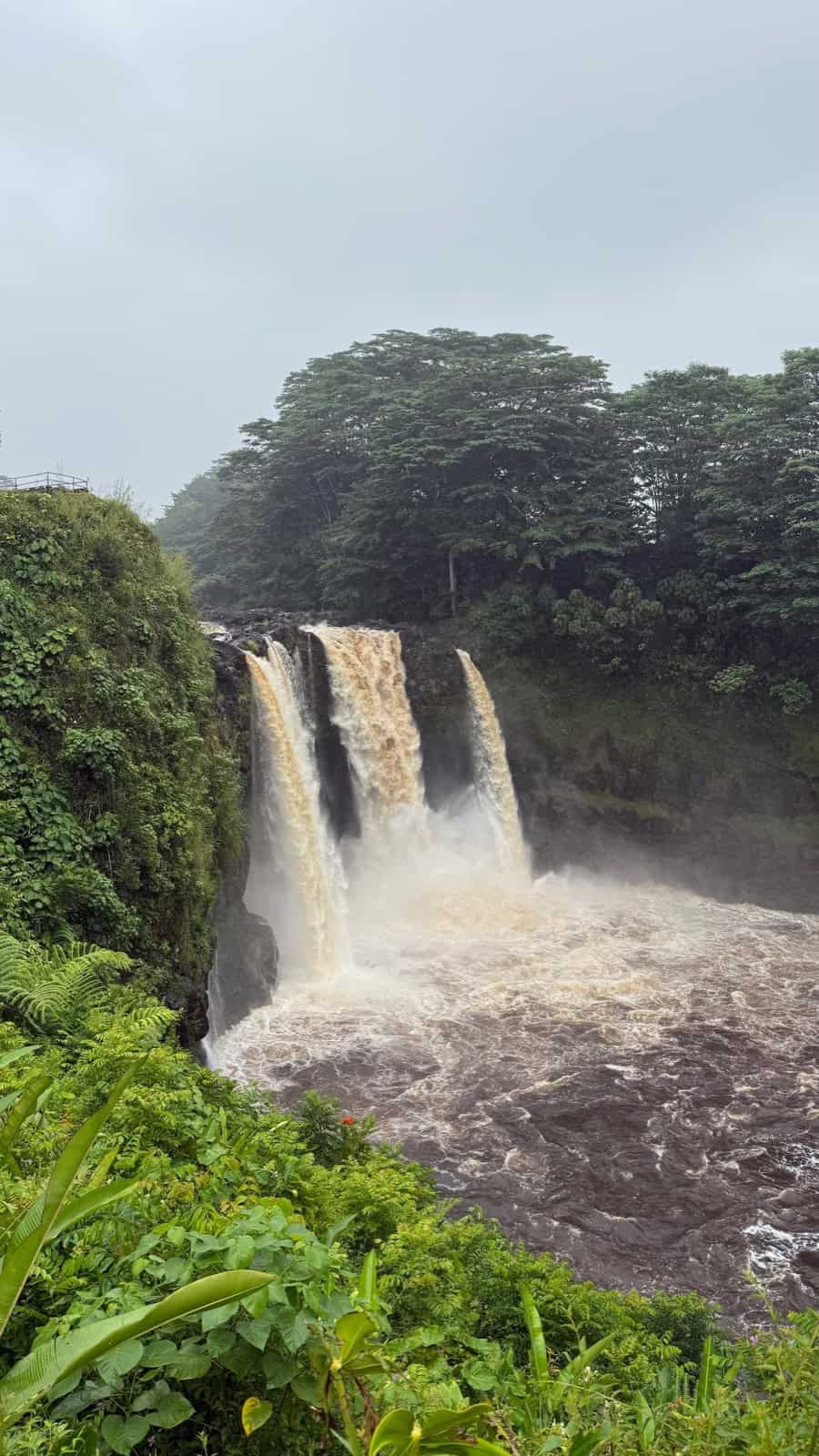
The Wailuku River pours over Rainbow Falls after overnight rain. The cave behind the falls is the legendary home of Hina.
Visiting Rainbow Falls and Boiling Pots today
Rainbow Falls sits in the middle of Hilo. Waiānuenue means “rainbow water”: on sunny mornings a rainbow forms in the spray, visible from the parking lot. The falls drop 80 feet in front of the lava cave, Hina’s home in the legend; Peʻepeʻe Falls and the Boiling Pots overlook are a short distance upstream.
Entry is about $22 for two people: $5 per person plus $10 per vehicle. After heavy rain the falls widen from one stream to three chutes of brown runoff. Do not swim: a state plaque counts 27 deaths in this stretch of the Wailuku between 1995 and 2024. Our Rainbow Falls guide has the parking and entry details, and the Big Island mythology hub has other Hawaiian legends.
About this telling
This telling follows the “Battle of the Wailuku River” placard at Wailuku River State Park (DLNR Division of State Parks), which credits Tales of the Menehune, compiled by Mary Kawena Pukui, retold by Caroline Curtis (Kamehameha Schools Press, 1985). That chapter condenses W. D. Westervelt’s Legends of Ma-ui (1910), collected in English from Hilo informants. No Hawaiian-language original of the story is known.
Older tellings make the hot stones Māui’s own, and some Hilo versions name the enemy Lonokaeho, turned to stone rather than thrown over the falls. The ʻōlelo noʻeau (poetical saying) “Ka ua lei māʻohu o Waiānuenue,” the rain of Waiānuenue that is like a wreath of mist, is recorded in the Pukui–Elbert Hawaiian Dictionary.
Read more
- Hina and the Wailuku River, in Westervelt’s Legends of Ma-ui. The 1910 chapter, free to read in full. It is the oldest written telling of the fight at the falls, and everything since, the park placard included, goes back through it.
- Tales of the Menehune, on Ulukau. The Pukui and Curtis book the park placard credits, free to read as scanned pages. This is the version the placard follows, and so the one this page follows.