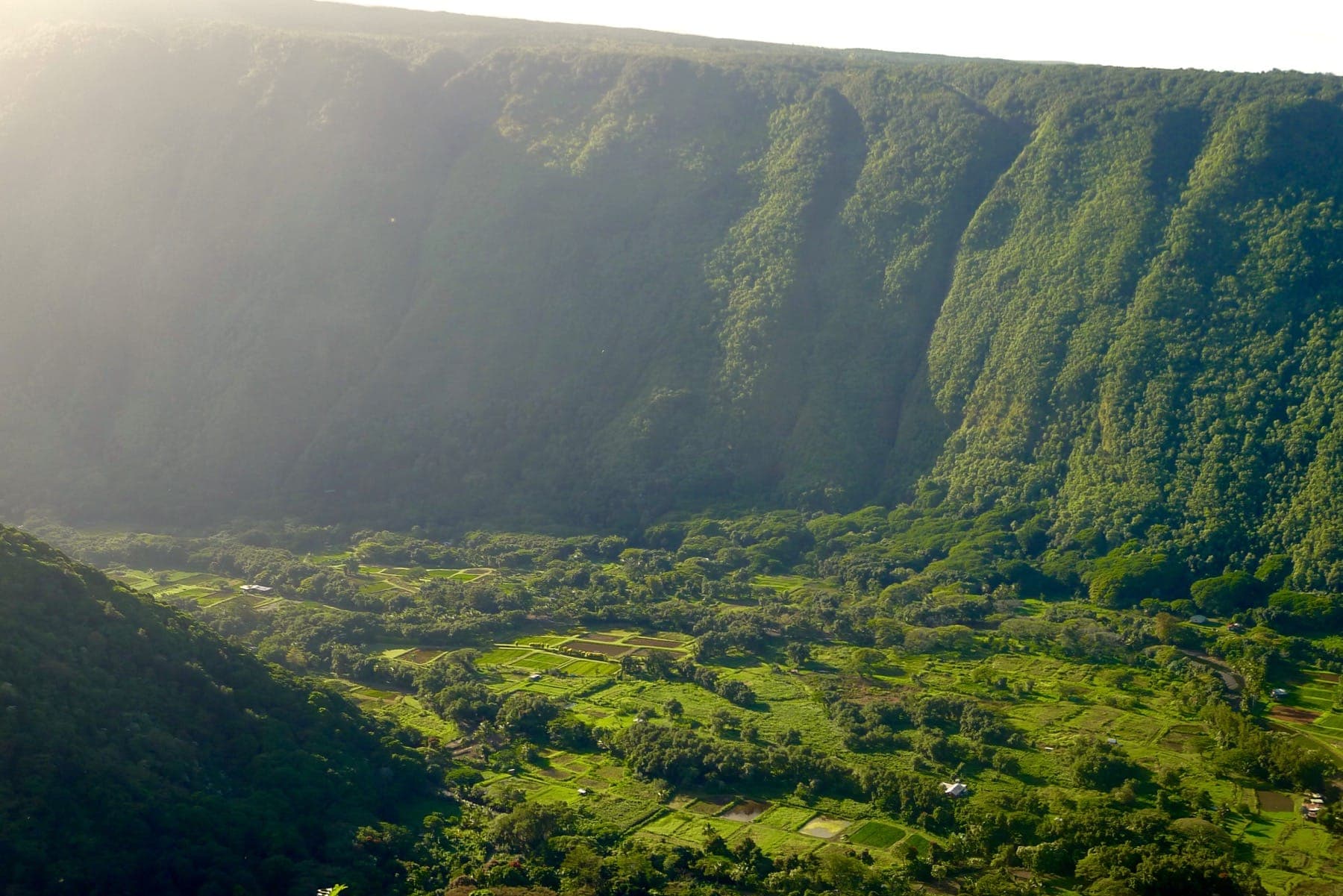
The rim lookout is free and needs no permit: the platform sits a ten-second walk from the parking lot at the end of Waipiʻo Valley Road in Kukuihaele. The valley floor is another matter. The county’s emergency rule bars all pedestrians from the road, so walking down is no longer legal, and for visitors the only way in is a shuttle tour at $67 per adult and $36.50 per child for a 1.5- to 2-hour ride.
If you came to hike down, the shuttle is the only substitute. The lot at the rim fills on weekends by mid-morning, and cell signal there comes and goes, so book before you leave the highway.
Table of contents
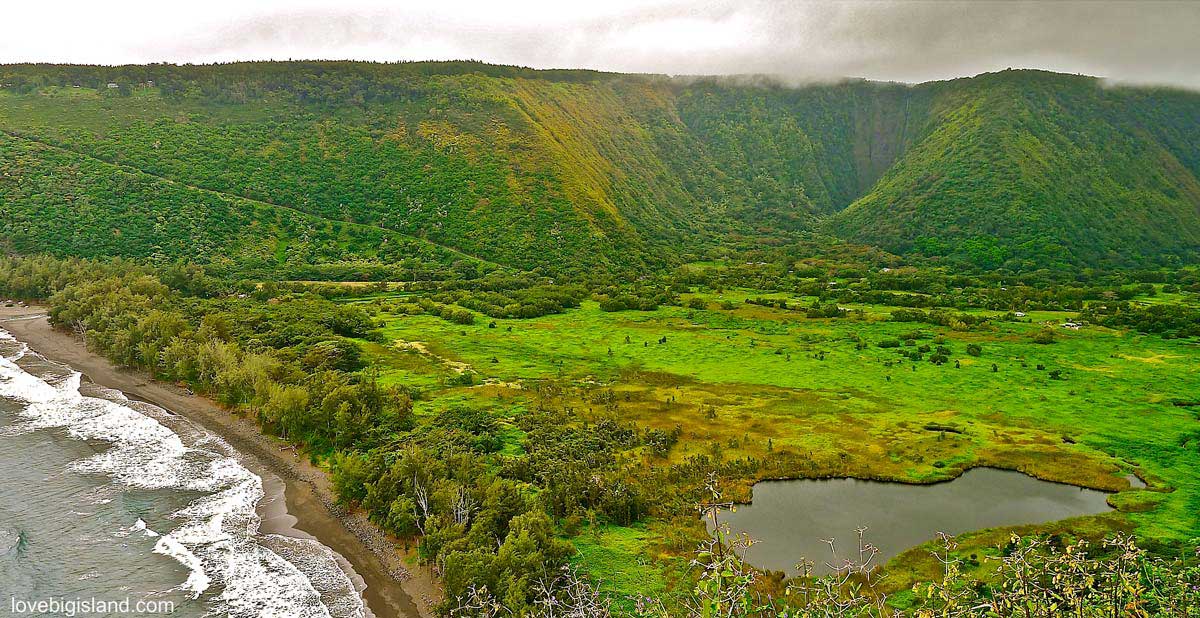
Overview of Waipiʻo Valley from the ‘opposite’ side. You can see the steep Waipiʻo Valley access road, the black sand beach, and taro fields.
Waipiʻo Valley lookout
The overlook is a paved platform at the valley rim. From there you see most of the valley floor: taro fields in the center, and the river cutting past them to the black sand beach at the ocean end. The cliffs west of the valley stretch along the Hāmākua Coast. The lookout faces two ways: valley to the south, sea cliffs to the north and west.
The falls inside the valley are not visible from the rim. Hiʻilawe Falls and Kaluahine Falls are both set back against the valley walls and only visible from the valley floor or from the ocean.
Bathrooms and a picnic area sit at the lot at the end of Waipiʻo Valley Road in Kukuihaele. It fills on weekends by mid-morning, but few people stay long.
The final scene of the 1995 film Waterworld, the “Dry Land” the characters reach at the end, was shot in Waipiʻo Valley. Which waterfall appears on screen is not something we can source to production records, so treat the Kaluahine attribution you will read elsewhere as unconfirmed.
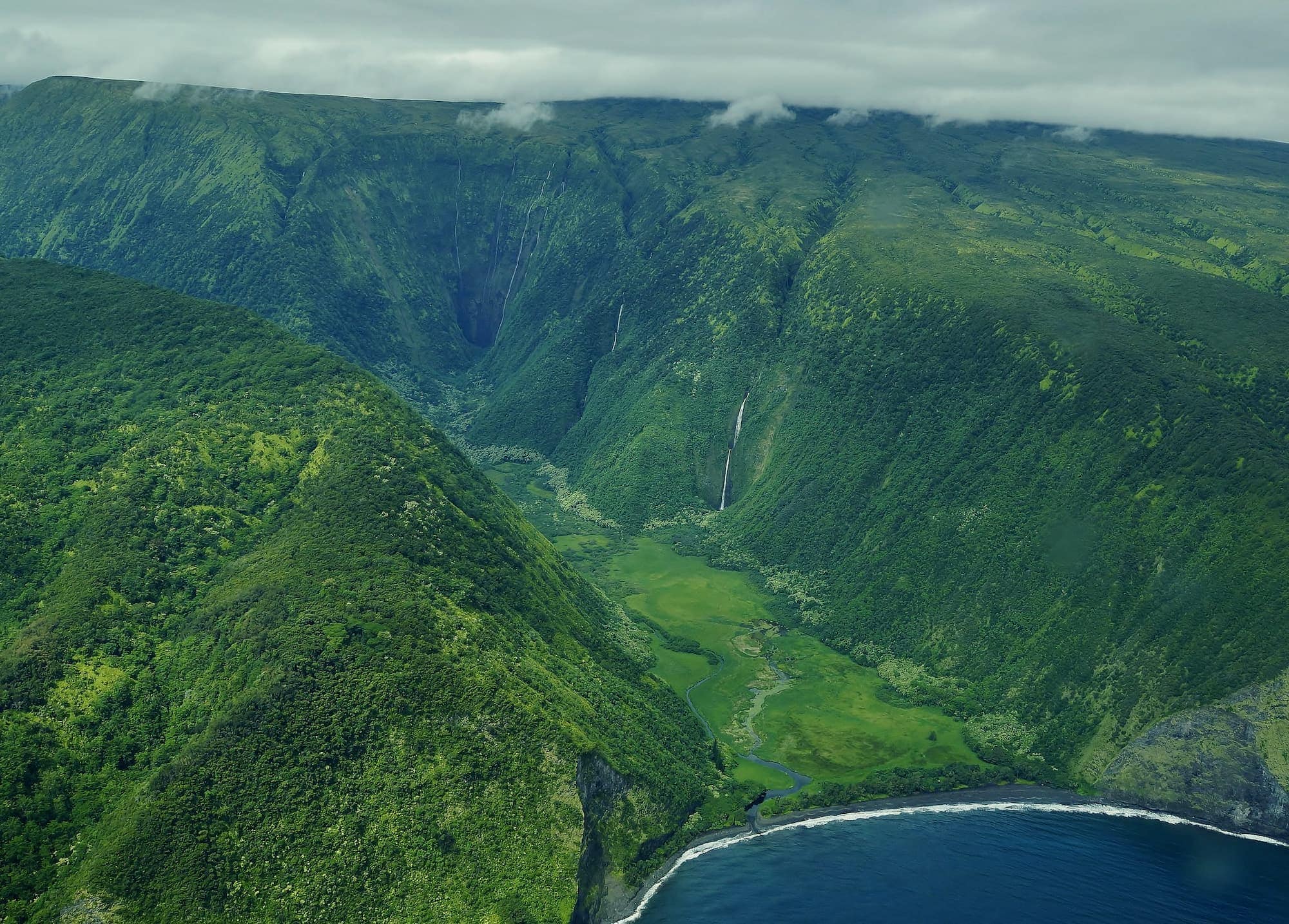
Aerial overview of Waipiʻo Valley. Image credit: Eric Tessmer, source.
The closure of Waipiʻo Valley Road: current status
The road has been closed since February 2022. The county rule doing it gets renewed roughly every 60 days, and the version in force as we write this is the 24th, signed July 1, 2026 and running through September 2, 2026. The underlying traffic emergency zone declaration runs to February 25, 2027, so expect the road rule to be renewed again rather than lifted.
The rule closes the road and then carves out a narrow exception. Closed to: all pedestrians, uncovered vehicles including ATVs, and horseback access. Open to: vehicular access by Hawaiʻi County residents, permitted licensed and insured tour operators, and Native Hawaiians exercising traditional or customary rights.
Even inside that exception the conditions are strict. Low-range four-wheel drive only, and the rule states that all-wheel drive vehicles do not count. Gross vehicle weight rating no higher than 10,000 lbs, 4WD engaged the whole way, every passenger seated and belted in an enclosed compartment, and makai-bound (heading for the ocean) vehicles yield to mauka-bound (heading inland). Tour operators need a permit from the Mayor’s office, valid four months at a time. The road closes outright during significant weather.
Why is Waipiʻo Valley closed?
A January 2022 geotechnical evaluation of Waipiʻo Valley Road found active rockfall, slope instability, and erosion along the route, and the County of Hawaiʻi closed the road to visitors on the strength of it. The report calls for rockfall mitigation and slope work before general access can resume. You can read the complete evaluation here, and the current emergency rule here (July 1, 2026).
Can visitors still access Waipiʻo Valley?
The rim, yes. The valley floor, only on a tour. Your options as a visitor:
- The Waipiʻo Valley overlook is free and open to everyone, with no permit and no booking.
- To reach the valley floor you must ride down with a permitted tour operator. You can’t drive yourself, and a rental 4WD doesn’t change that: the exception is for county residents, not for visitors with the right vehicle.
- You can’t walk down. The rule prohibits pedestrians on the road outright, with no carve-out for residents, tour guests, or hikers heading for the trails beyond the valley.
- Camping permits for the valley itself remain suspended. The County has said it is working on ways to restore public access as safety allows, and the state’s Nā Ala Hele advisory council has formally asked the Mayor to build a pedestrian lane into any reopening.
Tours into Waipiʻo Valley
One commercial tour currently runs on the valley floor: the Waipio Valley Shuttle, a ride down and back. Everything else is off.
The shuttle runs 1.5 to 2 hours, takes all ages, and costs $67 per adult and $36.50 per child as of July 2026. It starts at the lookout and loops the valley floor below, with a few stops where you get out. There are no restrooms down there, so use the ones at the rim first. You can book here.
The two options people still ask about:
- Mule-drawn wagon tours have not run since February 2022. The operator’s booking system no longer returns a bookable product, and parts of its website have been taken over by spam, so we’re not linking it.
- Horseback tours into the valley are barred by the emergency rule, which prohibits horseback access on the road, so these rides are not coming back on a schedule. Waipio on Horseback still runs rides, but at its own ranch above the valley rather than on the valley floor. A second operator that once ran valley rides has moved its product to Kohala, and a third has relocated to the Hāmākua Coast.
Hiking and Waipiʻo Valley: why it is off the table
Waipiʻo has some of the most demanding terrain on the island, and none of it is legally reachable on foot right now. The emergency rule bars pedestrians from Waipiʻo Valley Road, which is the only route between the rim and the floor, so both of the hikes this page used to describe are closed to you.
- The hike down into Waipiʻo Valley was one of our top-5 short hikes in Hawaiʻi: 6.5 miles from the overlook to the black sand beach and back, with about 800 feet of elevation each way. It has not been permitted since February 2022 and remains prohibited under the current rule.
- The Muliwai Trail zigzags up the far wall of the valley and runs on to Waimanu Valley, one of the hardest places to reach on foot on the Big Island. The trail itself is not closed, and Hawaiʻi DLNR still administers the Waimanu camping permits through its forest reserve reservation system. The problem is the approach: the trailhead sits across the Waipiʻo Valley floor, and you can’t legally walk there. Until pedestrian access returns, the permit gets you a campsite you have no lawful way to reach.
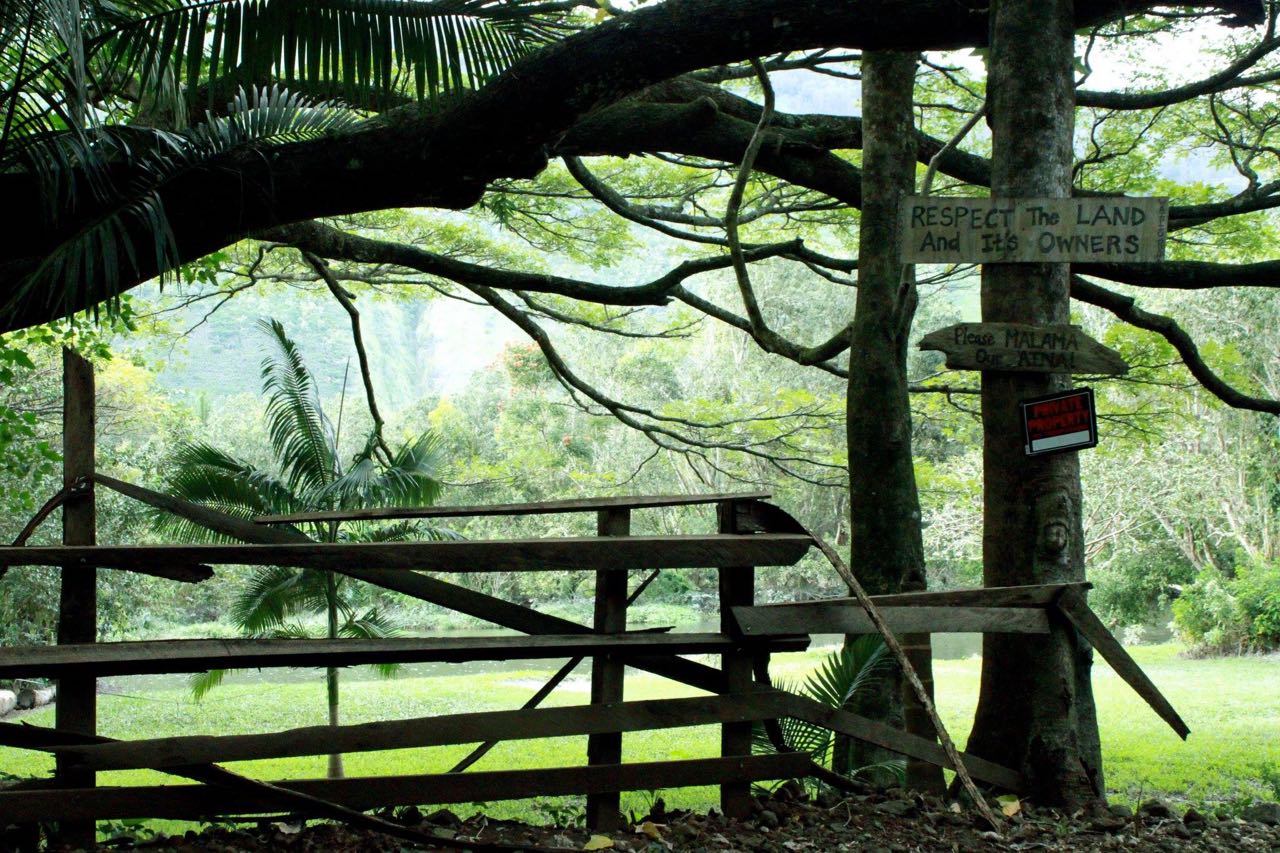
People live and farm in Waipiʻo Valley, and much of the floor is private land. On a shuttle tour, stay with your guide and respect the posted boundaries. Image credit: Joey Gutierrez
Getting down into Waipiʻo Valley
Visitor access to the Waipiʻo Valley floor is only possible as part of a tour
Waipiʻo Valley Road is closed to non-residents and to all pedestrians. Visitor access to the valley floor and the valleys beyond it is only possible as part of a tour.
Waipiʻo Valley Road is one of the steepest public roads in the state. The county’s own engineering evaluation puts it at about 4,100 feet long from the lookout to the valley floor, losing roughly 800 feet of elevation over 0.7 miles of that. The road is signed at 25%; the county’s measurements work out closer to 20% averaged over the steep section, and the 40% peak figure you will find repeated online has no engineering source behind it that we can find.
None of that is your problem as a visitor, because you are not driving it. Rental agreements on the Big Island commonly carry a clause against taking the car down Waipiʻo Valley Road, and the emergency rule settles the question anyway: the exception covers county residents, permitted operators, and Native Hawaiian practitioners, and a visitor in a rented 4WD is none of the three.
If you do go down on the shuttle, bring a swimsuit. The black sand beach is a good place for a quick dip, though the currents are strong enough that you should stay shallow.
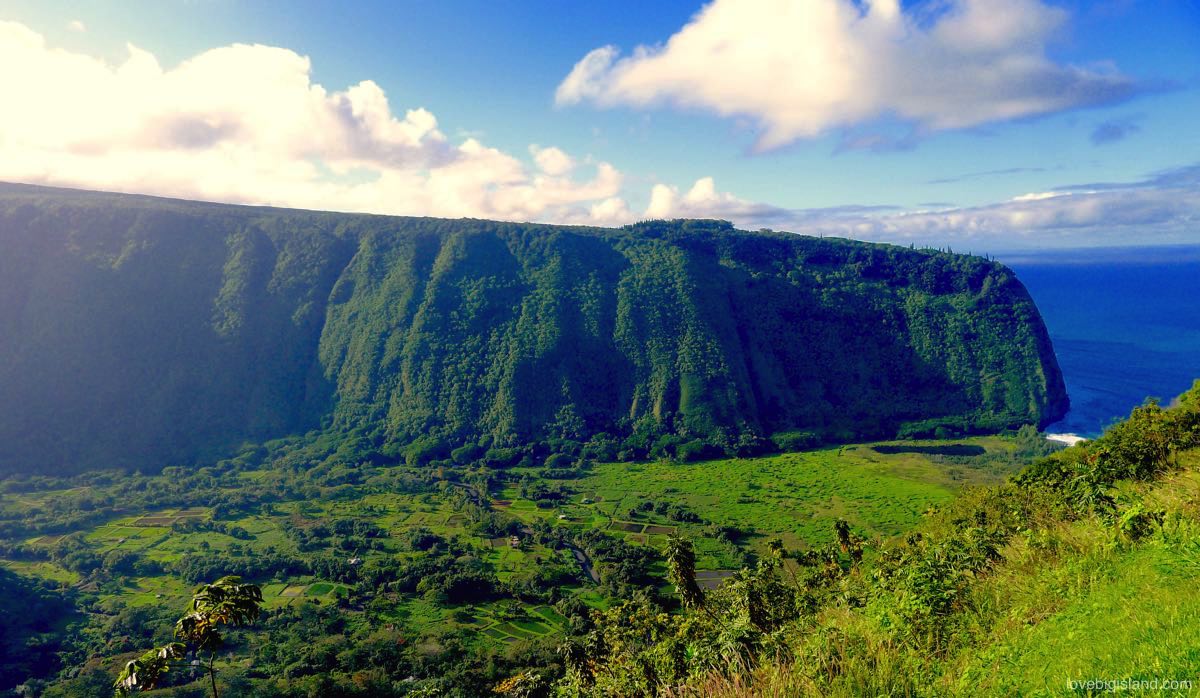
There are people living in Waipiʻo Valley. You can see the road and some houses and agricultural activity on the valley floor.
The black sand beach of Waipiʻo Valley
The beach sits to the right as soon as the road reaches the valley floor, a few minutes on. It’s split in two by the river draining the valley, and after heavy rain that crossing can be the hard part.
The sand runs black all the way to the waterline, but this beach has a reputation for rip currents and high surf, and it’s a poor place to swim in winter.
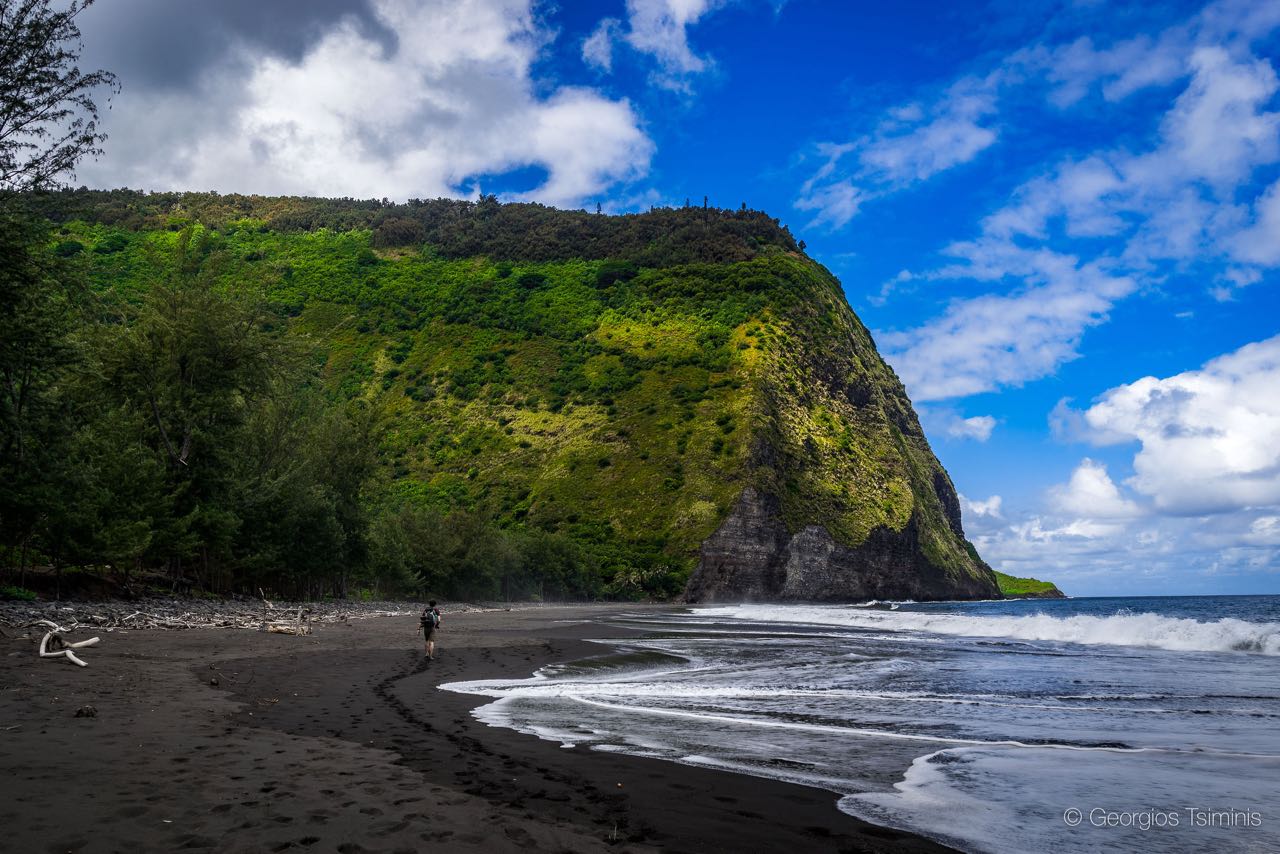
The black sand beach at the mouth of the valley, with the north wall dropping straight into the surf. Image credit: Georgios Tsiminis
Kaluahine Falls
If you are lucky, or unlucky depending on how you feel about rain, you will see Kaluahine Falls on the right hand (east) side once you reach the beach. It only runs when it’s been raining hard. World of Waterfalls has a longer write-up on Kaluahine.
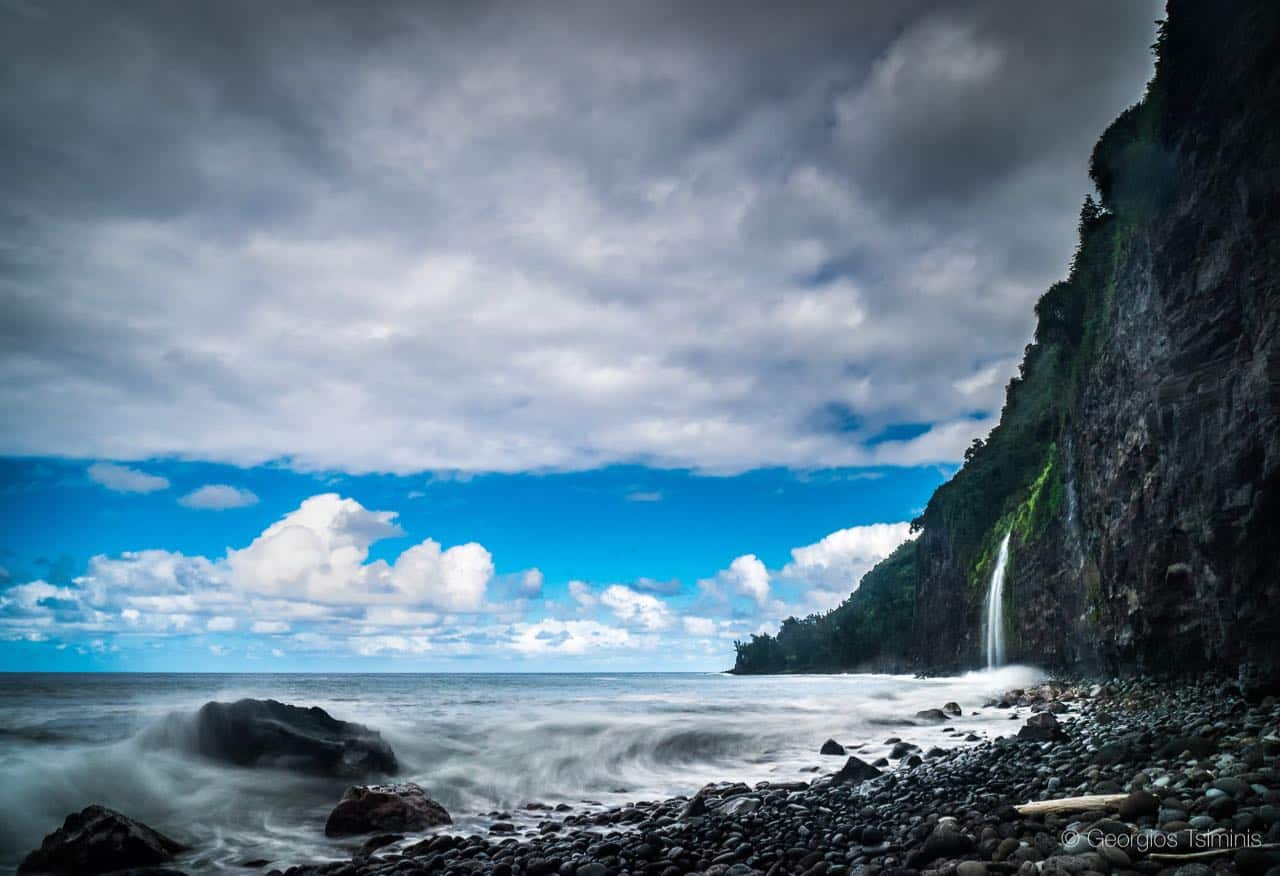
The Kaluahine falls are visible to the east from the black sand beach at the bottom of Waipiʻo Valley. Image credit: Georgios Tsiminis
A visitor account from before the 2022 closure
Several of the images in this guide have been provided by Georgios Tsiminis
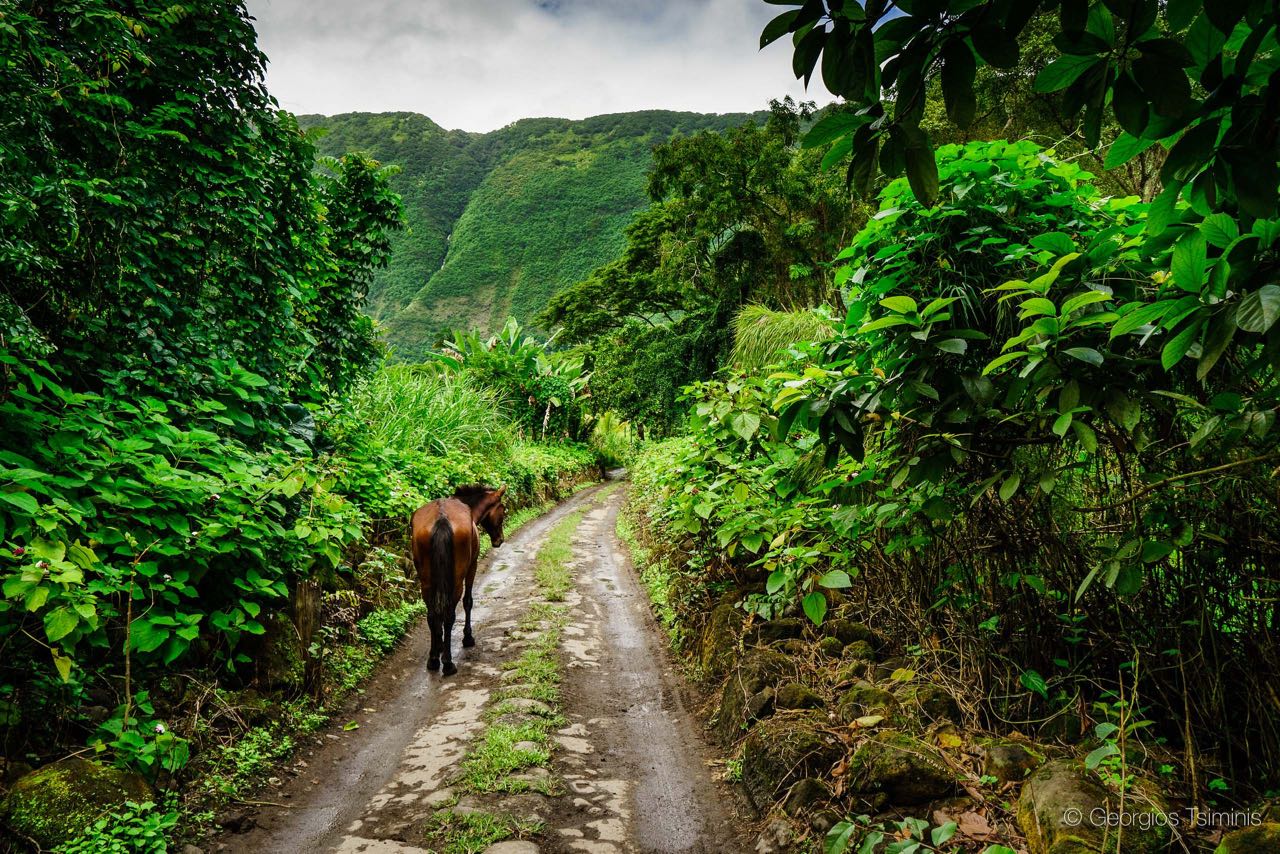
Horses roam loose on the valley floor and you will often meet one on the road. They are not tour animals: horseback access to Waipiʻo Valley Road is prohibited under the emergency rule. Image credit: Georgios Tsiminis
The following is his account:
Waipiʻo Valley from below: a 2019 visitor account (valley floor now requires a tour)
Note: This account was written in 2019, before the February 2022 closure. Walking down the road and reaching the beach on foot, as this account describes, are both prohibited today. We are keeping it because it is a good description of what the shuttle now takes you past.
As a first-time visitor to the Big Island I (Georgios Tsiminis) didn’t know what to do so I got some local knowledge on where I could go to make memories.
“Go to Waipiʻo Valley. No matter what else you do, go to the valley!”
Was the best advice I could have gotten!
I checked the map, packed my backpack, and off I went early in the morning. What greeted me at the valley outlook was a wall of green on every hillside and a black sand beach running the full width of the valley floor.
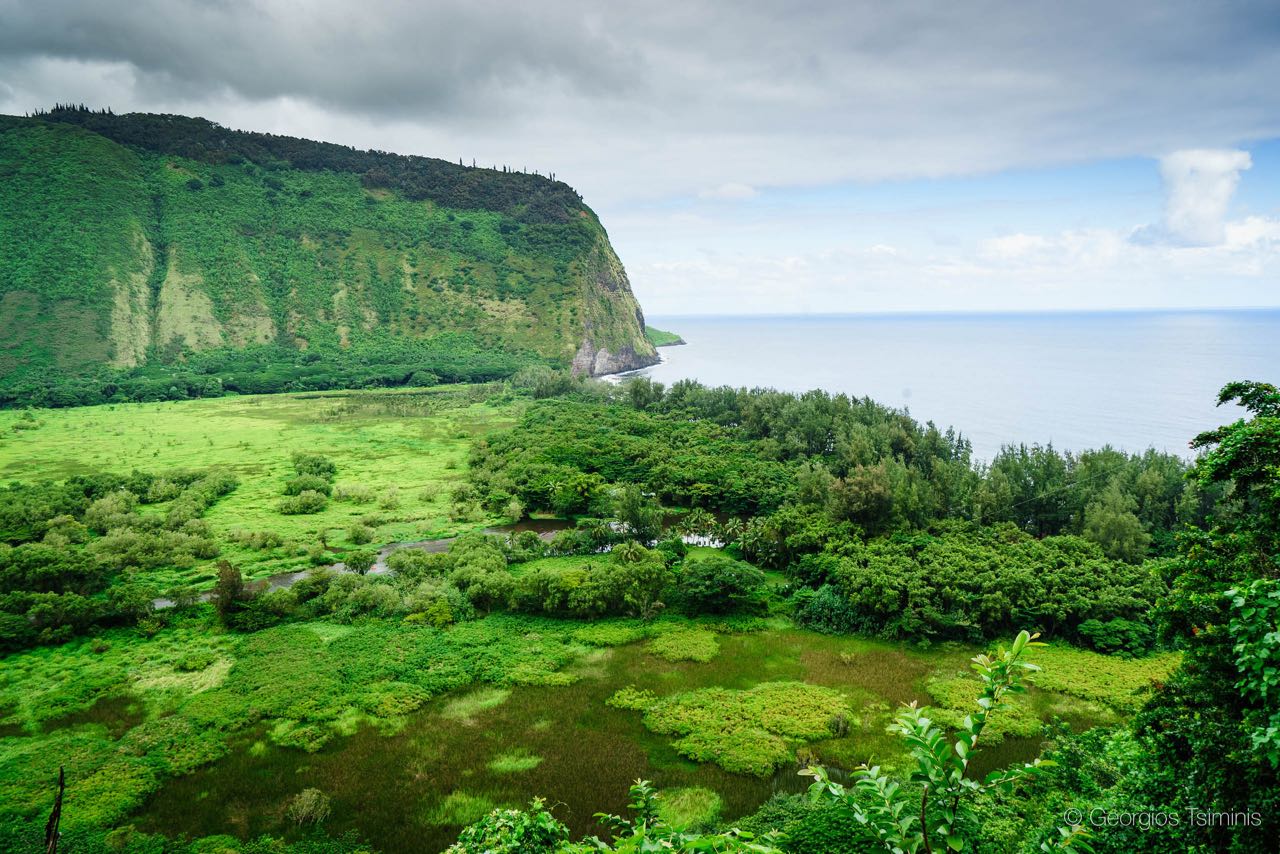
The valley floor opens up as you descend the access road. Image credit: Georgios Tsiminis
Walking down into the valley is not easy, but listen to the park keeper’s advice and you’ll be rewarded by dense tropical vegetation. At the bottom of the steep road turn left to explore inlands, where banana and avocado trees line the road leading into the valley. Horses roam free and waterfalls cascade from tall cliffs. Explore and enjoy, and then turn back and walk down to the shore of the ocean.
Black sand runs to the waterline. Waves at this beach are large and the surf is often rough, particularly in winter. Walk west along the beach as far as you can, take care when crossing the stream as the water is as strong as it is cold, and reach the end of the beach underneath the cliff for a clear view back across the valley.
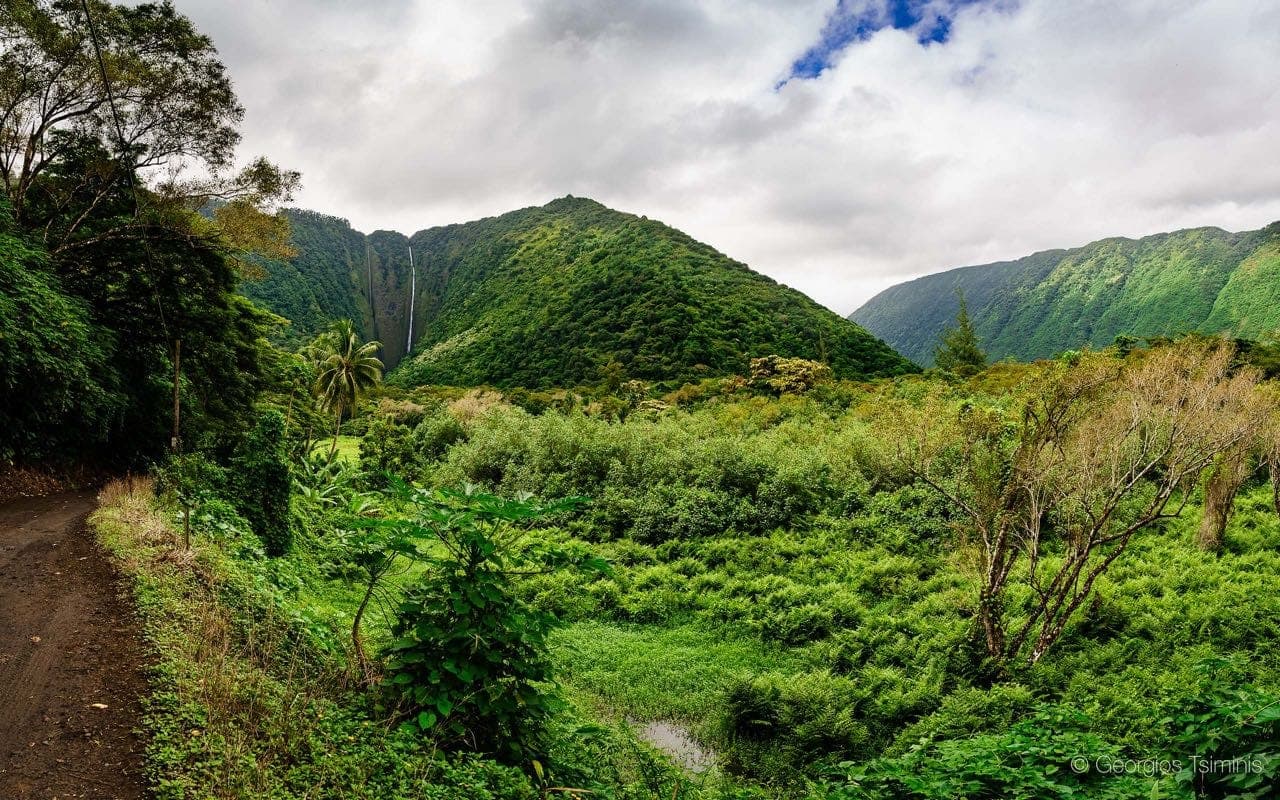
The Hiʻilawe falls (center left) are visible from many points in the valley. Image credit: Georgios Tsiminis
Look east across the beach in the distance and notice a waterfall straight from the cliff onto the rocky shore. Walk back along the beach and prepare for a tricky trek along boulders battered by the waves and a constant spray of salty water. You will lose sight of the waterfalls but fear not and persist.
I had to leave the valley as I was running out of daylight to cross the rocky path and climb back up that very steep road to the lookout.
Important: Valley floor access has changed since this visit. The road is closed to non-residents and to all pedestrians, and a guided tour is the only way for a visitor to reach the valley floor.