
After dark, operators drop lights into the water and reef mantas about 12 feet across come up to feed on the plankton a few feet below you. Snorkelers float at the surface on a lighted board; divers kneel on the sand and watch them pass overhead. They have no stinger and no barb.
Before you book, pick snorkel or dive, and a harbor. Keauhou boats run to Manta Village, Honokōhau boats to Manta Heaven, and either way you’re in the water 30 to 45 minutes of a 1.5 to 2.5 hour trip. Book early in your stay, because a night with no mantas normally means a free re-book or a steep discount, and tours start at $118.
Table of contents
- Frequently Asked Questions about our Manta Rays
- Manta ray Tours
- Manta ray night snorkel
- Manta ray night dive
- What is the Manta ray dive/snorkel
- What is it like to go on a manta ray snorkel/dive (with video)?
- Why is the Kona dive so special?
- About the Kona manta rays
- 3 good places where you can see manta rays
- Manta Ray encounter guidelines
The two operators we recommend sail from different harbors to different sites. Sea Paradise leaves Keauhou Bay for Manta Village, 2 hours for $130. Torpedo Tours leaves Honokōhau Harbor for Manta Heaven, 2.5 hours for $129. Our guide to picking the best manta ray tour compares the companies by harbor and sail time.
Frequently Asked Questions about Manta Rays:
These are the questions we get asked most often about the Kona manta ray tours. Click a question to open the answer.
Q: What happens when no manta rays show up on a tour?
Short answer: You most likely can re-book your tour.
Longer answer: It is impossible for manta ray tour operators to guarantee manta rays sightings every night of the year and it is possible that you’ll be unlucky and join a manta ray night dive/snorkel without seeing a single manta ray.
If this happens it is standard practice for the tour operators to either re-book you free of charge or to give a large discount for a tour one of the following nights. However, you should check these conditions yourself before booking.
This means that it is wise to plan your manta ray night dive early during your stay so that, if necessary, you can reschedule your tour without running into too many conflicts with the rest of your itinerary!
Q: Is there a Manta Ray season?
There is no season, because the manta rays you see at the night dive are residents. Individual animals return to the same feeding grounds year after year, so any time of year works.
Q: What is the difference between the manta ray night dive and manta ray night snorkel?
The biggest difference between the night dive and the night snorkel is your (vertical) location.
- If you go on a snorkeling tour you will stay near the water surface, probably holding on to a flotation device that also has lights attached to it to attract plankton and thus the manta rays.
- If you go on a diving tour you will be sitting on the ocean floor close and see the manta rays by looking up.
See this video to see the difference for yourself.
Q: What happens if I touch a Manta Ray?
Please don’t touch Manta Rays!
Manta Rays are covered by a thin coating of protective mucous that protects them from bacterial infections. Removing part of it by touching the rays exposes the mantas to infection.
Q: Is it safe to swim with Manta Rays?
Absolutely.
While manta rays are related to stingrays they do not have a stinger (or a barb) and can’t hurt divers or swimmers. Mantas feed on plankton (microscopic sea organisms) and their only possible interest in humans comes out of curiosity.
Q: Where can you see Manta Rays in Hawaii?
While you can sometimes see manta rays “in the wild” during daytime it is very difficult to anticipate on that happening. The Big Island has three locations where mantas feed most nights:
- Manta Village,
- Manta Heaven,
- Near the Kawaihae harbor.
The chance of seeing a manta ray during a tour at any of these locations is higher than 90%, read more about these locations on our website.
Get in touch with us for a personal answer if you have a question that is not answered above or in our guide.
Manta Ray Tours
You can do this on the surface with a snorkel or on the bottom with scuba gear. The snorkel needs no certification, but operators expect you to swim confidently and climb a boat ladder unassisted, and one of them puts a 16-year age floor on unaccompanied guests. The dive needs an open-water certification.
- Manta ray night snorkel
- Manta ray night dive
Good to know: these trips fill days ahead, so book yours as soon as your dates are set.
The Manta Ray Night Snorkel
You hold on to a lighted float and look down for most of the session. The mantas feed on the plankton the lights gather, which brings them within a few feet of the surface.
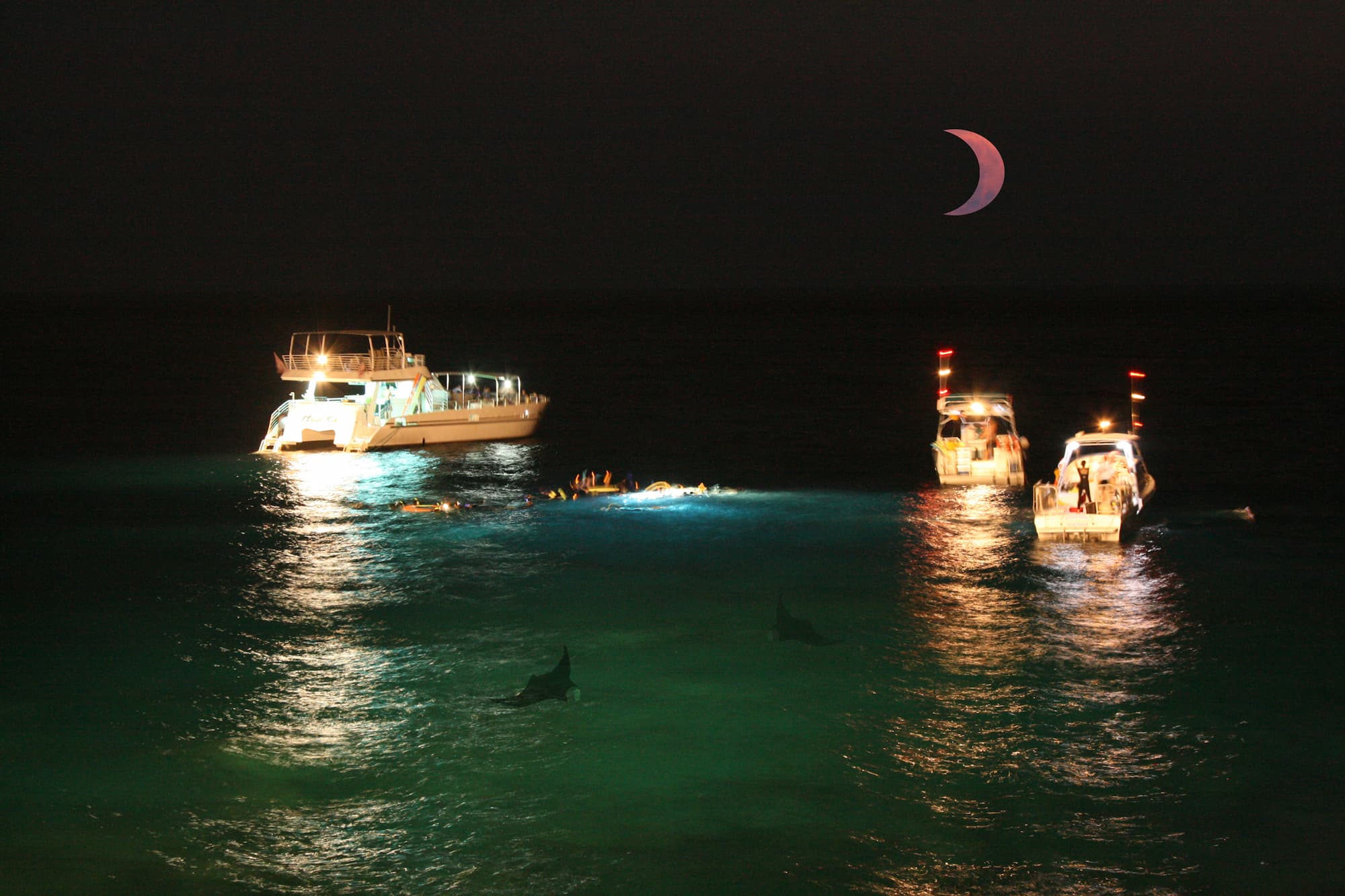
During most manta ray snorkels you will hold onto a floating raft to best see the manta rays. Image: Hawaii Tourism Authority (HTA) / Kirk Lee Aeder
Plenty of companies on the Kona coast run this trip, and they don’t all take the same care over manta ray welfare. We recommend Sea Paradise: they were on the Green List, Hawaii Ocean Watch’s short roster of operators meeting the industry standards, before it was suspended. They also leave from Keauhou Bay, so the Manta Village site is a few minutes away instead of a 45-minute sail.
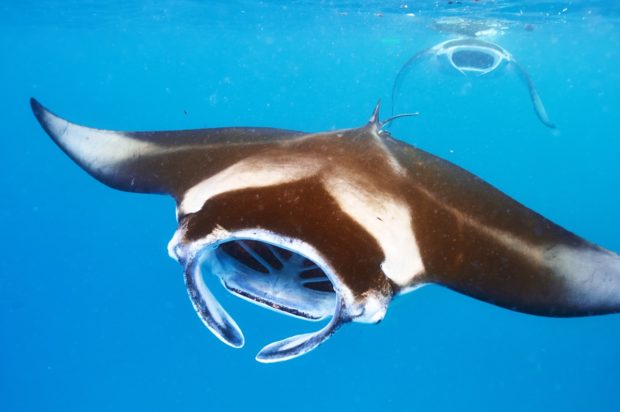
Sunset Manta Ray Night Snorkel at Keauhou Bay
Reef manta rays feed under a lighted float at Manta Village, off Keauhou Bay; Sea Paradise sees them on 85 to 95 percent of nights year-round. You hold still on the float while they pass; this is a fixed-position snorkel, not a free swim.
from:
$130
What is a suggested tour?Our suggested tours are hand-picked tours that receive consistent good reviews, give back to the community, and work hard to minimize their impact on the environment. Read more about these tours on our website.Good to know: you stay on the float instead of swimming around, because fins and a snorkel can scrape the mucus coating that protects a manta’s skin.
Manta Ray Night Dive
You sit on the sand for most of the dive while the mantas feed in the water above you. They can come as close as a nose-length.
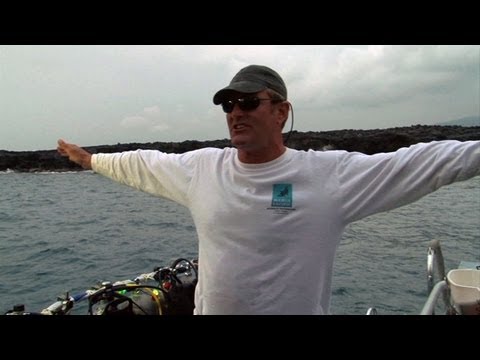
You can get an impression of how it is to go on a manta ray night dive from the following video. In it, you see Keller Laros (founder of the Manta Pacific Research Foundation) give a presentation on how to behave during the dive to a group of people about to go diving. The last few minutes show footage of that same manta ray dive.
Several Kona companies run the dive. We recommend Torpedo Tours, who were on the same Green List for their handling of the animals, and who put snorkelers and certified divers in the water on the same trip if your group is split.
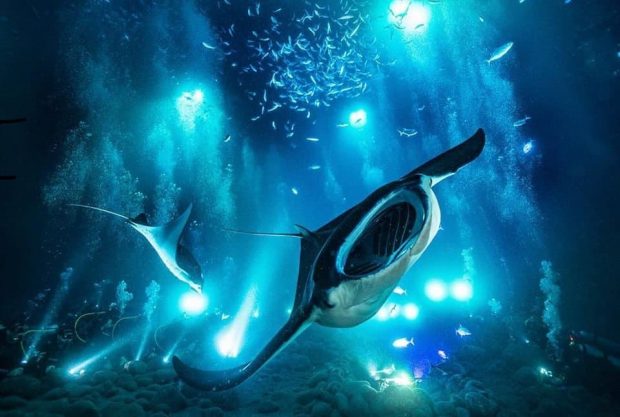
Torpedo Tours Manta Ray Night Snorkel and Dive
Manta rays at Garden Eel Cove off Kailua-Kona can reach 15-foot wingspans, and Torpedo Tours takes at most 18 guests to see them, with snorkelers and certified divers together on one boat. It has been owner-operated for over 30 years.
from:
$129
What is a suggested tour?Our suggested tours are hand-picked tours that receive consistent good reviews, give back to the community, and work hard to minimize their impact on the environment. Read more about these tours on our website.What is the Manta ray dive/snorkel and why is it so special?
The lights pull in the plankton, and the plankton pull in the manta rays. To feed, a manta swims with its mouth open and barrel-rolls through the light beam, over and over, so that it keeps passing back through the thickest patch of food. That is what brings them within a few feet of the people watching, sometimes for half an hour at a stretch.
What is it like to go on a manta ray night dive/snorkel tour?
You check in at the harbor and the crew runs the briefing, either on the dock or on the way out. It covers how to hold the float or settle on the sand, and what not to do once the rays arrive.
Once the boat is moored you get in and wait for the rays to find the lights. Count on 30 to 45 minutes in the water. The ride back is the cold part, because you’re wet and it’s dark, so bring a windbreaker or a sweater for the return leg.
And what is the difference between the two? (video)
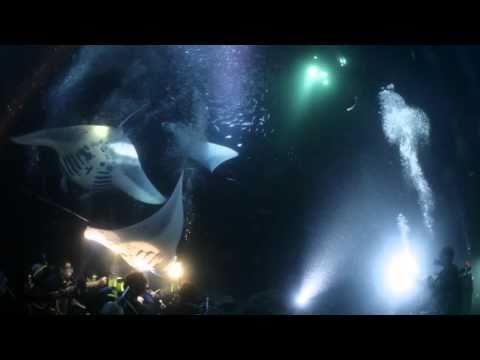
The video below was filmed during a manta ray night dive in Kona.
In the video the divers sit on the ocean floor looking up while the manta rays wheel around above them feeding. The lights overhead are the snorkelers’ floats.
Why is the Kona dive so special?
Hawaiʻi is not the only place where you can swim with manta rays. You can also dive with them in the Maldives, on the Great Barrier Reef and around the Galapagos. Almost all of those dives happen at cleaning stations, where a ray parks itself and smaller fish pick its skin clean.
Manta rays return to fixed feeding stations. There are three known feeding stations off the Kona coast: Manta Village, Manta Heaven, and an unnamed spot off the Kohala coast. The habit started with hotel lights. Bright lighting thrown on the water pulled in plankton, and the rays learned where to find it.
Nowadays operators bring their own lights. Divers carry a light and shine it up towards the surface, while snorkelers hold on to a float with a light that shines down.
In Kona the rays come to eat, so they keep barrel-rolling through the light for as long as the plankton holds.
The Kona Manta Rays
The animals you see at the night dive are reef manta rays, Mobula alfredi. They are the smaller of the two manta species found in Hawaiian waters, reaching about 14 ft (4.3 m) across at the top end. Most of the ones that turn up off Kona measure around 12 ft, which is still wider than the boat’s swim step.
Manta rays live on plankton, and they are thought to live around 40 years. The Kona animals show strong site fidelity: the same individuals come back to the same feeding stations for decades. Every spot pattern on a manta’s underside is unique, so the Manta Pacific Research Foundation has cataloged and named over 300 individual rays off this coast, as of 2026. The first one they logged, a female called Lefty, has been returning to the Keauhou site since 1979.
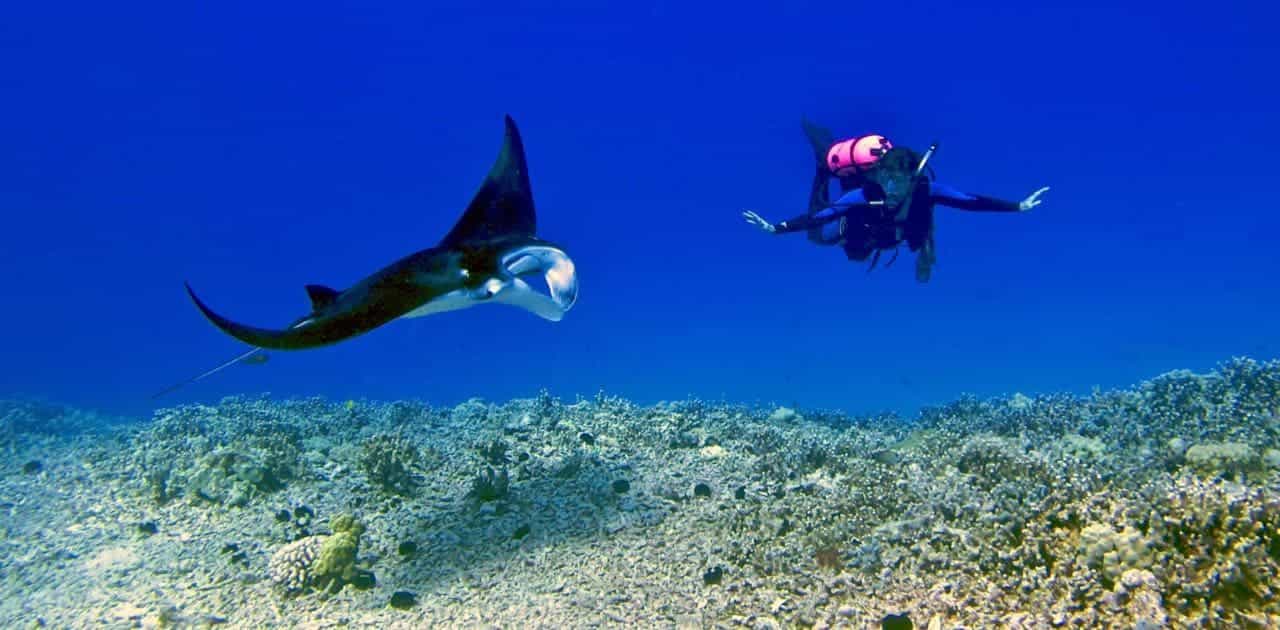
A female scuba diver swims with a young male Manta ray in the Kona district / Big Island. By Steve Dunleavy from Lake Tahoe, NV, United States – Nick and Isabelle, Kona Hawaii, CC BY 2.0, Link
The 3 places you can see manta rays on the Big Island
The two most consistent and popular places to see manta rays at night are nicknamed “Manta Village” and “Manta Heaven”. The third, off the Waikoloa coast near the Kohala Coast Resorts, is less reliable and less crowded: fewer rays, fewer boats.
Manta Village (south of Kona)
This is the original manta ray night dive location. Manta Village sits just offshore of the OUTRIGGER Kona Resort & Spa at Keauhou, about 7 miles south of Kona. It is also the busiest of the three: Hawaii Ocean Watch has counted more than 20 tour boats and around 330 people in the water there on a busy night.
Manta Village has historically had the highest success rate of the three sites, with most operators reporting sightings on over 90% of nights and an average of 4 or more rays per outing.
There are a few local operators (such as Sea Paradise) that operate from the nearby Keauhou Bay to reach this site. That cuts the sail from 45+ minutes to a few, a help if you get seasick, and it means less time sitting wet in the wind on the way home after 30 to 45 minutes in the water.
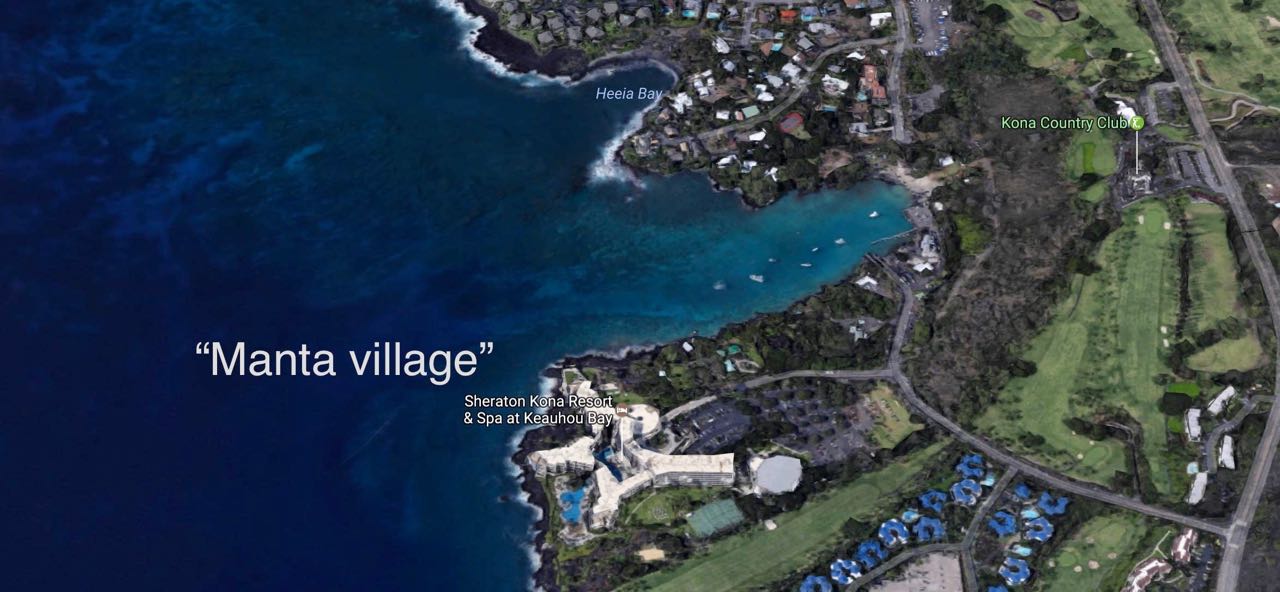
Manta Village sits offshore of Keauhou Bay, in front of the resort labelled Sheraton on this older map and now called the OUTRIGGER Kona Resort & Spa. Image credit: Google Maps.
Manta Heaven (north of Kona)
This site sits offshore of the Kona International Airport, about 8 miles north of Kona. Manta Heaven is a very popular spot for daylight dives, and is also known as “Garden Eel Cove”.
The sighting rate at Manta Heaven runs a little below Manta Village, but at around 90% of nights it’s still high. When the rays are in here, they show up in bigger groups.
One recommended operator that uses this dive site is Torpedo Tours.
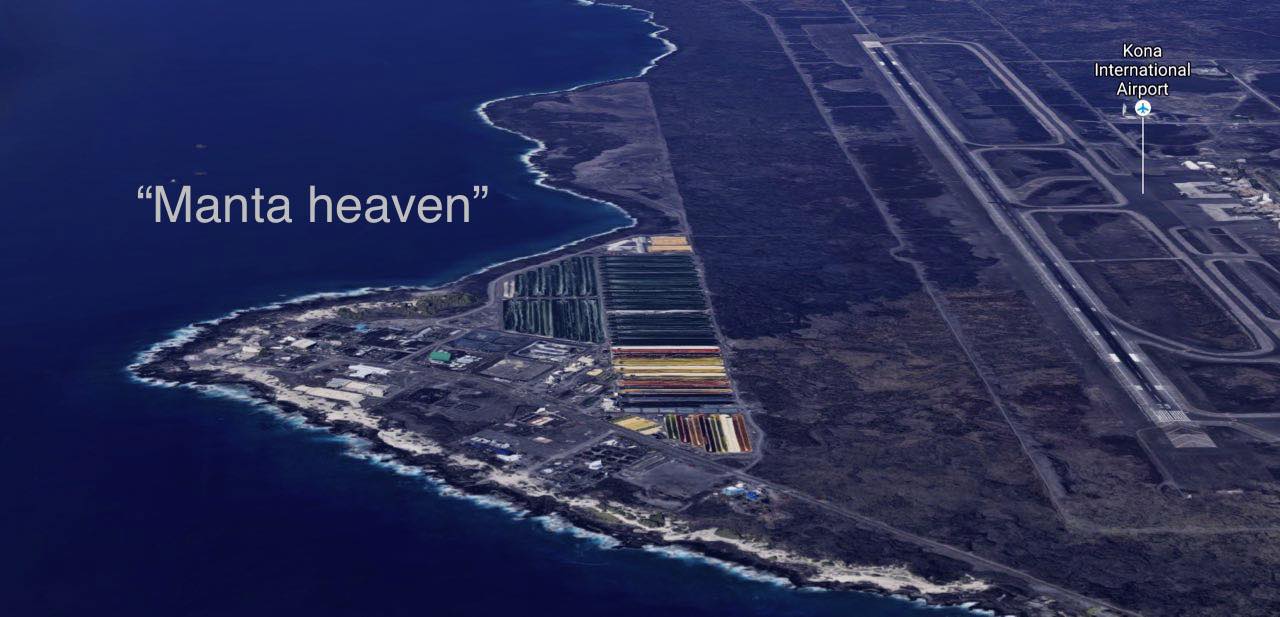
Manta Heaven sits offshore of Kona International Airport, about 8 miles north of Kona. Image credit: Google Maps.
Kohala Coast (near Waikoloa)
This is the northernmost of the three sites. It sits close to Waikoloa Village and the Kohala Resorts, near Kawaihae Harbor.
Few boats run here, and some nights your group has the site to itself. Fewer rays come, and on some nights none.
Guidelines for manta ray encounters and the Manta Green List
Kona manta operators work to a voluntary set of standards. Hawaii Ocean Watch used to publish a short Green List of the operators meeting them, and both companies we recommend here were on it. The list has been suspended since 2023. Hawaii Ocean Watch says the crowding at the Keauhou and airport sites now makes it close to impossible for any operator there to meet the safety and sustainability criteria, and in place of the list they publish questions to ask an operator before you book.
Responsible guidelines for the Manta Ray Night Dive/Snorkel:
Under HRS 188-39.5 it is illegal to capture, take, possess, abuse or entangle any ray in state marine waters, and the fines run from $500 for a first offence to $10,000, with a further administrative fine of up to $10,000 per animal. The no-touching rule in your briefing is state law.
The law says nothing about crowding, so Kona operators, guides and captains wrote their own code of conduct in 2013, after state and federal officials asked the industry for one. These are the rules you will be briefed on:
- Observe only: No touching. Resist the urge to “pet” the mantas. This will rub off their protective mucus coating. Do not chase, grab, or try to take a ride on the mantas. This doesn’t benefit the animal in anyway.
- Diver position: Divers, please stay on or near the sand, rubble or boulder bottom. An open water column is necessary for the mantas to maneuver. Avoid contact with coral, sea urchins, or other marine life. Form a semi-circle with your group.
- Snorkeler position: Snorkelers, please stay on the surface. Do not dive down into the water column where the mantas are feeding.
- Use of lights: Divers, please shine lights up into the water column to attract plankton. Snorkelers, please shine lights down.
- Making bubbles: Divers, please avoid exhaling bubbles directly into the mantas’ faces.
- Taking photos or videos: Be considerate of people and mantas when taking underwater photos or video. Minimize your equipment in the water column and let the mantas come to you.