
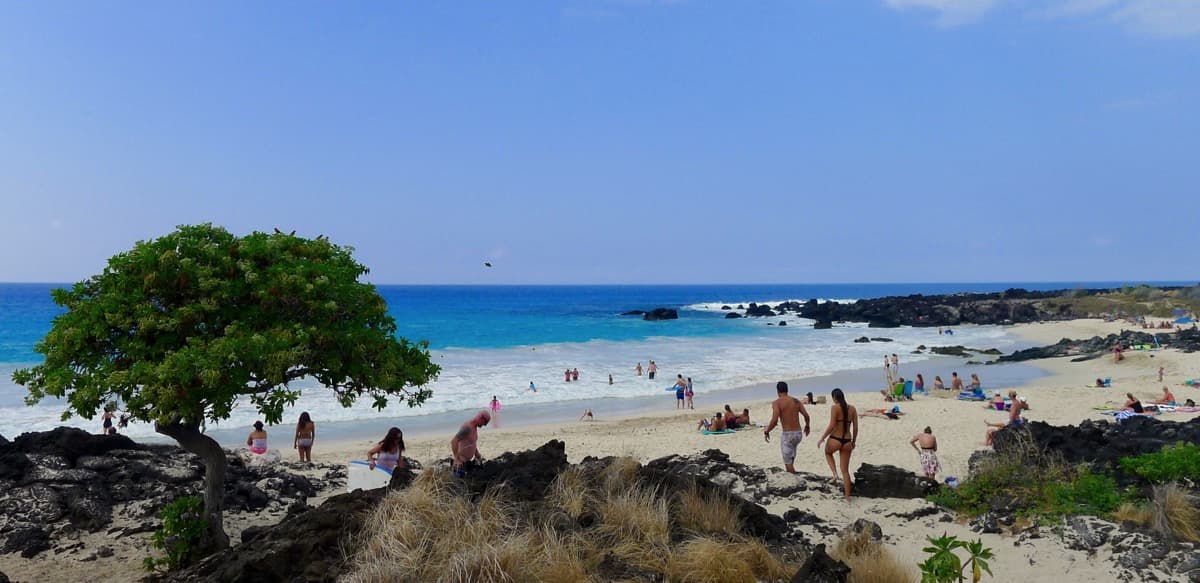
The Big Island has more sand colors than the rest of Hawaiʻi combined: black lava sand, coral white, salt-and-pepper, gray, and olivine green. Papakōlea, near South Point, has sand that is roughly 90% olivine crystal, and reaching it takes a hot, shadeless 2.5-mile hike each way. What you will not find here are the long white powder beaches of older islands like Oʻahu. As the youngest island, Hawaiʻi has fewer beaches and trickier access, but far more variety.
Start with the map, then work through the four regions, beginning at the southernmost beach in the country and going counter-clockwise: Kaʻū and Volcano in the south, Hilo in the east, Kohala and Waimea in the north, where Hāpuna and Kaunaʻoa hold the white-sand resort beaches, and Kona in the west. Many of the prettier coves have strong currents and are unsafe to swim, so check lifeguard status and hazards on each entry before you go.
Table of contents
A few questions come up again and again about Big Island beaches. Click any question to open the answer.
Q: Does the Big Island have good beaches?
You can find white, black, and green sand beaches on the Big Island. Because it is the youngest island in the chain, the beaches here are fewer and sometimes harder to reach than the excellent beaches on Maui and Oʻahu.
Q: Which side of the Big Island has the best beaches?
The Kohala coast (north) has the nicest resorts, the sunniest weather, and the most famous white-sand beaches. Scroll down to some of our favorites here.
Q: What colors of sand can I find on the Big Island?
You probably already know there are plenty of white-sand beaches on the Big Island, but did you know there are also famous black sand beaches (where the sand is crushed lava rock) and even a green sand beach (where the sand is made of olivine crystals)? You can find our favorite white, black, and green sand beach here.
Map of Beaches on the Big Island
The map below plots the most-visited beaches on the Big Island. Zoom in, explore by region, and click any marker for details. The same descriptions appear in the regional listings below, ordered from the southernmost beach in the country counter-clockwise around the island.
| Beach | What it’s like | Beach weather |
|---|---|---|
| South Big Island | ||
| Papakōlea South Full guide | olivine-green sand in a cinder-cone bay, a long hot walk in | 58/100 Best in September |
| Punaluʻu South Full guide | the classic black-sand beach, basking honu, palms | 35/100 Best in June |
| East Big Island | ||
| Kaimū East Full guide | young black sand and coconut seedlings over the lava that buried Kalapana | 20/100 Best in August |
| Pohoiki East Full guide | black-sand beach and warm ponds formed in the 2018 eruption | 17/100 Best in September |
| Richardson East Full guide | black sand with tide pools and basking turtles, east of Hilo | 13/100 Best in September |
| Leleʻiwi East | rocky tide pools with lifeguard, no sand beach | 13/100 Same weather as Richardson |
| Carlsmith East Full guide | spring-fed cold-water lagoons, snorkeling and turtles, east of Hilo | 12/100 Best in September |
| James Keʻaloha East | deep basin with white sand pockets and freshwater springs | 12/100 Same weather as Carlsmith |
| Onekahakaha East | seawall-sheltered lagoon, the gentlest swim near Hilo for small kids | 12/100 Same weather as Carlsmith |
| Coconut Island East | island park in Hilo Bay, closed since 2025 footbridge collapse | 12/100 Same weather as Carlsmith |
| North Big Island | ||
| Waipiʻo Valley North | remote black sand in a deep valley, shuttle access only | Not rated |
| Pololū Valley North | rocky valley floor reached by a steep trail, not for swimming | Not rated |
| Kapaʻa Beach Park North | rocky dive entry with west-facing sunset grills | Not rated |
| Mahukona North | shipwreck dive site from a ladder entry, no sand | Not rated |
| Spencer North | reef-sheltered family beach with lifeguard and camping | 80/100 Same weather as Kaunaʻoa |
| Kaunaʻoa North Full guide | white crescent below the Mauna Kea resort, reef at its north end | 80/100 Best in September |
| Hāpuna North Full guide | long white-sand crescent, big winter shorebreak | 81/100 Best in September |
| Waialea North | shady white-sand cove next to Hāpuna, calmer and smaller | 81/100 Same weather as Hāpuna |
| ʻAnaehoʻomalu North Full guide | salt-and-pepper sand, ancient fishponds and palms behind it | 80/100 Best in September |
| West Big Island | ||
| Kīholo Bay West | walk-in bay with tide pools, turtles, and cold spring-water patches | Not rated |
| Kukiʻo West | quiet white sand behind the Four Seasons gate, turtles on the shore | 75/100 Same weather as Kua Bay |
| Kikaʻua Point West | sheltered lagoon with almost no current, good for small kids | 75/100 Same weather as Kua Bay |
| Kekaha Kai West | state park covering Kua Bay, Makalawena, and Mahaiʻula | 74/100 Same weather as Makalawena |
| Kua Bay West Full guide | bright white sand and turquoise water, calm in summer, shorebreak in winter | 75/100 Best in September |
| Mahaiʻula West | palm-shaded white sand with a lava shelf, better for lounging than swimming | 74/100 Same weather as Makalawena |
| Makalawena West | remote white-sand coves reached on foot across old lava | 74/100 Best in September |
| Aiʻopio West | ancient fishtrap with calm shallow water inside Kaloko-Honokōhau | Not rated |
| Old Kona Airport West | former runway turned sunset park, rocky shore, not a swim beach | Not rated |
| Kamakahonu West | small protected pocket in downtown Kailua-Kona, beginner swimming | 42/100 Same weather as Kahaluʻu |
| White Sands West | punchy shorebreak that bodyboarders love, sand vanishes in winter | 42/100 Same weather as Kahaluʻu |
| Kahaluʻu West Full guide | reef-sheltered snorkeling with resident green turtles, little sand | 42/100 Best in December |
| Kealakekua West Full guide | clear snorkeling bay reached by kayak or boat, spinner dolphins, Captain Cook monument | 38/100 Best in December |
| Two Step West | lava-shelf snorkel entry beside the Hōnaunau boat ramp, no sand | 38/100 Same weather as Kealakekua |
| Hoʻokena West | community-run black sand beach with camping | Not rated |
Beach weather is a relative, typical-conditions rating from 250 m climate grids: not a forecast and not a count of good days. A beach marked “Same weather as” sits within a few kilometers of a rated beach and shares its climate, so it shows that beach’s rating. Numbers match the map. Beach facts (lifeguards, facilities, parking, fees) checked September 2026 against county, state park and ocean safety sources; conditions change, so check posted signs. Made by lovebigisland.com. | ||
Beaches near Volcano (South coast)
The south coast has only a handful of beaches, but they are some of the most distinctive on the island. Our favorite green (Papakōlea) and black (Punaluʻu) sand beaches are both on this side of the island. Our guide to Hawaiʻi’s hottest beaches has more.
Green Sand Beach / Papakōlea
Roughly 90% of Papakōlea’s sand is crystal, most of it olivine. That heavy volcanic mineral weathers out of the eroding ash ring behind the beach and settles in the bay. Reaching it takes a 2.5-mile hike each way across exposed, windy coast from the parking area near South Point, with no shade and no facilities once you start walking. Few make the hike, so the cove stays quiet. Our guide below has the directions and what to expect on the way:
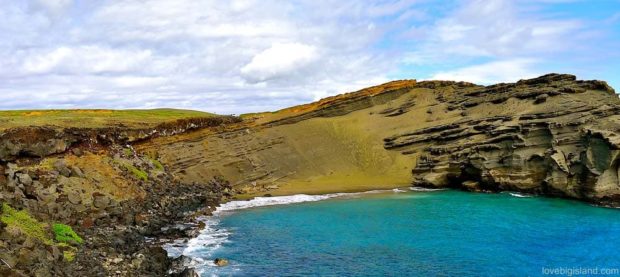
At Papakōlea roughly 90% of the sand is olivine crystal. Reaching it is a hot, shadeless 2.5-mile hike each way from South Point on the Big Island.
At a glance: Good for the views and hiking. No lifeguard. No restrooms or showers. Unpaved lot near South Point. Watch for exposed shadeless hike (2.5 miles each way) and no facilities once you start walking.
Typical beach weather: Among Big Island’s beaches, Papakōlea rates 58/100 (4 of 5 stars). The driest months are May to July (about an inch of rain a month), the wettest November to January (about 3 inches). The sky is usually clearest in the morning, and it’s at its best in September. From November to January, ʻAnaehoʻomalu usually has better beach weather.
Punaluʻu County Beach Park
Reaching Papakōlea takes a hard hike; Punaluʻu is easy to reach. It is the most famous black sand beach on the island, and you reach it straight from the parking lot rather than after a long hike. The jet-black sand sits between Kona and Hilo, easiest to get to from Volcano Village, and green sea turtles often haul out to rest on the warm sand. Give them plenty of room and resist the urge to get close for a photo.
As of November 2026 the county beach park here is closed until a pending county purchase of the land goes through, so don’t count on a lifeguard, restrooms or the parking lot. A strong rip current runs out through the boat channel, and the water is rougher than it looks from shore.
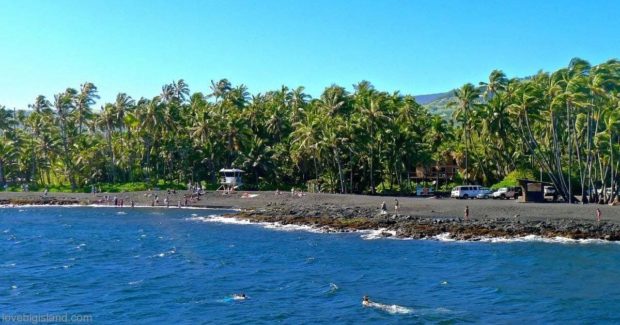
Turtles, Swimming and Snorkeling at Punaluʻu Black Sand Beach
Green sea turtles bask on the black lava sand at Punaluʻu, the most accessible black sand beach in Hawaiʻi. What to know about swimming, snorkeling, and honu.
If black sand beaches are your thing we recommend that you have a look at our 7 favorite black sand beaches in Hawaiʻi.
At a glance: Good for turtle watching and the views. No restrooms or showers. Parking lot closed. Beach park CLOSED since the county lease ended Aug 29, 2026; shoreline access stays open. Watch for rip current (boat channel).
Typical beach weather: Among Big Island’s beaches, Punaluʻu rates 35/100 (2 of 5 stars). The driest months are April to June (about 1½ inches of rain a month), the wettest November to January (about 4½ inches). The sky is usually clearest in the morning, and it’s at its best in June. From November to January, ʻAnaehoʻomalu usually has better beach weather.
Beaches near Hilo (East coast)
These are the most popular beaches in and around Hilo. The east side has black sand, lava rock, and tide pools instead of wide open sand, so here you snorkel calm protected coves rather than swim big beaches. Our Hilo beaches guide has more on the east-side beaches.
Kaimū Beach Park
In 1990 a lava flow buried the old Kaimū beach, once a famous black sand beach, under about 15 meters of rock. A new black sand beach has since formed on top of the hardened flow, reached by a short walk across the lava. Strong currents and unpredictable waves make this a beach for walking and watching rather than swimming, but few other places show new land forming this directly.

Kaimū black sand beach in Kalapana
In 1990 lava buried the old Kaimū beach and most of Kalapana. A new black sand beach now sits 50 ft above it. Parking, the eco-path, and what to expect.
At a glance: Good for the views. Not a swimming beach. No lifeguard. No restrooms or showers. New sand over the 1990 lava that buried Kalapana. Watch for strong currents and unpredictable waves.
Typical beach weather: Among Big Island’s beaches, Kaimū rates 20/100 (1 of 5 stars). Rain falls in every month: about 4 inches a month even from June to August, and about 9 inches a month from November to January. The sky is usually clearest in the afternoon, and it’s at its best in August. From November to January, ʻAnaehoʻomalu usually has better beach weather.
Isaac Hale Beach Park / Pohoiki
This is the youngest black sand beach in Hawaiʻi, and you can almost watch it age. When Kīlauea’s 2018 eruption poured lava into the ocean here, the waves ground the fresh rock into black sand and piled it into the bay within weeks. The result is the Pohoiki black sand beach, at the end of Highway 137 in lower Puna.
Swimming is off-limits: a dangerous shore break, strong currents, and lava boulders line the water’s edge. There are picnic tables, a playground, and a lifeguard on duty during park hours.
Several naturally warm thermal ponds sit at the same park, though the Department of Health flags them as unmonitored and a bacterial risk if you have any open cuts. Our hot ponds guide covers these thermal ponds.

The 2018 eruption transformed Pohoiki's black sand beach in weeks and left a new beach behind. Strong shore break, no swimming, plus the drive out to lower Puna.
At a glance: Good for the views. Not a swimming beach. Lifeguard on duty. Picnic tables. Thermal ponds nearby; DOH flags bacterial risk with open cuts. Watch for dangerous shorebreak, strong currents and lava boulders at the shoreline.
Typical beach weather: Among Big Island’s beaches, Pohoiki rates 17/100 (1 of 5 stars). Rain falls in every month: about 6 inches a month even from April to June, and about 9 inches a month from November to January. The sky is usually clearest in the afternoon, and it’s at its best in September. From November to January, ʻAnaehoʻomalu usually has better beach weather.
Ahalanui Park
Ahalanui, also known as Puʻalaʻa County Park, is on this list as a memorial more than a destination. Until July 2018 it was a volcanically heated pool, partly walled off from the ocean, and one of the warmest, easiest swims in Puna on a day when the sea felt cool. The same eruption that built Pohoiki’s black sand buried Ahalanui under lava for good.
Our Ahalanui guide has more.
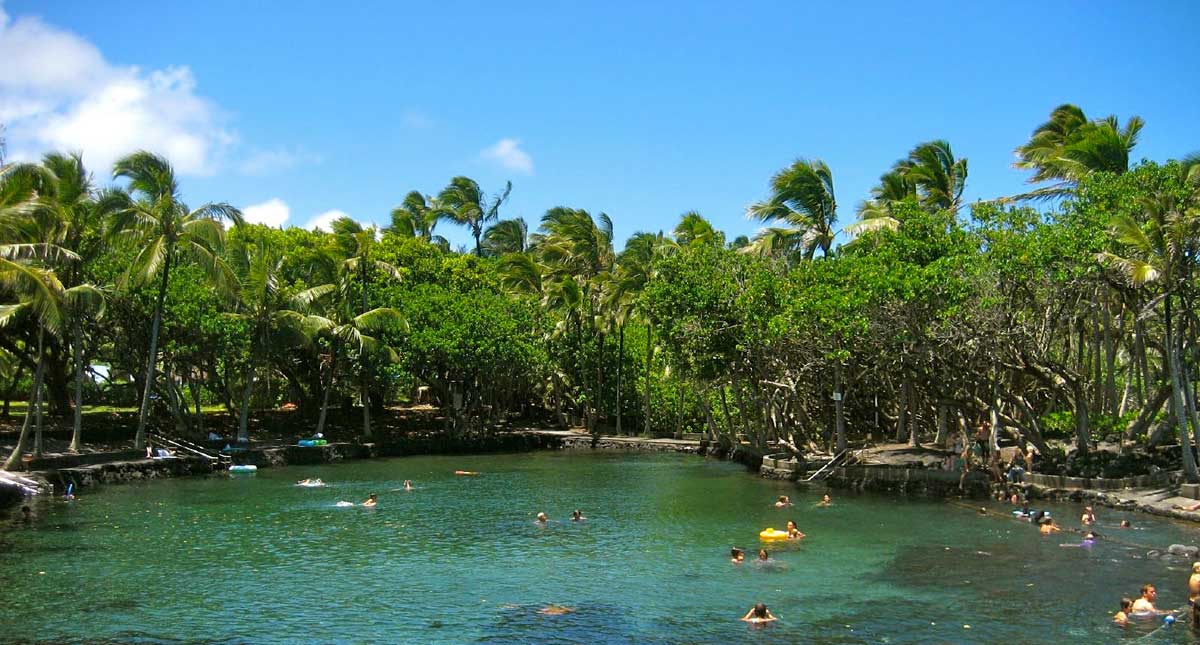
The Ahalanui hot ponds in the Puna district before 2018. The pool was partly separated from the ocean to create a lukewarm swimming pool.
Kapoho Tide Pools (destroyed by the 2018 LERZ eruption)
Before 2018, Kapoho was the best snorkeling many visitors did on the Big Island: a sprawling network of tide pools up to 10 feet deep, threaded with lava rock and crowded with fish, all calm and protected from the open ocean. The same lava flow that reshaped lower Puna filled them in completely. Like Ahalanui, Kapoho is here so you know what the eruption took.
Our Kapoho tide pools guide has more.
Richardson Beach Park
Richardson is the black sand beach closest to Hilo and the most reliable snorkeling on this side of town. A natural lava rock breakwater calms the swimming area, so the water stays manageable even when the open coast is rough, and green sea turtles are a regular sight along the rocks. It is one of the few Hilo-area beaches with the full set of facilities: showers, bathrooms, picnic areas, and a lifeguard. Our guide below has directions and photos:

Freshwater springs keep Richardson's shallow and nearly current-free: the best snorkeling on the Hilo side. Black sand, tide pools, lifeguard on duty.
At a glance: Good for snorkeling, turtle watching and families. Lifeguard on duty. Restrooms, showers and picnic tables.
Typical beach weather: Among Big Island’s beaches, Richardson rates 13/100 (1 of 5 stars). Rain falls all year, about 10½ inches a month. The sky is fairly even all day, and it’s at its best in September. From October to December, ʻAnaehoʻomalu usually has better beach weather.
Leleʻiwi Beach Park
Leleʻiwi, also known as Waiʻuli, trades sand for a rocky shoreline and freshwater-fed tide pools, the structure holds a lot of sea life close to shore, good for snorkeling. It is one of the better underwater spots near Hilo and often overlooked, with plenty of picnic tables on land and a lifeguard on duty during the day. Bring lunch and plan to stay a while.
Our Hilo beaches guide has more on this beach.
At a glance: Good for picnics. Lifeguard on duty. Picnic tables. Rocky shore, no sand; the draw is the tide pools.
Typical beach weather: Leleʻiwi shares the climate of nearby Richardson, which rates 13/100. Rain falls all year, about 10½ inches a month.
Carlsmith Beach Park
Carlsmith is a protected white sand lagoon ringed by black lava rock, which keeps the water calm and clear and the snorkeling close to shore. The lava walls knock down the swell, so it is one of the gentler places to get in the water around Hilo, and a good choice for families. County lifeguards are on duty daily, 9:30am to 4:45pm. Restrooms and a picnic area round it out.

Carlsmith beach park (Four Mile) in Hilo
Fresh water seeps into the lagoon at Carlsmith, cooling a few spots even as the reef keeps the rest calm for swimming. Turtles are regulars here.
At a glance: Good for snorkeling, swimming and families. Lifeguard on duty. Restrooms and picnic tables.
Typical beach weather: Among Big Island’s beaches, Carlsmith rates 12/100 (1 of 5 stars). Rain falls all year, about 10½ inches a month. The sky is fairly even all day, and it’s at its best in September. From October to December, ʻAnaehoʻomalu usually has better beach weather.
James Keʻaloha Beach Park
James Keʻaloha is a roomy family beach with a rocky shoreline that works for snorkeling on calm days and surfing when there is swell. A deep, protected basin with white sand pockets and natural freshwater springs sits at its center, though the footing is uneven lava and there is no lifeguard, so it runs rougher than nearby Carlsmith. There is a large picnic area and restrooms, and plenty of open space to spread out. Watch the water during high surf, when rip currents along this stretch get strong.
Our Hilo beaches guide has more on this beach.
At a glance: Good for families. Protected basin on calm days; rip currents during high surf. No lifeguard. Restrooms and picnic tables. Watch for uneven lava footing and rip currents (high surf).
Typical beach weather: James Keʻaloha shares the climate of nearby Carlsmith, which rates 12/100. Rain falls all year, about 10½ inches a month.
Onekahakaha Beach Park
Onekahakaha is the Hilo beach parents pick first. A lava rock seawall shelters a shallow, sandy-bottomed lagoon that stays calm enough for small children to wade in, the gentlest swimming on this side of the island, and nearby tide pools give older kids something to snorkel. A lifeguard is on duty during the day. Add grassy areas, picnic spots, and the occasional ice cream stand, and you can easily spend an afternoon here with a young family.
Our Hilo beaches guide has more on this beach.
At a glance: Good for swimming and families. Lifeguard on duty. Picnic tables. Seawall-sheltered lagoon, gentlest swim near Hilo for small kids.
Typical beach weather: Onekahakaha shares the climate of nearby Carlsmith, which rates 12/100. Rain falls all year, about 10½ inches a month.
Coconut Island
Mokuola, better known as Coconut Island, is closed. The footbridge connecting it to Hilo’s shoreline collapsed in November 2025, and Hawaiʻi County has the park shut down while engineers assess repairs, so there is no way across right now. When it reopens, this small island in Hilo Bay has a few pocket beaches, a grassy lawn, picnic tables, water calm enough for an easy swim, and a stone tower about 20 feet high that keeps local kids jumping all day.

Coconut Island (Mokuola) in Hilo
The footbridge to Coconut Island (Mokuola) in Hilo collapsed in November 2025, so the island is closed. A temporary span is targeted within about two years.
At a glance: Good for swimming and picnics. No lifeguard. Picnic tables. CLOSED since Nov 2025 footbridge collapse; temp fix targeted ~2 yrs.
Typical beach weather: Coconut Island shares the climate of nearby Carlsmith, which rates 12/100. Rain falls all year, about 10½ inches a month.
Beaches near Waimea / the Kohala resorts (North coast)
The white sand beaches on the Kohala coast are the closest thing the island has to the classic resort-beach experience: wide, calm, and reliably sunny. Add a couple of dramatic black sand beaches tucked beneath thousand-foot cliffs at the north end, and
Waipiʻo Valley Black Sand Beach
Reaching Waipiʻo beach used to mean walking or driving down one of the steepest roads in the country. Hawaiʻi County’s ongoing emergency rule now closes that road to all pedestrians and to any vehicle except a resident’s, a permitted tour operator’s, or a Native Hawaiian exercising customary rights, so a visitor can no longer walk or drive down on their own.
The Waipiʻo Valley Shuttle is the practical way in, $67 for adults and $36.50 for kids, about 1.5 to 2 hours round trip. Once you are down, the black sand beach beneath the valley’s high walls is a dramatic place to rest, though rip currents and high surf, especially in winter, make swimming dangerous.
Read more about the road closure and how to visit in our guide to Waipiʻo valley.
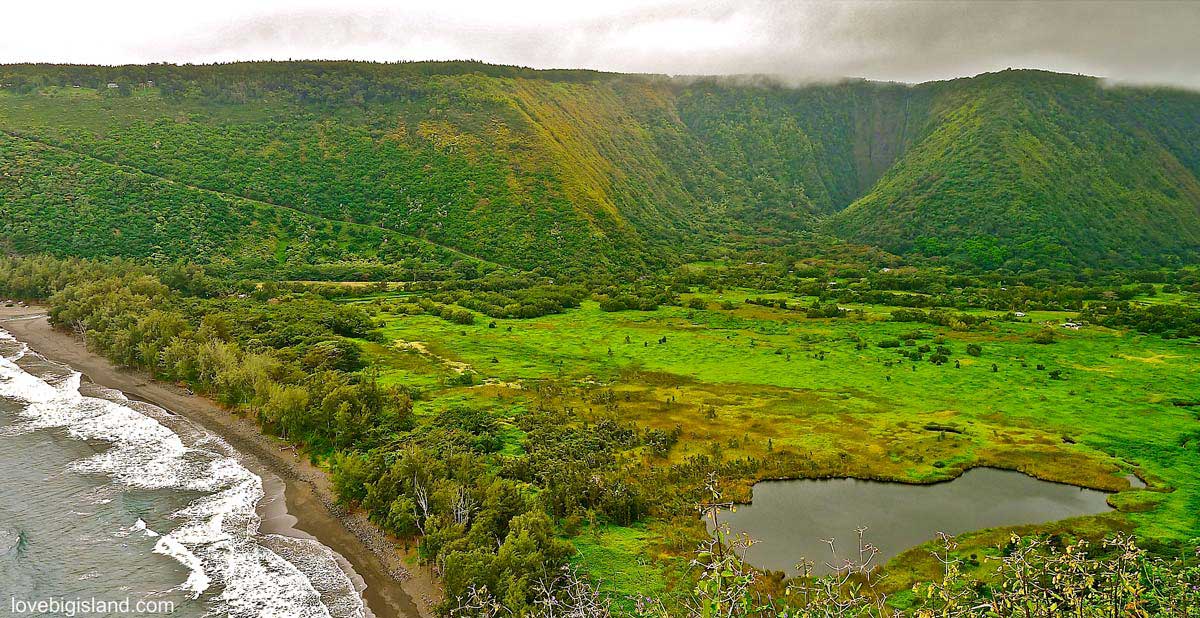
Overview of Waipiʻo Valley from the ‘opposite’ side. You can see the steep Waipiʻo Valley access road, the black sand beach and taro fields.
At a glance: Good for the views and hiking. Not a swimming beach. No lifeguard. No restrooms or showers. Shuttle required, ~$67/adult. Valley floor closed to walk-in/drive-in; shuttle only. Watch for rip currents and high surf.
Pololū Valley Black Sand Beach
Pololū sits at the opposite end of the Kohala coast from the resorts, and it is nothing like them. The beach itself is more often fist-sized stones than sand, with murky water and strong currents that rule out swimming or snorkeling. People come for the view and the walk down to it.
To reach the beach you descend about 400 vertical feet from the parking lot. The path has some of the best coastal views on the island. It is one of our 5 favorite hikes on the Big Island. Our Pololū Valley page has more.

The beach in Pololū valley is a good place to rest after the hike down. It is one of our favorite 5 short hikes of the Big Island.
At a glance: Good for the views and hiking. Not a swimming beach. No lifeguard. No restrooms or showers. Small free lot at the lookout. Watch for strong currents.
Kapaʻa Beach Park
Kapaʻa is a rocky shoreline where you can snorkel and dive well once past the entry; the swimming is poor. Locals come mostly for the park behind it: restrooms, picnic tables, and BBQ grills facing west, which makes it a popular spot for a sunset cookout.
At a glance: Good for diving, sunsets and picnics. No lifeguard. Restrooms and picnic tables. Free parking lot.
Mahukona Beach Park
Mahukona is an abandoned sugar-era harbor with almost no sand, one of the more interesting places to snorkel on the island. You climb down a steel ladder into the bay, and below you sits the wreck of the SS Kauai, a steamship that sank in 1913, with its engine, propeller, and scattered cargo still on the seafloor at depths to about 40 feet.
Turtles, eels, and octopus have moved into the machinery and concrete pilings. In winter, the same calm bay is a good spot to watch for whales offshore. There is no lifeguard, so save it for calm summer conditions.
At a glance: Good for diving and whale watching in winter. Calm bay in summer; save it for calm conditions. No lifeguard. No restrooms or showers. Watch for ladder entry, no sand.
Samuel M. Spencer Beach Park
An offshore reef and the harbor just to the north calm the surf at Spencer, which makes it one of the calmest, most kid-friendly swimming beaches on the Kohala coast. County lifeguards are on duty daily, 9:30am to 4:45pm. The park behind it has a picnic area, BBQ facilities, and tent camping with a permit.
It also sits right next to a national park and a national historic trail.
The first minutes of the video below show the beach and the camping spots at Spencer Beach Park:

Right next to the beach park is one of the island’s four national parks, the Puʻukoholā Heiau National Historic Park. Spencer is also the trailhead for a 15-mile stretch of the Ala Kahakai National Historic Trail, which runs south to ʻAnaehoʻomalu Bay.
At a glance: Good for swimming and families. Lifeguard on duty. Restrooms and picnic tables. Free parking lot.
Typical beach weather: Spencer shares the climate of nearby Kaunaʻoa, which rates 80/100. Rain is light from June to August (under ½ inch a month) and heaviest from December to February (about 1½ inches a month).
Kaunaʻoa Beach
Kaunaʻoa, the beach in front of the Mauna Kea Beach Hotel, is a quarter-mile crescent of soft white sand on calm water in summer: a quarter-mile crescent of soft white sand on calm water in summer. You can snorkel at the rocky ends and body surf gently in the middle, though winter swells can bring a strong shorebreak and rip currents, and there is no lifeguard. Public parking is limited and fills early, since the hotel only releases a set number of beach passes each day. More information about Mauna Kea beach:
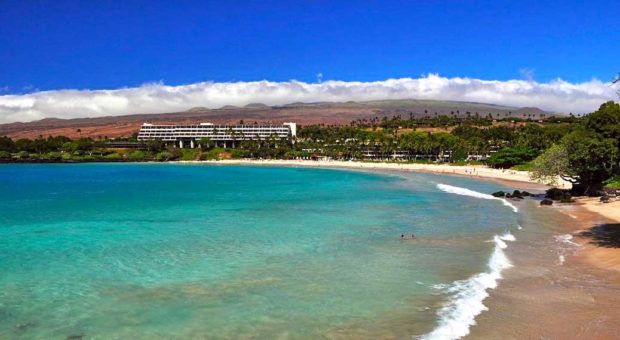
Mauna Kea Beach is public, but the lot belongs to the hotel and the few non-guest stalls go early. How non-guests get in, and where to park if you miss out.
At a glance: Good for swimming, snorkeling and bodyboarding. Calm summer; winter shorebreak and rip currents. No lifeguard. No restrooms or showers. Limited parking (resort-capped, fills early). Watch for rip currents (winter) and shorebreak (winter).
Typical beach weather: Among Big Island’s beaches, Kaunaʻoa rates 80/100 (5 of 5 stars). Rain is light from June to August (under ½ inch a month) and heaviest from December to February (about 1½ inches a month). The sky is usually clearest in the morning, and it’s at its best in September.
Hāpuna Beach State Park
Hāpuna is the big one: a half-mile of wide, open white sand that regularly appears on ‘best beaches in the world’ lists, and usually the easiest swimming beach on the island. County lifeguards are on duty daily, 9:30am to 4:45pm, and worth checking in with: the shore break here has caused broken bones and spinal injuries, especially when winter surf picks up. The rocky points at each end hold the snorkeling.
In summer the beach can be 200 feet deep from tree line to water. It also has the fullest set of facilities of any beach here: restrooms, showers, picnic tables, snorkel rental, BBQ, and food concession stands. More information about Hāpuna beach:
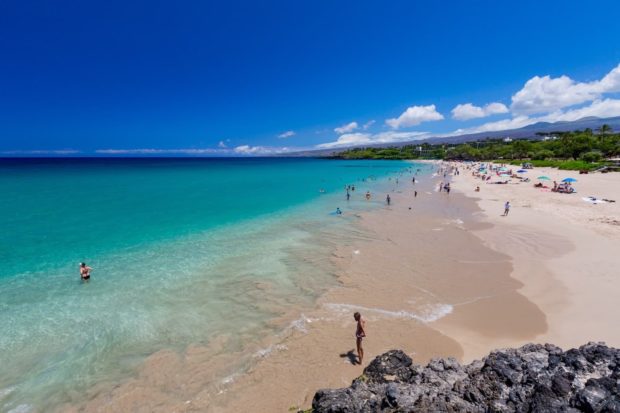
Swim, snorkel, and bodysurf off half a mile of white sand, with a lifeguard, shade, and a picnic pavilion. $5 per person plus $10 parking, free for HI residents.
At a glance: Good for swimming, bodyboarding, families and snorkeling. Lifeguard on duty. Restrooms, showers and picnic tables. Paid parking lot. Non-residents pay $5 per person and $10 per vehicle. Watch for dangerous shorebreak.
Typical beach weather: Among Big Island’s beaches, Hāpuna rates 81/100 (5 of 5 stars). Rain is light from June to August (under ½ inch a month) and heaviest from December to February (about 1½ inches a month). The sky is usually clearest in the morning, and it’s at its best in September.
Waialea Bay Beach
Waialea, better known as 69 Beach, is Hāpuna’s quieter neighbor: a more sheltered, tree-lined white sand cove just to the south. When the surf is calm the snorkeling around the rocks is better than at Hāpuna, and the shade makes it easier to stay all day. It is smaller than Hāpuna and fills up on weekends. More information about Waialea Bay Beach:

Waialea Beach (Beach 69) is a shaded, quieter alternative to Hāpuna, with white sand that returns each summer and a protected bay for snorkeling.
At a glance: Good for snorkeling and swimming. No lifeguard. No restrooms or showers. Small free lot, fills on weekends.
Typical beach weather: Waialea shares the climate of nearby Hāpuna, which rates 81/100. Rain is light from June to August (under ½ inch a month) and heaviest from December to February (about 1½ inches a month).
ʻAnaehoʻomalu Beach
ʻAnaehoʻomalu, almost always shortened to A-Bay, fronts the Waikoloa resort area and backs onto a pair of ancient Hawaiian fishponds, so a short walk takes you from snorkeling to archaeology. An offshore reef keeps the water calm for swimming, diving, and snorkeling, and the sand here is salt-and-pepper rather than pure white. It is also the south end of the Ala Kahakai trail that starts at Spencer.

A Bay (ʻAnaehoʻomalu Bay) at Waikoloa has calm, sandy-entry swimming and a free lot 2 minutes from the sand. Murky for snorkeling; we come back for the sunset.
At a glance: Good for swimming, diving, sunsets and families. No lifeguard. No restrooms or showers. Free parking lot.
Typical beach weather: Among Big Island’s beaches, ʻAnaehoʻomalu rates 80/100 (5 of 5 stars). Rain is light from June to August (under ½ inch a month) and heaviest from January to March (about 1½ inches a month). The sky is usually clearest in the morning, and it’s at its best in September.
Beaches near Kona (West coast)
The Kona (west) coast gets the most sun on the island, and the most traffic as a result. These are all good places to spend a warm afternoon:
Beach highlights: see our list of 10 best Kona beaches to see where we like to hang out.
Kīholo Bay
Kīholo is a bay where cold fresh water springs up through the seafloor and mixes with the ocean, so the water can look milky and turn noticeably cold in patches. Most of the shoreline is private, but a public access trail leads to the beach, and at low tide the bay fills with tide pools worth snorkeling. Green sea turtles are common here. You have to walk in from the highway; there is no parking at the sand.
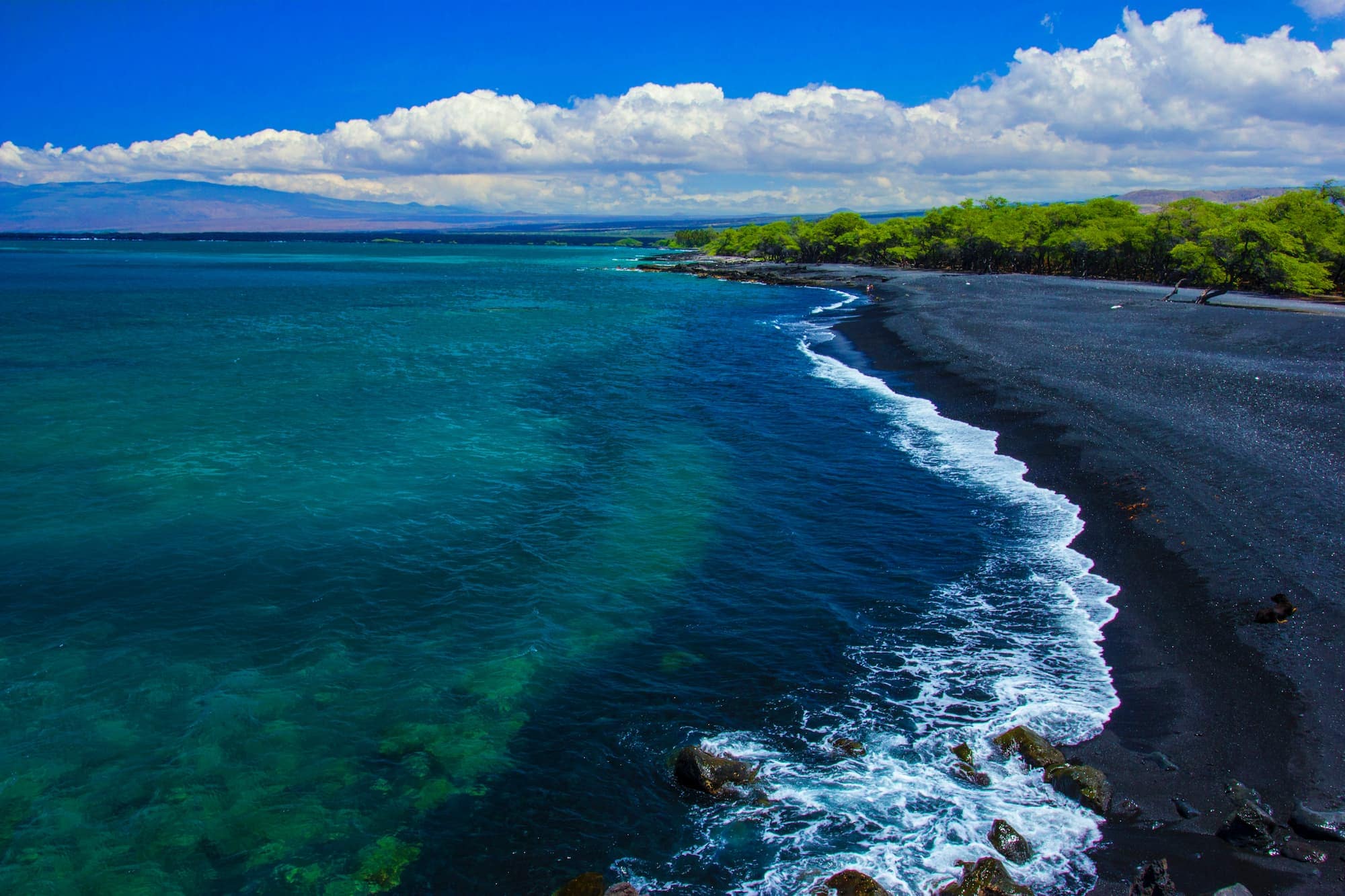
Kīholo Bay has tide pools, wildlife, ancient ponds and rock formations. Photo by Paul Blessington on Unsplash
At a glance: Good for turtle watching. No lifeguard. No restrooms or showers. No parking at the beach; walk from a highway pull-off. Watch for cold spring-water patches.
Kukiʻo Beach
Kukiʻo is one of the better beaches on the island for seeing green sea turtles, which gather along its long stretch of white sand. The same lava rock that makes it good turtle habitat, scattered above and below the waterline, makes it a poor swimming beach. Come to walk the sand and watch wildlife rather than to get in the water. Access is through the Four Seasons, which hands out a limited number of free public passes when there is room.
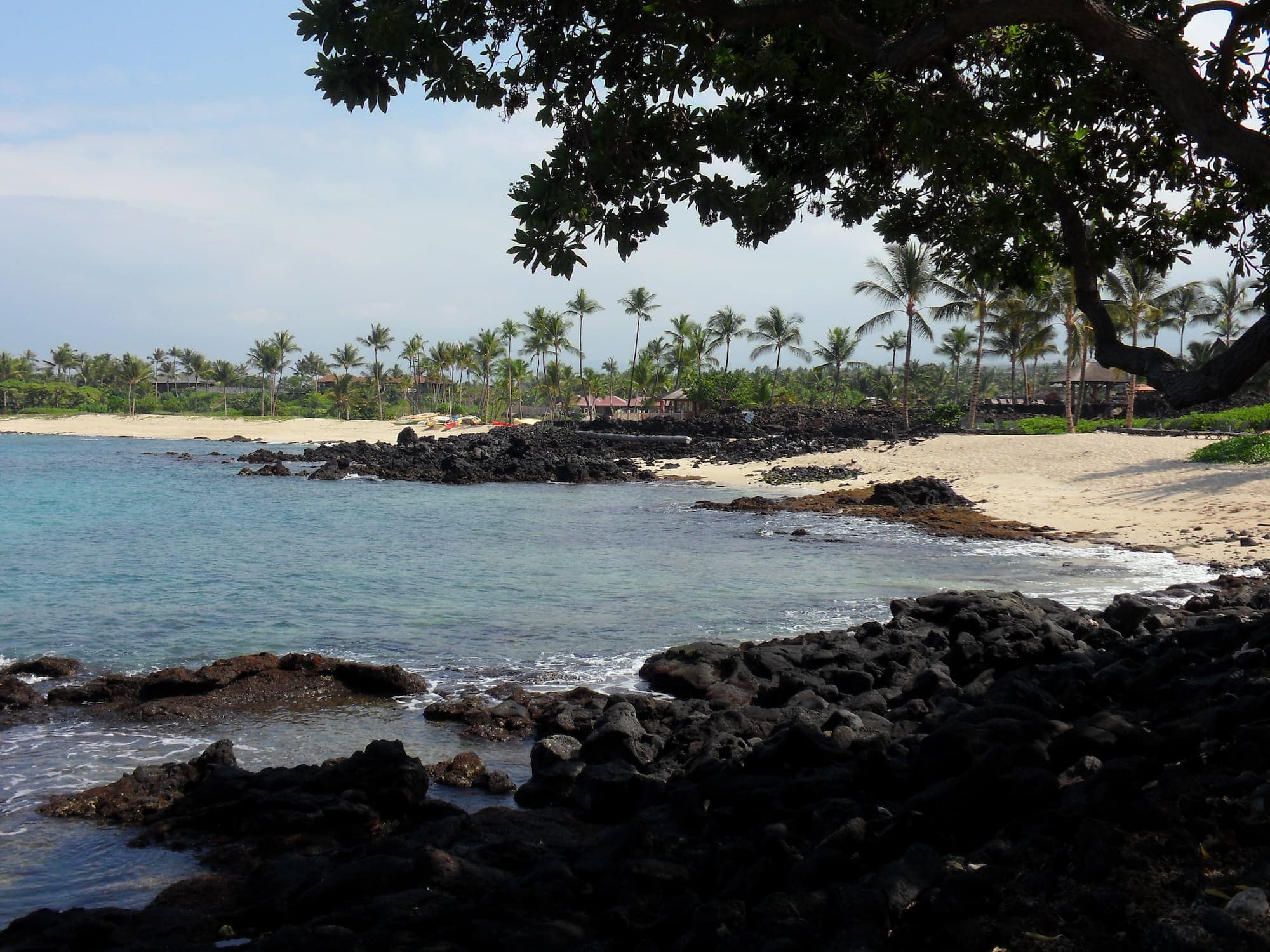
Kukiʻo Beach is one of the quieter beaches on the Big Island. Enter from the Four Seasons Drive where the “gate keeper” will give you a no-charge pass if there is room. Image credit: Mark, source.
At a glance: Good for turtle watching and beach walks. No lifeguard. No restrooms or showers. Limited (Four Seasons day-use pass, subject to availability).
Typical beach weather: Kukiʻo shares the climate of nearby Kua Bay, which rates 75/100. Rain is light from July to September (under an inch a month) and heaviest from December to February (about 1½ inches a month).
Kikaʻua Point Beach
Kikaʻua Point is a sheltered lagoon with almost no current or waves. That is a rare enough combination on this coast that families with small children pick it out specifically. There is little to snorkel here, so come for the calm, shallow water for wading. There is no lifeguard, so keep an eye on young kids yourself.
At a glance: Good for families. Sheltered lagoon with almost no current, good for small kids. No lifeguard. No restrooms or showers.
Typical beach weather: Kikaʻua Point shares the climate of nearby Kua Bay, which rates 75/100. Rain is light from July to September (under an inch a month) and heaviest from December to February (about 1½ inches a month).
Kekaha Kai State Park
Kekaha Kai is a stretch of coast holding three of the best beaches: Mahaiʻula, Makalawena, and Kua Bay. All three set white sand and blue-green water against fields of pitch-black lava, far enough from Kona to stay quiet. white sand and blue-green water set against fields of pitch-black lava, far enough from Kona to stay quiet.

The 3 beaches in the Kekaha Kai state park are (from North to South): Maniniʻowali Bay (a.k.a. Kua bay), Makalawena beach and Mahaiʻula Bay. Image adapted from Google Maps.
Getting there means a rough, rocky, winding road across lava that not every rental car is allowed on. If you have a rental, check with the company before you drive in.
At a glance: Good for swimming and hiking. No lifeguard. Picnic tables. Paid lot at Kua Bay. $5 per person and $10 per vehicle for non-residents. Umbrella park: see Kua Bay, Mahaiʻula, Makalawena. Watch for dangerous rip currents during high surf and no drinking water.
Typical beach weather: Kekaha Kai shares the climate of nearby Makalawena, which rates 74/100. Rain is light from June to August (under an inch a month) and heaviest from December to February (about 1½ inches a month).
Kua Bay Beach
Kua Bay, officially Maniniʻowali, is the brightest-looking of the three Kekaha Kai beaches: white sand and clear water reached by a short walk from a paved lot, the easiest access in the park. On calm days the swimming and snorkeling are excellent. In winter it can turn into a shore break that tosses people around, so respect the surf when it is up. There is no lifeguard. More information on Kua Bay Beach:

Maniniʻōwali Beach Guide (Kua Bay)
As of 2026, Kua Bay charges $5 per person plus $10 per vehicle, paid on site by QR code. What to know about the white sand, summer snorkeling, and parking.
At a glance: Good for swimming, snorkeling and bodyboarding. No lifeguard. No restrooms or showers. Paid parking lot (QR code on site). $5 per person and $10 per vehicle for non-residents. Watch for winter shorebreak.
Typical beach weather: Among Big Island’s beaches, Kua Bay rates 75/100 (5 of 5 stars). Rain is light from July to September (under an inch a month) and heaviest from December to February (about 1½ inches a month). The sky is usually clearest in the morning, and it’s at its best in September.
Mahaiʻula Beach
Mahaiʻula is the relaxed, shady option in Kekaha Kai: a curve of white sand backed by coconut palms, quieter than Kua Bay because you reach it by the rough road rather than a paved lot. A lava shelf just offshore makes swimming awkward, so this is more a beach for lying under the palms with a book than for getting in the water.
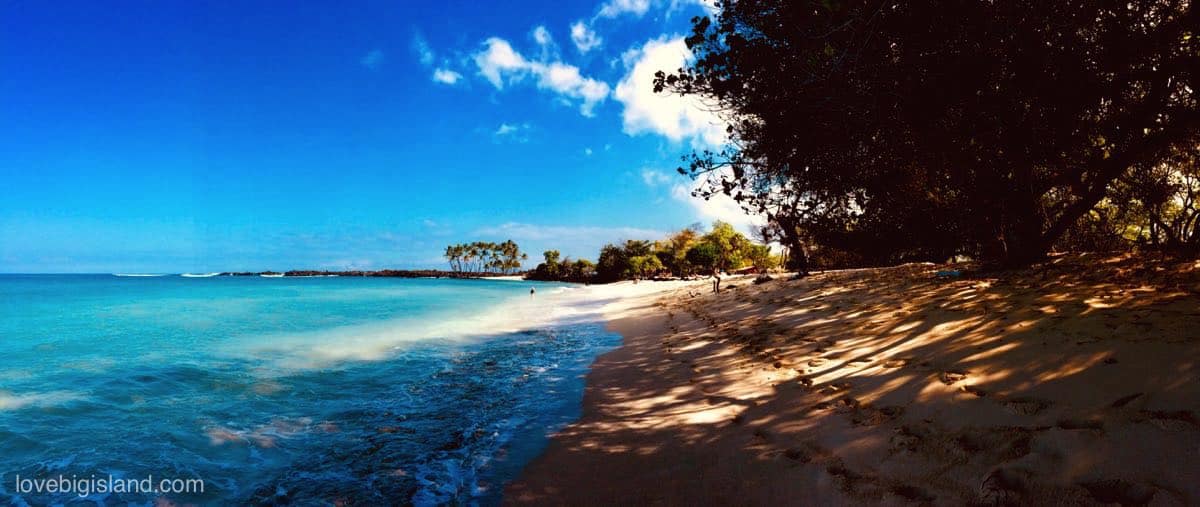
Mahaiʻula beach is the most southern beach in the Kekaha Kai State Park on the Kona coast.
At a glance: Good for a quiet day and picnics. No lifeguard. Picnic tables. Limited (rough lava road). Watch for lava shelf offshore.
Typical beach weather: Mahaiʻula shares the climate of nearby Makalawena, which rates 74/100. Rain is light from June to August (under an inch a month) and heaviest from December to February (about 1½ inches a month).
Makalawena Beach
Makalawena takes a hot, exposed one-mile hike across lava beyond Mahaiʻula, and it regularly places on best-beach lists for the whole state. Few make the hike, so the dunes and water often stay near-empty. Bring everything you need, because there is nothing out here.
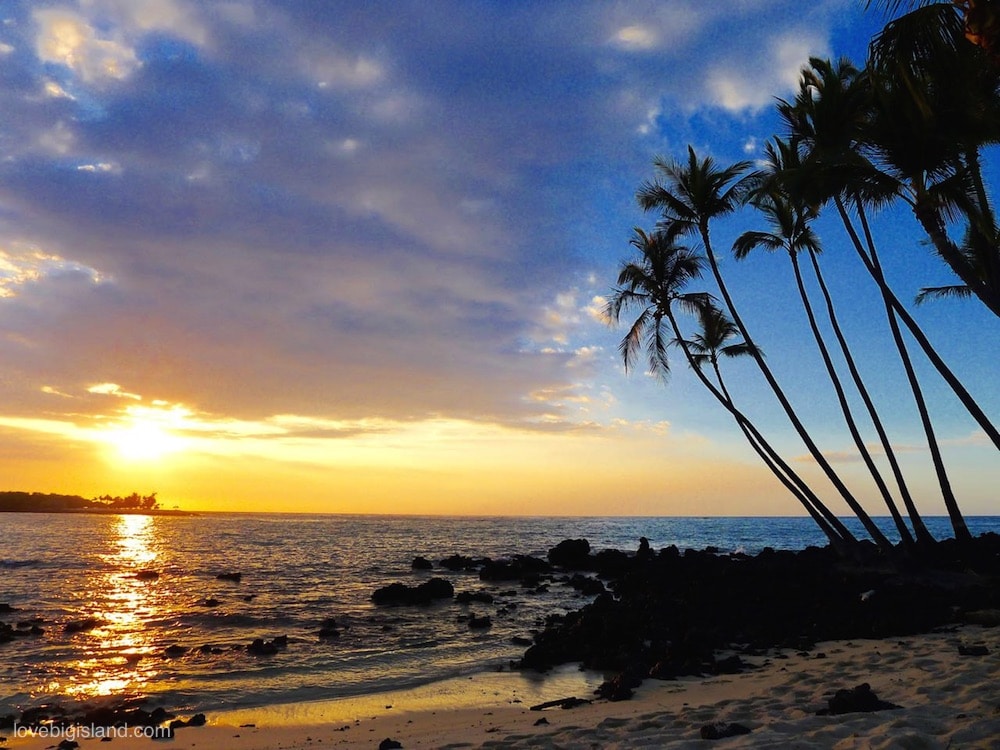
Mahaiʻula beach is the southernmost of the three Hawaiʻi Big Island beaches making up Kekaha Kai State Park.
At a glance: Good for swimming and a quiet day. No lifeguard. No restrooms or showers. No parking; one-mile hike across lava from Mahaiʻula. Watch for remote, hot, exposed hike and no facilities or water.
Typical beach weather: Among Big Island’s beaches, Makalawena rates 74/100 (5 of 5 stars). Rain is light from June to August (under an inch a month) and heaviest from December to February (about 1½ inches a month). The sky is usually clearest in the morning, and it’s at its best in September.
Aiʻopio beach
Aiʻopio is a small, protected beach where ancient Hawaiians built a fishtrap whose stone walls still hold calm, shallow water, ideal for young children. It sits inside Kaloko-Honokōhau National Park and is easiest to reach from the Honokōhau small boat harbor. If you have booked a boat tour that departs from this harbor, arrive early and walk over to take a look at this small beach.
At a glance: Good for families and history. No lifeguard. No restrooms or showers. No parking; walk from Honokōhau harbor. Ancient fishtrap inside Kaloko-Honokōhau NHP, free entry.
Old Kona Airport Beach Park
You park on a runway here: Kona’s first airport closed in 1970, and its airstrip is now the parking lot for this long beach park right at the edge of town. The shoreline is rocky and the ocean is often too rough to swim, but the convenience and the west-facing view make it a local favorite for bringing food and watching the sunset.
At a glance: Good for sunsets, picnics and beach walks. Not a swimming beach. No lifeguard. No restrooms or showers. Free parking lot. Watch for rocky shoreline and rough water.
Kamakahonu (King Kam) Beach
Kamakahonu, nicknamed King Kam after the King Kamehameha hotel behind it, is the most central beach on the island: a small, calm pocket of sand right in downtown Kailua-Kona on the north side of the pier. The protected water is gentle enough for beginners, and the snorkeling around the pier is decent despite the downtown location. It is the easiest swim to fit between other things in town. More information on King Kam Beach:

A sheltered white-sand beach between Kailua pier and the King Kam hotel, best for an early swim or snorkel. Kona Boys rents gear on site. Parking is paid.
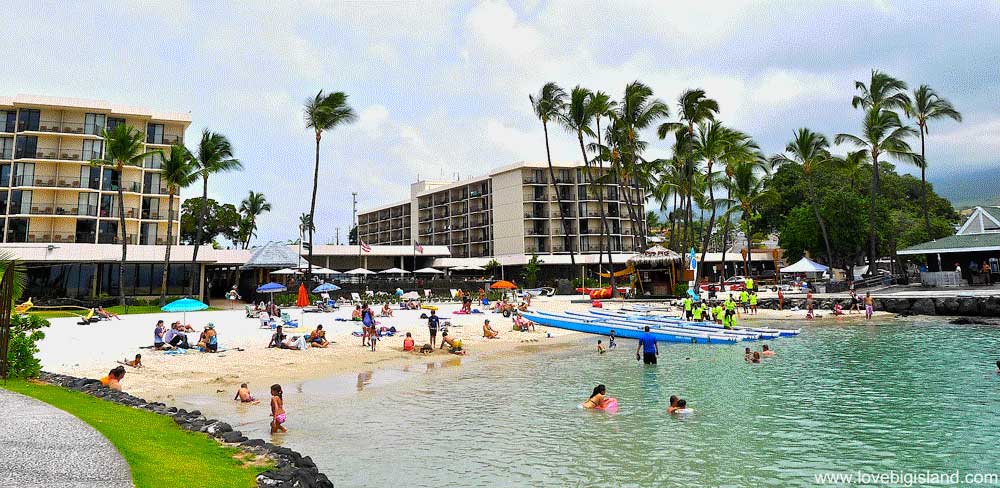
King Kam beach in downtown Kona is a good place to take a quick dip in between activities. You can find decent snorkeling on the other side of the pier
At a glance: Good for swimming and snorkeling. No lifeguard. No restrooms or showers. Paid metered downtown parking.
Typical beach weather: Kamakahonu shares the climate of nearby Kahaluʻu, which rates 42/100. The driest months are December to February (about 2 inches of rain a month), the wettest July to September (about 3½ inches).
White Sands Beach Park
Magic Sands is named for the sand itself: during big winter swells the surf can strip the entire beach of sand overnight, then deposit it back weeks later. When the sand is in, it is a compact, lively town beach with a punchy shore break that bodyboarders love and swimmers should respect. County lifeguards are on duty daily, 9:30am to 4:45pm, with showers, a bathroom, and a volleyball net on site.
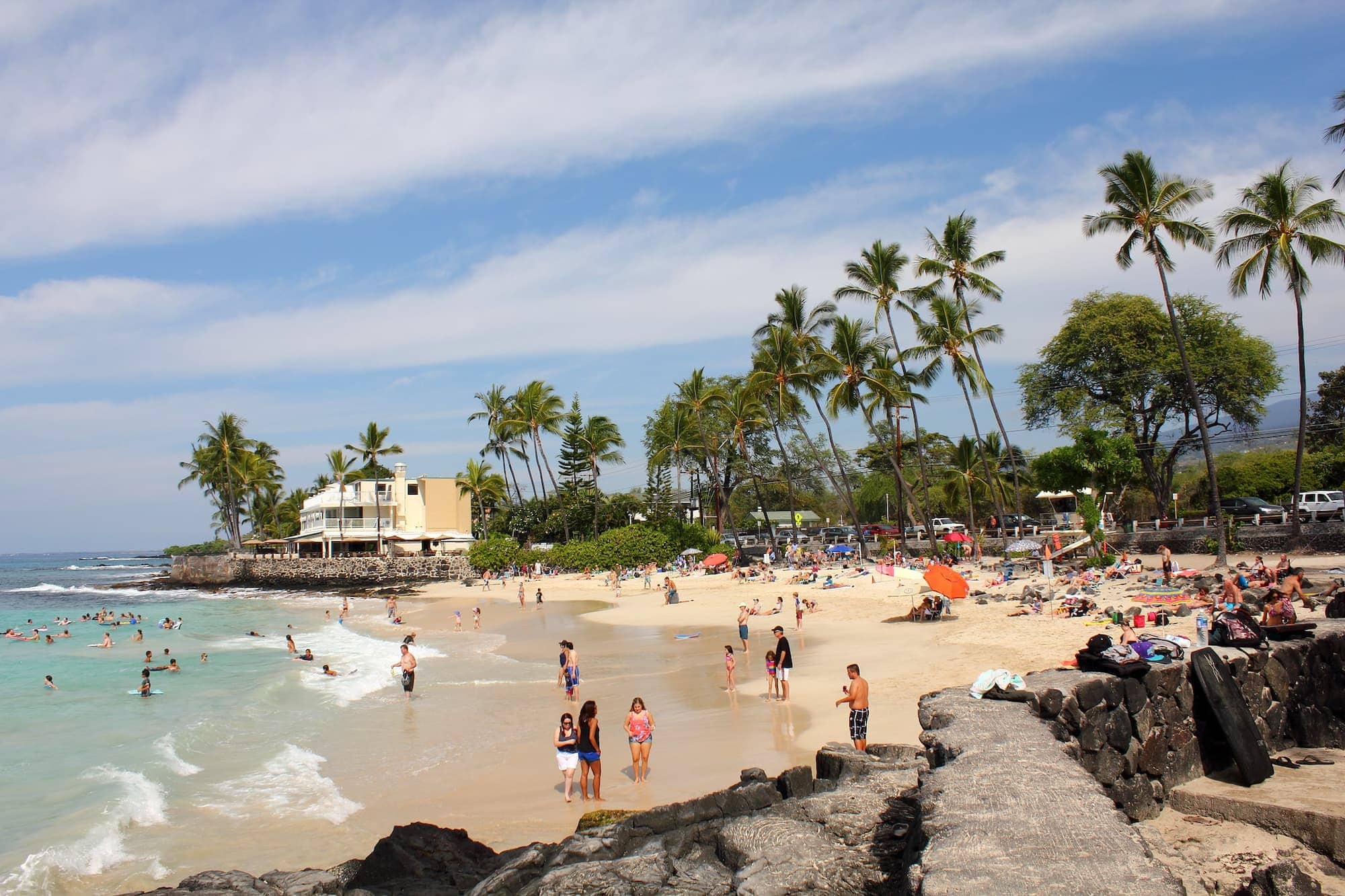
About 4 miles south of central Kailua-Kona, this small beach (also called White Sands and, officially, Laʻaloa Beach) has clear blue-green water, great sunsets, and an often dangerous shore break. Image credit: Steve Shupe, source.
At a glance: Good for bodyboarding, sunsets and snorkeling. Lifeguard on duty. Restrooms and showers. Also called Laʻaloa; sand vanishes in winter and returns. Watch for dangerous shorebreak and seasonal sand loss (winter).
Typical beach weather: White Sands shares the climate of nearby Kahaluʻu, which rates 42/100. The driest months are December to February (about 2 inches of rain a month), the wettest July to September (about 3½ inches).
Kahaluʻu Beach Park
Few places on the Kona coast give you a better chance of snorkeling with green sea turtles than this protected cove. The reef sits close to shore in shallow, mostly calm water, forgiving for first-timers, though the entry is rocky enough that you will want water shoes. Two lifeguard towers mark the safe zone, and the pavilion has reef-safe sunscreen dispensers.
A northbound current runs out of the bay and picks up with bigger swells, so check the flags before you swim out. It is one of our 3 favorite snorkeling spots on the Big Island.
Read more on our website about snorkeling, surfing and going to the beach at the Kahaluʻu beach park.
At a glance: Good for snorkeling, turtle watching, families and surfing. Lifeguard on duty. Picnic tables. Watch for rocky entry (water shoes recommended) and northbound current in bigger swells.
Typical beach weather: Among Big Island’s beaches, Kahaluʻu rates 42/100 (3 of 5 stars). The driest months are December to February (about 2 inches of rain a month), the wettest July to September (about 3½ inches). The sky is usually clearest in the morning, and it’s at its best in December. From July to September, Hāpuna usually has better beach weather.
Kealakekua Bay Park
Nāpōʻopoʻo, a rocky beach in the state historical park, and Manini Beach a third of a mile south, with a patch of sand and a lawn made for sunsets, are both poor swimming spots.
Kealakekua bay however is one of the best snorkeling and kayaking destinations on the island. Spinner dolphins often rest here, and the monument to Captain Cook across the water is reachable by a challenging trail, by kayak, or on a boat tour. Kayaking requires a permit. Read more about snorkeling at Captain Cook or about visiting Kealakekua Bay in general on our website.
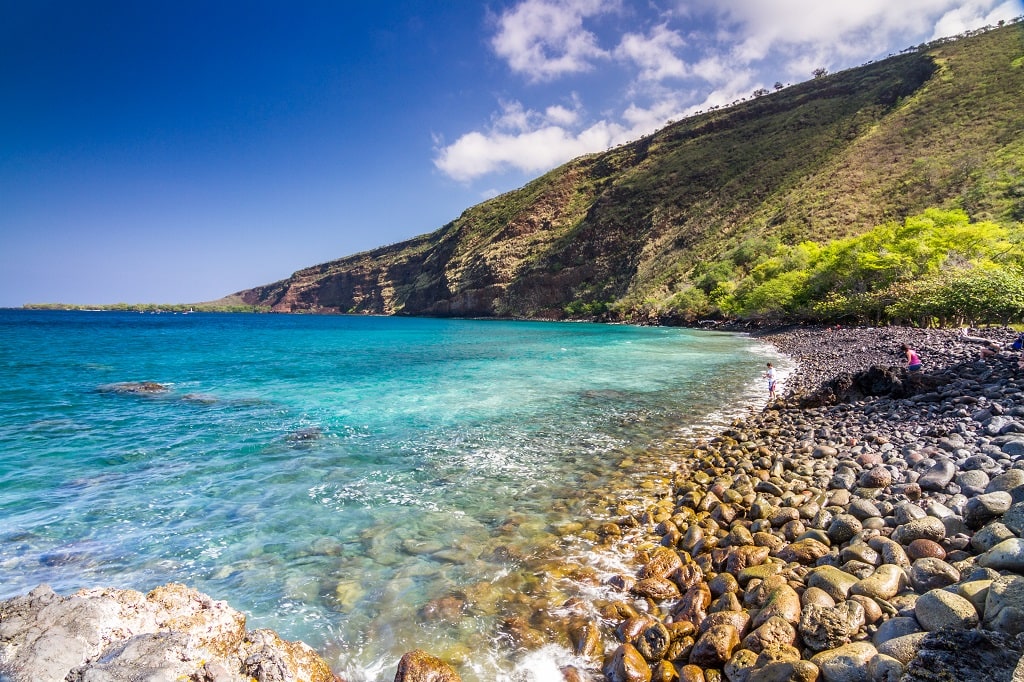
Nāpōʻopoʻo Beach is a small rocky beach in the Kealakekua Bay State Historical Park. Image credit: Nnachappa64, Own work, CC BY-SA 4.0, Link
At a glance: Good for snorkeling and diving. Nāpōʻopoʻo and Manini Beach are poor for swimming; the bay is for snorkeling and kayaking. No lifeguard. Restrooms. Vessels need a DLNR permit to be on the bay. Watch for rocky entry and permit required for vessels.
Typical beach weather: Among Big Island’s beaches, Kealakekua rates 38/100 (3 of 5 stars). The driest months are December to February (about 2 inches of rain a month), the wettest July to September (about 4 inches). The sky is usually clearest in the morning, and it’s at its best in December. From July to September, Hāpuna usually has better beach weather.
Two Step (Hōnaunau Bay)
Two Step is the snorkeling entry to Hōnaunau Bay, 40 minutes south of Kailua-Kona by car and just outside Puʻuhonua o Hōnaunau National Historical Park. You step in off a lava shelf beside the county boat ramp, with boats launching alongside. There’s no lifeguard. The county lists the footing, currents and waves as hazards, and the park service warns that large waves can arrive with little warning as you get in or out.
Parking near the ramp is limited and the only facilities are portable toilets. The park service asks snorkelers to park outside the park gate so its small lot stays open for people visiting the puʻuhonua (place of refuge).
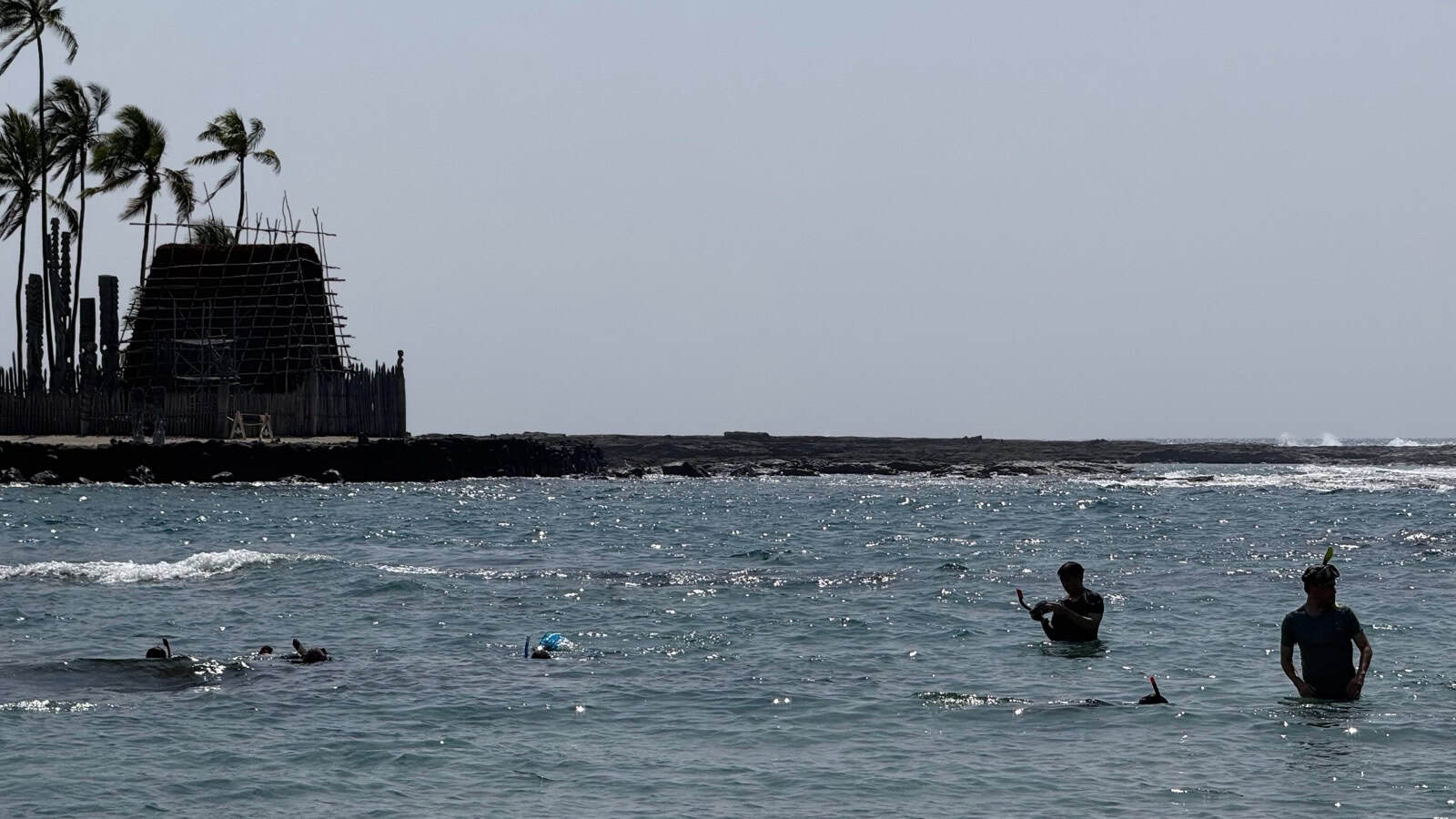
Snorkelers at Two Step, with Hale o Keawe, the temple at Puʻuhonua o Hōnaunau, on the point behind. Surf was breaking over the lava shelf that September afternoon. Photo: Gerrit van der Plas, Sep 2026.
Swimming and snorkeling are not allowed anywhere inside the park, including Keoneʻele Cove, where green sea turtles rest. Snorkel gear and towels are not allowed in the Royal Grounds or the puʻuhonua either. Spinner dolphins rest in the bay during the day, and federal law requires you to stay 50 yards from them.
Our snorkeling guide shows where on the reef to start, and our Puʻuhonua o Hōnaunau guide covers the park walk, fees and history.
At a glance: Good for snorkeling and diving. No lifeguard. No restrooms or showers. Limited at the county boat ramp; NPS asks snorkelers to park outside the park gate. No ocean access inside Puʻuhonua o Hōnaunau; portable toilets only. Watch for boat traffic at the ramp, large waves on entry and exit and currents.
Typical beach weather: Two Step shares the climate of nearby Kealakekua, which rates 38/100. The driest months are December to February (about 2 inches of rain a month), the wettest July to September (about 4 inches).
Hoʻokena Beach Park
Hoʻokena is a community beach first and a visitor beach second. In the 1880s this was a busy steamship landing with a wharf, school, and courthouse, until storms wrecked the landing and most villagers moved upland. Today the local non-profit Friends of Hoʻokena Beach Park co-manages it with the county, so you pay a small fee that goes back into the park.
The sand is fine black-and-white ground to a dark steel-gray that gets hot, so bring flip-flops. Snorkeling is good at both ends of Kauhako Bay, with the sandier, calmer swimming down the south end. Tent camping is by permit only. Give the fishing canoes on the beach a wide berth, since they are culturally important here.
At a glance: Good for swimming. No lifeguard. No restrooms or showers. Free parking lot. Small day-use fee; camping $6/night resident, $21/night non-resident.
Water and Beach Safety
The ocean here deserves more respect than it usually gets. Water that looks calm can still pull hard, and the swimmers who get into trouble are often the confident ones who underestimated it. Strong currents move beneath the surface, coral can cut your feet and is easily damaged, and sea urchins wedge into the rocks where you least want to step. Never turn your back to the ocean, and always follow posted signs.
More practical tips are:
- Some beaches may be closed because of high surf and/or dangerous currents. You can find up-to-date hazard ratings for the Big Island beaches at this website of the county of Hawaiʻi.
- The Hawaiian sun is stronger than it feels this close to the equator. Apply sunscreen generously and often, and wear a shirt if you go out snorkeling.
- Though the crime rate in Hawaiʻi is low, visitors should be as cautious as they would be at any other destination. Do not lock valuables in your vehicle. If you must, pack items out of sight before parking.
- Please make sure to clean up after yourself.
7 tips for going to the beach in Hawaiʻi
Beaches here come with a few rules and conditions you will not have met back home: stronger sun this close to the equator, black sand that can get hot enough to hurt, local laws on what you can bring, and fragile coral reefs ringing every island.
- Use reef-safe sunscreen. Hawaiʻi state law bans the sale of sunscreen containing oxybenzone or octinoxate, and Hawaiʻi County goes further: only mineral sunscreens, active ingredient zinc oxide or titanium dioxide, are legal to sell here. Check the label before you buy.
- Bring a hat to protect your face and your eyes. Sunburns can cause premature aging and UV rays can also damage your eyes. Prevention is the key.
- Bring a reusable water bottle to stay hydrated and minimize plastic waste.
- Wear shoes or flip flops. Sand on our beaches gets hot, especially the black sand, and sharp pieces of shell and coral can cut your feet.
- The Hawaiian sun is intense. Lip balm with a high (30+) SPF gives extra protection to your most vulnerable pieces of skin such as your lips, earlobes, etc. (this tip also features in our list of 11 mistakes most tourists make in Hawaiʻi)
- Smoking and drinking alcohol is illegal on beaches and in state parks. If you want to enjoy any of those things, please don’t do it on the beach.
- Some beaches have far more amenities than others. With young children especially, double check for available bathrooms before you go.
Things to do on the beach
Big Island beaches are emptier than those on Oʻahu or Maui. Hit a remote one on a weekday and you can have the sand to yourself. The quieter the beach, the less likely it has water, shade, or restrooms, so pack your own.
Take your snorkel gear and spend your time swimming between fish in every color of the rainbow. Green sea turtles turn up at more than a dozen beaches on this list, and manta ray night dives run out of Kona. Read more on snorkeling and buying or renting gear. If you like playing in the waves, bring along a bodyboard, SUP board, or surfboard.
A big group will not run out of things to do at the beach. If you are not the sun worshiper your travel companion is, bring a book (any of the books on our list of 18 books to read on Hawaiʻi would be a good fit), good food and drinks, snorkel gear, or whatever you enjoy doing, and do your thing.
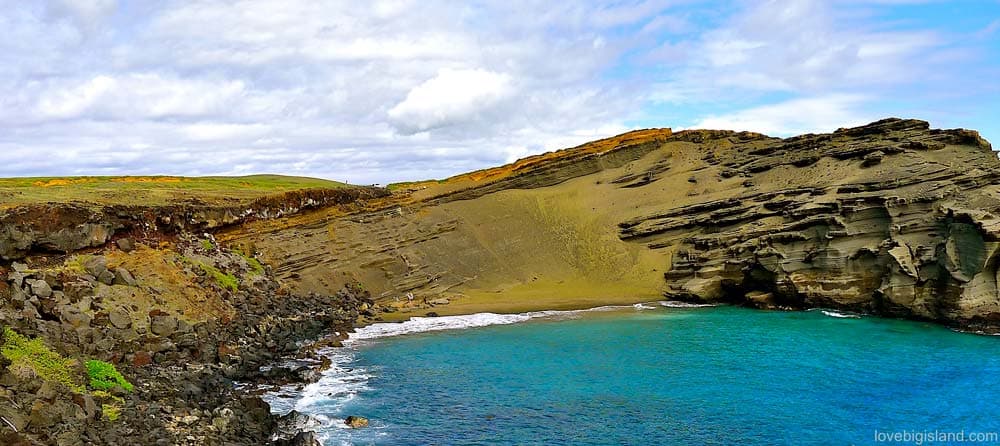
Green Sand Beach in the Kaʻū district, near the south point of the island.
More Hawaiʻi beach guides
Ask a Big Island resident about the beaches and many will shrug and tell you to go to Maui or Oʻahu. Do not listen. The variety here, black, white, green, and salt-and-pepper sand within a couple hours’ drive, is something the other islands cannot match. Our Oʻahu (28 beaches), Maui (23 beaches), and Kauaʻi guides map the beaches on each island: