
Māui, the demigod, once tried to haul the Hawaiian Islands up from the sea floor as one land. The attempt failed because one of his brothers looked back. In one version his hook was Kaʻuiki, the red cinder headland at Hāna Bay on east Maui.
The legend of Māui fishing up the islands
Māui lived at Hāna with his mother, Hina, and his brothers. He had a magic fishhook called Mānaiakalani, and for bait he took an ʻalae (mud hen), one of Hina’s birds.
He got his brothers to paddle far out to a fishing ground called Poʻo, seaward of Kīpahulu. Fishermen found the spot by lining up their canoe with Ka Iwi o Pele, a cinder hill on shore. Māui let the line down, and something enormous took it, pulling like a great ulua (giant trevally).
For two days the brothers paddled and Māui pulled. He told them to keep paddling and not to look back. Slowly the catch rose, and Māui saw that it was land, coming up from the sea floor.
One brother turned to look. The line broke, the land slipped away, and only parts of it stayed above the water. That is why Hawaiʻi is a chain of separate islands.
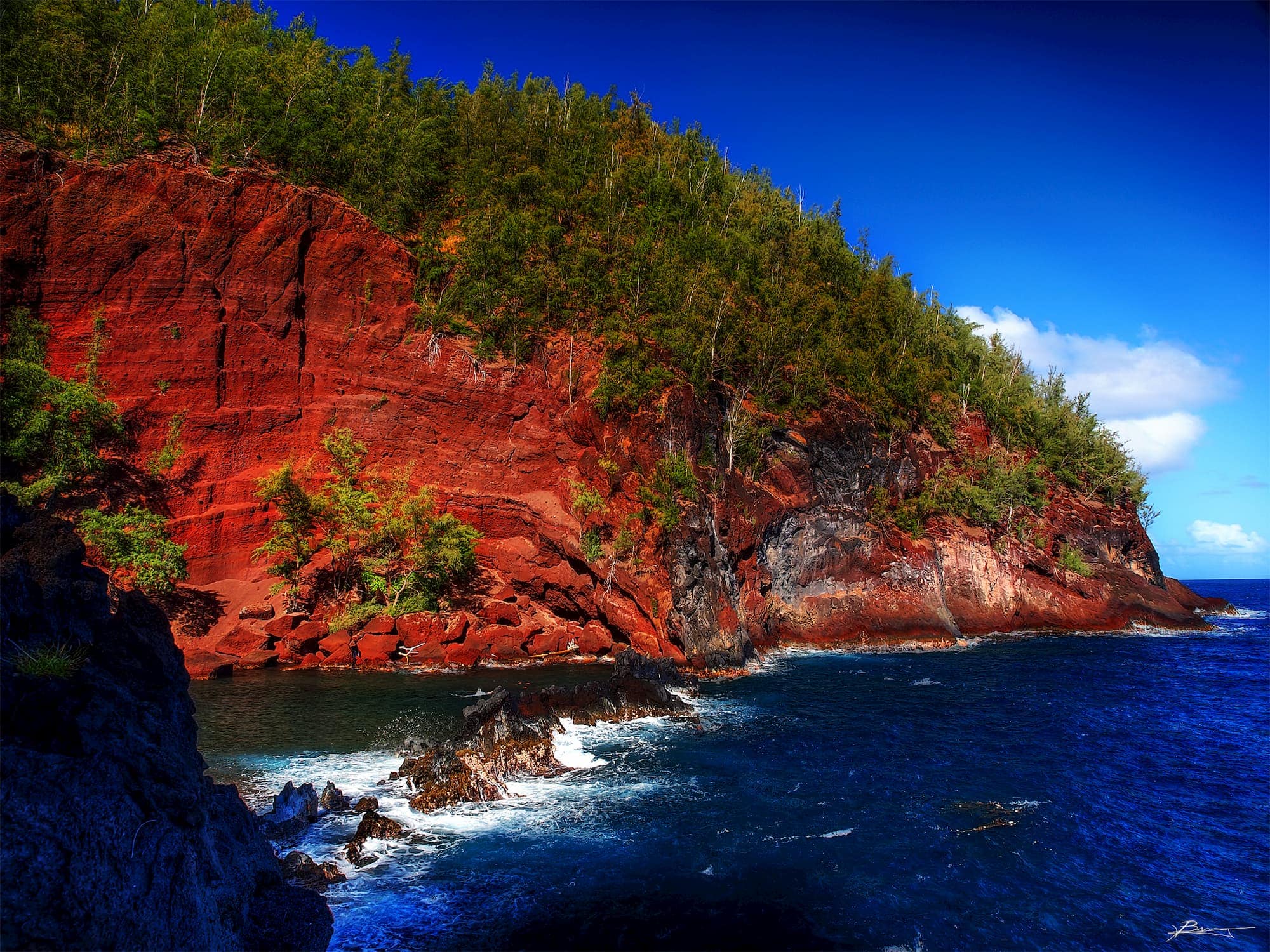
The red cinder cliffs of Kaʻuiki Head at Hāna, home of Māui in the legend. Image credit: Paul Bica, source.
Where the legend is set: Hāna, Kaʻuiki Head and Kīpahulu
Kaʻuiki Head is the cinder cone on the south side of Hāna Bay. In the legend it was Māui’s home. Poʻo lies off Kīpahulu, farther along the coast from Hāna, where the Kīpahulu District of Haleakalā National Park reaches the sea. Our Road to Hāna guide has the drive and the stops at Hāna and Kīpahulu.
Another version is set at Kaʻena Point, Oʻahu’s western tip. There Māui threw his hook toward Kauaʻi to drag it over, and a boulder, Pōhaku o Kauaʻi (rock of Kauaʻi), broke loose and fell at his feet. The stone lies at Kaʻena Point.
Māui’s fight for his mother is on our Rainbow Falls legend page, and his catch of the sun on Māui snaring the sun at Haleakalā. Our mythology hub lists each legend we retell with a short summary, grouped by theme and by island, with a map of where each one is set.
About this telling
The fishing story combines several sources. The trip to Poʻo off Kīpahulu and the brother who looks back follow an East Maui telling by Puaoaloa, printed in the Hawaiian-language newspaper Ka Nupepa Kuokoa in June and July 1863. We read it in Mary Kawena Pukui’s English translation, as summarized in Martha Beckwith’s Hawaiian Mythology (1940).
The ʻalae bait and Kaʻuiki as the hook come from the chant for the chief Kualiʻi, which we read in Hawaiian in Abraham Fornander’s collection (volume 4) with its printed notes. In the chant’s Hawaiian, Mānaiakalani names the fishing line; Beckwith’s sources make it the hook, and so do we. Māui seeing land rise from the sea follows the National Park Service’s telling. The Kaʻena Point version follows Nathaniel Emerson’s note in Pele and Hiiaka (1915) and Place Names of Hawaiʻi, which says sea goddesses snagged the hook on the rock.
Read more
- Moʻolelo o Maui, at the National Park Service: a short English telling of Māui and his brothers fishing up the islands, printed in a classroom lesson plan. Open it for the brothers who beg Māui to cut the line and the one who finally turns to look.
- The chant for Kualiʻi, in Fornander’s collection on Ulukau: the Hawaiian text of the chant’s passage on Māui’s great fishhook, with the English translation and notes on the facing page. Its notes name Kaʻuiki, the headland at Hāna, as the hook.