
The demigod Māui climbed Haleakalā, the 10,023-foot volcano on Maui, roped the sun by its legs and beat it until it promised to cross the sky more slowly. In Hawaiian legend, that is why the mountain is called Haleakalā, “house of the sun.”
The legend of Māui and the sun
Long ago the sun raced across the sky. There was hardly time to cook food before dark. Māui’s mother, Hina, made kapa (bark cloth), and kapa has to dry in the sun. Before she had it all spread out, night fell.
Māui decided to slow the sun down. From the ridges above ʻĪao Valley he watched it come up the eastern side of Haleakalā and pass right over the summit.
Hina gave him fifteen strong cords and sent him to his grandmother, who lived by a large wiliwili (Hawaiian coral tree) on the mountain. Every morning the sun stopped there to eat the bananas she cooked for it. Māui climbed to the tree above Kaupō and waited until the rooster crowed three times.
When his blind grandmother laid her bananas down, he stole them. She sniffed out a man and asked who was there. “I am the son of Hina,” he said, “and I have come to kill the sun, because it goes too fast for her kapa to dry.”
She gave him one more rope and a stone for an adze (a cutting tool), and told him to hide by the tree. As the sun’s legs came up over the mountain one by one, Māui snared them and tied the ropes to the wiliwili. The sun tried to go back down the mountain into the sea, but Māui hauled it up and struck it with the adze until it begged for its life. It promised to travel slowly, and it still does.
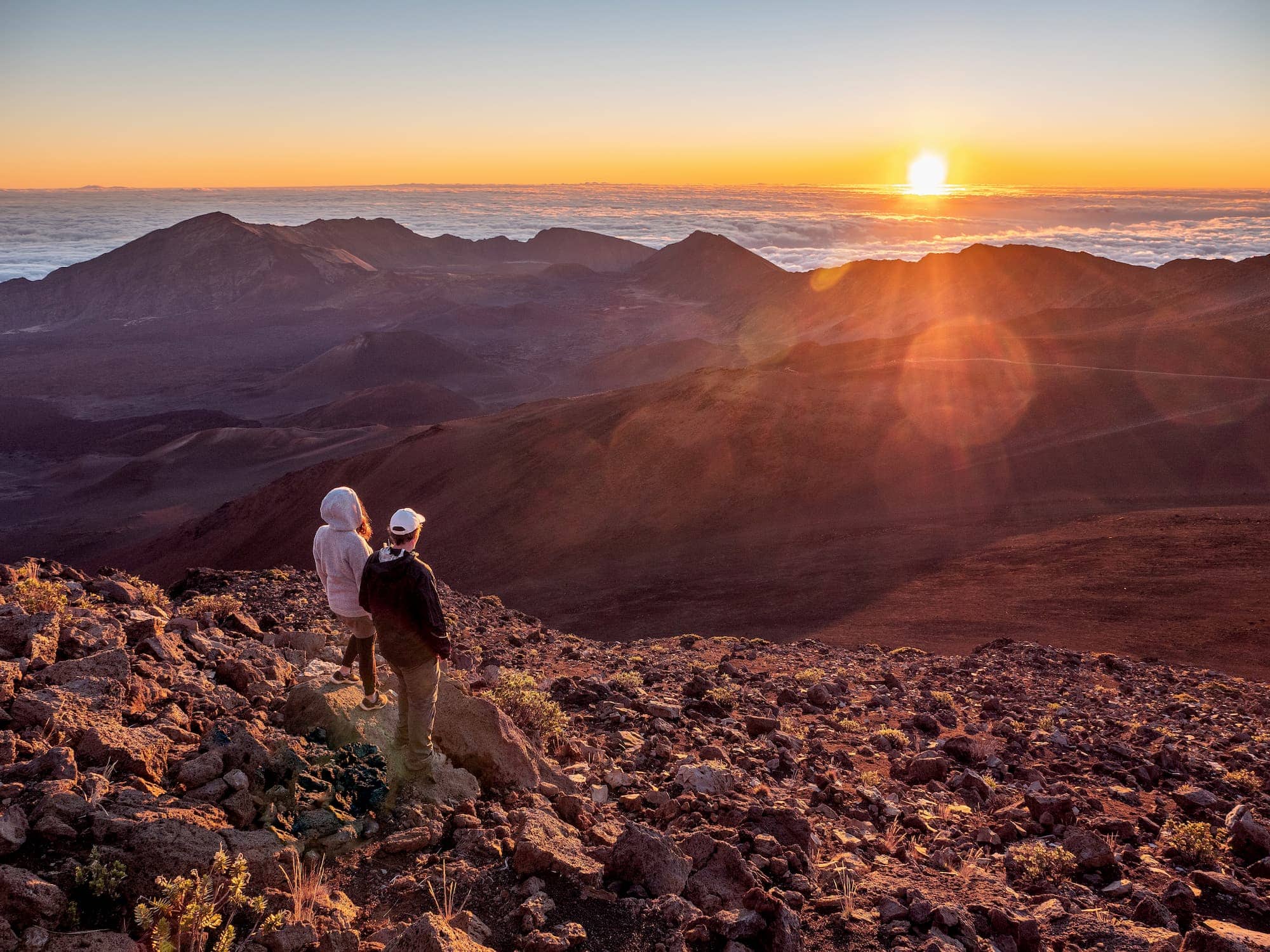
Seeing the sunrise from the Haleakalā summit. Image credit: James Wheeler, source.
Seeing the sun rise from Haleakalā’s summit
The summit is in Haleakalā National Park, about two and a half hours’ drive from Kahului. For sunrise, every car entering between 3 and 7 a.m. needs a $1 reservation, bookable up to 60 days ahead and separate from the entrance pass.
Our Haleakalā National Park guide covers entrance fees, the summit hikes and camping. Māui’s other feat on Maui, fishing up the islands, is set at Kaʻuiki in Hāna. Our Hawaiian mythology hub lists every legend we retell, with a short summary and a map of where each is set.
About this telling
This retelling follows the National Park Service’s telling from Haleakalā National Park, which ties the park’s name to this story. The park’s version matches the one W. D. Westervelt printed in Legends of Ma-ui (1910), which he drew in part from the missionary A. O. Forbes; we did not read Forbes’s own account.
The Hawaiian-language telling we read is Lemuel K. N. Papa Jr.’s “He moolelo no Maui,” printed with an English translation in Abraham Fornander’s folklore collection (vol. 5). Papa has no grandmother and no wiliwili tree: Māui snares the sun with a rope of coconut husk and breaks off its strong rays. Papa also writes that the mountain should be called Alehelā, from alehe (to snare) and lā (the sun).
Read more
- Māui snaring the sun, at Haleakalā National Park: the park’s own telling, with the grandmother and the wiliwili tree.
- Papa’s “He moolelo no Maui” in Fornander’s collection, on Ulukau: the Hawaiian text with the English translation on the facing page, pages 536 to 541. Open it for the coconut-husk version, Māui’s birth above Kahakuloa and his escape from a chief’s sacrifice.