
Every fall a small brown-and-gold shorebird lands on the same lawn it left in spring, flying in from Alaska across open ocean. On the Big Island the kōlea (the Pacific golden plover) belongs to Kumukahi, a god who settled at the island’s easternmost point and can walk as a man or fly as a plover at will.
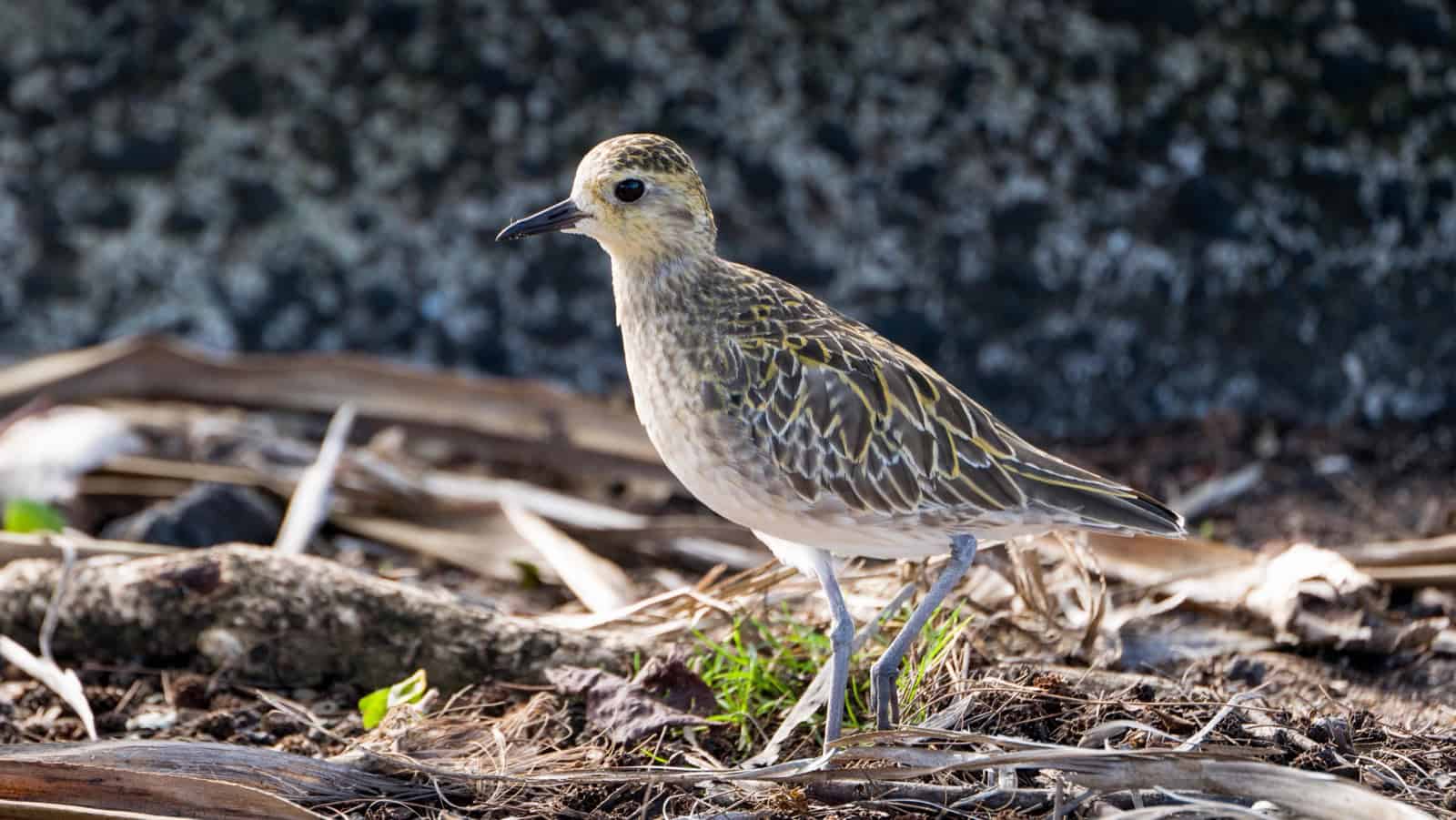
The kōlea returns to the same Big Island lawns and fields each fall, then flies back to Alaska to breed in spring. Credit: P. A. J. Schat
Kumukahi, the plover god, and the hunter who wronged his birds
At the easternmost point of Hawaiʻi Island, where the sun first reaches the land, lived a being who could walk as a man or fly away as a kōlea at will. His name was Kumukahi. He had sailed from Kahiki (the ancestral homeland overseas), a relative of Pele, with his brother Palamoa and his sister Sunrise, and settled on the cape in Puna that still carries his name.
He loved sport, above all hōlua (racing a narrow sled down a steep track of packed stone). He held games at the cape, and Pele, fond of him, would join them in the form of a beautiful young woman. One day she came instead as an old woman, asked to race, and was turned away. Her anger came as lava. She chased him to the sea and buried him at the point, where a red stone marks him still.
His two wives stand near him as stones, one of them named Haʻehaʻe. The old people said the two of them push the sun back and forth between them through the year, and they called the cape the Ladder of the Sun. People carried their sick to the point to be healed at first light, facing the rising sun, and called on Kumukahi and his brother Palamoa as gods of healing.
The kōlea were his birds, their ʻaumakua (family guardian), and to kill them was to strike the god. In Kaʻū, on the dry south side of the island, a hunter named Kumuhana killed far more plover than he could ever eat. A neighbor who worshipped Kumukahi warned him to stop. He paid no attention. Then a flock of plover came into his house and pecked and tore at him until he was dead. Kaʻū has called that place Ai-a-kolea, the impiety to the plover, ever since.
What the kōlea is, and where you can see it
The kōlea is a shorebird you can watch all winter on the Big Island. It flies in each fall and back to Alaska each spring to breed, and the same individual returns to the same patch of ground year after year: a lawn, a park, a golf course, a cemetery. Watch one spot through a winter and you are probably watching one bird.
You see it here in its plain winter coat, mottled brown and gold with gray legs. Just before it leaves in spring it molts into a bolder black-and-gold breeding plumage, so the birds look sharpest right as they go.
Two old sayings turn on this coming and going. One is the plover that eats until it is fat and then flies home to Kahiki, said of a foreigner who arrives, makes money, and leaves. The other is the plover whose egg no one here has seen, because it is laid in a far-off land, said of something no one can reach or know.
Pele’s own story is on her page, and the rest of these island legends sit on the mythology hub.
About this telling
Kumukahi the plover-god comes from Martha Beckwith’s Hawaiian Mythology (1940), which drew on information Mary Kawena Pukui shared. The sledding contest with Pele follows a retelling on Images of Old Hawaiʻi that credits Pukui and a source it names as Lopes. The hunter’s tale of Ai-a-kolea is Laura Green’s telling, set in Kaʻū. The two sayings come from Mary Kawena Pukui’s ʻŌlelo Noʻeau. These stories come from different tellings, brought together here.
No single Hawaiian-language original of the kōlea’s story was read for this page: these are English collections and retellings that themselves rest on Hawaiian sources.
Read more
- Martha Beckwith’s Hawaiian Mythology, the Kumukahi entry. A readable prose telling of how the plover-god came from Kahiki and settled at the cape.
- Laura Green’s Folk-Tales from Hawaii, the Aiakolea story. The full account of Kumuhana and the plover that killed him, free to read online.