
In Kaʻū, the island’s southern district, the people stoned one chief, crushed another under a temple log and sank a third under his own fish. A hill near South Point is named for Koihala, and an ocean current off the point for Halaʻea.
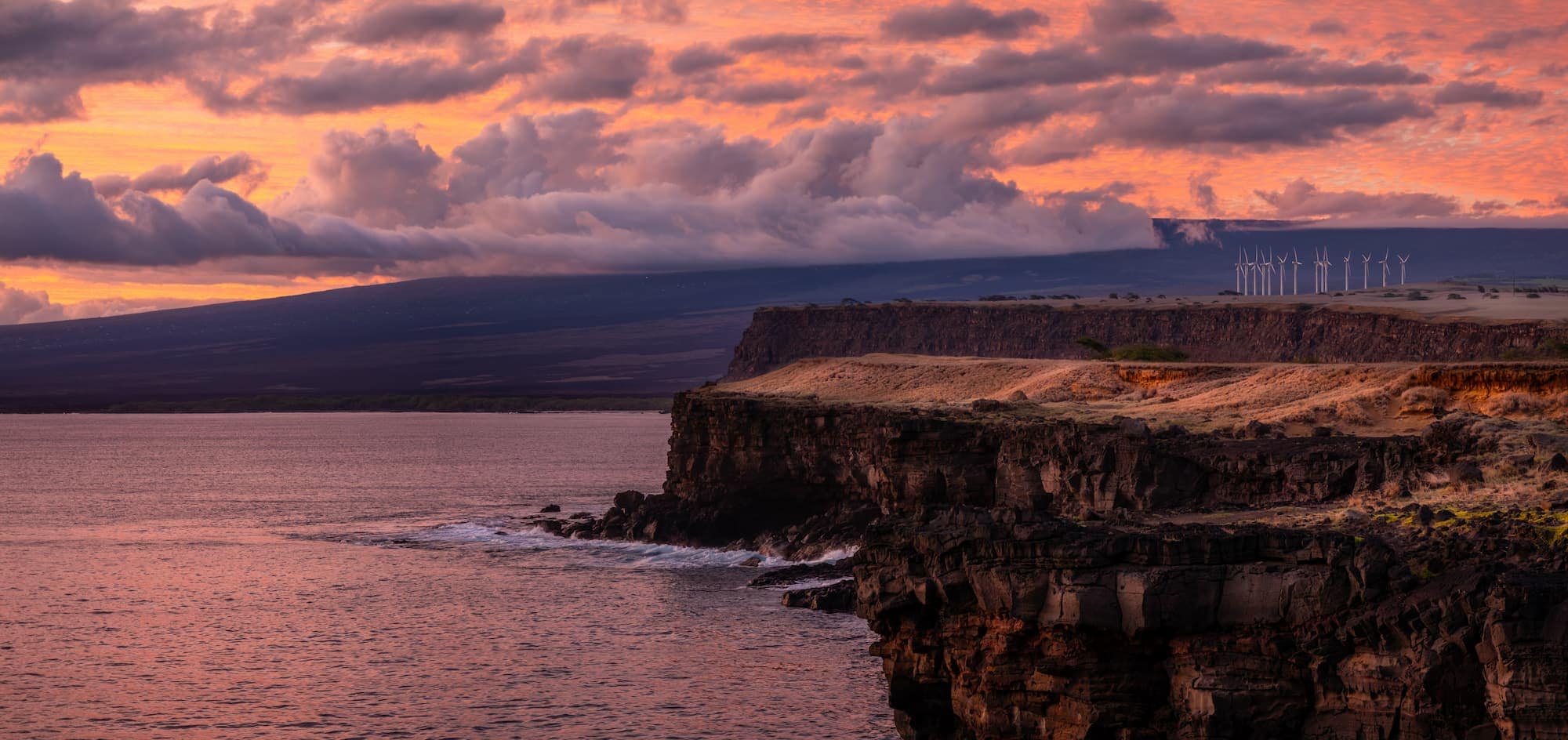
In the story, Halaʻea’s fishermen sank his canoe in these waters. Sunset at South Point. Photo by Aaron Huber on Unsplash.
How the people of Kaʻū killed three chiefs
Koihala, Kohaikalani and Halaʻea each ruled in Kaʻū, and each pushed his people too far.
Koihala and the stones in the food bundles
Coming home from Kona by canoe, Koihala sent word for his people to meet him at Kapuʻa with pig, dog, sweet potato, poi (pounded taro) and water. His canoes passed Kapuʻa without landing, and he called to the people on shore to go on to the next landing, and then the next. At each one they dug an imu (underground oven) to keep the food hot.
Finally he told them to climb a steep pali (cliff) and meet him at Kaʻaluʻalu. Footsore and hungry, they ate the food themselves and filled the food bundles with stones. When Koihala came for his meal, they said, “Here is your pig, here is your dog, here are your potatoes,” and stoned him to death.
Kohaikalani and the temple log
Kohaikalani’s priests told him to build a heiau (temple) on top of a steep hill to raise his mana (spiritual power). His people, children included, hauled the stones up the hill in a silent human chain. No one was left to farm or fish, and food ran short. Two kahuna (priests) warned the people that the chief would sacrifice them when the temple was done, and told them what to do.
Hauling the great ʻōhiʻa (a native tree) log for the temple’s image, the people stalled on the steepest part of the hill and said it would move only if the chief pushed from the lower end. He did. Near the top, they let go of the ropes, and the log slid back down the hill over him and killed him.
Halaʻea and the fish
Halaʻea claimed every aku (skipjack tuna) his fishermen caught off Ka Lae (South Point) and let the surplus rot while their families went without. One day the fleet made a huge catch, and Halaʻea paddled out to claim it. The fishermen surrounded his canoe and threw their fish in, load after load. “Enough!” he called. He had claimed all of it, they answered, so all of it was his.
They kept piling fish in until his canoe sank, and the current carried him off toward the horizon. He was never seen again.
Because of chiefs like these, the people of Kaʻū got a name for not putting up with a bad ruler: mākaha (fierce).
Where the Koihala and Halaʻea stories happened near South Point
Ka Lae is South Point, the island’s southern tip. Fishermen still fish there, where the current named for Halaʻea, coming from the east, meets the Kāwili current from the west. In Kaʻū, people say “Kō ke au iā Halaʻea” (the current carried Halaʻea away) of someone lost through his own foolishness.
Kaʻaluʻalu, where Koihala told his people to meet him, is a bay northeast of South Point. Puʻuokoihala, a small hill on the way from there to the town of Waiʻōhinu, is named for him. Our Kaʻū guide has South Point and the district’s black and green sand beaches, and our Big Island mythology hub has the island’s other legends.
About this telling
This retelling follows the version that gives the stories to three separate chiefs: Albert Francis Judd’s “Incidents in Hawaiian History” in the Pacific Commercial Advertiser of 11 December 1890, and the National Park Service’s telling from Hawaiʻi Volcanoes National Park. Halaʻea’s story and the saying also follow Mary Kawena Pukui, the Kaʻū-born scholar, who told them to Kepā Maly in 1977. Pukui’s Place Names of Hawaii is the source for the two currents at Ka Lae.
In Pukui’s own telling, retold by Clarice Taylor in the Honolulu Star-Bulletin in 1949, Koihala is the chief who builds the heiau and dies under the log; Judd and the park split those stories between two chiefs, and we do the same here. We didn’t read a Hawaiian-language original of any of these stories.
Read more
- The Despotic Chiefs of Kaʻū, at the National Park Service: a short English telling of all three chiefs on one page, from Hawaiʻi Volcanoes National Park.
- Judd’s “Incidents in Hawaiian History,” at the Library of Congress: the Pacific Commercial Advertiser page of 11 December 1890, with Judd’s telling of all three chiefs. Look for the column signed A. F. J.