
Ka-Miki (the quick, adept one) and his older brother Makaʻiole (rat eyes) traveled Kona beating every champion who would face them. At Hōnaunau they would not lie down for a sacred ceremony, and the chief’s officer came to seize them. They ran for the puʻuhonua (place of refuge), the one ground in the district where a pursuer could not follow.
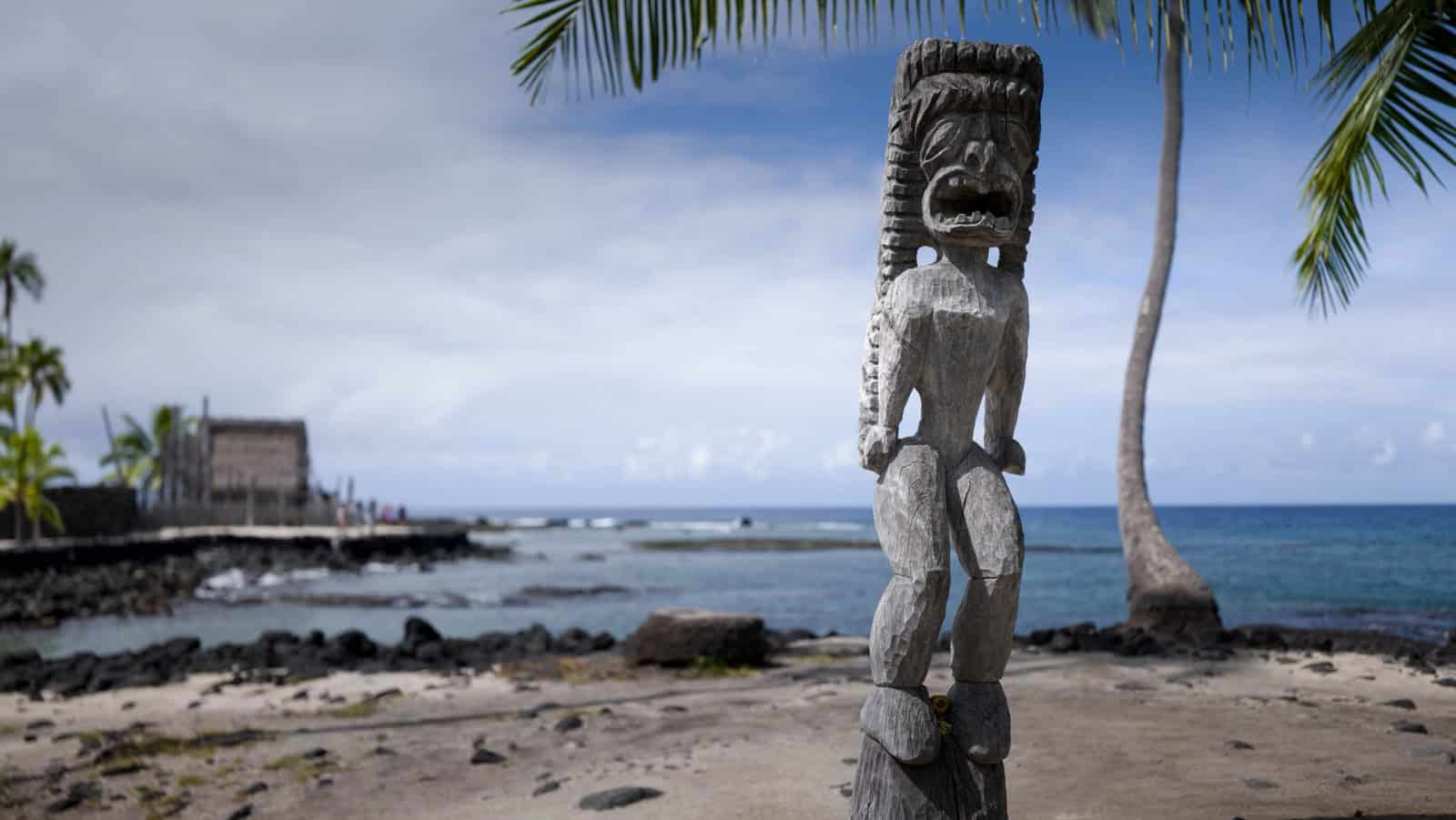
Carved kiʻi (wooden images) stand at Puʻuhonua o Hōnaunau, the south Kona place of refuge where someone who broke a kapu could be absolved and go home free. Credit: P. A. J. Schat
The legend of Ka-Miki and Makaʻiole
Ka-Miki and his older brother Makaʻiole were born with more than human strength and raised in the uplands by their ancestress, who taught them every art of fighting and contest. When they were grown they set out along the ala loa (the old trail that ringed the island), working south through Kona toward Hōnaunau, and they beat every champion who stood against them.
Champions of the Kona contest grounds
At the contest ground above Hōlualoa, a warrior named Pālauʻeka leapt at Ka-Miki and was thrown clear off the field before he landed a blow. It set the pattern for the whole journey. Someone would rush them, and the brothers, who already knew every hold and strike, would put him on the ground.
Not everyone fought fair. A priest named Keahiolo, jealous of the two, invited them to share ʻawa (the kava drink) with a war club hidden in the mat beside him. Ka-Miki saw it, struck first with a rolling stone, and told the priest his own god had left him for turning on a guest.
Farther down the coast at Keauhou, the brothers took a shark-tooth knife and a carved club as contest prizes, throwing one local champion out of the ring ten times over and another five. By the time they neared Hōnaunau, people along the shore knew them.
The flight into the place of refuge
At Hōnaunau they walked in on an ʻaha kapu (a sacred ceremony for the gods). The drums were sounding, and everyone within earshot had to lie face down, but the brothers kept walking. When the guards reprimanded them, Ka-Miki said he knew the kapu (sacred law) well, but seeing the guards themselves standing, he had taken the drums for the chief’s entertainment.
The excuse did not hold. The guards came at them with clubs, and the brothers put them down. When the chief heard of it, he sent his officer Uia to take the two prisoner. Uia and his men closed in, but Ka-Miki and Makaʻiole broke free and ran into the heiau (temple), throwing themselves down before the kahuna (priest) who kept it.
Uia demanded the two men. The priest refused: this was a puʻuhonua, kapu ground where a life was spared, and no one could be taken from it. Uia threatened to send his warriors in and kill them all. Did he want the wrath of the gods, the priest asked, for blood shed inside the sacred walls? Uia could not enter, and in the end he and his men left.
Then the priest chanted, calling out the guardian gods of Kona one after another to hold the ground the brothers stood on. Inside the walls they were beyond reach. Whatever a man had done, once he crossed into the refuge the chase was over, and the priest could absolve him and send him home free.
Puʻuhonua o Hōnaunau today
The place in the story is real. Puʻuhonua o Hōnaunau sits on the south Kona coast and is now a national historical park.
The Great Wall still stands between the royal grounds and the refuge, built of stacked lava rock without mortar. Behind it is Hale o Keawe, the reconstructed temple that once held the bones of chiefs. Their mana (spiritual power) made the ground inviolable. Carved kiʻi stand along the shore.
In old Hawaiʻi, breaking a kapu could cost you your life. The one way out was to reach a puʻuhonua like this one, sometimes by swimming across the bay under pursuit, where a kahuna could absolve you and let you go home.
You can walk the grounds today. Our Puʻuhonua o Hōnaunau park page has hours and directions for a visit, and our Big Island mythology guide has the other legends.
About this telling
This retelling follows “Kaʻao Hoʻoniua Puʻuwai no Ka-Miki” (The Heart-Stirring Story of Ka-Miki), a Hawaiian-language newspaper serial written by John Wise and J.W.H.I. Kihe. We read the Hōnaunau episode in Dorothy Barrère’s reconstruction of the story for the National Park Service, her 1957 cultural history of Hōnaunau, in which Mary Kawena Pukui translated the priest’s long chant. The Kona contest episodes come from Kepā Maly’s translation of the same serial. This is an early-1900s retelling by Hawaiian authors rather than an ancient pre-contact legend: Wise and Kihe wove older Hōnaunau place traditions into a single connected story.
Read more
- Puʻuhonua o Hōnaunau National Historical Park: the National Park Service’s own history of the site.
- Kaʻao Hoʻoniua Puʻuwai no Ka-Miki, in the original Hawaiian: Wise and Kihe’s newspaper serial in the IHLRT nūpepa archive, the story our retelling ultimately traces to. The Hōnaunau episode runs later in the same serial.