
Pele lives at Halemaʻumaʻu, the crater at the summit of Kīlauea, and she got there by being run out of somewhere else. The story of how she reached the Big Island is a family quarrel that ends with her digging a home into a volcano.
How Pele came to Kīlauea
Pele was born in Kahiki, a distant land, to Haumea and Moemoeʻaʻaliʻi. She had thirteen brothers and sisters, and the family was odd even by the standards of gods: one came from the crown of his mother’s head, one from her mouth, one from an eye, one from her chest. Pele was the only one of the fourteen born the way people are born.
As she grew up, she and her older sister Nāmakaokahaʻi could not live in the same place. The story never says why. Pele took her youngest sister Hiʻiaka and left Kahiki to look for somewhere else.
They came down the island chain, Kauaʻi first, then Oʻahu, then Molokaʻi, and kept going until they reached the youngest island at the end of it. She settled at Halemaʻumaʻu and has been there ever since.
Pele at Kīlauea today
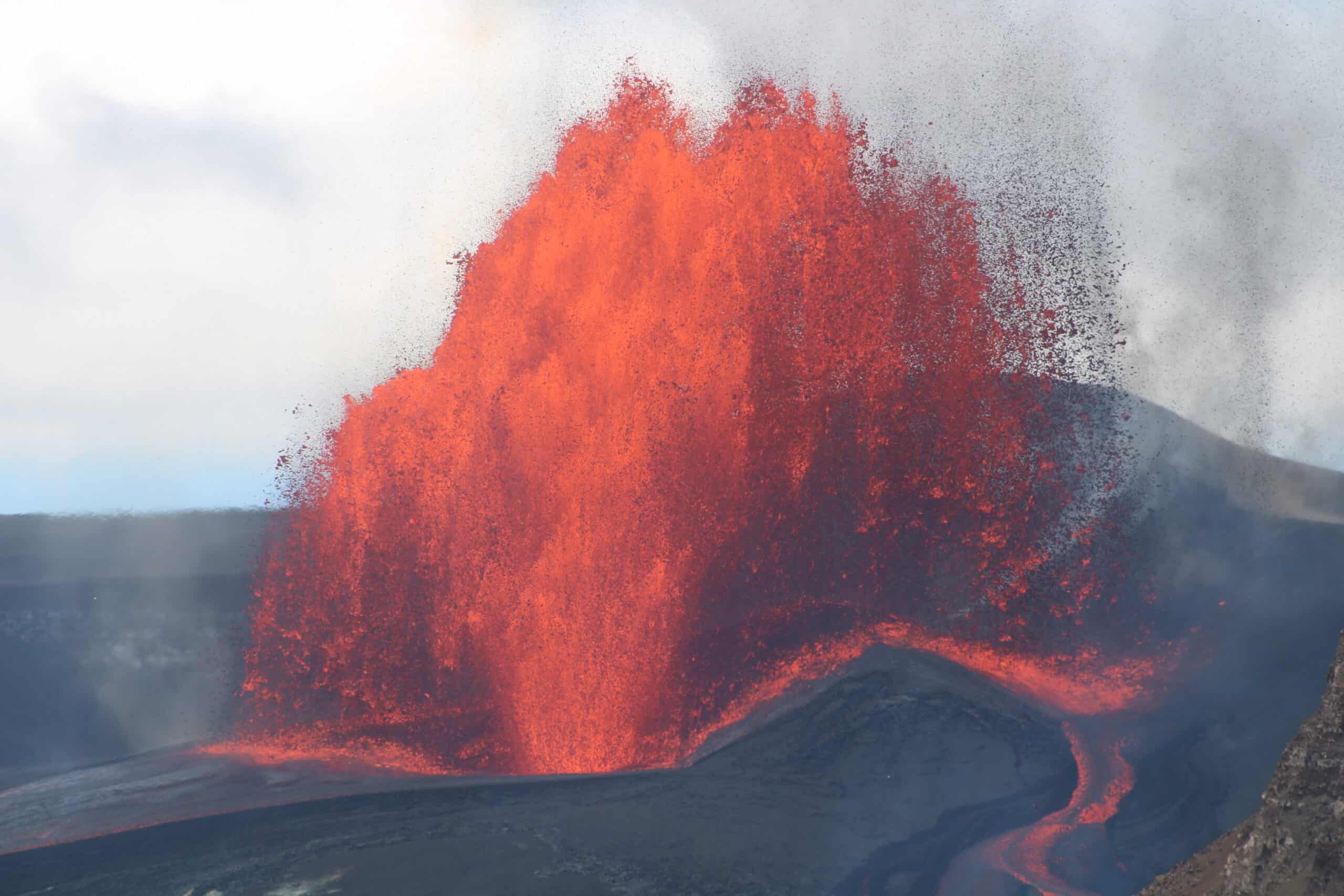
Pele’s home, mid-eruption. Halemaʻumaʻu has kept erupting into our own time. Image credit: USGS Hawaiian Volcano Observatory.
She is not a closed subject. For some families in Puna and Kaʻū she is still a family deity. Kīlauea itself is described as her walled city, with districts and gates, running from the crater all the way to the summit of Mauna Loa.
The crater has kept erupting into our own time, and that is part of why her stories stayed alive when others faded. If you are driving up, check nps.gov that morning for which overlooks are open.
Two more of her stories have their own pages: Pele and Kamapuaʻa, and the ʻōhiʻa lehua. Her quarrel with her sister is on Pele, Hiʻiaka and Lohiʻau.
About this telling
This page follows three Hawaiian-language books published by Hale Kuamoʻo at UH Hilo, which draw on Hawaiian newspaper serials from 1906 and 1915. The National Park Service tells parts of it differently.
Read more
- Pele, at the National Park Service. A short page in plain English, written by the park that sits on her crater. It covers her migration down the island chain, her other names, and the protocol of asking permission before you pass through her districts.
- Holo mai ʻo Pele mai Kahiki, on Ulukau. One of the three Hawaiian-language books this page follows, free to read. It sets down the migration story as it ran in the newspaper Ka Hōkū o Hawaiʻi in 1915.