
The pineapple is the fruit most associated with Hawaiʻi, yet it isn’t native to the islands. It originated in South America, near what is now Brazil and Paraguay, and became tied to Hawaiʻi through the industry James Dole started in 1903. By the 1960s peak, Hawaiʻi grew over 80% of the world’s canned pineapple.
If you’ve grown up seeing the pineapple as a symbol of Hawaiʻi, the Hawaiian name says otherwise: hala kahiki, foreign hala. A single plant takes more than two years to produce one fruit. Most canned pineapple now comes from Indonesia, Thailand, and the Philippines,.
In this guide you will:
Table of contents
- Find 14 cool pineapple facts,
- Learn about the history of the pineapple and how it came to Hawaii,
- See where to see pineapple growing in Hawaiʻi today, and
- Finally: does the pizza Hawaii come from Hawaii?
14 cool Pineapple facts
Not that you need any extra reason to like pineapples even more, but just in case: 14 interesting things that you may not have known about our favorite fruit:
- A pineapple is neither a pine nor an apple, but a fruit consisting of many berries that have grown together.
- This also means that Pineapples are not a single fruit, but a group of berries that have fused together. The technical term for this is a “multiple fruit” or a “collective fruit”. You can see a 1 minute time lapse of a pineapple growing from many berries into one pineapple in the video directly below this list.
- The scientific name of a pineapple is Ananas comosus. This word comes from the Tupi words “nanas” (which means pine) and “comosus” (which means tufted). Tupi is the language used by the Tupi people, who are indigenous people of Brazil.
- In Hawaiian, a pineapple is called “hala kahiki”. This is because the Hawaiians thought the pineapple resembled the “Hala” fruit. “Kahiki” means foreign, hence pineapples became “foreign Hala’s in Hawaiʻi.
- Pineapples were historically very useful on long boat trips. Eating pineapple prevented scurvy, and pineapple juice mixed with sand is a great cleaning agent for boats.
- Pineapples can “eat you back”! Pineapples contain an enzyme called “bromelain”. This enzyme breaks down proteins in your mouth. So when you eat a pineapple, it is eating you back. Once the bromelain enters your stomach the enzymes are broken down, so you don’t need to worry about being eaten inside-out [source]. Workers on pineapple fields often lose their fingerprints, which could be caused by this enzyme!
- Pollination of pineapples is required for seed formation, but the presence of seeds has a negative effect on the quality of the fruit. Possible pollinators for Pineapples are honey bees, pineapple bees, and Hummingbirds. In Hawaiʻi, the import of hummingbirds is prohibited for this reason.
- It can take more than two years for a pineapple plant to produce a single pineapple fruit.
- Pineapple plants can grow from seeds or through vegetative reproduction (cloning). Cloning is by far the most popular method to grow new pineapples. To clone a pineapple you can use four different parts of the plant: the crowns, slips, suckers, and shoots. The crown is the very top of the pineapple fruit. Slips are the leafy branches that are attached directly below the fruit. The suckers and shoots both originate from near the bottom of the stem.
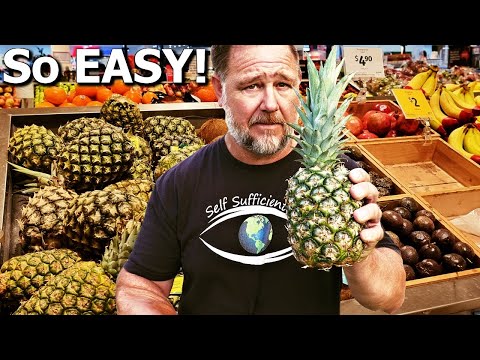
- Have a look at the video below this list, by Mark from Self sufficient Me, if you want to know how to grow a pineapple at home.
- Do you want to grow pineapples yourself? In Hawaiʻi, the best pineapples in terms of sugar content and sugar-acid balance grow at an elevation of ≈300 m.
- Pineapples can be tricked into flowering using smoke! This was first discovered on the Azores Islands using smoke. Later research showed the component in smoke responsible for the flowering to be ethylene. Now, forced flowering of pineapples is standard practice on Hawaiʻi because it allows the fruits to be produced throughout the year.
- Pineapple production on Hawaiʻi has severely decreased in the past few decades. Harvest volume now is only a few % of the peak rate it once was :(
- The last pineapple cannery in Hawaiʻi, the Maui Land and Pineapple plant in Kahului, closed in 2007, and growers now ship only fresh pineapple from the islands. That became possible because newer, sweeter cultivars travel better than the old ones (the so-called ‘MD-2’ pineapple).
History of the Pineapple in Hawaiʻi
Pineapples come originally from South America, most probably from the region between South Brazil and Paraguay. From here, pineapples quickly spread around the continent up to Mexico and the West Indies, where Columbus found them when visiting Guadeloupe in 1493 [1]. Columbus then brought the pineapple back to Europe, from which it later made its trip to Hawaiʻi.
Pineapples proved to be an exceptionally good fruit to bring on long sailing voyages because they help to prevent, just like oranges, the often lethal disease scurvy [2]. Pineapple mixed with sand also cleaned for the large wooden ships used to cross the oceans.
When exactly the first pineapples arrived in Hawaiʻi is not certain. It is probable that they arrived together with the earliest European visitors to the Hawaiian Islands. The first documented claim of these early visits was by the Spaniards in the 16th century (source [3] or [4]). That is two centuries before Captain Cook (1778). Since pineapples were such a popular fruit to take on long transatlantic voyages, any ship arriving in Hawaiʻi may have brought some of these fruits along with them.
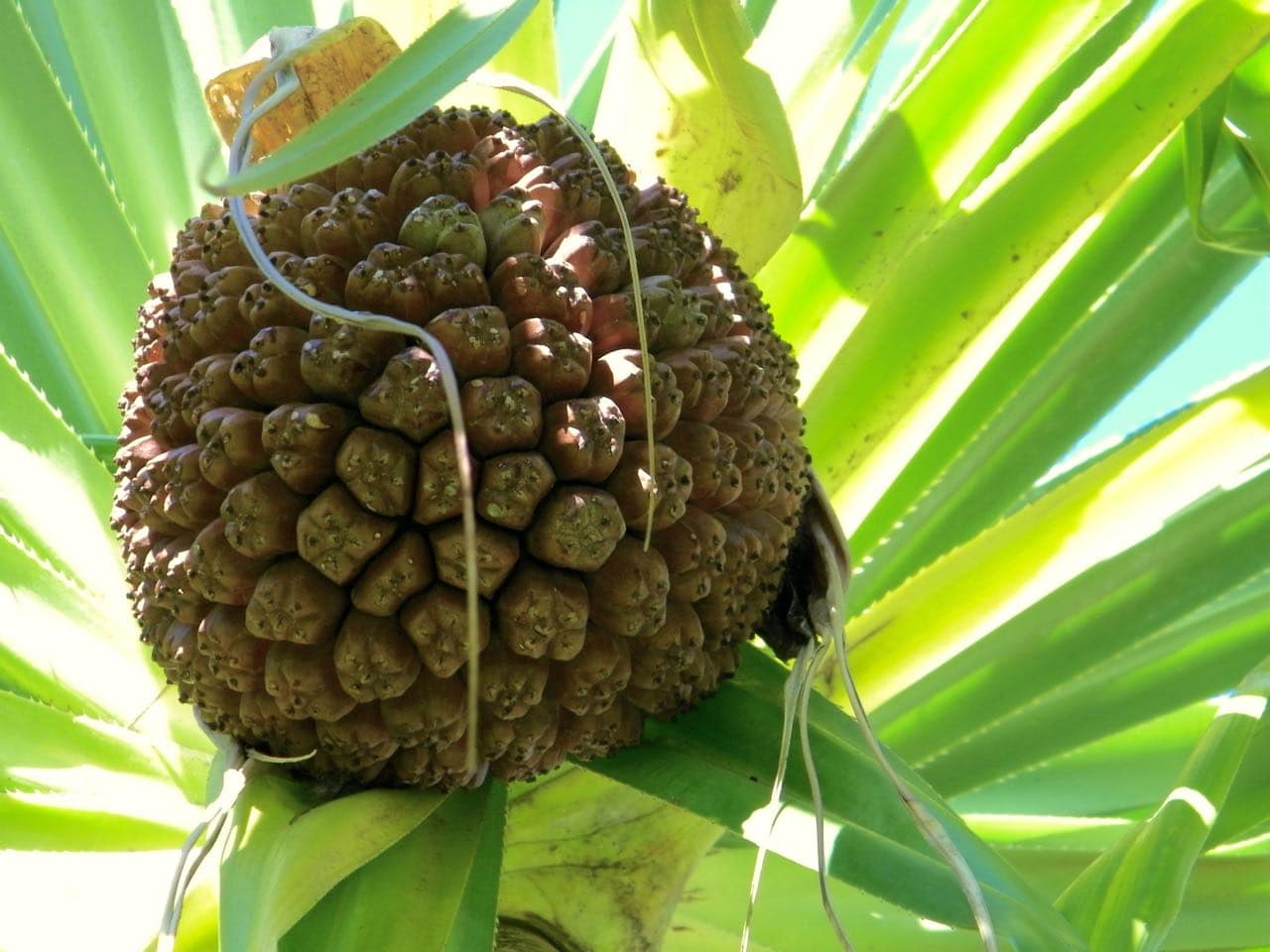
The resemblance of the Hala fruit to pineapples is the reason why pineapples are called “Hala Kahiki” in Hawaiian. Source: Hala fruit by Frikitiki and is licensed under CC BY 2.0
After their first arrival it took them a while to become the great success they are now. Two technologies made the pineapple a success in Hawaiʻi: ocean steamers, which made shipping perishable fruit viable, and canning, which let growers harvest the fruit ripe and preserve it for customers worldwide. Canning made it easy to harvest the pineapples ripe and to preserve their (great!) taste for customers all over the world. The first steps into the commercialization of pineapples were taken in the 1880s, but things really picked up after James Drummond Dole (do you recognize that name?) started his pineapple business in 1903.
By the early 1960s, Hawaiʻi supplied over 80% of the world’s output of canned pineapple. As growing pineapples got cheaper in other countries, the Hawaiian canneries closed one by one: Del Monte’s in 1985, and Dole’s cannery in Iwilei, on Oʻahu, in 1991. The last one running was the Maui Land and Pineapple cannery in Kahului, which stopped canning in 2007. Today about 75% of the world’s pineapples come from Indonesia, Thailand, and the Philippines.
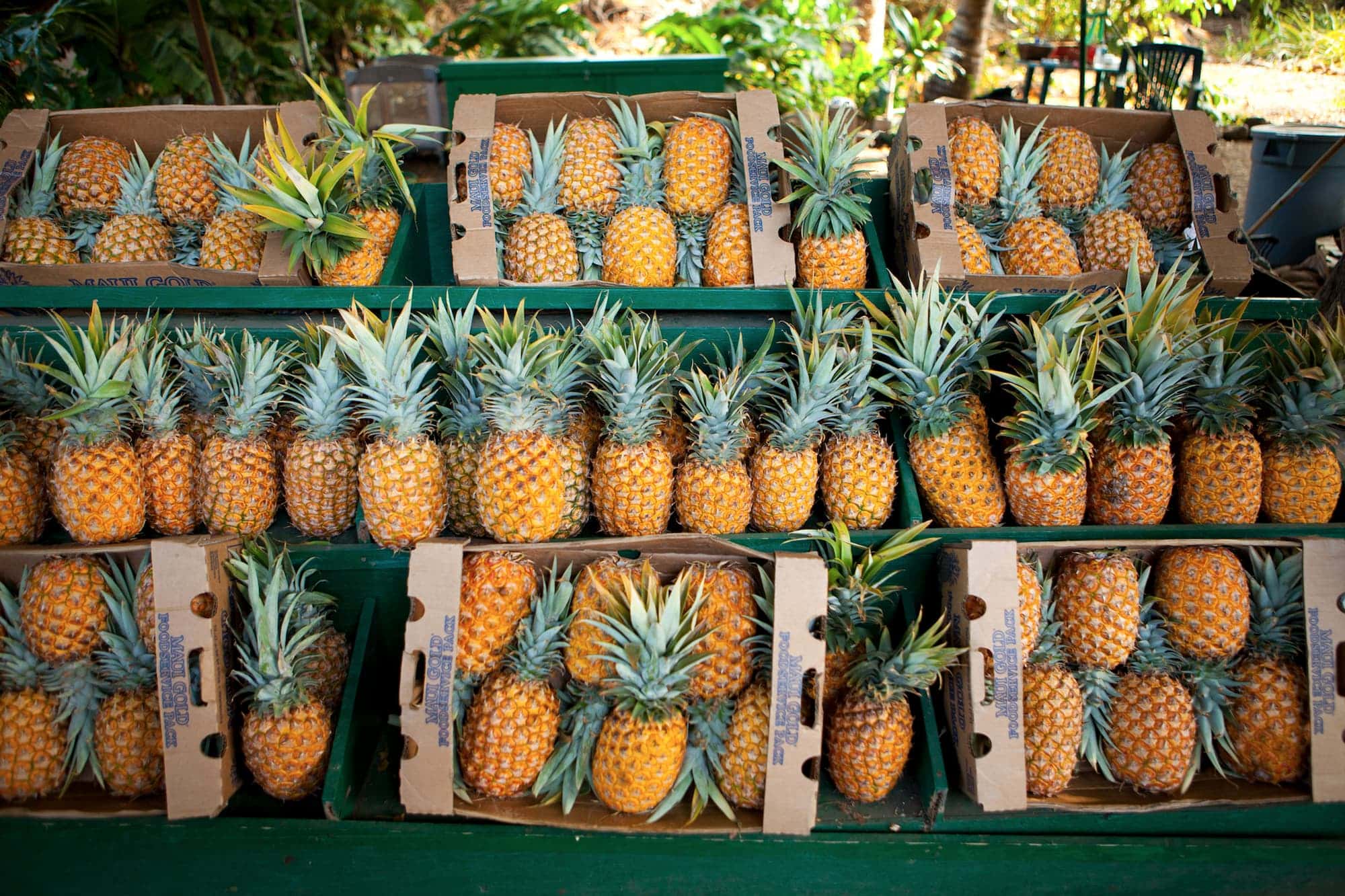
Pineapples for sale at a roadside stand on Maui. Credit: Hawaii Tourism Authority (HTA) / Dana Edmunds
Where to see pineapple growing in Hawaiʻi today
Two places show pineapple growing: the Maui Pineapple Tour on Maui and Dole Plantation on Oʻahu. Both sit off the Big Island, which has no comparable pineapple attraction of its own. The Maui tour is the hands-on field tour, run on a working Maui Gold farm in the upcountry town of Hāliʻimaile. It lasts about 1.5 hours and costs around $95 per adult, about $75 for children 3 to 12, with several departures a day.
Dole Plantation is the other option, in Wahiawā on Oʻahu, about 30 minutes from Waikīkī. This is a roadside attraction and gardens, not a working-farm field tour. Entry to the grounds and gift shop is free, and it opens daily from 9:30 a.m. to 5:30 p.m. The Pineapple Express train ride, the Pineapple Garden Maze (one of the largest hedge mazes in the world), and the Plantation Garden Tour are each ticketed separately. It sells Dole Whip soft-serve.
If you want to bring fruit home, fresh Hawaiʻi pineapple clears the airport agricultural inspection for a mainland flight. The Maui tour hands every guest a whole pineapple, already packed and cleared to carry on.
Does Pizza Hawaiʻi come from Hawaiʻi?
“Does the pizza Hawaiʻi come from Hawaiʻi?”
They will almost certainly deny any connection, but are they right?
The Pizza Hawaiʻi is a pizza with cheese, tomatoes, ham, and pineapple. It is the most popular pizza in Australia (about 15% of all pizzas sold there [5]) but has very little to do with the Hawaiian islands.
Or does it?
We think the pizza Hawaiʻi may have Hawaiian origins after all.
The Hawaiian pizza’s closest ancestor is the “Toast Hawaiʻi”, an open-faced sandwich made with a slice of toast covered by a slice of ham and cheese below a slice of pineapple with a cherry in the middle which is then grilled. This sandwich is attributed to the German TV-cook Clemens Wildenrod who published it in 1955 [6]. “Hawaiʻi” in the name for this toast obviously comes from the use of pineapple, which was then already associated with Hawaiʻi. However, the connection between the pizza Hawaiʻi and the Islands of Hawaiʻi might be closer!
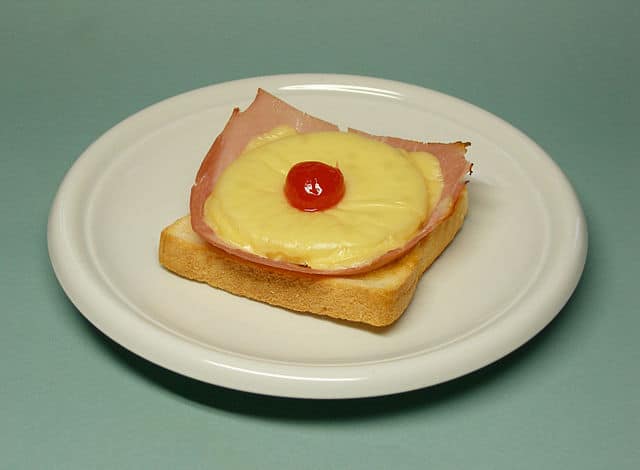
An uninspiring piece of toast Hawaiʻi. Image credit: Wikipedia (Rainer Zenz)
There do exist recipes of grilled spam-sandwiches including pineapple and cheese that date back to the 1930s. One example is the recipe from the Hormel cookbook from 1939: Put spam slices on buttered toast, cover with pineapple and grated cheese and put under the grill until the cheese melts. Doesn’t that sound familiar?
Spam was a main ingredient in the US army diet and as such came to Hawaiʻi. Spam still is very popular in Hawaiʻi, and recipes with spam and pineapple likely spread around the world with the US army canteens.
The question is then if Clemens Wildenrod was ever exposed to this spam recipe. We think that it is very probable that is the case. Clemens was living close to Wiesbaden after the 2nd world war, and Wiesbaden was the city where one of the largest concentration of US troops was stationed. Of course, we cannot be sure but the next time that someone mentions a pizza Hawaiʻi this might be a nice story to recount, especially if that other person is from Hawaiʻi!
Sources:
- [1] Bartholomew, D, Paull, R, and Rohrbach, K. 2003. The pineapple botany, production, and uses. CAB International, New York, New York, USA. [ebook]
- [2] Wikipedia article on scurvy.
- [3] Hawaiʻi archives: Spaniards on Hawaiʻi./spaniard47nnw.txt
- [4] “Fruit of the Islands”. Pittsburg Magazine 39 (3): 92. 2008
- [5] PQM goes to Australia
- [6] Entdeckt: Spamwich – das Vorbild für Toast Hawaiʻi?