
Within an afternoon’s drive of Kailua-Kona there is white sand at Hāpuna, black lava rock at Kekaha Kai, a shallow reef at Kahaluʻu. There are no boardwalks or beach clubs here, the way there are on Oʻahu and Maui.
Table of contents
This list runs from the easiest beach to reach to the hardest. At the easy end, Kamakahonu is a short walk from a downtown Kailua-Kona parking garage. At the hard end, reaching Kīholo Bay means a walk in past a chain of anchialine pools before you see open water. The calmest shallow water for young kids is at Kamakahonu; the reef snorkeling is at Kahaluʻu. A few require a hike in, a camping permit, or a stop at a resort gate.
Q: What are the best Kona beaches for families?
Hāpuna Beach has the fullest set of facilities on this list: restrooms, showers, picnic tables, a snorkel rental stand, and food stalls. King Kam beach has calm water for young swimmers and first-time snorkelers, and the shops and restaurants of downtown are a short walk away.
Q: What is the best Kona beach for snorkeling?
Kahaluʻu Bay is one of our favorite snorkeling spots on the entire island for its ease of access and shallow waters.
Q: What is the best Kona beach for beach bums?
Magic Sands and Kukiʻo Beach are the two easiest places on this list to just sit in the sun.
Q: What is the best Kona beach for sunsets?
The beach at the Old Kona Airport has a paved shoreline path and one of the better sunset views in Kona.
Q: What is the best Kona beach for camping?
Camping is possible at both Hoʻokena and Kīholo Bay.
Q: What is the best Kona beach for hikers?
Kīholo Bay has a 3-mile round-trip trail in from the Kīholo Trailhead, and a coastal trail links the three Kekaha Kai State Park beaches.
Q: What is the best Kona beach for swimming?
Hāpuna Beach, Aiʻopio at Kaloko-Honokōhau, and the lagoons at Kīholo Bay have calm water for swimming.
Hāpuna Beach
Hāpuna is the largest white sand beach on the island, with calm water and a gradual slope that make it one of the easiest places on this list to just walk in and swim.
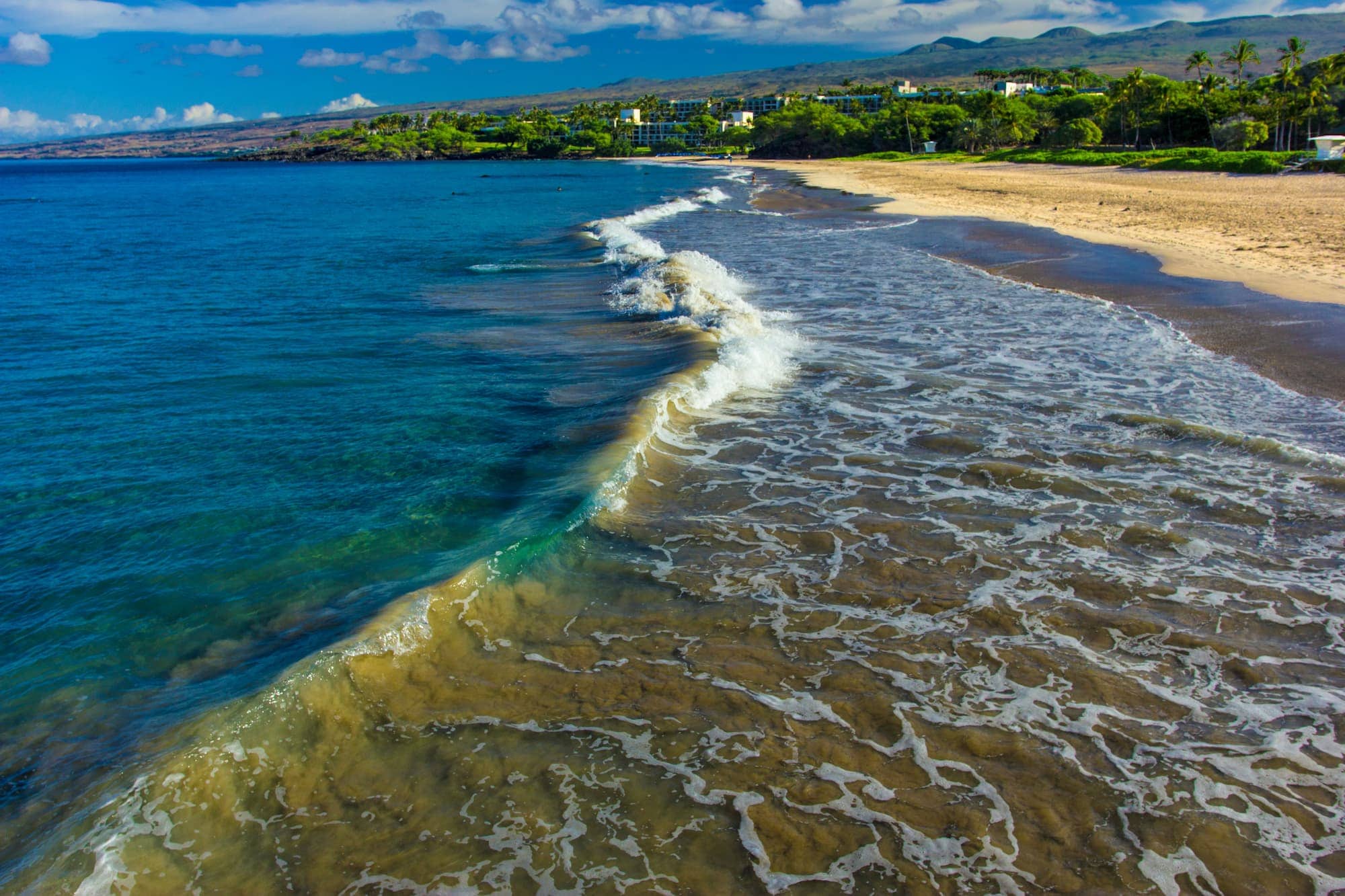
The largest of the island’s white sand beaches, Hāpuna is a half mile of fine white sand with a gradual slope into calm water. Photo by Paul Blessington on Unsplash.
Good to know:
Snorkeling is good near the rocks that bookend each end of the beach.
Hāpuna Beach is well suited for:
Families, thanks to a full slate of conveniences: restrooms, showers, picnic tables, a snorkel rental stand, and food stalls.
Avoid Hāpuna Beach if..
You want an empty beach.
Kahaluʻu Beach
Kahaluʻu is one of the few beaches near Kona where you can snorkel a healthy reef without a boat, five miles south of town and easy to reach, with a beginner-friendly surf break alongside it.
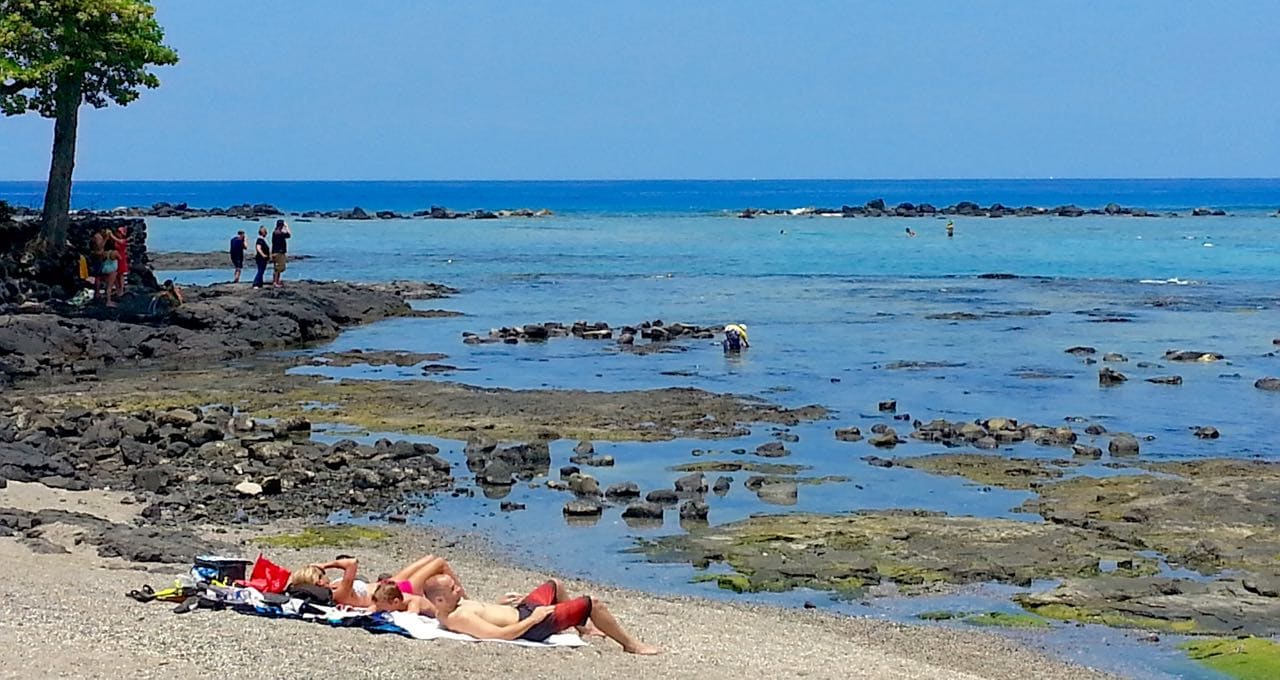
Kahaluʻu Beach Park is one of the best snorkeling spots on the Big Island. By trickofthelight – original, CC BY 2.0.
Good to know:
If you go to Kahaluʻu, plan to spend most of your time in the water. There’s a shaded patch under a stand of palms, but the shore itself is rocky, with a steady stream of swimmers getting in and out. It’s a busy beach, with not a lot of room to spread out a towel.
Kahaluʻu Beach is well suited for:
Snorkelers and surfers. Kahaluʻu Beach is one of our favorite snorkeling spots on the Big Island for its ease of access and shallow waters. On its outer reef, surf schools teach beginners how to ride waves. There are tide pools along the shore, and the beach has lifeguards. You can rent a snorkel set or surf board from the Surf & Sea across the street. Book surf classes ahead of time.
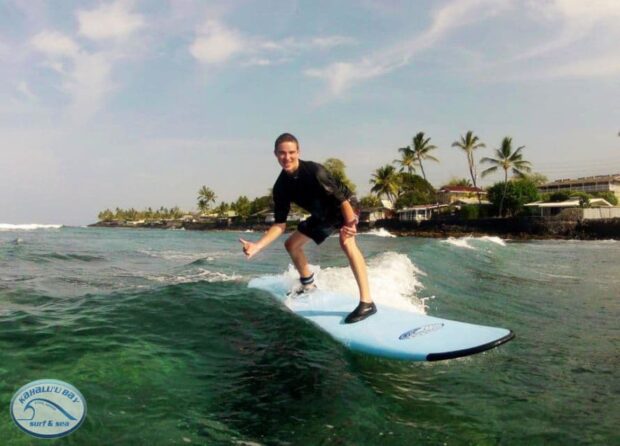
Surf Lessons in Kona at Kahaluʻu Bay
Two-hour surf lessons at Kahaluʻu Bay, one of the more forgiving breaks on the Kona coast. CPR-certified instructors work in the water alongside you, timing waves and helping you catch them
from:
$139
What is a suggested tour?Our suggested tours are hand-picked tours that receive consistent good reviews, give back to the community, and work hard to minimize their impact on the environment. Read more about these tours on our website.Avoid Kahaluʻu Beach if..
You’re looking to read a book in peace and quiet.
White Sands (Magic Sands / Laʻaloa Beach)
About 4 miles south of Kailua-Kona, White Sands Beach (officially Laʻaloa Beach) is a small strip of sand with a steady, often dangerous shore break.
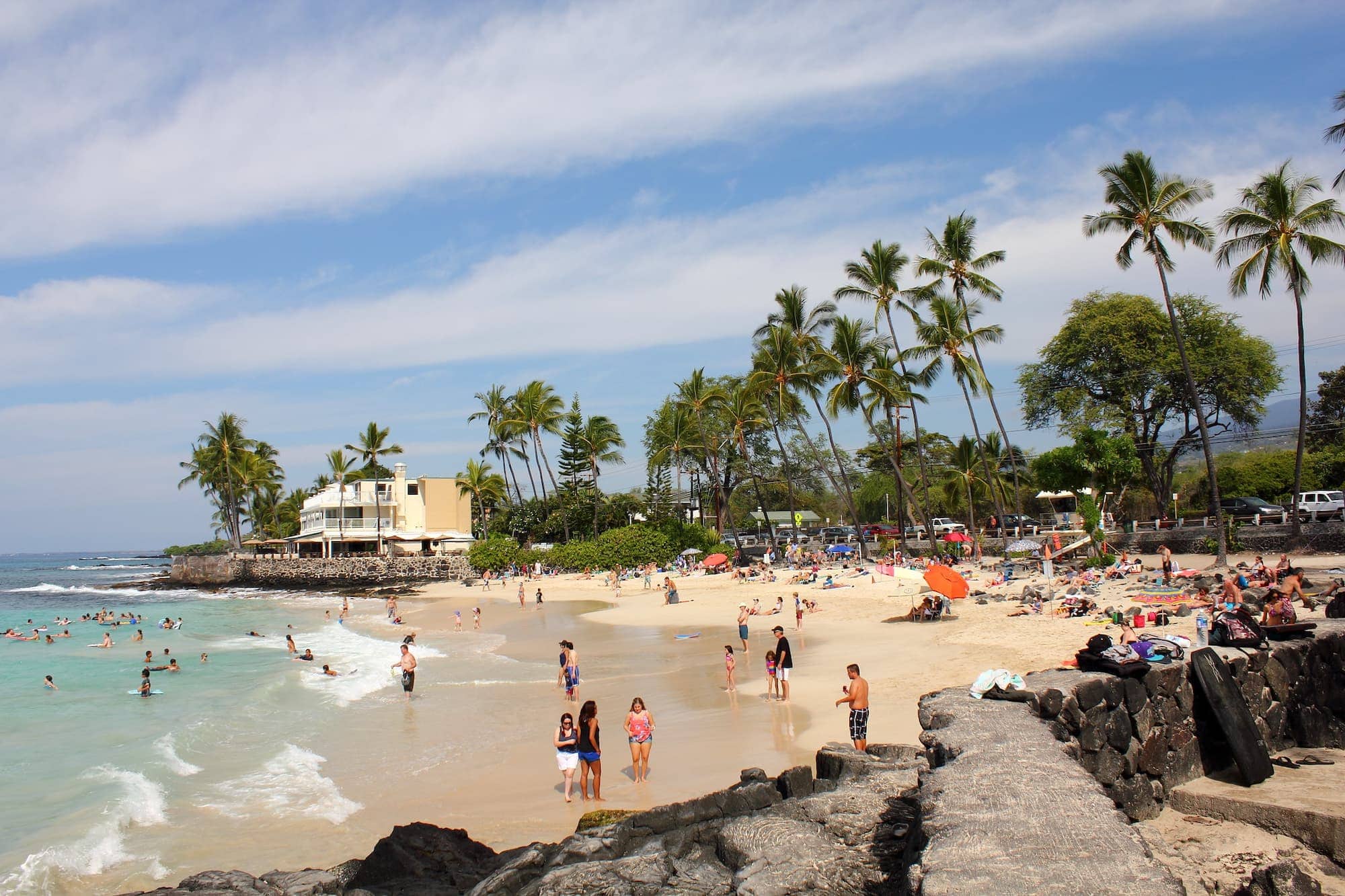
About 4 miles south of central Kailua-Kona, this small beach (also called White Sands and, officially, Laʻaloa Beach) has blue-green water, good sunsets, and an often dangerous shore break. Image credit: Steve Shupe, source.
Good to know:
White Sands Beach is also known as Magic Sands Beach because rough ocean conditions often make it disappear. The shore break is steady here, but swimming is possible most days and there are lifeguards on duty.
White Sands is well suited for:
Sunbathers and bodyboarders. Though compact, White Sands is a good spot for sunbathing and a quick dip, and local bodyboarders ride the shore break.
Avoid White Sands if..
You have young children who want to play in the water. The shore break could knock them over and cause injury.
Kamakahonu Beach (King Kam Beach)
Also called King Kam Beach for the King Kamehameha hotel (now the Courtyard by Marriott King Kamehameha’s Kona Beach Hotel) that fronts it, this white-sand beach sits in the center of downtown Kona on the north side of Kailua Bay, with good snorkeling just offshore.
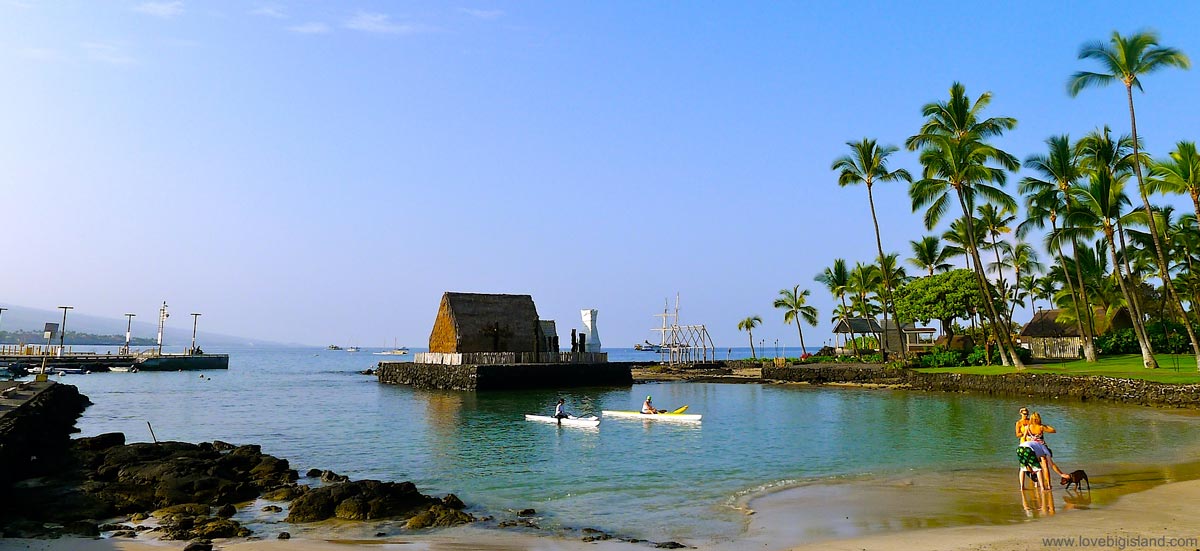
King Kam beach is a small beach fronting Kailua Bay most suited for snorkeling and sunbathing in the center of downtown Kailua-Kona.
Good to know:
King Kam Beach is one of the only “urban” beaches on the Big Island, sitting in downtown Kailua-Kona right next to the main harbor. From the beach, you can look across the bay and see the rows of stores and restaurants downtown, as well as several historic sites nearby, including a reconstructed temple right on site and the Huliheʻe Palace across the bay.
King Kam Beach is well suited for:
Calm water makes this a good pick for young swimmers or first-time snorkelers, and it’s an easy walk to the shops and restaurants of downtown. It’s a convenient stop before or after a boat tour leaving from Kailua Harbor, and steps from the door if you’re staying at the King Kam hotel.
Avoid King Kam Beach if..
You’re looking for a big, long, natural beach outside of town.
Kaloko-Honokōhau National Historical Park
Kaloko-Honokōhau National Historical Park has two beaches: Honokōhau and Aiʻopio. Both are part of a more than 1,000-acre historical complex, with ancient archaeological sites and cultural artifacts, including fishponds, along the shore.
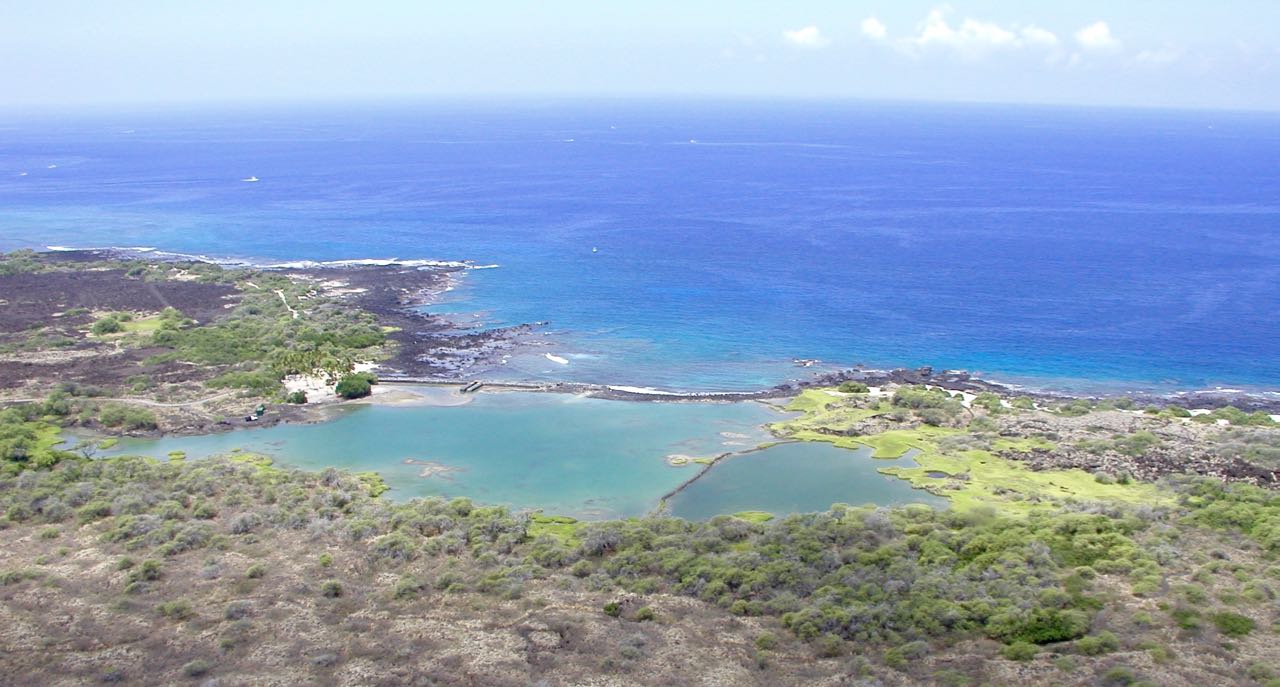
Aerial view of the Kaloko Fishpond in the Kaloko-Honokōhau National Historical Park from the east. Image credit: NPS
Good to know:
To reach the beaches via the main entrance to the park, you hike some of the island’s most historic trails, including Ala Kahakai National Historic Trail. Depending on your route, the hike in can run several miles across lava flows, tide pools, and anchialine pools.
There’s a shortcut if you’d rather skip the multi-mile hike. Follow directions to here and look for a trail at the end of the road. From there, it’s just a short walk to Aiʻopio Beach.
Kaloko-Honokōhau Beach is well suited for:
Swimmers, beach bums, and explorers. Conditions are usually gentle at Aiʻopio, good for swimming and reliable for spotting sea turtles. Check out the preserved ancient Hawaiian temple (known as a heiau), then walk the shoreline north toward Honokōhau, which overlooks the Aimakapa fishpond and has room to spread out.
Avoid Kaloko-Honokōhau Beach if..
You prefer to drive right up to your beach. Accessing these beaches requires a short hike over sandy ground.
Old Kona Airport Beach
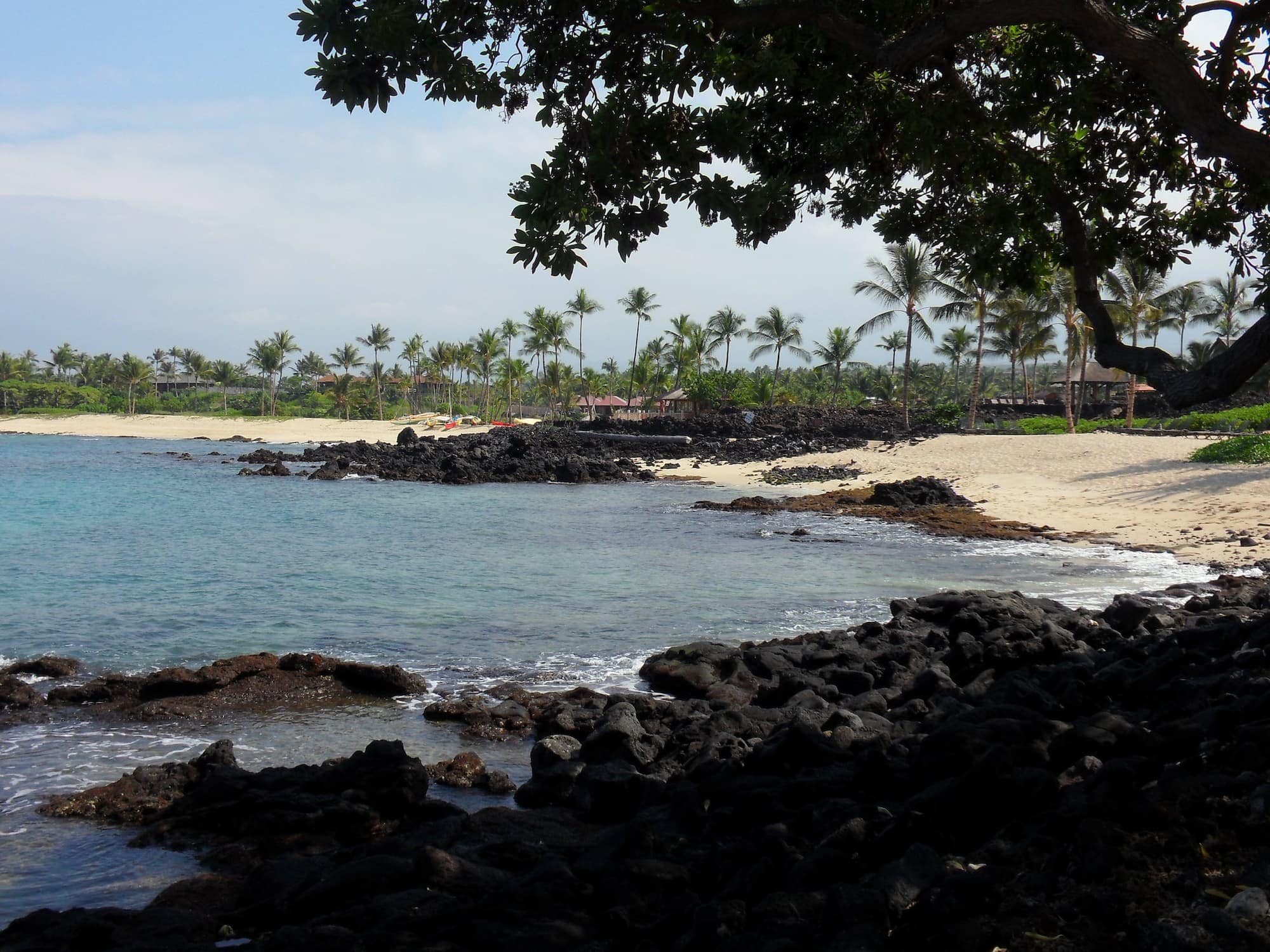
When the original Kona airport closed down back in 1970, part of what remained was turned into a public park. Today, the old runway is the parking lot for this beach complex, which includes a paved walking path, skate park, and pavilion.
Good to know:
The ocean can often be rough here and there are a lot of submerged rocks, so safe and relaxed swimming is not always possible.
Old Kona Airport Beach is well suited for:
Walkers and sunset watchers. Old Kona is best for a beach walk, with lava rock formations to explore, and it’s one of the better sunset spots in Kona. Bring your own food for a picnic at sundown.
Avoid Old Kona Airport Beach if..
Your primary goal is to swim.
Kukiʻo Beach
Kukiʻo Beach is a long stretch of soft white sand backed by rocky coastline views, and a regular spot for green sea turtles.
Enter Kukiʻo from the Four Seasons Hualālai drive, where the gate keeper will give you a no-charge pass if there is room. Image credit: Mark, source.
Good to know:
Kukiʻo Beach sits in front of the Four Seasons Hualalai, about 18 miles north of Kailua-Kona, and reaching it means driving through the hotel gates. All beaches in Hawaiʻi are public, so tell the security guard you’re headed to Kukiʻo and they’ll point you to the public access way.
Shade is limited, so bring your own if needed.
Kukiʻo Beach is well suited for:
Everyone but swimmers. Walk or sunbathe on Kukiʻo’s soft white sand; calm mornings are good for kayaking or stand-up paddling.
Avoid Kukiʻo Beach if..
You want to swim. There are lots of submerged lava rocks that make it difficult and/or dangerous to swim.
Hoʻokena Beach Park
Hoʻokena is one of the last active Hawaiian fishing villages in the islands, with canoes still lined up on the sand and the remains of an old steamship pier still visible offshore.
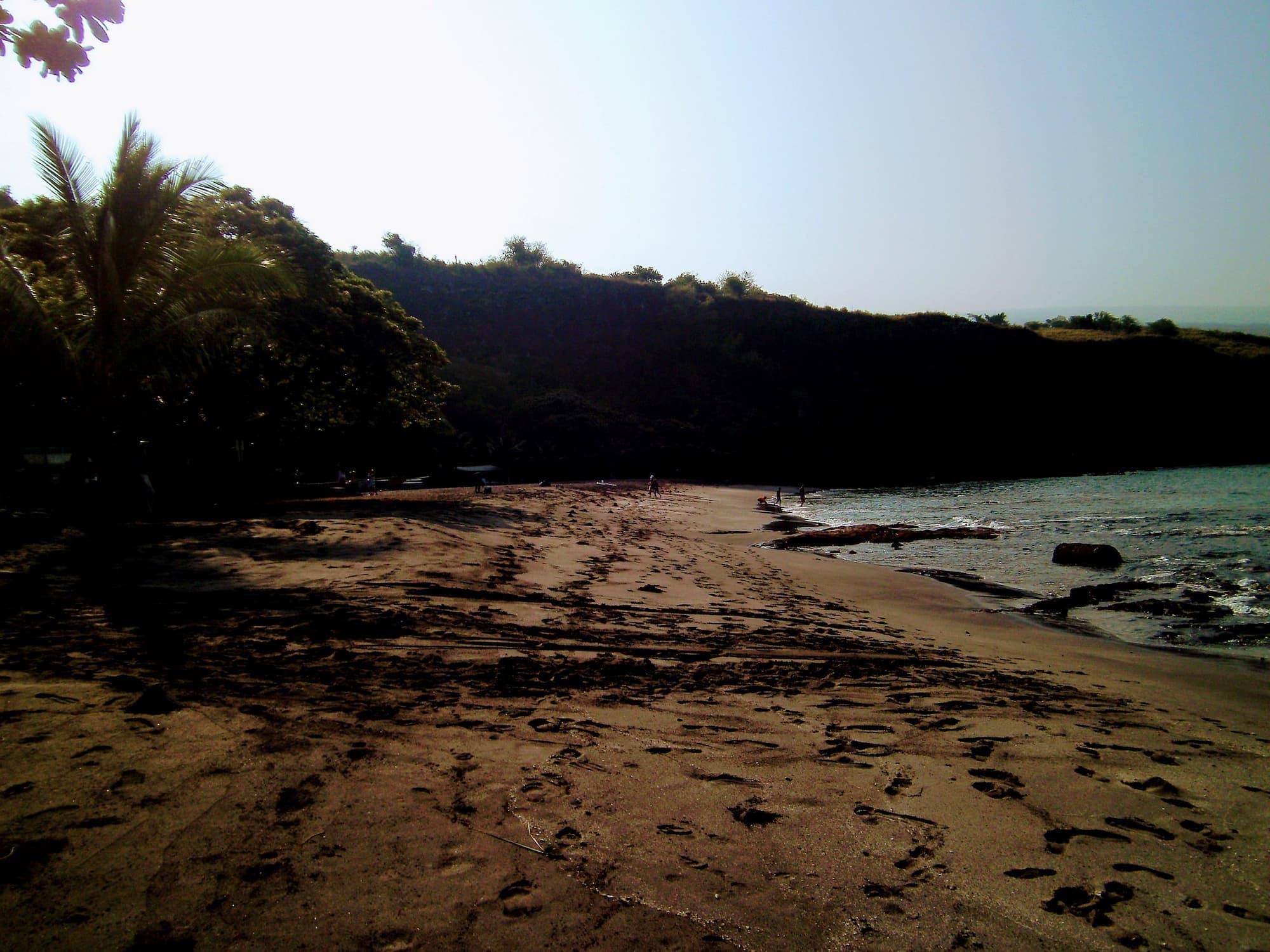
Hoʻokena Beach is edged by coral reef with a canoe fishing heritage, plus a campsite and kayak & snorkel rentals. Image credit: Amanderson2, source.
Good to know:
The sand is a mix of coral and gray grains, coarse-looking but soft underfoot. At the base of a volcanic hill and ringed by trees, it has some of the best coastal views on this stretch. Swimming, kayaking, and snorkeling are all possible when the water’s calm; in rougher conditions, watch the local bodyboarders in the shore break instead.
Hoʻokena Beach is well suited for:
Curious travelers and campers. Hoʻokena has been a fishing village far longer than it has been a beach park; hookena.org has the village’s history.
Camping is permitted at Hoʻokena with a reservation (about $21 per person per night for non-residents, $1 to $6 for Hawaiʻi residents), .
Avoid Hoʻokena Beach if..
You’re looking for a long, classic, white sandy beach for sunbathing.
Kekaha Kai State Park
Kekaha Kai State Park has three beaches: Mahaiʻula Beach, Makalawena Beach, and Maniniʻowali Beach (Kua Bay). All three are white sand edged with lava rock.
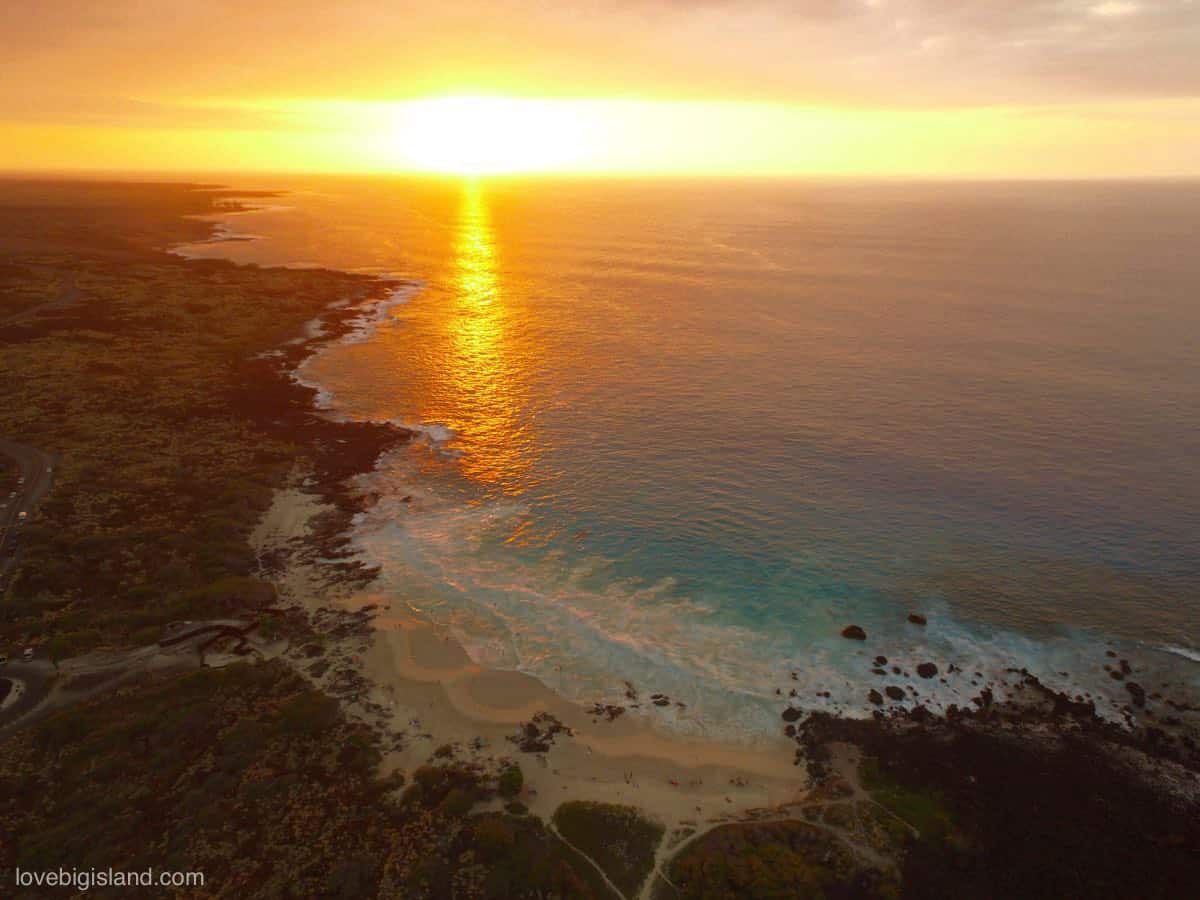
Maniniʻowali Beach is one of our favorite places on the Big Island to visit to see the sun set.
Good to know:
All three sit well off the main road in undeveloped country. Kua Bay has a paved road right to it, Mahaiʻula has an unpaved, bumpy lava rock road, and Makalawena is foot access only, the least visited of the three.
Kekaha Kai State Park beaches are well suited for:
Swimming is possible at all three beaches, though sticking to the lifeguarded areas is the safer bet, and the water is a clear green-blue at all three. A coastal trail links the three beaches, and the sand runs in long open stretches.
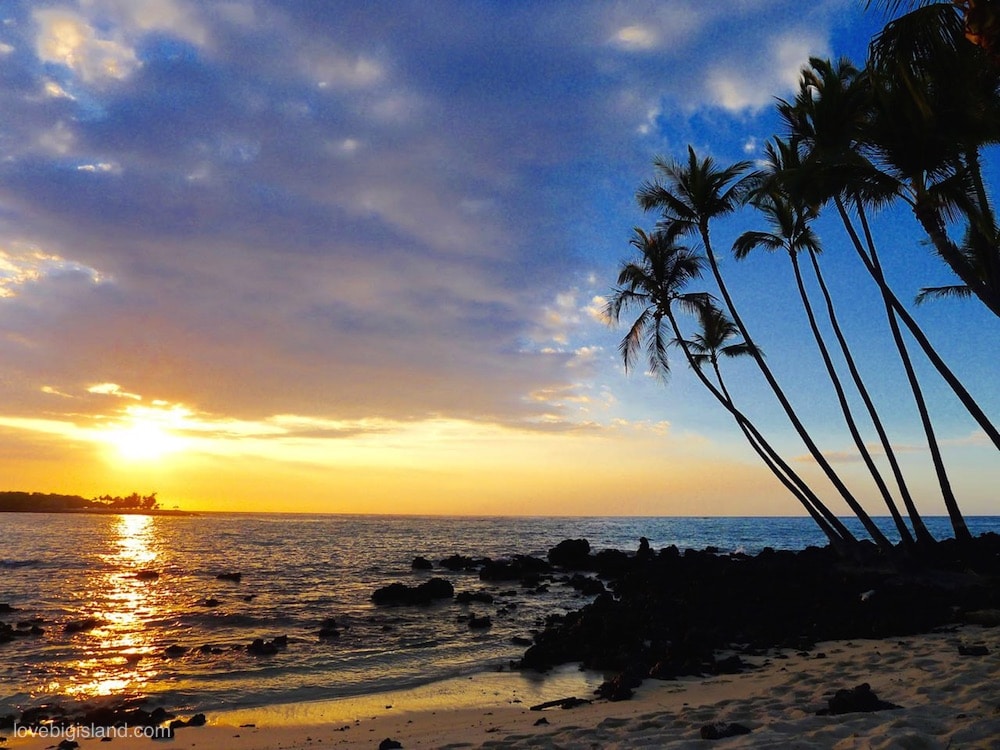
Mahaiʻula Beach is the southernmost of the three beaches making up Kekaha Kai State Park.
Avoid Kekaha Kai State Park if..
You don’t want a bumpy unpaved road (Mahaiʻula) or a walk in (Makalawena). Kua Bay is the one with a paved road.
Kīholo Bay
Kīholo Bay is visible from the scenic lookout at mile marker 82 along the highway, its water tinted bright blue-green where fresh water mixes with salt. Black sand beaches here are lined with tide pools, and several lagoons are calm enough for swimming.
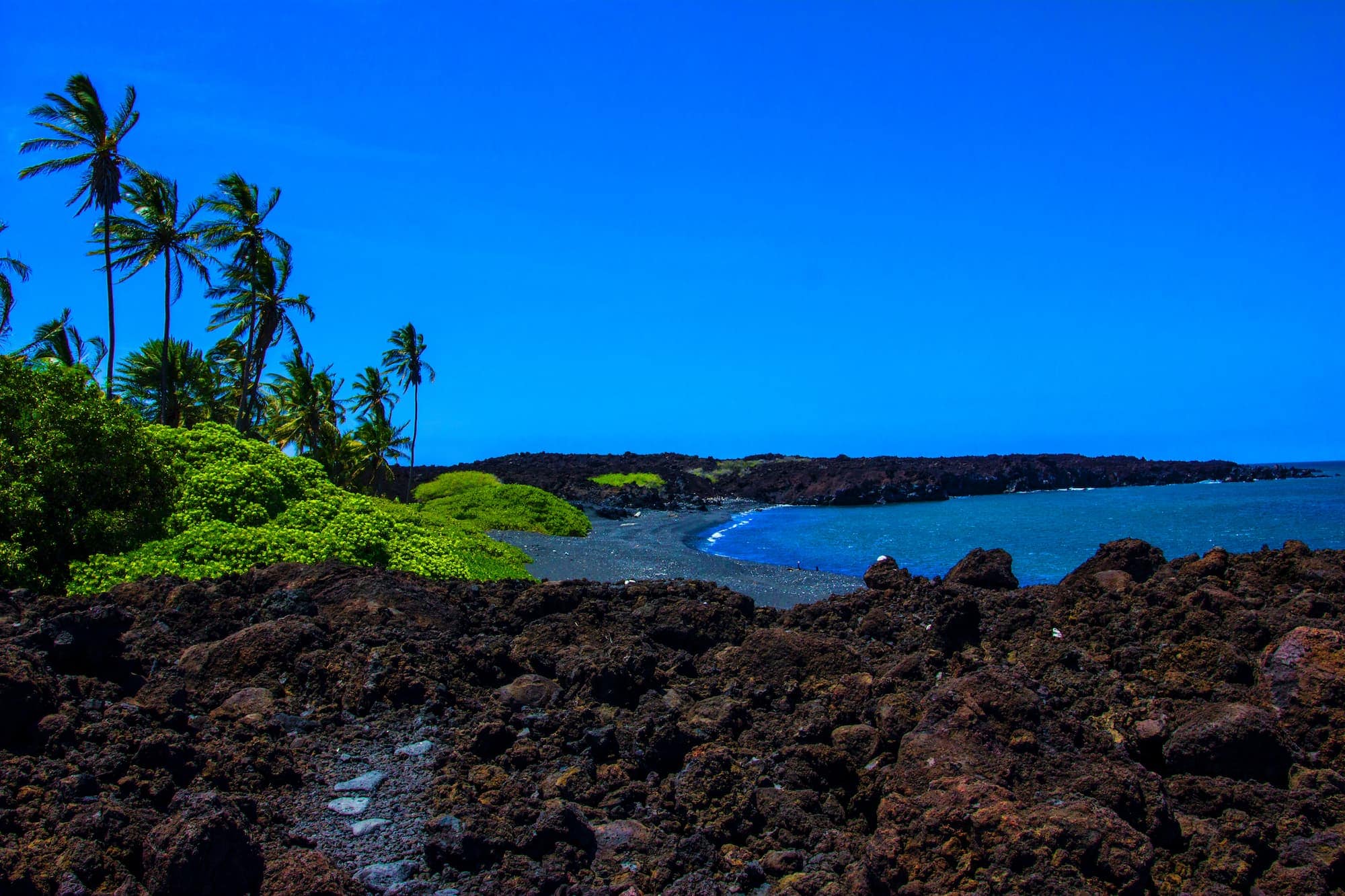
Flanked by old lava flows, Kīholo Bay is a protected series of calm tide pools. Photo by Paul Blessington on Unsplash
Good to know:
Kīholo Bay is part of Kīholo State Park Reserve, protected for its regular sea turtle visits and fragile surrounding ecosystem. You can drive right up to the coast and walk north along the beach, or park at the Kīholo Trailhead and hike down into the bay, about 3 miles round trip. Much of the surrounding land is private property, so stick to the marked trails and roads.
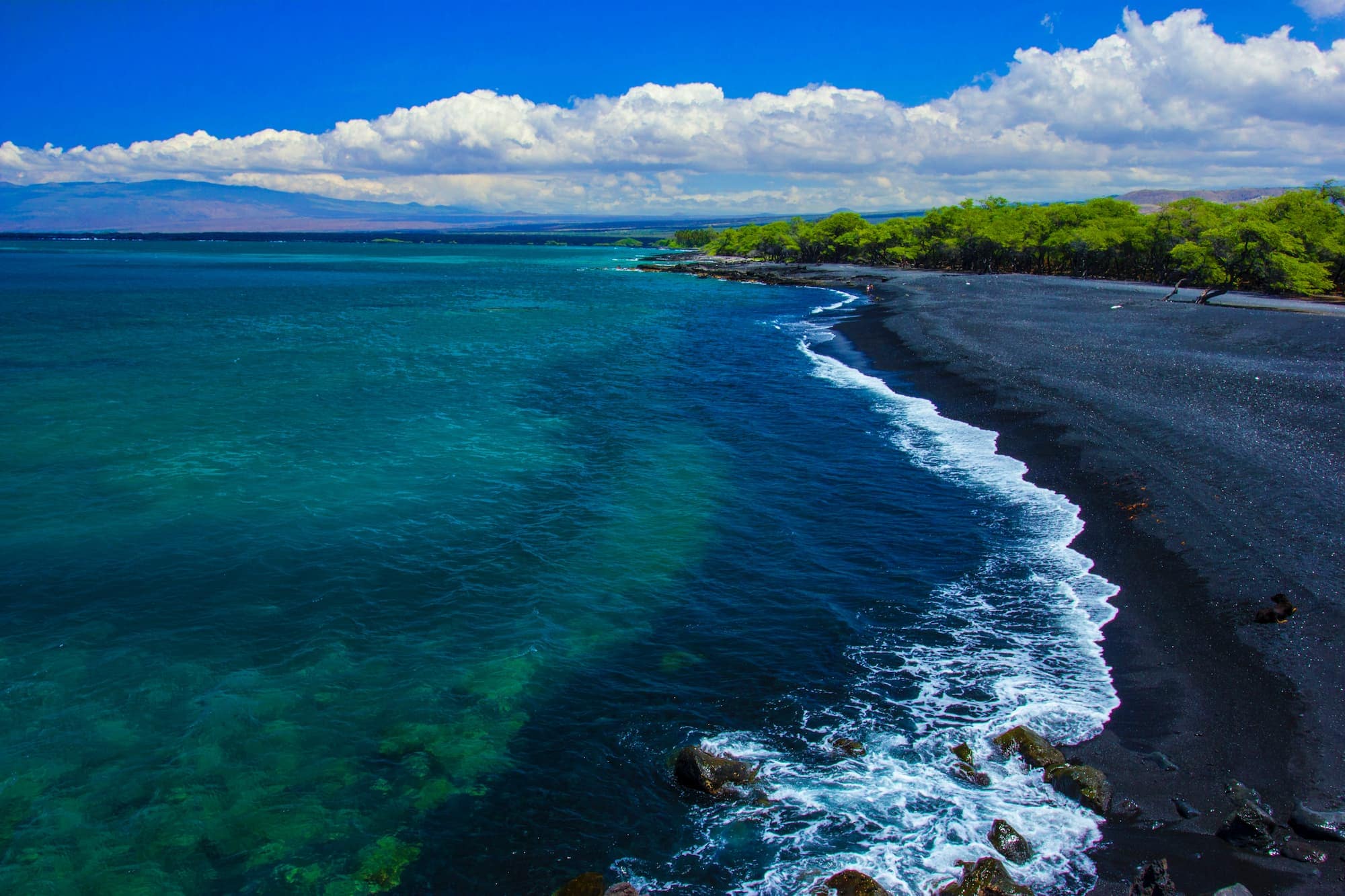
Kīholo Bay has tide pools, ancient fishponds, rock formations, and regular sea turtle visits. Photo by Paul Blessington on Unsplash
Kīholo Bay is well suited for:
Conservation-minded travelers and anyone happy to float. Walk the black sand beaches and tide pools slowly, and float in the lagoons, which are calm. Camping is allowed with a permit (weekends only, $20 to $30 per night per site).
Avoid Kīholo Bay if..
You’re low on energy and hiking in from the Kīholo Trailhead. That route is 3 miles round trip over uneven lava ground, so come when you’re rested, not at the end of a long beach day.