
Kailua-Kona gets about 27 inches of rain a year, and the wettest months are July and September. That’s backwards from the rest of the island, where the rain comes in winter. The town sits on the leeward coast, sheltered by the mountains from the trade winds that soak Hilo, and temperatures hold between 70 and 80°F (21 to 27°C) all year.
If you’re planning a snorkel trip, the hour matters more than the month here. Skies are clearest from 8 to 10 am, and cloud cover reaches roughly 80% by 2 pm. Rain arrives late afternoon or evening, so a wet forecast rarely costs you a morning.
Table of contents
- Kailua-Kona weather by month (January through December)
- A typical day in Kailua-Kona: average daily weather
- Kailua-Kona weather summary in a table: temperature, rainfall, and cloud cover throughout the year
The trade winds hit the eastern slopes of every high island in Hawaiʻi and drop their rain there. The mountains behind block the rest, and Kona sits on the west coast, in that rain shadow.
Kona’s 27 inches of rain a year sits near the dry end of the island’s range: the Waikoloa resort coast north of here averages 9 inches, Waimea 37, Volcano Village 122, and Hilo 142, all from the same climate atlas.
For the island-wide picture, and for which side to stay on, start with our Big Island weather guide.
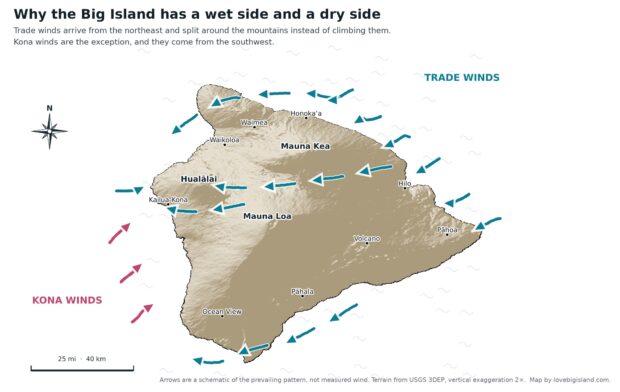
Weather on the Big Island, Explained
Hilo gets 120 to 151 inches of rain a year, the Kohala coast under 10. Daytime highs sit in the high 70s to high 80s every month. Pick your side first.
Kailua-Kona weather by month: temperature, rainfall, and cloud cover
August is the warmest month in Kailua-Kona at about 78°F, January the coolest at about 71°F. That’s under seven degrees of spread across the whole year, and there is no cold season.
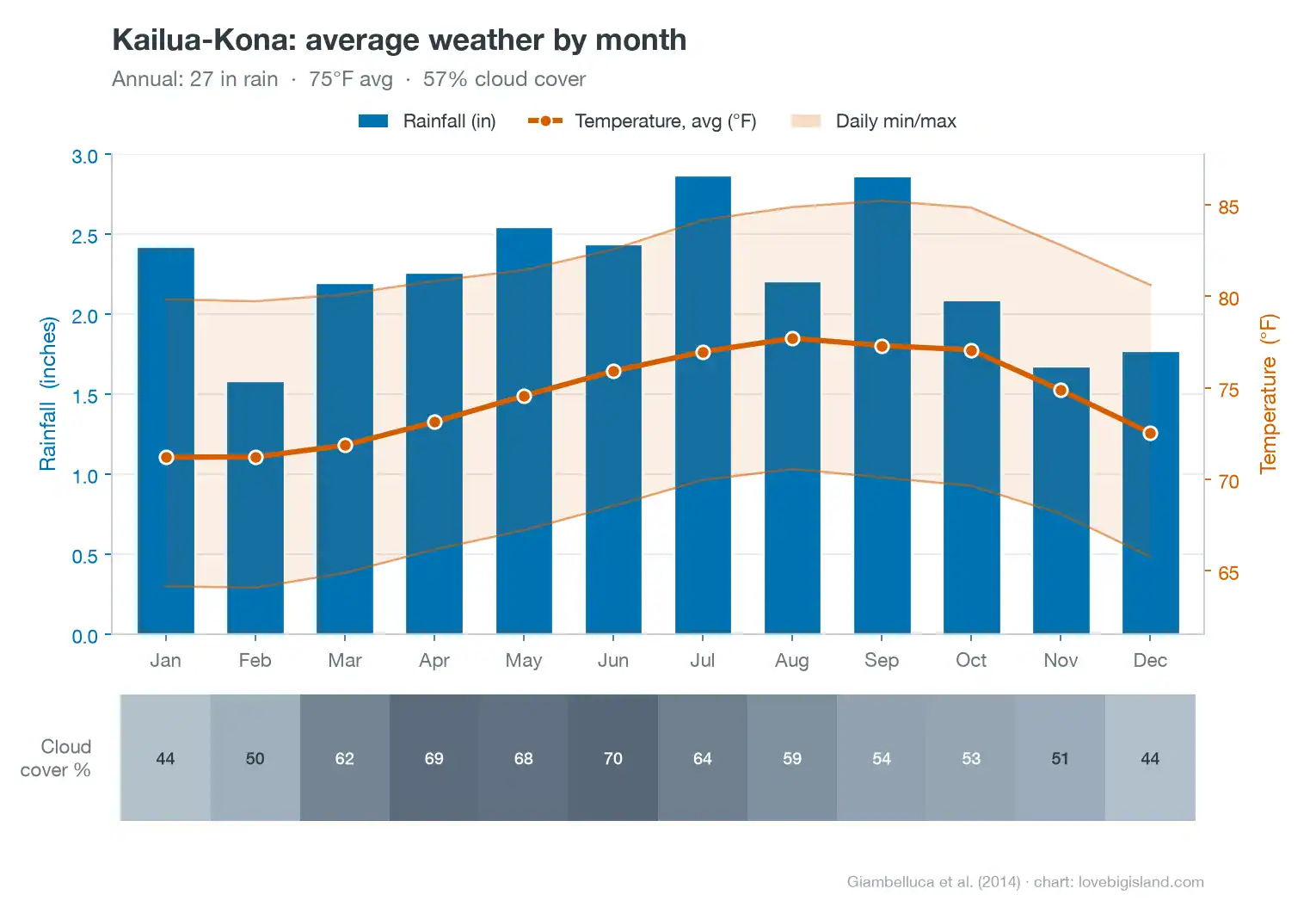
Even in July and September, the wettest months, the rain mostly comes in the late afternoon or early evening rather than as an all-day soak.
April, May, and June are the cloudiest months, with clouds blocking the sun close to 70% of the time. December and January are the sunniest, at under 50%.
Kailua-Kona weather by hour: when the clouds roll in
Cloud cover swings a lot over the course of a day in Kona. Your best shot at clear sky is the morning, roughly 8 to 10 am; after midday the clouds build fast, and by 2 pm there is about an 80% chance of cloud cover.

Air temperature barely moves over the day, only about a 10°F range. Direct sun makes it feel warmer; wind and rain make it feel cooler. If you have one outdoor thing to do in Kona, do it before noon.
Kailua-Kona weather forecast
Everything on this page is long-term averages, so any single day can be well off these numbers.
For current conditions and the local forecast for Kona, check the NOAA forecast.
Kailua-Kona weather table: every monthly average in one place
Kailua-Kona averages 74.5°F and 26.97 inches of rain over a year, with cloud cover at 57%. The table breaks that down month by month.
| month | T (°F) | Rainfall (in) | Cloud Frequency (%) |
|---|---|---|---|
| January | 71.21 | 2.428 | 43.51 |
| February | 71.22 | 1.585 | 49.70 |
| March | 71.86 | 2.202 | 62.45 |
| April | 73.13 | 2.266 | 69.40 |
| May | 74.56 | 2.551 | 67.85 |
| June | 75.91 | 2.440 | 70.49 |
| July | 76.97 | 2.872 | 63.54 |
| August | 77.71 | 2.210 | 58.86 |
| September | 77.31 | 2.868 | 53.86 |
| October | 77.07 | 2.092 | 53.00 |
| November | 74.87 | 1.678 | 50.86 |
| December | 72.53 | 1.776 | 44.12 |
| Annual | 74.53 | 26.967 | 57.30 |
Sources
All tables and figures on this page were created by Love Big Island using data from Giambelluca, T.W., X. Shuai, M.L. Barnes, R.J. Alliss, R.J. Longman, T. Miura, Q. Chen, A.G. Frazier, R.G. Mudd, L. Cuo, and A.D. Businger. 2014. Evapotranspiration of Hawaiʻi. Final report submitted to the U.S. Army Corps of Engineers, Honolulu District, and the Commission on Water Resource Management, State of Hawaiʻi.
We downloaded the data from the Rainfall Atlas of Hawaiʻi, the University of Hawaiʻi project that now hosts the evapotranspiration atlas for the main Hawaiian Islands.
Explore the data yourself: the UH Hawaiʻi Climate Data Portal publishes interactive climate maps, live readings from the Hawaiʻi Mesonet station network (live data), and monthly climate summaries.