
ITO sits a few miles from downtown Hilo and about 45 minutes from Hawaiʻi Volcanoes National Park, on the wetter, greener east side of the Big Island. It’s the main airport for East Hawaiʻi, around Hilo and Puna. Most flights in are interisland, and nonstop mainland service is limited.
If you’re staying on the Hilo side or heading up to Volcano, fly into ITO rather than Kona (KOA). The highway to Volcano, Kona, and Waimea runs right past the terminal. You pick up a rental car and reach downtown Hilo in minutes.
About Hilo Airport
Most people flying into ITO are island-hopping within Hawaiʻi. Hawaiian Airlines flies to Hilo from Honolulu (HNL) and Kahului (OGG), and Southwest Airlines flies in from Honolulu. There is one nonstop mainland route: Southwest’s Las Vegas flight, added in 2026. Most mainland visitors otherwise connect through Honolulu or fly into Kona. Read more about flights to Hilo from the mainland and interisland flights to Hilo.
See the official Hilo Airport website for live flight and terminal information.
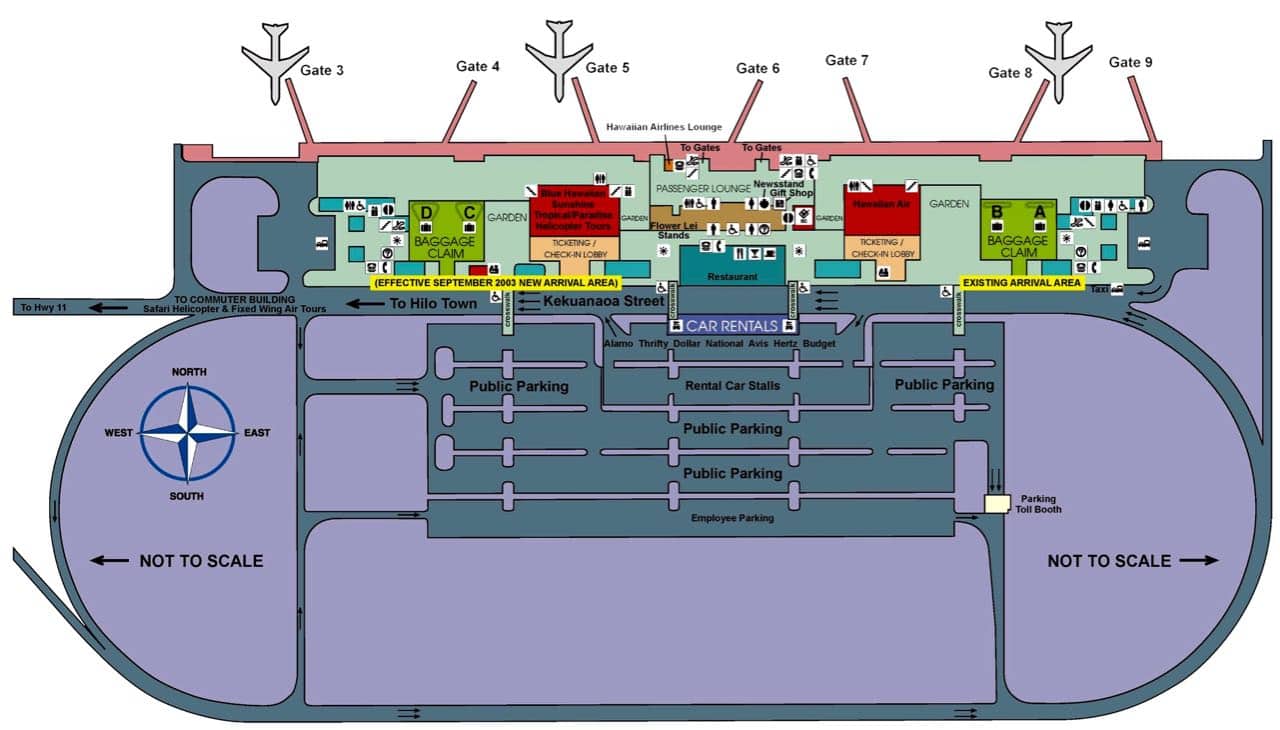
Map of the terminals at the Hilo airport. Image source: hawaii.gov.
Why is Hilo International Airport called ITO?
Fly into Hilo and the baggage tag reads ITO. That three-letter code is the airport’s IATA (International Air Transport Association) code, and for most airports the code comes from the city name. Honolulu is HNL and Kona is KOA, but Hilo as ITO is less obvious.
There are three possible origins for the Hilo / ITO connection that we think are likely:
- Hilo Airport was called ITO after one of the first Hawaiian Airlines Hilo Airport station managers: “Mr. Ito”.
- The airport was called ITO because both HIL (Shillavo Airport in Ethiopia) and ILO (Mandurriao Airport in Iloilo, Philippines) were already taken. ITO also sounds a lot like Hilo.
- Hilo was designated ITO because in the first half of the twentieth century, residents of the Big Island of Hawaii referred to the City of Hilo as Hilo Town, thus HIlo TOwn being the closest city or town to the airport.
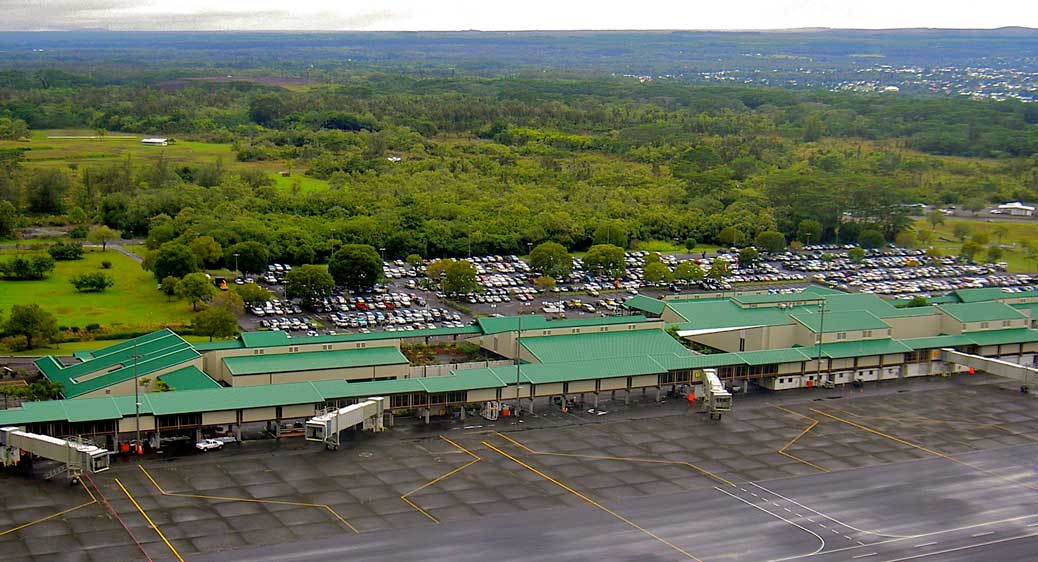
Hilo International Airport (ITO) on the Big Island, Hawaii. Photo Credits: Bill Rand on Flickr
Ground transportation at Hilo Airport
Most people rent a car right outside the open-air arrival area. Rideshare and taxis wait at the curb, and the county bus runs into town.
The major national agencies keep counters and a lot right by the terminal, and a few local companies operate nearby, often at better rates. See our guide to renting a car at the Hilo airport for the details.
Uber and Lyft both serve ITO. They pick up in marked rideshare zones toward the west end of the curb, near the commuter terminal, so open your app for the exact spot once you land.
Taxis use the exclusive taxi lane in front of baggage claim, and courtesy phones inside let you call one if none are waiting. The airport no longer posts a set meter rate, so agree on the fare before you ride, or arrange a pickup ahead of time. Approximate one-way fares, from the airport’s own ground transportation page:
- Banyan Drive hotels: $13 to $15
- Downtown Hilo: $15 to $17
- Volcano: $100
- Keaʻau: $30
- Pahoa: $50
- Honokaʻa: $130
- Waimea: $190
- Waikoloa: $230 to $250
- Kailua-Kona: $260 to $320
These are estimates, not guaranteed, and a rideshare is often cheaper for the short runs into Hilo.
The county Hele-On bus also stops at the airport and runs into downtown Hilo, and it’s the cheapest way in. Routes and times change, so check the current schedule on the county Hele-On site before you count on it.
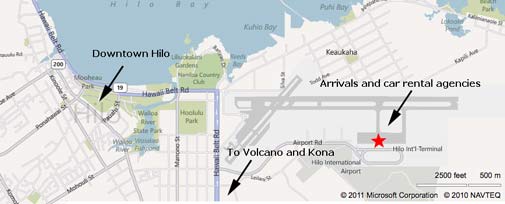
Hilo International Airport sits minutes from downtown Hilo, while Volcano Village and Hawaiʻi Volcanoes National Park are about 45 minutes by car.
Drive times from Hilo Airport
Downtown Hilo is only a few miles from the terminal. With a rental car, expect roughly these drive times:
- Hawaiʻi Volcanoes National Park: 45 min
- Waimea: 1 hr 30 min
- Kailua-Kona: 2 hrs 30 min

This is the view just before the plane lands at Hilo: Hilo Bay and Coconut Island.
Parking at Hilo Airport
The public parking lot sits right in front of the terminal, a short walk from the gates. In January 2026 ITO moved to a ticketless system: a camera reads your license plate on the way in, and you either register your plate and card online for automatic payment or pay the attendant on the way out. The state says parking rates did not change with the switch, and current rates are posted at the lot.
If you’re picking someone up, use the free cell-phone waiting lot at the Commuter Air Terminal, just west of the main terminal. It’s open from 5 a.m. to 10 p.m., first come first served, with a 45-minute limit and no charge. Wait there until your traveler has their bags, then pull around to arrivals.