
In Hawaiian legend, the koaʻe kea (the white-tailed tropicbird) over Kīlauea’s crater is Punaʻaikoaʻe, an Oʻahu chief who escaped a moʻo (a giant shape-shifting lizard spirit) and found shelter with the volcano goddess Pele. His story ends on the sacred cliff of Pele’s eldest brother, where the moʻo came for him and the volcano drove her off.
The legend of Punaʻaikoaʻe and the lizard spirit Kalamainuʻu
Punaʻaikoaʻe, a chief of Oʻahu, was surfing at Waimānalo when a woman came to him on the water. She was Kalamainuʻu. He followed her on his board across to Molokaʻi, to her cave, and she took him as her lover. In time he found he was her captive.
Her brother Hīnale told him what she was: a moʻo in a woman’s shape. Punaʻaikoaʻe made a plan. He told her he longed for the ice-cold water of Poliʻahu, the snow goddess of Mauna Kea, and she agreed to fetch it. Before she left, he secretly punched holes in her huewai (water gourd), so the water ran out every time she filled it.
While she struggled, he fled to Kīlauea and put himself under the protection of Pele‘s family, the family of his former wife. Pele, taken with his looks and angry at how Kalamainuʻu had treated him, took him in.
When Kalamainuʻu understood she had been tricked, she called the moʻo from every island. They swarmed to the edge of Pele’s crater, and she threatened to fill it with their phlegm and put out the fires unless Punaʻaikoaʻe was handed over.
In her rage she didn’t notice she was standing on Kapalikapuokamohoaliʻi, the sacred cliff of Kamohoaliʻi, Pele’s eldest brother. The ground under her feet grew unbearably hot. The volcano threw rock into the air, and its heat and gas killed Pele’s enemies in the cracks of the crater. Kalamainuʻu barely escaped by plunging into a pond called Lokoaka.
She never got him back. His kinolau (a body form a god or spirit can take) is the koaʻe kea, which still flies over Pele’s home under her protection. His name means “Puna the tropicbird eater.”
Where to see the cliff and the koaʻe kea at Kīlauea Overlook
The cliff from the story is the Kīlauea Overlook in Hawaiʻi Volcanoes National Park, which the park names Kapalikapuokamohoaliʻi. It sits on the caldera rim 2.5 miles from the entrance station, a short walk from its own parking lot, or 0.4 miles on foot from the Uēkahuna overlook.
Halemaʻumaʻu, the crater at the summit, is Pele’s home in Hawaiian tradition. Koaʻe kea often soar above the caldera, and within weeks of the 2018 summit collapse they were circling Halemaʻumaʻu looking for new nest sites. From the rim you may see them circle and call out. Our Hawaiʻi Volcanoes National Park guide lists the other rim viewpoints and the park hours.
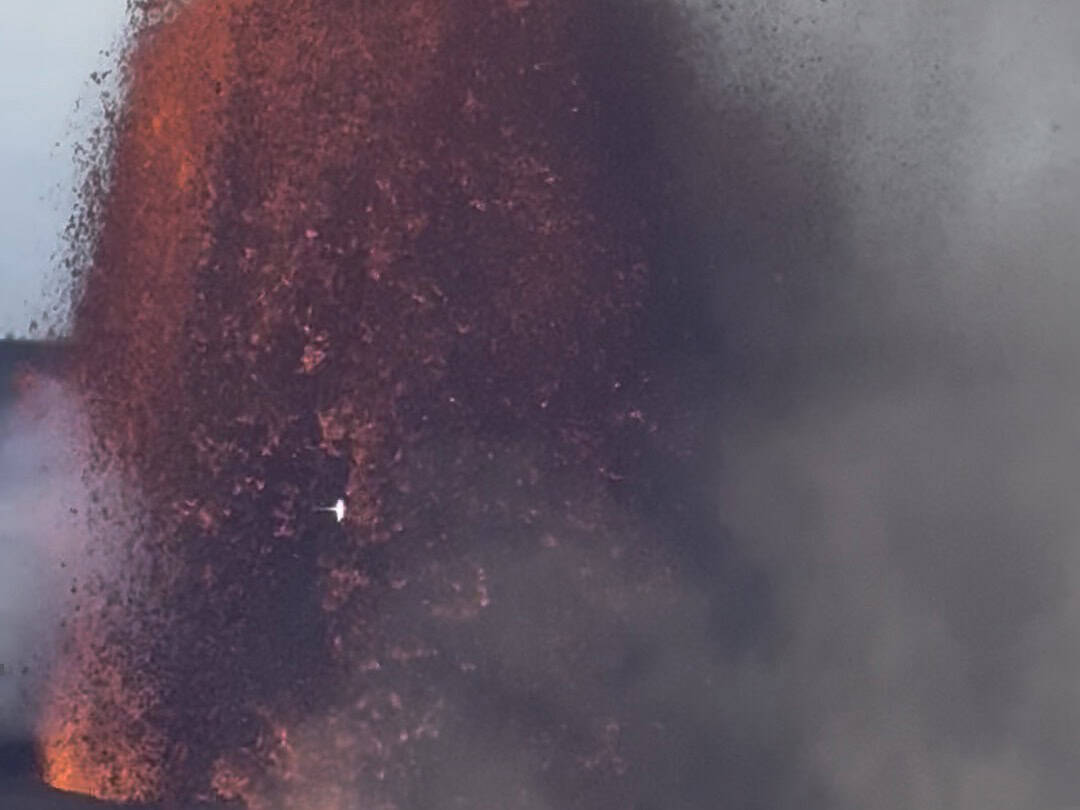
A koaʻe kea, the white-tailed tropicbird, crosses in front of a Kīlauea lava fountain, filmed from Keanakākoʻi Overlook on 5 May 2026 during one of our visits to the park.
About this telling
This page follows the National Park Service’s version from Hawaiʻi Volcanoes National Park, which combines details from older printed tellings.
Its plot, with the island of Molokaʻi, the gourd with holes and the battle at the crater, matches the version Thomas Thrum and W. D. Westervelt printed in English early in the 1900s, in which they name the moʻo Kihawahine.
The name Kalamainuʻu comes from Samuel Kamakau’s telling in the Hawaiian-language newspaper Ke Au Okoa in January 1870, in which Punaʻaikoaʻe is a chief of Kauaʻi and the story ends in a fish trap on Oʻahu, never reaching Kīlauea. We read Kamakau in English translation, not in the Hawaiian.
Read more
- Punaʻaikoaʻe, at the National Park Service. The park’s short English version, which names the moʻo Kalamainuʻu and ends the story at Kīlauea.
- Martha Beckwith’s Hawaiian Mythology (1940), on Ulukau. In this section Beckwith sets Kamakau’s 1870 telling beside the version Westervelt printed.