
Naupaka grows in two places on the Big Island: as a low shrub along the coast, and as a taller one up in the wet uplands. Look closely at either flower and it seems torn in half, small white petals bunched on one side, as if the rest went missing. There is a story about why.
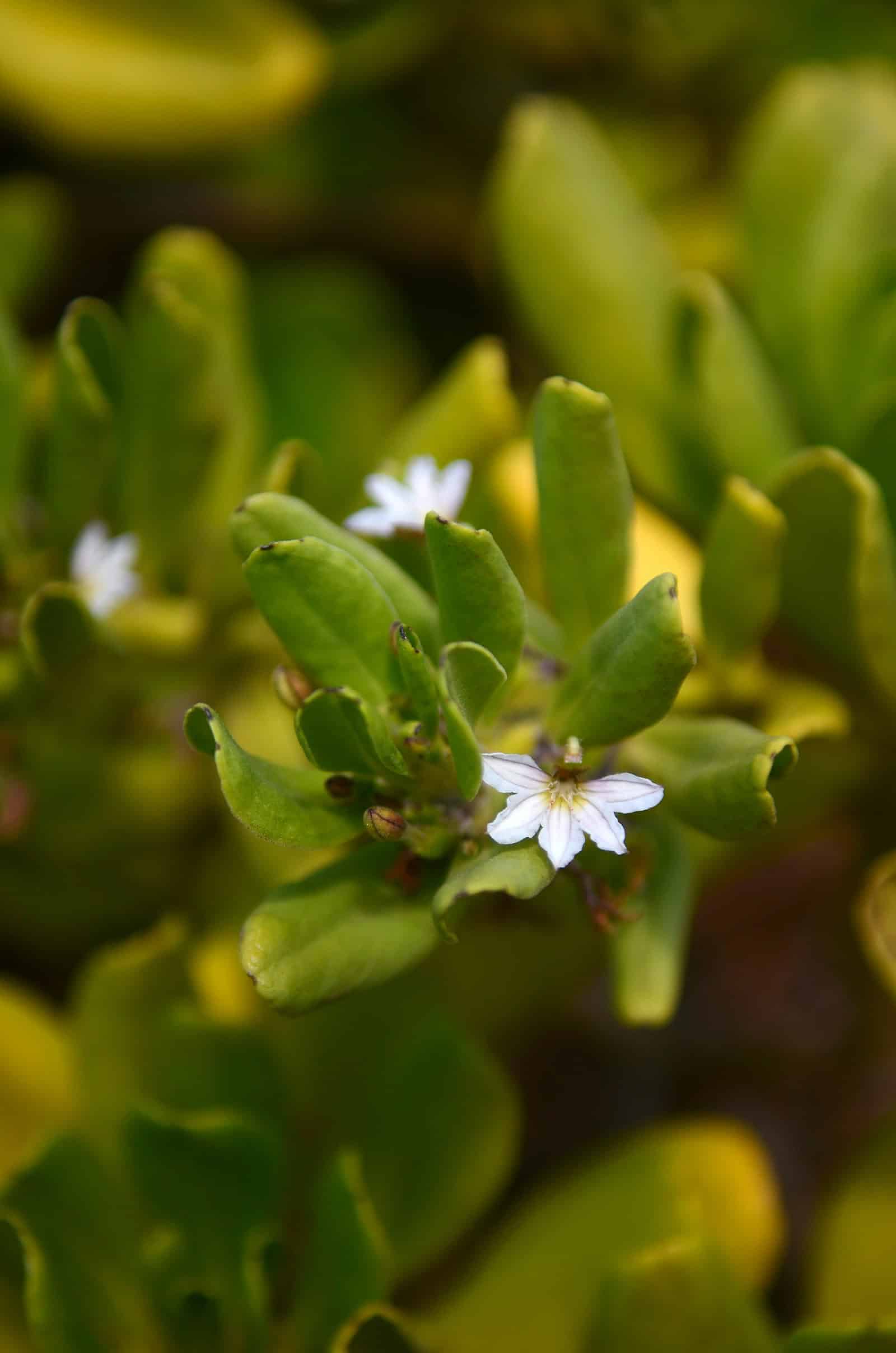
The half-flower of naupaka: the mountain and shore shrubs both bloom this way, which is where the legend begins. Photo: Emma Renly / Unsplash.
The legend of the half-flower
Naupaka was a chief’s daughter, loved by everyone in her village, until she fell for a young man named Kauʻi. He was a commoner, and the rank of the day did not let a woman like her marry one. Her family took the problem to the elders, and the elders sent the couple higher still, up to a mountain temple, to let the gods answer.
At the temple the sky went dark. Rain came down hard, thunder broke, lightning crossed the air. That was the answer, and it was no. Naupaka took the flower from her hair, tore it in two, and pressed one half into Kauʻi’s hand. She would stay in the mountains. He would go back down to the sea.
The naupaka blossoms around them bowed their heads, and ever since, the mountain flowers and the shore flowers have each bloomed as half a flower. The old people say that one day the two will find each other again and the blossoms will open whole.
There is an older telling as well, a family story rather than a romance. In it Naupaka is a man who marries ʻŌhikimakaloa, a woman of lower rank, and two jealous rivals turn him against her.
She follows him with gifts from the shore into the mountains, but he tears them away, and the fallen flowers take root as the half-blossomed shrubs. He ends as a shrub by the shore, she as a small sand crab below it. Same half flower, a different story behind it.
Seeing naupaka at Hawaiʻi Volcanoes National Park
You can find both halves of the story inside Hawaiʻi Volcanoes National Park. The coastal shrub, naupaka kahakai, is one of the most visible plants along the park’s undeveloped shoreline, low and spreading. The mountain kind grows up in the wet ʻōhiʻa forest near the rim of Kīlauea, and you pass it on the short loop trail at Nāhuku, the Thurston Lava Tube.
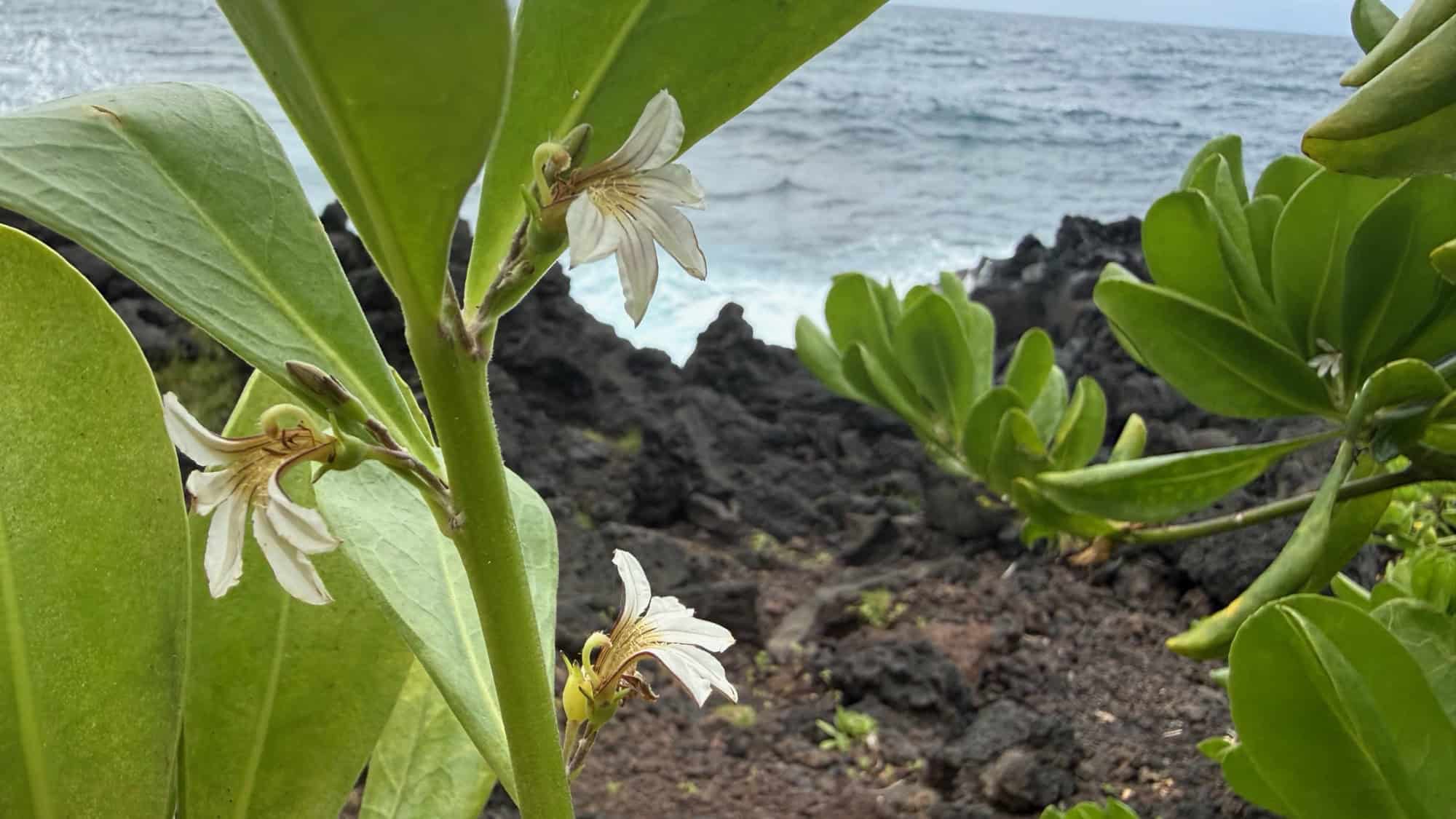
Naupaka kahakai, the shore half of the pair, spreading low over black lava along Government Beach Road on the Puna coast.
Four naupaka species grow in the park, among them Kīlauea naupaka, which grows almost nowhere else, along Hilina Pali Road and the western flanks of Mauna Loa. Each has the same one-sided bloom. Hold a mountain flower next to a beach flower and you have the whole legend in your hand.
The rest of the legends we have written up sit on the mythology hub.
About this telling
The love story here follows the telling of the Hawaiian teacher and composer Nona Beamer, one of the best-known versions of the popular romance. The older version, with ʻŌhikimakaloa and the two rivals, comes from a name chant for the Oʻahu chief Kūaliʻi, printed with a facing English translation by Abraham Fornander in 1880.
Naupaka and ʻŌhikimakaloa are named in the chant, and later tellers grew those few lines into the marriage story. The chant belongs to Oʻahu, which is why we tie the plant, not the story, to the Big Island. We read Beamer’s telling and the Fornander chant, but not the 1868 newspaper printing of the chant, which differs in places.
Read more
- Naupaka, as told by Nona Beamer (Mānoa Heritage Center). The full love story in Nona Beamer’s words, short and in English. The telling our version follows.
- Fornander, the Song of Kūaliʻi (1880). Hawaiian with a facing English translation. The written source we followed for the chant, which names Naupaka and ʻŌhikimakaloa in its genealogy section (Hawaiian p. 377, English p. 391).