Kapukapu and Hōlei guard the sea cliff at Pānau, on the Puna coast, and their child is born a shark. He grows up wanting one thing: a place among the great sharks of the islands. Getting it means going through one of them.
The legend of the shark child of Pānau
His parents name him for Kaʻahupāhau, the great shark of Puʻuloa, because he carries the same reddish tinge she does. They raise him on ʻawa, the kava root, and his mother’s milk, then carry him down the cliff and set him in the sea. His father chants to him at the water’s edge, telling him to know this coast, eat, and go. The child answers by slapping his tail, and the sea surges up the cliff with a rainbow bent over it.
What he wants is a place in the family of Kamohoaliʻi, king of all sharks and an older brother of Pele. To get it he has to be known, so he travels the coast of Hawaiʻi paying his respects to the shark chief of each district: Kepanilā of Hilo, Kāneilehia of Kaʻū, Kua of Kona, Manokini of Kohala, Kapulena of Hāmākua. They come with him.
Crossing to Maui they reach Kauhuhu, who rules that channel and is feared for it. Kauhuhu opens his jaws to swallow the child whole. Kaʻehuiki swims straight in and kills him from the inside.
At Kahoʻolawe, Kamohoaliʻi takes him into the family and gives him a hundred forms, great power, and a long life. He sails on to Kahiki, comes home, and lives now in the sea caves of Pānau.
Getting to the Puʻu Loa petroglyphs
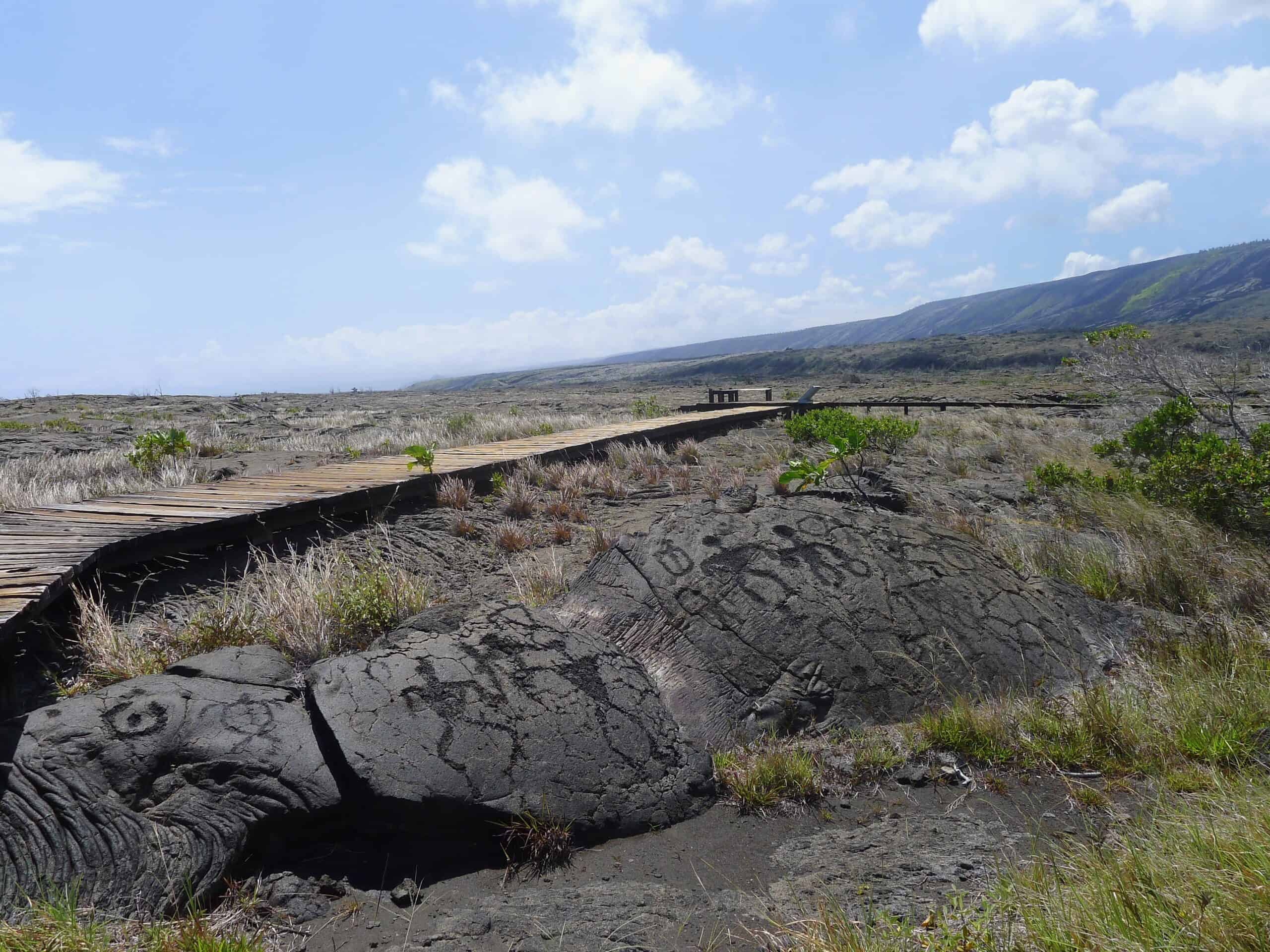
The boardwalk at Puʻu Loa runs a loop around the carvings, on the same stretch of Puna coast as Pānau. Staying on it is what keeps the petroglyphs intact.
Pānau sits on the Puna coast inside Hawaiʻi Volcanoes National Park. The closest a visitor gets is the Puʻu Loa petroglyph field, 16 miles down Chain of Craters Road, then 0.7 miles each way over open lava to a boardwalk with no shade on it.
We have another Big Island shark story that goes the other way round. In Punia and the shark Kaiʻaleʻale, from Kohala, a shark kills a man and his son grows up to take revenge on it.
About this telling
Told by William Henery Uaua in the Hawaiian-language newspaper Ke Au ʻOkoʻa in 1870, read here in the 1994 Hale Kuamoʻo edition.
Read more
- The shark child of Puʻuloa, at the National Park Service. Short and in English, from the park the story’s stretch of coast sits in. It names his parents and the district shark chiefs he sets out to meet.
- He Moʻolelo Kaʻao no Kaʻehuikimanōopuʻuloa, on Ulukau. Uaua’s 1870 serial in Hawaiian, in the 1994 Hale Kuamoʻo edition, free to read. This is the text our retelling works from.