
Among Hawaii’s native land snails, about 99% are endemic, and beetles are nearly as high. Those are some of the highest endemism rates recorded anywhere. Endemic means a species evolved here and lives nowhere else on earth.
Endemic species live only in Hawaii. Native ones got here on their own but may live elsewhere too, so which of the two you count changes the number a lot. The figures below come from the Hawaii Biological Survey’s published tables.
Table of contents
The claim is partially true. More than 90% of Hawaii’s native species that live on land are endemic. Widen it to every native species, including the marine ones, and the share drops to just under half. Measured against all species recorded here, native and non-native together, it is about 39%.
Native (endemic and non-endemic) and alien species
Species in Hawaii are either native, meaning they arrived without human help, or alien, meaning humans introduced them. Native species split further into endemic and non-endemic groups.
“Native” means that a species occurs naturally within a region, either because it evolved there or because it arrived without human assistance. For example, the Iʻiwi bird shown below is native (and endemic!) to the Hawaiian islands.
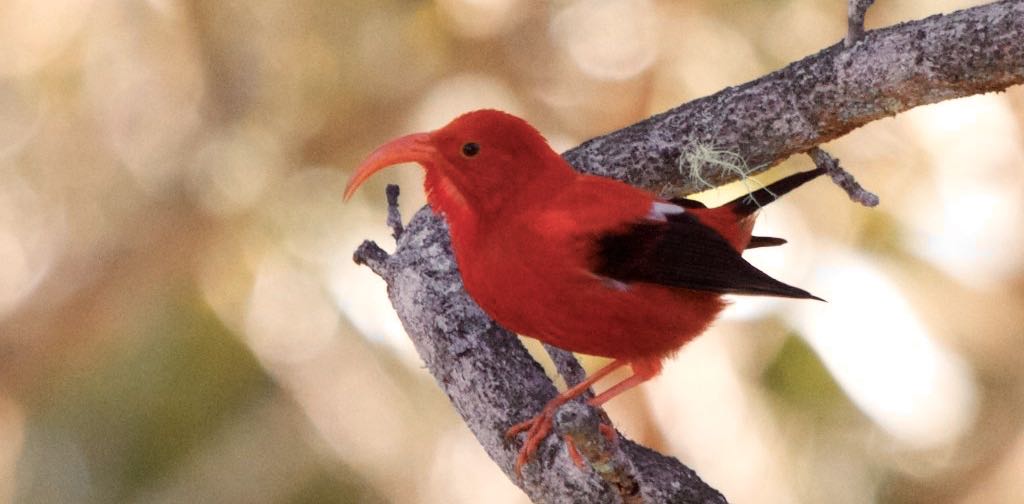
The Iʻiwi bird is endemic to Hawaii. Source: Iʻiwi|Puʻu oʻo Trail | 2013-12-17at12-43-209 by Bettina Arrigoni, licensed under CC BY 2.0
Native species can be split into endemic and non-endemic species. Endemic in biology means that a species is unique to a defined geographical location. Practically this means that a non-endemic native Hawaiian species also lives outside Hawaii. Endemic species live only in Hawaii.
Finally, alien species are introduced from outside ecosystems. They can harm local species by competing for the same resources. Biologists also call them non-native or invasive species. In Hawaii, about 5,200 species are non-native, a fifth of everything recorded here (source).
How many species are there in Hawaii?
The Bishop Museum’s Hawaii Biological Survey has been counting the species in Hawaii since 1992.
Their most detailed assessment, published in 2003 (source), counted 25,615 species in the state: 9,987 endemic, 5,175 non-native, and about 10,450 native to Hawaii but living elsewhere too. A 2006 update raised the running total to 26,608 (source).
That 26,608 is still the figure Bishop Museum quotes, restated unchanged in its 2015 and 2020 reports. Writing in 2015, the Survey called Hawaii the only state in the country with an accurate accounting of every plant and animal within its borders, native and alien alike. The percentages below come from the 2003 breakdown, not from that 26,608 total.
The discrepancy comes from how the surveys group species. Surveys group species by taxonomy or by habitat. If you look only at the native species living on land (terrestrial species), you get the 90% number. Marine species spread more easily (living on an island doesn’t stop them!), which lowers the number of endemic species.
This table lists Hawaii’s species counts by taxonomic group, per the 2003 Allison survey. The last row’s totals differ from the 25,615 and 26,608 figures quoted above.
| Totals | Endemic | Alien | Species at risk | Extinct | |
| Algae + other protists | 2013 | 82 | 18 | 0 | 0 |
| Fungi and lichens | 2088 | 240 | ? | 0 | 0 |
| Flowering plants | 2264 | 918 | 1101 | 654 | 97 |
| Other plants | 766 | 241 | 47 | 0 | 0 |
| Molluscs | 1339 | 962 | 96 | 127 | 500 |
| Insects | 8427 | 5462 | 2609 | 289 | 74 |
| Other arthropods | 1191 | 366 | 735 | 4 | 0 |
| Other invertebrates | 4003 | 822 | 253 | 7 | 0 |
| Fish | 1216 | 149 | 73 | 1 | 0 |
| Amphibians | 8 | 0 | 8 | 0 | 0 |
| Reptiles | 27 | 0 | 23 | 0 | 0 |
| Birds | 294 | 63 | 53 | 36 | 88 |
| Mammals | 44 | 2 | 19 | 2 | 2 |
| Totals | 23680 | 9307 | 5035 | 1120 | 761 |
Hawaii vs the Galapagos islands: comparing endemic species
Hawaii has far more endemic species than the Galapagos.
Darwin’s work on evolution made these South American islands famous.
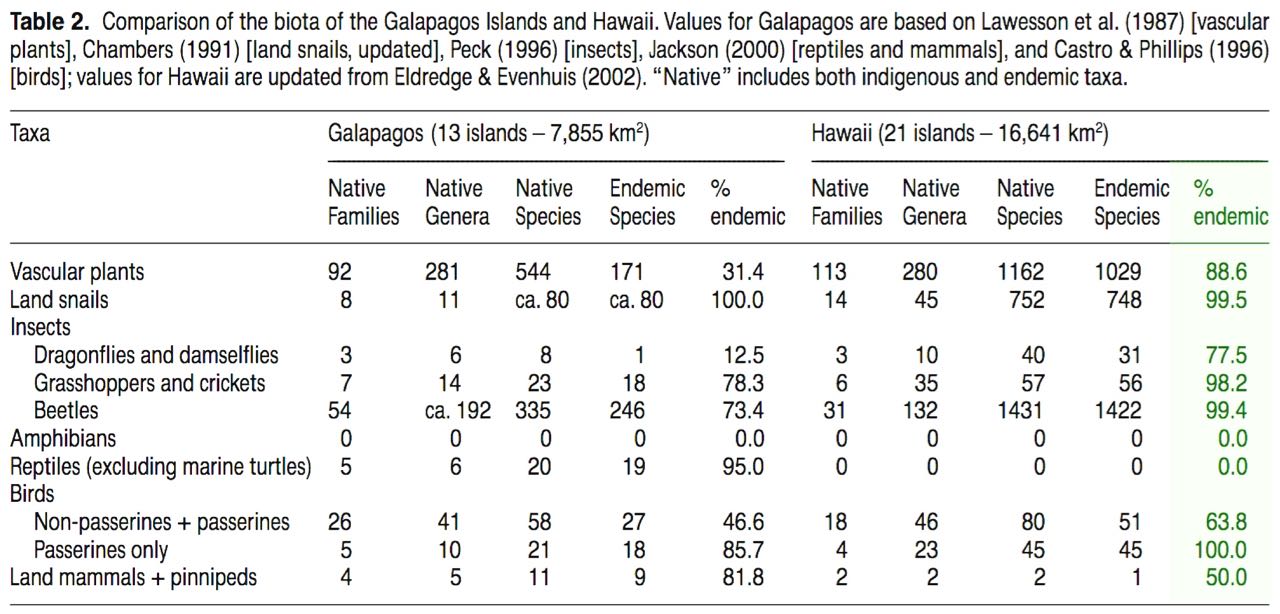
Comparison of the endemic diversity of the Galapagos islands (left) with Hawaii (right). Adapted from Table 2 in Allen Allison 2003, Org. Divers. Evol. 3, 103–110 (2003), doi:10.1078/1439-6092-00065
Bishop Museum attributes the difference partly to distance. Hawaii sits 4,000 km from the nearest continental land mass; the Galapagos sit 1,000 km from South America. Habitat variety adds to it: the Big Island alone spans 8 of the 13 Köppen climate sub-zones.
Resources used in this article
- The Hawaii Biological Survey.
- The 2003 publication “Biological surveys – new perspectives in the Pacific” by Allen Allison (source).