• Skip to main content
  • Skip to primary sidebar
  • Skip to footer
Love Big Island
Tours
Green Sand Beach (Papakōlea): the geology and the myths
Home » 40+ Big Island Facts » Green Sand Beach

Green Sand Beach (Papakōlea): the geology and the myths

By Gerrit van der Plas | updated August 3, 2026 (What changed?)

The sand at Papakōlea is 88 to 92 percent crystals by weight, and most of those crystals are olivine. That is the green. They weathered out of Puʻu Mahana, the eroded ash ring standing behind the beach, and the narrow bay has been sorting them ever since: surf carries the lighter grains out to sea and leaves the heavy olivine behind.

Green Sand Beach is the tourist name. Papakōlea is the older one, from papa (flats) and kōlea, the Pacific golden plover that winters here. The claim that this is one of only four green sand beaches on the planet traces to a 2017 magazine listicle, and the “only two” version that replaced it cites a source making no count at all.

Table of contents
  1. Where the beach’s three names come from
  2. Why the sand is green
  3. How many green sand beaches there really are

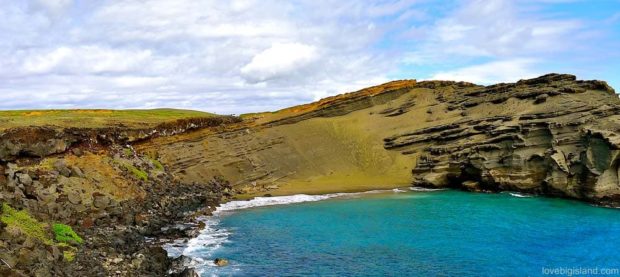
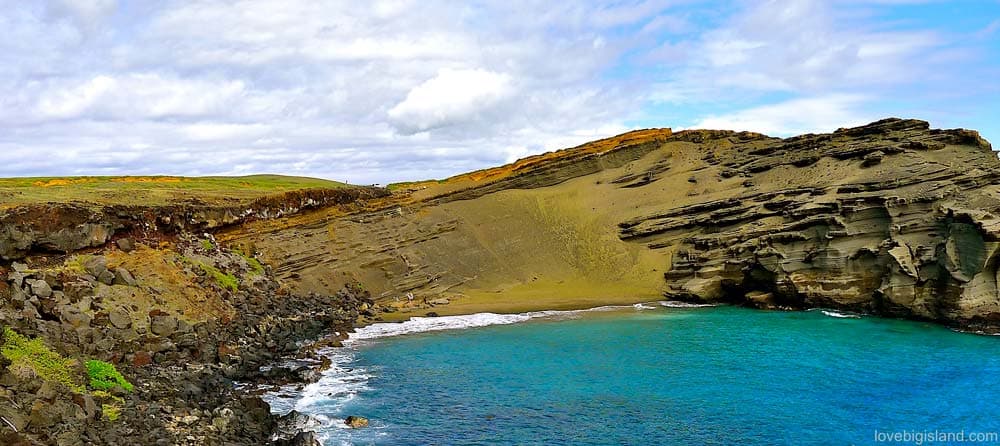
The eroded wall of Puʻu Mahana curving around the green-tinged sand at Papakōlea

The eroded flank of Puʻu Mahana wraps around Papakōlea, near the south point of the island. The layered ash beds visible in the cliff are what the olivine weathers out of.

The different names of Green Sand Beach

Papakōlea Beach is the Hawaiian name. Mahana Beach comes from the cone behind it.

  1. Papakōlea Beach

    The name joins papa, flats, and kōlea, the Hawaiian name for the Pacific golden plover (Pluvialis fulva), which arrives around the end of August and leaves in early May for Siberia and Alaska. Pukui, Elbert and Mookini give the literal translation as plover flats.

  2. Mahana Beach

    The cone behind the beach is Puʻu Mahana, warm hill. Radiocarbon dating of charcoal from it came back older than the method can measure, so USGS gives a floor instead of a date: more than 49,000 years ago.

  3. Green Sand Beach

    The descriptive name, and the one on almost every map and tour listing.
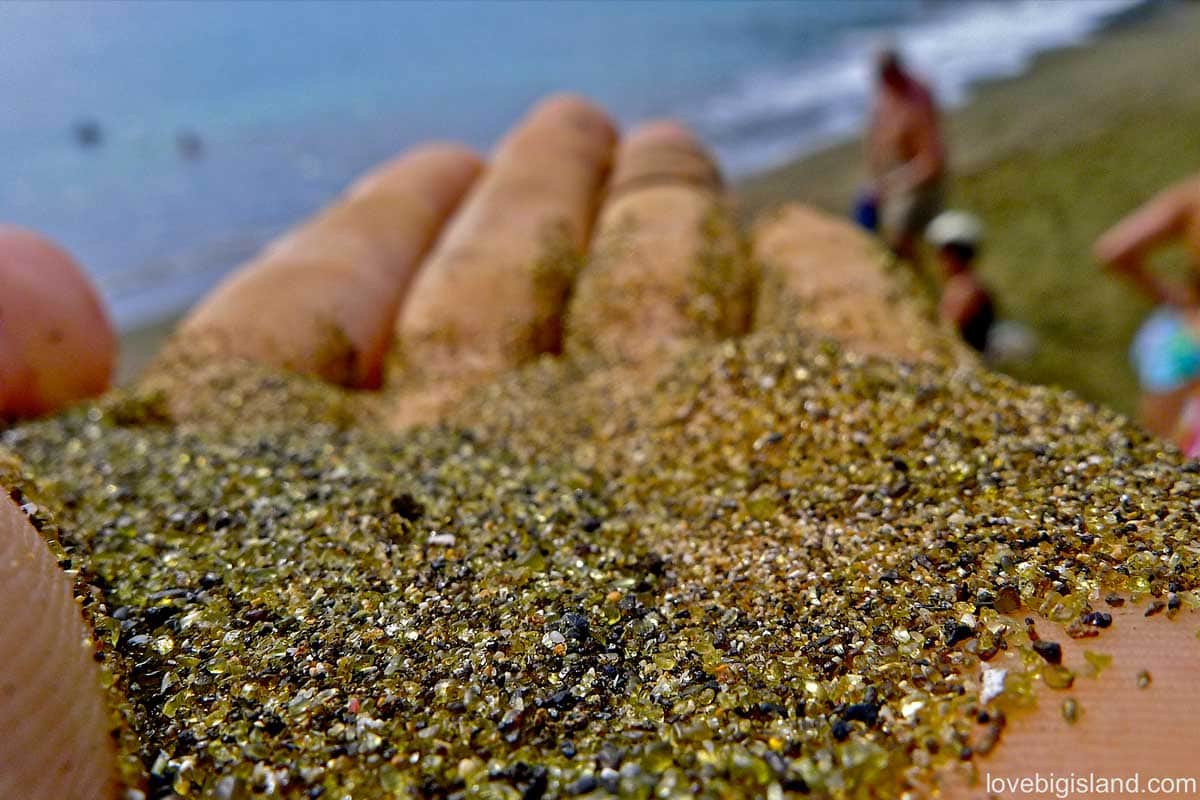
A handful of Papakōlea's green sand held up, with the beach behind

A handful of sand from Papakōlea Beach on the Big Island of Hawaiʻi

Why is the sand at Green Sand Beach green?

The color comes from olivine, a green glassy crystal that is denser and tougher than the ash fragments, volcanic glass and black pyroxene making up the rest of the beach. USGS records that olivine is sometimes called Hawaiian diamond, and that the mineral in the cone above Waikīkī is reportedly how Diamond Head got its name. Peridot, the jewelry-grade form of olivine, is the birthstone for August.

All of that ash came out of Puʻu Mahana, and what kind of cone it is took a paper to settle. USGS classed it as a littoral cone in 1987, built where lava ran into the sea. George Walker’s 1992 study, written to answer exactly that question, identified it instead as a Surtseyan ash ring standing on a primary vent. The olivine was in the magma, and the ash preserved it.
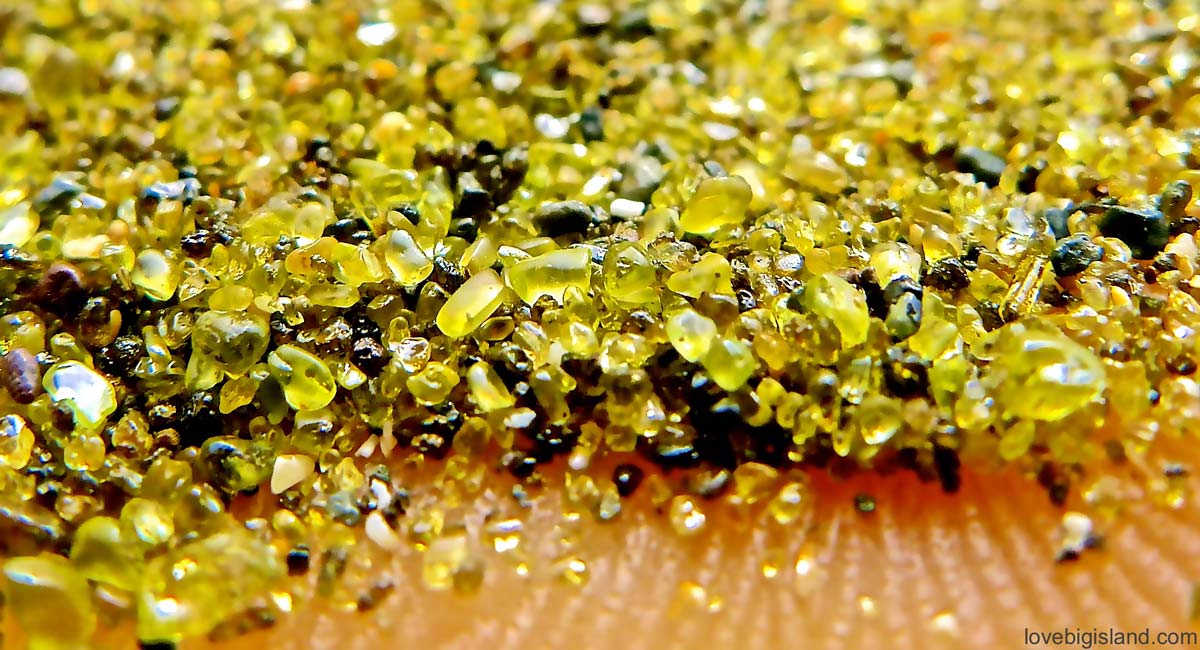
Macro view of green olivine grains mixed with black lava and white shell fragments

Green sand from Papakōlea Beach, held in the palm of a hand.
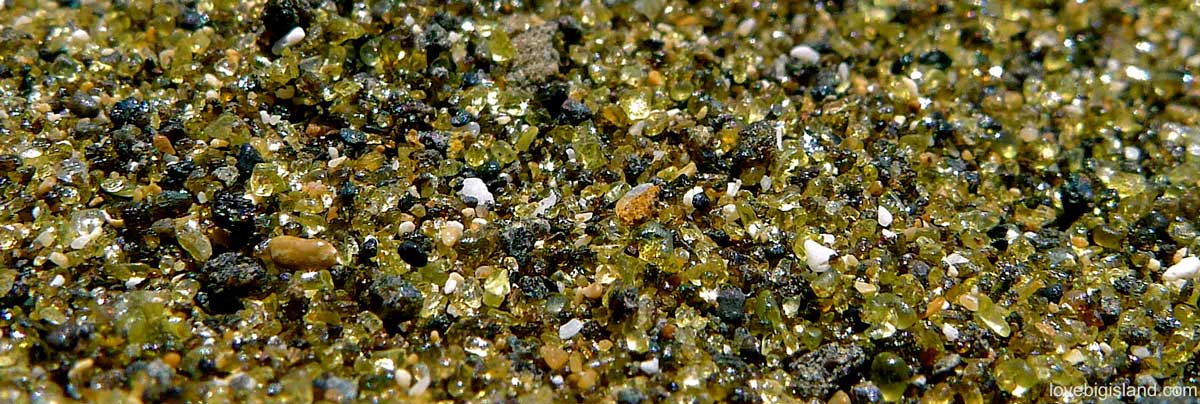
Close-up of Papakōlea sand, olive-green grains among black and white specks

Up close the sand separates into green olivine crystals, black lava fragments and white pieces of sea shell.

How many green sand beaches are there in the world?

Nobody knows, and the number you will find quoted is almost certainly made up.

Where “only four” came from

For years the widely repeated figure was four: Papakōlea, Talofofo Beach on Guam, Punta Cormorant in the Galápagos, and Hornindalsvatnet in Norway. It came from a 2017 travel-magazine listicle by way of Wikipedia, where editors flagged it as inadequately sourced in 2023 and deleted it in May 2025.

Two of the four don’t survive contact with a map. Hornindalsvatnet is Europe’s deepest lake, 1,686 feet down, and it has no beach. Talofofo Bay’s sand is brown river silt. We pulled the article’s edit history, and Wikipedia editors had removed the Guam entry in 2008, 2012 and 2025 before it stayed gone.

Wikipedia now says two, Papakōlea and Punta Cormorant, citing the Galápagos Conservancy. We read that page: it describes Punta Cormorant’s olivine beach and makes no claim about a worldwide count at all.

Why no geologist has published a number

Because there’s no threshold. Olivine enrichment is a continuum, not a property a beach either has or lacks, so there’s no line to count across. The geologist Siim Sepp, who catalogs sands at Sandatlas, puts it plainly: greenish beach sands containing lesser amounts of olivine “are not uncommon in volcanically active areas”. There are less-green examples on the Big Island itself, including Richardsons Ocean Park in Hilo, where black lava sand is mixed with olivine without the beach reading as green.

And green sand doesn’t have to mean olivine at all. “Greensand” proper is a marine sedimentary sand colored by glauconite, a different rock in a different setting. Malachite, chlorite, epidote and serpentine each color sand somewhere too, though Sepp notes those cases are “really specific and spatially very confined”.

How concentrated the olivine really is

Degree, not rarity. George Walker measured the beach sand at 88 to 92 percent crystals by weight, mostly olivine, and called it perhaps the finest example in Hawaiʻi. His comparison was to other Hawaiian beaches, in a peer-reviewed paper, and nobody has run the equivalent comparison worldwide.

Where the other sand colors on the Big Island come from

Our Big Island beaches article covers the black and white sand beaches and names our pick for each. Reaching Papakōlea itself means walking in across Hawaiian Home Lands from the parking area, which we cover on our visiting Green Sand Beach page.

Papakōlea Green Sand Beach inside its eroded cinder cone bay

Green sand beach (Papakōlea)

At Papakōlea roughly 90% of the sand is olivine crystal. Reaching it is a hot, shadeless 2.5-mile hike each way from South Point on the Big Island.

Read more →

Recent updates to this page

  • Aug 3, 2026 Removed the widely repeated but unsourced claim that only four green sand beaches exist in the world.

Primary Sidebar

Written by:

Gerrit van der Plas

Last updated:

August 3, 2026 (What changed?)

Tired of Generic Travel Estimates? So Were We.

See what your Hawaiʻi trip could really cost, based on how real travelers spend.

What Will Your Trip Cost?

How many people are you traveling with?


Find us on Instagram

Instagram grid of Big Island photos: a lava fissure, palms at sunset and coral sand

Big Island photos and quick tips, most days. Follow along on Instagram.


Monthly Newsletter

One email a month on what's new and worth knowing on the Big Island. Get our free monthly updates and plan with local insight:

subscribe

Trip-Planning Emails

Planning a Big Island trip? Our free 5-day email series walks you through it, one short email a day. No fluff, just what helps:

Sign me up!

We did all the research so you don't have to

Call us for advice! In a 30-minute call we help you set up the trip of your dreams. Great for first-time visitors.

Find out more

Hawaii Trivia

  • Hawaii Factsheet (all)
  • Endemic Species on Hawaii
  • Green Sand Beach
  • Hāpuʻu (Hawaiian tree fern)
  • Hawaii’s antipodes
  • Kahili Ginger
  • Lake Waiau on MaunaKea: the only alpine lake in Hawaiʻi, at 13,020 feet
  • The longest Hawaiian name
  • Pāhoehoe and ʻAʻā Lava
  • Pele’s Hair
  • Pineapples

Highlights

  • Big Island factsheet
  • History and Culture
  • National parks
    • Hawaii Volcanoes National Park
    • Pu’uhonua o Hōnaunau National Park
  • Museums
  • Local food
  • 3 Big Island Records
  • Hawaii Pictures
  • Annual events

Myths and Legends

  • Myths and Legends
  • Pele and the volcano
  • Pele and Hiʻiaka
  • The child born a shark
  • Punia and the shark
  • Pele and Kamapuaʻa
  • ʻŌhiʻa and Lehua
  • A chief who fought with words
  • Hina and Kuna

On this page

  • Where the beach's three names come from
  • Why the sand is green
  • How many green sand beaches there really are

Share with friends:

Footer

Love Maui

1: Maui Overview
2: Things to Do
3: Where to Stay
4: Popular Sights and Destinations
5: Road to Hana (Maui)
6: Maui Itinerary
7: Maui blog posts

The second-biggest island in the chain, much of Maui’s appeal comes from its natural landscape and biodiversity, including its two massive volcanoes, whale watching and marine ecosystems

Love Oʻahu

1: Oʻahu Overview
2: Things to Do
3: Where to Stay
4: Popular Sights and Destinations
5: Oʻahu Beaches
6: Oʻahu Itinerary
7: Oʻahu blog posts

Oʻahu is the busiest and most visited of the Hawaiian Islands, with the widest range of things to do: nature, culinary discoveries, historic landmarks, shopping, nightlife and festivals.

Love Kauaʻi

1: Kauaʻi Overview
2: Things to Do
3: Where to Stay
4: Popular Sights and Destinations
5: The Nāpali Coast
6: Kauaʻi Itinerary
7: Kauaʻi blog posts

With a population of less than 75,000, Kauaʻi is truly a small-town island, littered with open space, protected preserves, and old plantation history.

Let’s connect

Facebook
Pinterest
X
Instagram
Subscribe to our Newsletter

Made with by Love Big Island


© 2011–2026 lovebigisland.com | About Us | Contact | Sitemap (xml)/(html) | Privacy Policy

  • Book Tours
  • Planning a trip? Start here!
    • 1: Calculate your trip costs
    • 2: When should you go?
    • 3: Flying to Hawaii
      • 3a: Interisland Flights
    • 4: Get a Rental Car
    • 5: Find Accommodations
  • Regions
    • Kailua-Kona
      • Accommodations
      • 5 Highlights
      • Things to Do
      • Kona Beaches
    • Hilo
      • Accommodations
      • Highlights
      • Things to Do
    • Volcano Village
      • Accommodations
      • Highlights
      • Things to Do
    • Waimea
      • Accommodations
      • Highlights
      • Things to Do
    • Puna
    • Kaʻu
    • Kohala
  • Things to Do / Activities
    • ATV
    • Beaches
      • ʻAnaehoʻomalu Beach
      • Carlsmith beach park
      • Hapuna beach
      • Kaimu beach
      • Kahaluʻu Beach Park
      • Kamakahonu (King Kam) Beach
      • Kaunaʻoa (Mauna Kea) Beach
      • Maniniʻowali beach (Kua Bay)
      • Papakolea (Green sand beach)
      • Pohoiki Beach
      • Punaluʻu
      • Richardsons’ (Hilo)
      • Waialea Beach (Beach 69)
    • Biking / Cycling
    • Botanical Gardens
    • Camping
    • Chocolate and Cacao Farm Tours
    • Dolphins!
    • Farm Tours (BIG list)
    • Farmers Markets
    • Golfing
    • Hawaii Volcanoes National Park
    • Helicopter Tours
    • Hiking
    • Horseback Riding
    • Hot ponds
    • Kona Coffee Tours
    • Lava Viewing Guide 🌋
    • Lava Tubes
    • Luau and Hula
    • Manta Ray night dive / snorkel
    • MaunaKea Summit + Stargazing
    • Road Trips!
    • Scuba Diving
    • Snorkeling
    • Stand Up Paddle boarding (SUP)
    • Surfing
    • Be a Volunteer
    • Waterfalls
    • Waterfall Rappelling
    • Whale Watching
    • Ziplining
  • Six full Itineraries
    • One Day (day trips)
    • Two Days
    • Three Days
    • Five Days
    • Seven Days
    • For Cruise Ship Visitors (shore excursions)
  • Highlights
    • Annual Events
    • Museums
    • History and Culture
    • 4 National + 14 State Parks
      • Hawaii Volcanoes National Park
      • Puʻuhonua o Hōnaunau National Park
    • Local food & produce
      • Macadamia Nuts
      • Kona Coffee
      • Chocolate
    • Nature and Wildlife
    • Hawaii Trivia: 40+ fun facts
      • Pineapple History, Facts and Trivia 🍍🍍🍍
      • The opposite of Hawaii
      • The longest Hawaiian name
      • Hāpuʻu: the Hawaiian tree fern
      • Endemic and Native Species
      • Kahili Ginger
      • Pāhoehoe and ʻAʻā Lava
      • Lake Waiau on MaunaKea
      • Pele’s Hair (volcanic glass)
      • Green Sand Beach Trivia
    • What is Big Island weather like?
  • Favorite Sights and Destinations
    • Hawaii Volcanoes National Park
    • MaunaKea
    • Pololū Valley
    • Waipiʻo Valley
  • Oʻahu
  • Kauaʻi
    • Sights and Destinations
      • The Nāpali Coast
      • Waimea Canyon
    • Trip Planning Resources
      • 7 day itinerary
      • Getting Around
      • Where to Stay
    • Things to Do
      • Air Tours
      • Beaches
      • Culinary Tours and Activities
      • History and Cultural Activities
      • Land Activities
      • Water Activities
  • Maui
    • Things to Do
      • Air Tours
      • Beaches
      • Culinary Tours and Activities
      • History and Culture
      • Nature and Wildlife
      • Land Activities
      • Water Activities
    • Sights and Destinations
      • Haleakalā National Park
      • Road to Hana
    • Trip Planning Resources
      • 8 day Itinerary
      • Getting Around
      • Where to Stay
  • Free Newsletter