
![Hāpuʻu or Hawaiian tree fern [trivia]](https://www.lovebigisland.com/wp-content/uploads/hapuu-volcano.jpg)
The Hāpuʻu (Cibotium menziesii) or Hawaiian tree fern is very common on the Hawaiian islands and can grow up to heights of 40 ft (12 meters). This fern is what gives many places on Hawaiʻi such a distinct “Jurassic Park” feel. The ferns are native to Hawaiʻi and can most easily be spotted at the windward (east) side of all Hawaiian islands at elevations between 1,000 and 6,000 ft (300 to 1,800 meters).
There used to be Hāpuʻu all over the Hawaiian islands but due to population pressure and their transplantation for landscaping purposes they are becoming more difficult to find. A reliable place to see them (and to get that Jurassic Park vibe) is in the rainforests of Volcano Village or in the adjacent Hawaii Volcanoes National Park.
Beyond how they look, Hāpuʻu ferns have a couple of practical uses:
Food:
The core of the fern is starchy and can be cooked. We have never tried it but since the Hawaiians only ate Hāpuʻu in times of famine, its taste cannot have been that good. (see also the proverb explained below)
Medicine:
Different parts of the Hāpuʻu were used by the Hawaiians as medicine. Uses included treatment as a blood purifier, a remedy for appetite loss, relief for muscle pain, a tonic for weakness, and relief for chest pain [source].
Other uses:
The pulu (silky hairs) were used to absorb bodily fluids of deceased people and the trunk of a large specimen can be used as a container for uhi (yam) plants.
Hāpuʻu in Hawaiian proverbs
There is a Hawaiian proverb that mentions the hāpuʻu. This saying is connected to times of famine and death, and goes as follows:
He hāpuʻu ka ʻai he ʻai make
(translated: If the hāpuʻu is the food, it is the food of death.)
The reason for this is that during a famine people had to depend on hāpuʻu to stay alive, but the process of making the hāpuʻu edible takes a long time. First, the hāpuʻu needs to be harvested. Then, the imu (underground oven) needs to be prepared, and finally, the hāpuʻu needs three full days in the imu before it’s ready to eat.
If the food was done in time, then hunger was stayed; if not, there was another long delay, and by that time someone may have starved to death.
If you are interested in Hawaiian proverbs we recommend ʻŌlelo Noʻeau: Hawaiian Proverbs & Poetical Sayings, published by the Bishop Museum.
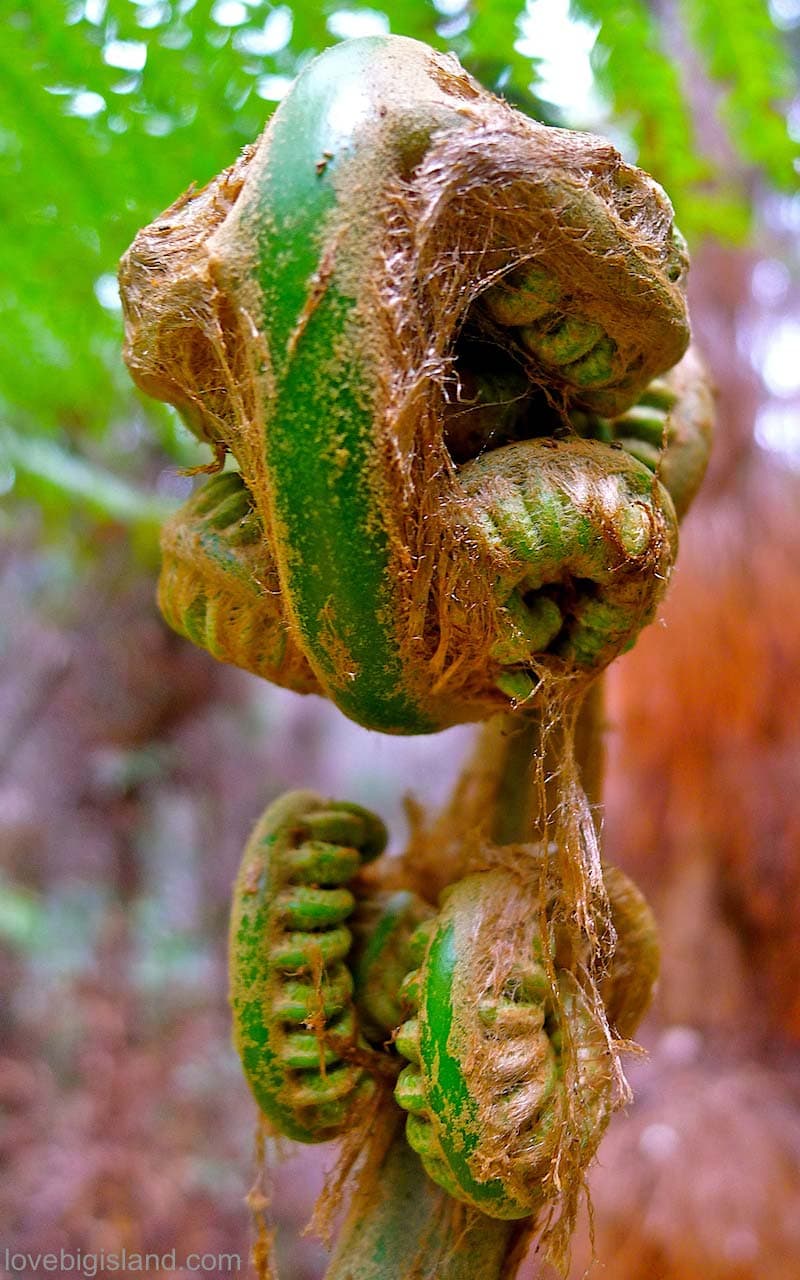
The Hāpuʻu is a tree fern endemic to Hawaiʻi. Normally they grow to be between 7 and 25 ft, but ferns up to 40 ft have been found