
Mauna Kea keeps its snow through the winter, and the island’s fire stays south at Kīlauea. The old story says it was not always settled that way. It took a sled race, and a fight between two goddesses, to drive the fire off the mountain for good.
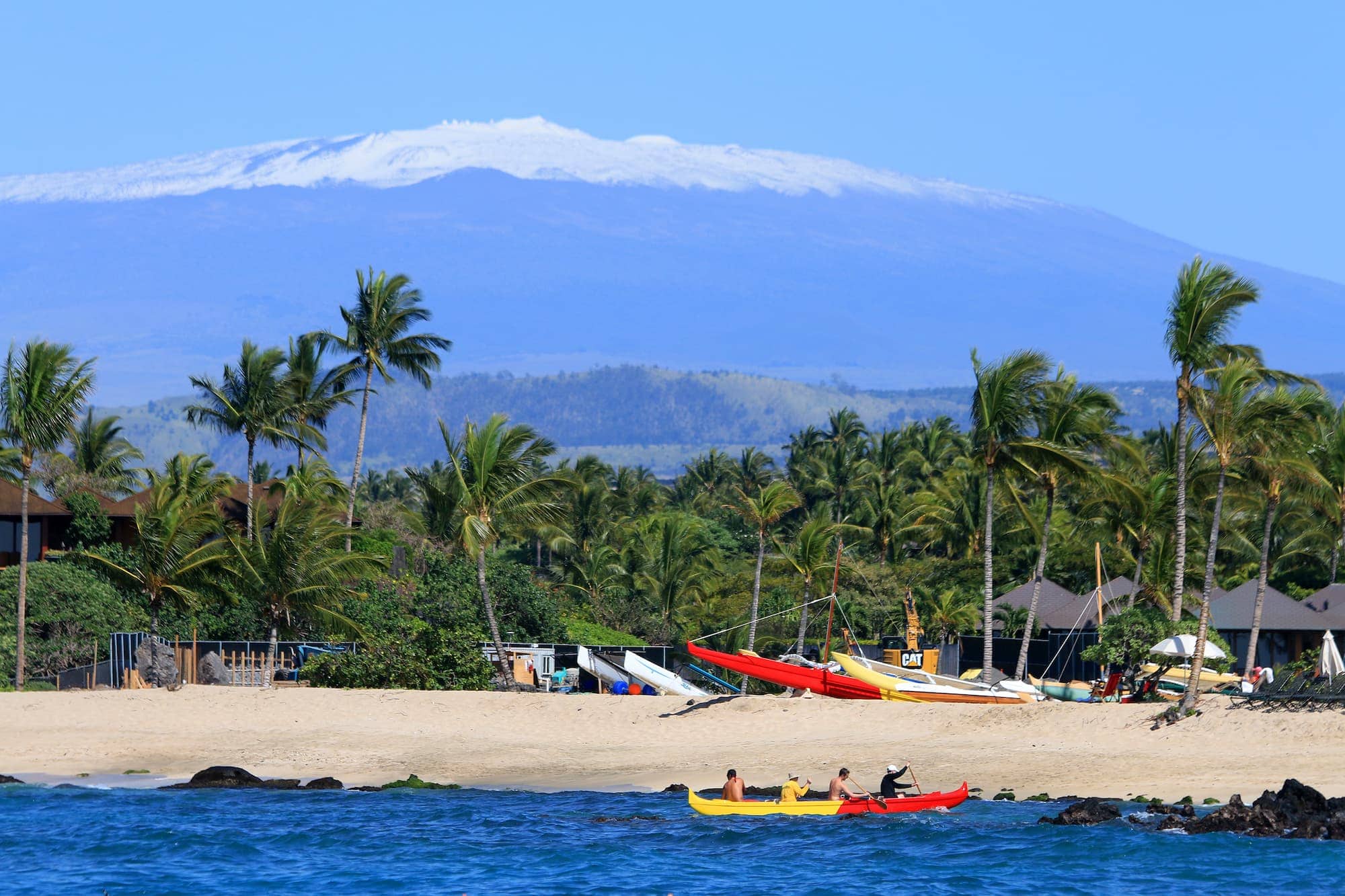
In the legend, Poliʻahu’s snow drove Pele’s fire south to Kīlauea. The sometimes snow topped Maunakea (with telescopes) dominates the island and can be seen from many beaches. Image credit: Hawaii Tourism Authority (HTA) / Kirk Lee Aeder
The legend of Poliʻahu and Pele
Poliʻahu is the goddess of Mauna Kea and the snow on its summit. Three companions shared the mountain with her: Lilinoe of the mist, Waiau of the still water near the top, and Kahoupokane of the springs. Pele, the goddess of fire, lived to the south and was no friend to any of them.
One day Poliʻahu and her companions were racing holua, long narrow sleds, down the grassy slopes above Hāmākua. A woman none of them knew asked to join. She gave her name as Keahilele, flying fire. On the course she ran like fire itself, but Poliʻahu was faster and won the race.
The stranger could not stand losing. She threw down the sled and split the slope open. Smoke and fire came up through the cracks. This was Pele. Poliʻahu knew her at once and fled toward the summit while the lava climbed after her.
Near the top Poliʻahu gathered her strength and threw her mantle of snow down over the mountain. The snow drove onto the fire and cooled the lava until it hardened and choked the burning rivers. The ground went still. Pele was beaten back, and her fire went south to Kīlauea, where it stays. The sled course was gone, buried under new stone.
Mauna Kea, the snow, and Lake Waiau today
Mauna Kea rises to 13,796 feet and holds snow in winter. It is also the island’s stargazing mountain, and the summit stays cold long after the fire moved south.
Just below the summit, at 13,020 feet, sits Lake Waiau, the only alpine lake in Hawaiʻi. It carries the name of Waiau, one of Poliʻahu’s three companions on the mountain.
The two goddesses still divide the island in the telling: snow and cold on Mauna Kea, Pele‘s fire at Kīlauea. Our mythology hub collects the rest of the island’s legends. If you drive up in winter, you can still see the snow on the summit that the legend gives to Poliʻahu.
About this telling
This retelling follows the moʻolelo as the University of Hawaiʻi at Hilo’s Maunakea education material presents it, drawing on Keawe Vredenburg’s account, which names the disguised racer Keahilele and assigns each of Poliʻahu’s companions a domain on the mountain. It builds on the older written version, W. D. Westervelt’s “Pele and the Snow-Goddess” in Hawaiian Legends of Volcanoes (1916), and Martha Beckwith’s Hawaiian Mythology (1940) records the same story and cites only Westervelt for it.
Poliʻahu also appears in the Hawaiian-language romance Ka Moʻolelo o Lāʻieikawai (S. N. Haleʻole, serialized in a Hawaiian newspaper in 1863), but there she is a chief’s bride on Kauaʻi, not Pele’s rival on the sled course. No Hawaiian-language original of the sled-race story itself is known.
Read more
- The deities of Maunakea, at UH Hilo. The stewardship page for the mountain itself, in plain English, and the telling this page follows. It also sets the story in the wider cultural picture of the summit.
- Pele and the Snow-Goddess, in Westervelt’s Hawaiian Legends of Volcanoes. The 1916 chapter, free to read in full. It is the oldest written version of the sled race, and every later telling, this one included, goes back through it.