
In old Hawaiʻi, breaking a kapu (a sacred law) meant death. But anyone who reached a puʻuhonua (a place of refuge), by land or by swimming the bay, was pardoned by a kahuna (priest) and spared. This one, on the south Kona coast, still has the rebuilt Hale o Keawe temple, carved kiʻi (god images), and the Great Wall, dry-stacked lava up to 12 feet tall.
Use the Table of Contents to skip ahead to the information you are looking for:
Table of contents
- About Puʻuhonua o Hōnaunau
- Things to see in the park
- History + cultural significance
- The Kapu system
- Kiʻi
- Practical information
- Things to do close to the park (activities and places to eat)
Ka-Miki and the story of the refuge
One old story shows exactly how this place of refuge worked. It tells how two hunted brothers, Ka-Miki and Makaʻiole, ran onto this ground and threw themselves before the priest, who would not hand them to the chief’s officer, because no one could be taken from a puʻuhonua. Read the full legend: Ka-Miki and the place of refuge
A paved half-mile loop runs through the Royal Grounds and the puʻuhonua, an easy hour on foot with daily ranger talks on the history; the longer 1871 Trail goes 2.25 miles round trip to an abandoned fishing village. The park is about 40 minutes south of Kailua-Kona, and Hōnaunau Bay (Two Step), one of the island’s best snorkeling spots, sits right next door.
Our guide to cultural and historical things to do on the Big Island lists the other historic sites around the island.
About the Puʻuhonua o Hōnaunau National Historical Park
The “place of refuge”, also called the “city of refuge”, sits on the south Kona coast. It was a sanctuary for those who broke a kapu law, an offense punishable by death in old Hawaiʻi. Several of the Big Island myths and legends we retell turn on kapu of this kind, including the law Pele placed on Lohiʻau. If you reached the puʻuhonua, a kahuna would pardon you and give you a second chance at life. A sacred site carrying the powerful mana (spiritual power) of 23 interred aliʻi (chiefs), the Puʻuhonua and Royal Grounds were used by Hawaiians for centuries.
Things to do/see in the park + visitor tips
Walk the park on a self-guided tour along a 0.5-mile trail. Grab a park map that matches the numbered markers along the trail so you can read about each point of interest (or look at pages 4 and 5 of the online version here). A narrated tour by phone follows the same numbered stops; call (808) 217-9279.
Park ranger talks on the history of Hawaiʻi and the park run daily in the Amphitheater next to the Visitor’s Center. Talk times are posted outside the Visitor’s Center, which is open daily.
You can easily spend a few hours here, but if you are short on time, focus on the Royal Grounds and the Puʻuhonua (see map below). The main sections, in order:
- Visitor Center
- Royal Grounds
- Puʻuhonua (place of refuge)
- 1871 Trail & Kiʻilae Village

Annotated map of the Puʻuhonua o Hōnaunau National Historical Park showing park attractions such as the visitor center, the great wall, the royal grounds, and the Puʻuhonua. Satellite image adapted from Google Maps.
Visitor’s Center
The Visitor’s Center and bookstore is where you arrive when you enter the park. Pick up a map for the self-guided tour, and a staff member can answer any questions. The bookstore has a good selection of reads and DVDs on Hawaiian culture, history, geology, and legends. The bathrooms are directly to the left of the bookstore, and the Amphitheater where ranger talks are held is to the right.
The Royal Grounds
As you enter the Royal Grounds, you walk beneath towering coconut palms. These trees are part of a royal coconut grove, planted to commemorate chiefs who have passed on.
The Hale o Keawe temple, guarded by carved wooden kiʻi that stand for Hawaiian gods, is a deeply sacred site. It was built around 1700 to house the bones of Keawe-ʻĪ-kekahi-aliʻi-o-ka-moku, a king of Hawaiʻi Island and great-grandfather of Kamehameha I. After Keawe’s death, 22 others were deposited in the temple along with numerous unnamed warriors.
Hawaiians held that the mana of the bones spread out over the refuge. Today the remains of the chiefs rest in the mausoleum at Mauna Ala on Oʻahu, and Hale o Keawe was reconstructed in the late 1960s.
The temple and the Royal Grounds are separated from the Puʻuhonua by the Great Wall, built over 400 years ago from uhau humu pōhaku (dry-stacked lava rock laid without mortar). In the mid-1960s, close to 80% of the wall was rebuilt. It runs up to 12 feet tall, 18 feet wide, and about 965 feet long.
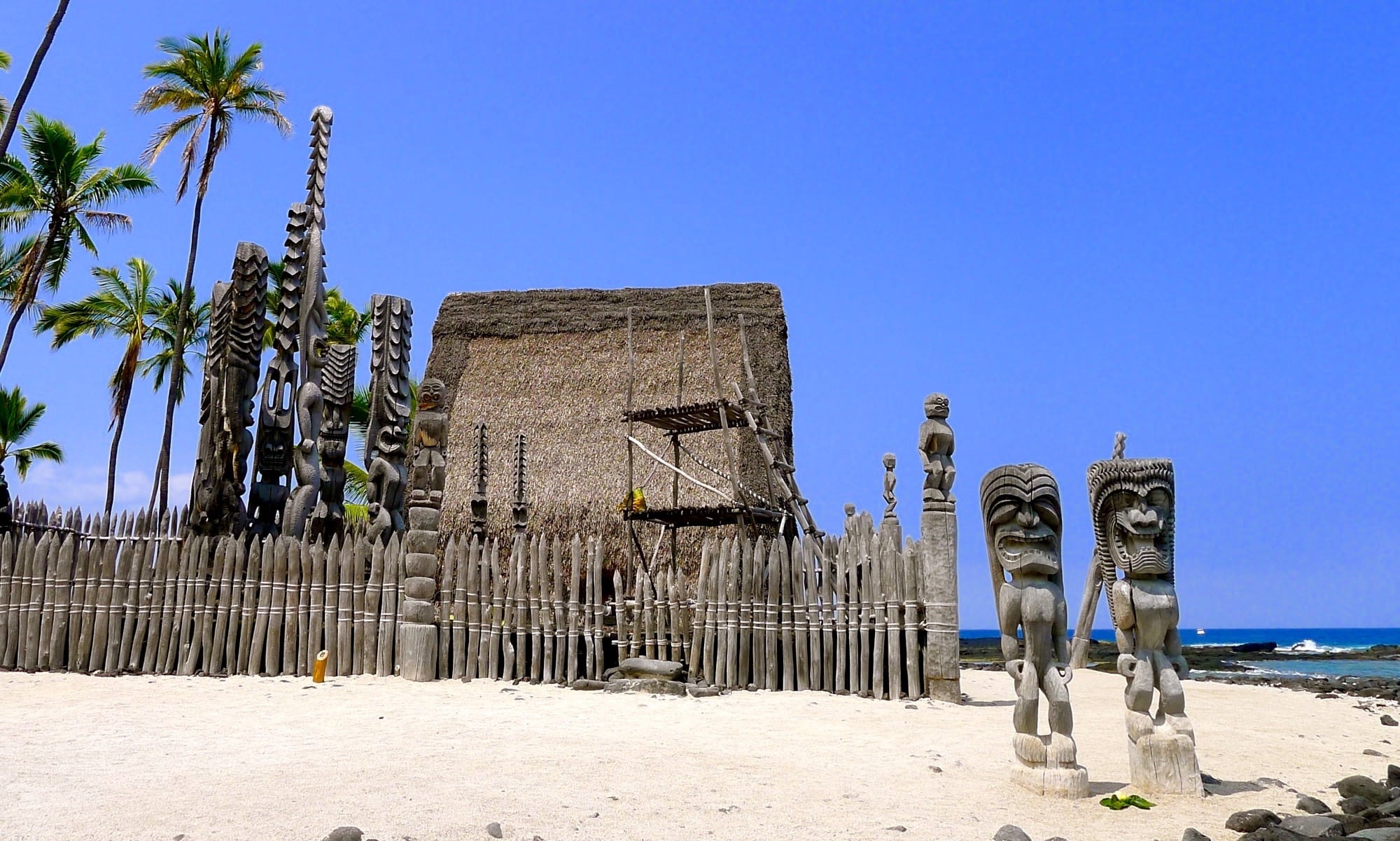
In ancient times Hale o Keawe was a royal mausoleum, housing the remains of deified high chiefs.
Other points of interest inside the Royal Grounds include Keoneʻele Cove, a canoe landing for aliʻi, a Hālau waʻa (canoe house), fish ponds, and Kōnane, a Hawaiian strategy game played with rocks that resembles checkers.
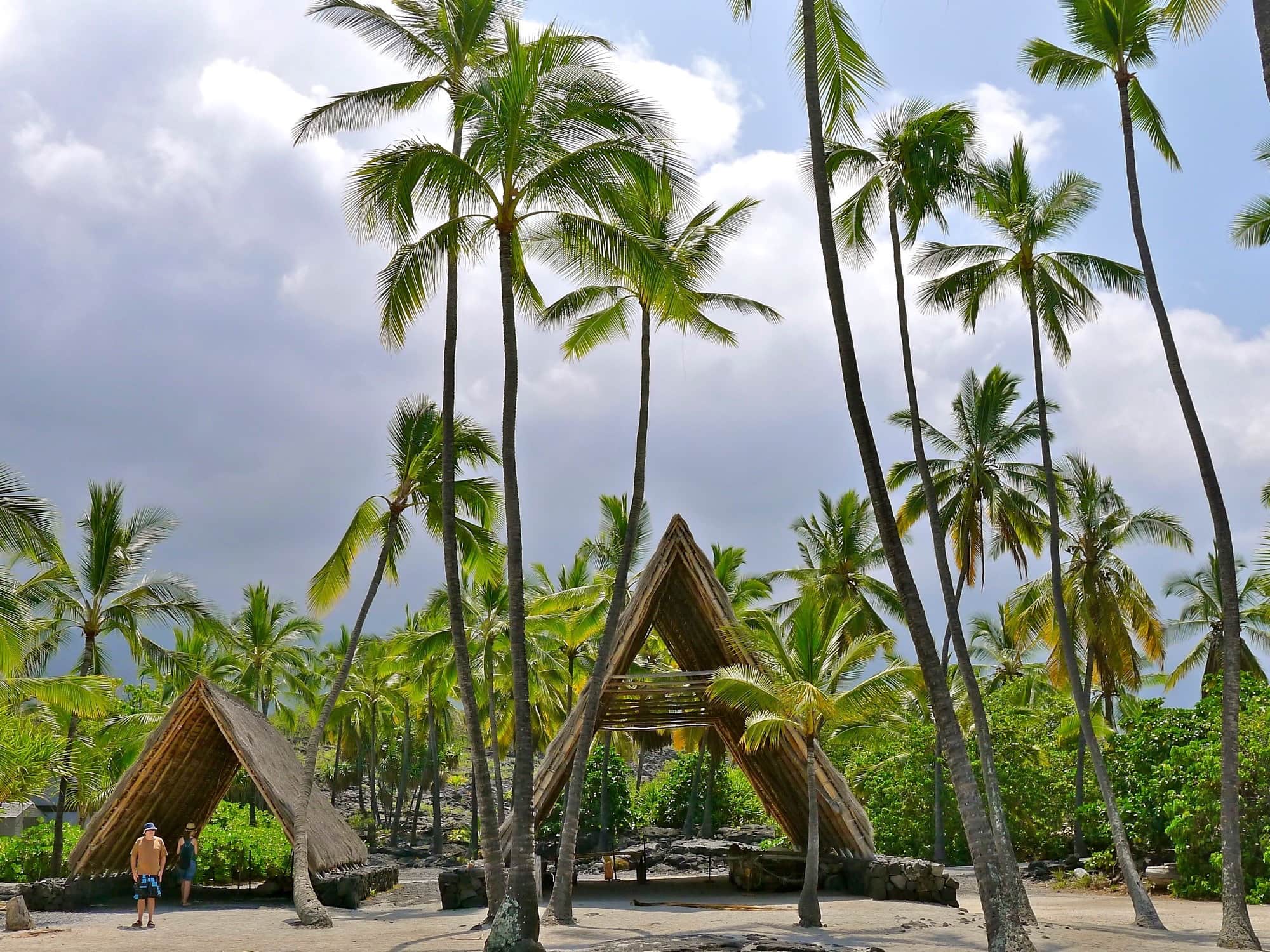
Reconstructed Hālau waʻa that acts as a shelter for canoes on the Royal Grounds
The Puʻuhonua (place of refuge)
Imagine swimming for your life in the open ocean, dodging sharks, currents, and pursuers as a wanted man or woman. You have broken a law in the kapu system, punishable by death. You are headed to the puʻuhonua, the place of refuge, where you can take sanctuary and receive a pardon from a kahuna. A ruling class of aliʻi governed the island through strict enforcement of kapu.
The island was divided into six districts, or moku, each with its own puʻuhonua. Rather than jail or penal punishment, the old Hawaiian way of dealing with those who broke a law was spiritual.
When you visit the Puʻuhonua, you can walk the ground where people sought refuge over the centuries, and see where the aliʻi and kahuna who pardoned them lived. The puʻuhonua also sheltered women, children, and the elderly in times of war. As you walk through it you will see the foundations of older heiau (temples) and the Great Wall that separates the Puʻuhonua from the Royal Grounds.
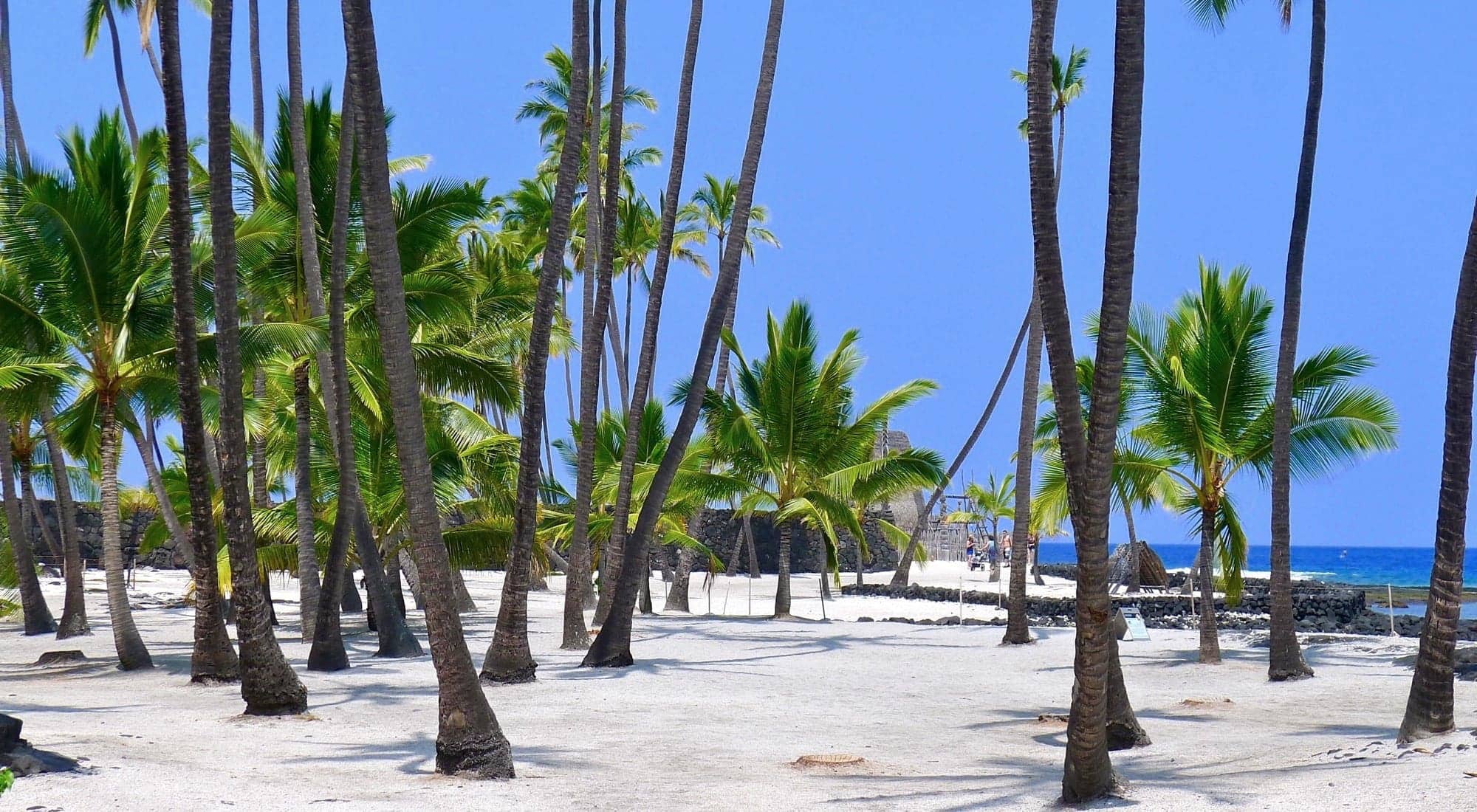
Looking from the Royal grounds through a coconut grove to the Great Wall that shields the Puʻuhonua (place of refuge) part of the park.
1871 Trail & Kiʻilae Village
The 1871 Trail begins behind the Visitor’s Center and leads to the site of an abandoned fishing village, passing Alahaka Heiau and other remnants of old Hawaiian settlement. It is part of the network of foot trails Hawaiians used to move around the island before there were roads.
The hike to Kiʻilae Village is 2.25 miles round trip. The trail is quiet, with mountain views to the left, but it is hot and open with little shade, so carry water. Medicinal noni trees grow along it, and birds perch in them. A second coastal trail intersects the 1871 Trail and makes an alternate route back, passing the site of what was once the Keawe House and ʻOʻmaʻ Heiau.
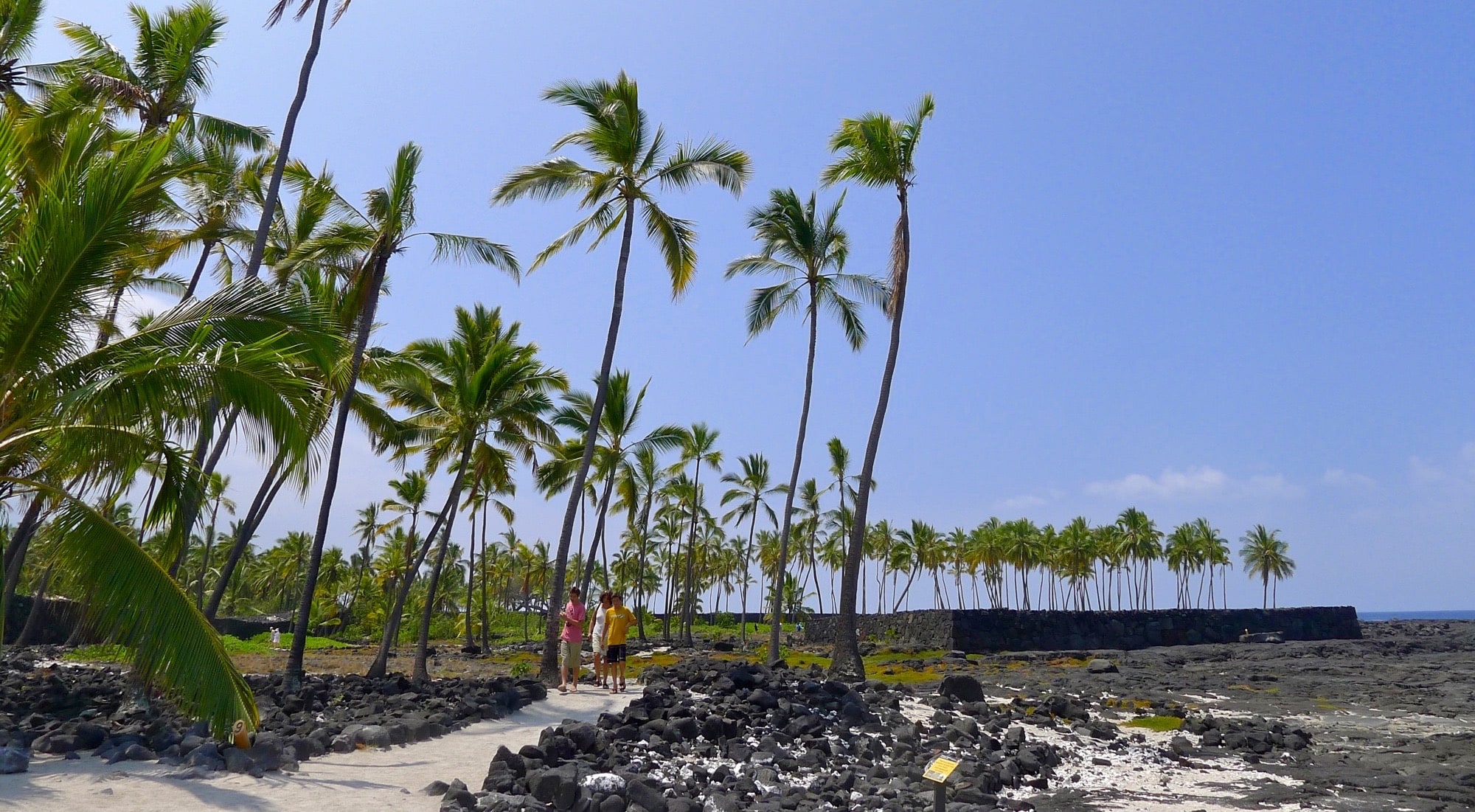
Part of the 1871 trail that leads to the site of an abandoned fishing village
Annual Cultural Festival & Craft Demonstrations
Each summer, on the weekend before the Fourth of July, Hawaiian cultural practitioners gather at Puʻuhonua o Hōnaunau National Historical Park for festivities and traditional craft demonstrations. Artisans demonstrate lei making, lauhala (pandanus leaf) weaving, wood carving, and other Hawaiian crafts. For dates and details, contact the Visitor’s Center or see the park event page.
History & Cultural Significance
Just over 200 years ago, the puʻuhonua was still in active use, and the kapu system was the law across Hawaiʻi.
History of the Puʻuhonua o Hōnaunau National Historical Park
The Puʻuhonua, Royal Grounds, and surrounding historical sites were designated a National Historical Park in 1961. The wall around the Royal Grounds dates back over 400 years, and the original Hale o Keawe temple was built around 1700. Other heiau foundations on the site may be older still.
This sacred site was used by Hawaiians for several centuries, until the kapu system ended in 1819. As Christianity spread and the old religion was suppressed, the temples fell into disrepair or were destroyed. In the late 1960s, the site structures were rebuilt in replica using traditional materials and methods, and the Great Wall and other heiau foundations were restored.
The Kapu System
In old Hawaiʻi, the kapu system was the code of strict laws that governed daily life. Hawaiians believed the aliʻi, the ruling class of chiefs who migrated to Hawaiʻi from Tahiti, held a divine power, or “mana”, that gave them the right to govern.
Many kapu laws controlled access to certain places and regulated the sustainable use of natural resources, as well as maintaining the social order. Commoners could not look an aliʻi in the eye or cast their shadow upon them. Men and women could not eat together, and women could not eat certain foods that symbolized gods, such as bananas, coconuts, or pig. Fishing during spawning was forbidden.
The punishment for breaking a law was death. Jailing or detaining people was not practiced. The only way to escape punishment was to reach the nearest puʻuhonua. Within the walls, you were safe. After a short time in the puʻuhonua, a kahuna would pardon you and allow you to return home.
Kiʻi
Around the Hale o Keawe temple you will notice many kiʻi, carved wooden statues of Hawaiian gods. In the Hawaiian language, kiʻi means “images”. Fashioned from wood or stone, kiʻi are the embodiment of a deity, either akua (gods) or ʻaumākua (personal or family guardians).
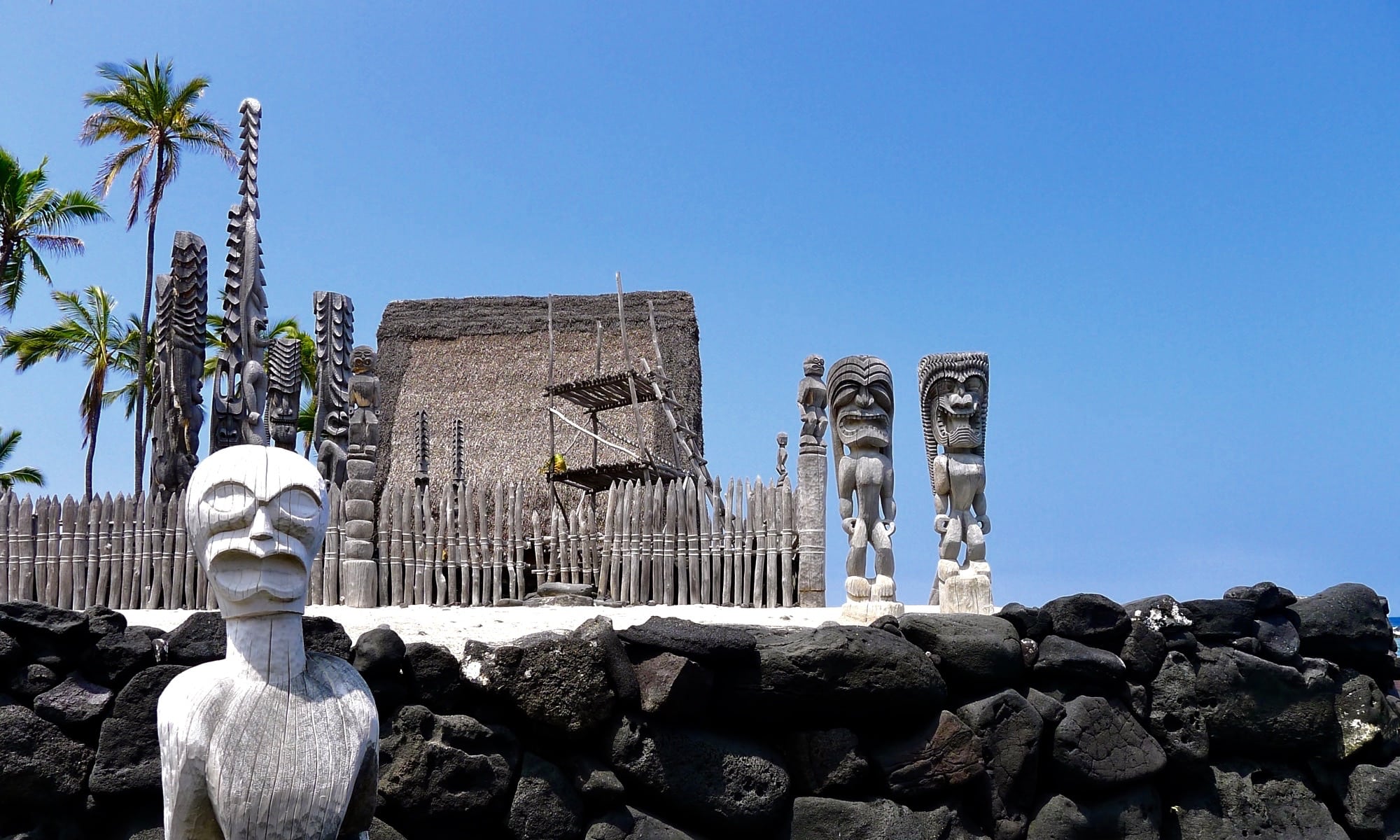
Several Kiʻi (carved wooden statues of Hawaiian gods) in front of Hale o Keawe
Practicalities (directions, admission)
The park is open daily from 8:15 a.m. to sunset (the gates close 15 minutes after sunset), in Hōnaunau, about 20 miles and roughly a 40-minute drive south of downtown Kailua-Kona. Use your GPS, or follow the route descriptions below.
- Directions + parking
- Admission
- Good to know: Visitor tips
Directions:
From Kona, head south on Highway 11 for about 20 miles. Turn right onto Highway 160, which takes you down toward the coast. The park entrance is on your left, marked by a large sign and a kiʻi. Travel time from Kailua-Kona is about 40 minutes.
From Hilo, head to the park over Saddle Road, then follow the directions from Kona. This route is about 100 miles, roughly 2 hours and 11 minutes from downtown Hilo. An alternate route runs around the southern tip of the island, through Volcano, Kaʻū, and Ocean View to Hōnaunau, where you turn left onto Highway 160. It is only slightly longer, about 109 miles and roughly 2 hours and 25 minutes.
Parking:
Parking is just inside the park gates and is included in the $20 per-vehicle entrance fee.
Park admission / entrance fees
The entrance fees are:
- $20.00 per private non-commercial vehicle (15 or fewer passengers), valid 7 days
- $10.00 per person on foot or bicycle, age 16 and older (children under 16 free), valid 7 days
- $15.00 per motorcycle, valid 7 days
- $35.00 Puʻuhonua o Hōnaunau NHP Annual Pass
- $55.00 Hawaiʻi Tri-Park Annual Pass
Good to know: Puʻuhonua o Hōnaunau accepts credit or debit cards only for entrance fees and passes. There is no cash payment.
If you are planning to visit other national parks such as Hawaiʻi Volcanoes National Park, the Hawaiʻi Tri-Park Pass ($55) is the better buy. It covers 1 full year from the date of first use at Hawaiʻi Volcanoes National Park, Puʻuhonua o Hōnaunau National Historical Park, and Haleakalā National Park (on Maui).
Helpful Tips for Visitors
When visiting, keep the following in mind:
- Plan to be outdoors, with little shade
- Wear comfortable walking shoes
- Allow at least 1 to 1.5 hours to see the Puʻuhonua, Royal Grounds, and Visitor’s Center
- Allow more time if you plan to hike the 1871 Trail
- Don’t swim or sunbathe on the park grounds
- Don’t touch, move, or climb on artifacts and sacred sites
Things to do close to Puʻuhonua o Hōnaunau:
The park sits on a stretch of the south Kona coast with plenty of good stops nearby, plus places to eat on the drive back to Kona.
Activities:
- Snorkeling: Right next to Puʻuhonua o Hōnaunau is Hōnaunau Bay (Two Step), one of our favorite snorkeling spots on the Big Island. You’ll see tropical fish and sea turtles in the bay, over large brain coral and lava arches. Entry is off a lava ledge, the two steps the spot is named for, not a sand beach. Bring your own gear, there are no rentals here.
- Kealakekua Bay: A few minutes north, Kealakekua Bay and the Captain Cook Monument have some of the clearest water on the coast, reached by kayak or boat tour.
- Road trip: You can fit a visit into a day-long drive that also includes a Kona coffee farm and more snorkeling. See our South Kona scenic drive for the route.
- Coffee: The south Kona district grows Kona coffee. See our Kona Coffee Guide for our favorite farm tours.
Where to eat nearby
- For an authentic Hawaiian plate lunch, head to Super J’s (or see their Facebook page ) in Hōnaunau for laulau (pork wrapped in taro leaf and steamed).
- Just south of Captain Cook, The Coffee Shack serves American breakfast and lunch with wide views of the coast far below. They also do good pie and coffee.
- Further north, Kainaliu town has several options, including Annie’s Burgers and Kaya’s Cafe, a local coffee shop with homemade quiche and vegan and gluten-free baked goods.
- Historic Teshima’s restaurant serves a mix of local, Japanese, and American food in a sit-down setting.