
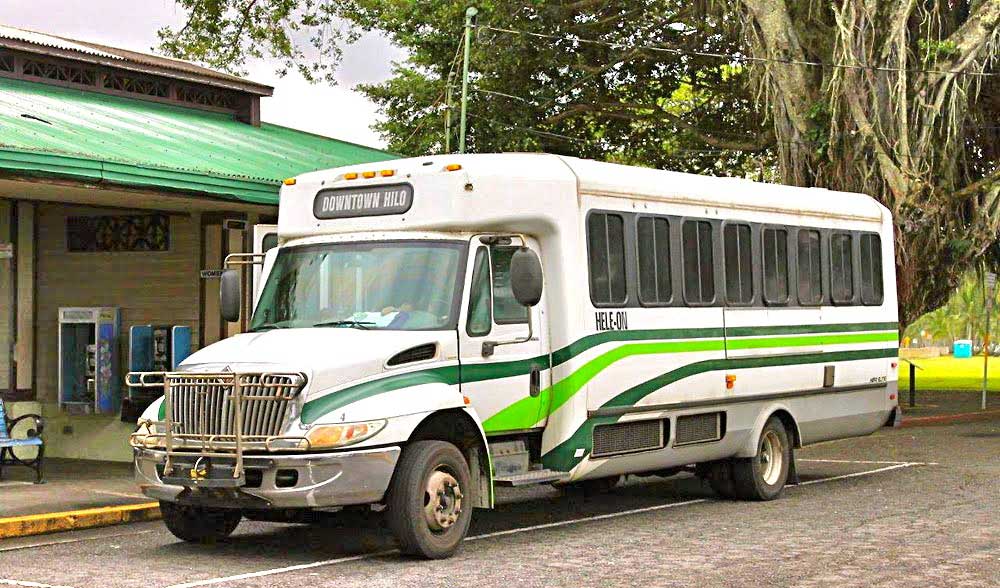
The Hele-On bus is free for every passenger through 2028, part of a county fare-free experiment. But Hele-On is built for local commuters, so it’s slow and limited if you want to string together the island’s sights in a day.
This guide is for the traveler weighing the bus against a rental car, or planning a car-free day. Most visitors rent, because the island is large and Hele-On’s rural routes run only a few times a day. It does reach Hawaiʻi Volcanoes National Park seven days a week, so you can spend a day at the crater without a rental car.
This guide covers:
Table of contents
- The bus price and schedule
- Taking the bus from the airports
- The (dis)advantages of taking the bus
- The shared ride (taxi) program
If the bus and shared rides seem like too much of a hassle, have a look at our car rental tips for the Big Island.
How much does the Hele-On bus cost?
Right now, nothing. The Hele-On bus is free for every passenger until December 31, 2028, and while the fare-free program runs there’s no ticket to buy and no fare to pay. You board and ride.
The baggage rule is simple: anything that fits under your seat or on your lap rides free, but a large suitcase or bulky item that would block the aisle or take up a second seat isn’t allowed on board at all. Plan for that if you’re heading to or from the airport with checked luggage. Bikes ride free too, either on the rack on the front of the bus or stowed in the baggage compartment on the larger buses.
One cost still applies: if you ride to Hawaiʻi Volcanoes National Park and get off there, you owe the park’s $15 per-person entrance fee, paid at the gate and good for seven days.
Hele-On bus schedule and trip planners
The bus runs seven days a week, but the schedule is built around local commuters, not sightseeing. Fixed routes cover a wide window across the system, roughly 3:15 a.m. to 2:30 a.m., though any single route runs far less often than that, and the rural routes that reach the more remote corners of the island may only come by a few times a day. Some routes run Monday through Friday only.
Check the current route timetables and maps on the county’s official Hele-On bus schedules and maps page. Times are approximate, so build in a buffer and confirm the last departure before you rely on a bus for the trip back.
You can also plan a point-to-point trip with Moovit, which maps out the routes and transfers between two locations. Try the Moovit trip planner.
Hawaii Bus Plus, an app built for the Hele-On bus
There’s no official Hele-On app, but a local developer built Hawaii Bus Plus, which works like the transit apps you already know. It finds the routes nearest you and shows when the next bus is due, with point-to-point directions across multiple routes. It also maps HIBIKE Bikeshare stations, the island’s bikeshare, for the last stretch.
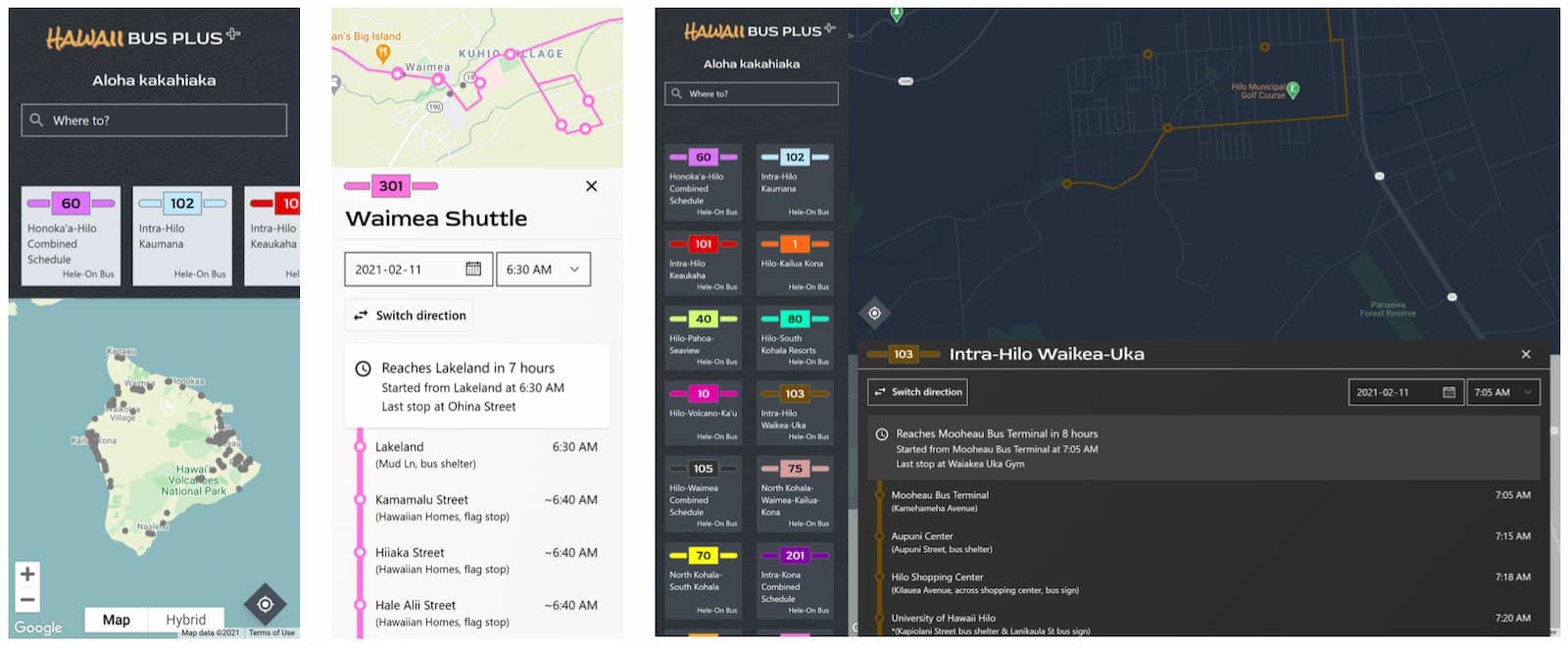
Several examples of what the Hawaii Bus Plus app looks like on a phone and tablet.
Hawaii Bus Plus dropped its subscription and is now free to use on the web, with no download required. See the Hawaii Bus Plus website to get started.
Taking the bus to and from the airports
You can reach both main airports by bus, but buses to the airports are infrequent, so plan around it rather than assuming a bus will be waiting. Hilo International connects on Route 101 (Keaukaha), from a stop between the airport restaurant and the helicopter counter. The Kona airport (Ellison Onizuka International at Keahole) is served by several routes, including Route 2, the Blue Line, from a stop by the rideshare pickup across from Hawaiian Airlines and TSA.
Only a handful of trips serve each airport a day, so check the exact times before you fly and keep a backup in case the bus doesn’t line up with your flight. The county’s airport service page has the current routes and stops, and our guides to the Hilo airport and Kona airport list the ways to reach each airport.
When the Hele-On bus makes sense
If you have time, the bus does get you between towns. Routes stick to the more populated areas, service thins out in the evenings and on weekends, and you should expect to walk a fair way to and from stops.
For most sightseeing it’s too slow, with a couple of exceptions. Hele-On runs to Hawaiʻi Volcanoes National Park seven days a week, so you can get to the park for the day without a car. It also reaches Mauna Kea State Recreation Area, mid-elevation on Saddle Road, seven days a week. That stop is not the summit or the Visitor Information Station, though, so the bus won’t get you to the summit or the stargazing higher up.
On a cross-island ride you sit among local residents, which you don’t in a rental car.
The bus is fine for a slow, cheap trip but a poor fit for a packed one. If your days are full, a rental car is the faster and more flexible choice.
The shared-ride taxi program (Hilo only)
The Hilo area has a subsidized shared-ride taxi program that fills the gaps the fixed bus routes leave. The county covers up to $15.80 per trip, about four miles, and you pay whatever the metered fare runs beyond that. Travel is unlimited now: the county dropped the old distance cap and mail-order coupon books when it overhauled the program in 2023.
To use it you need a Shared Ride Program Identification Card. Fill out the participation form on the county’s shared-ride taxi program page and send a copy of your ID. Service hours match the regular bus routes; rides outside those hours run at the full metered rate.
There’s no participating shared-ride taxi in Kailua-Kona right now, so on the Kona side you’re looking at a regular taxi or a rideshare app like Uber or Lyft.