
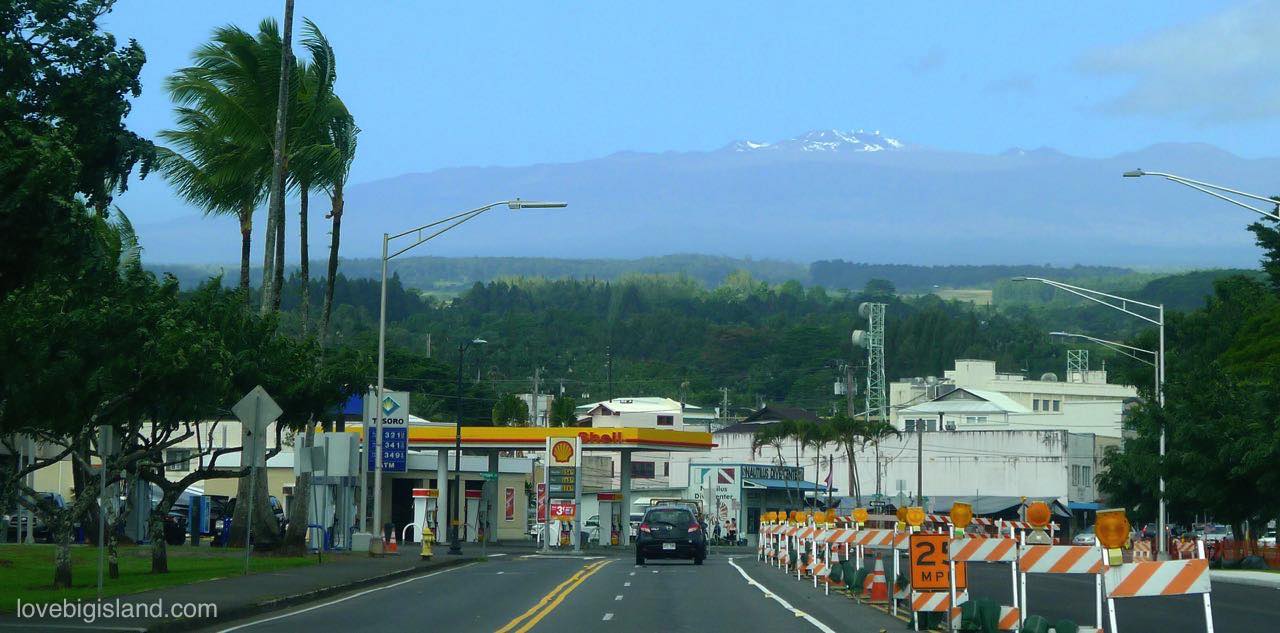
Rent a car. At 95 miles across at its widest point, the Big Island is bigger than all the other Hawaiian islands combined, and the bus is too infrequent to rely on. At 45 to 55 mph the whole way, crossing the island takes a couple of hours.
Even a rental has limits: most agencies won’t let their cars near Maunakea’s summit or Green Sand Beach. The bus and taxis cover some trips without a car, and some tours reach places a rental can’t.
Table of contents
- Getting around with a rental car
- Driving between Kona and Hilo: the three routes:
- Getting around without a rental car:
- Flying between the Hawaiian islands
- The dos and don’ts of Island Hopping
- Flying to Hawaiʻi
Getting around the Big Island with a rental car
A rental car reaches all three sides of the island; without one you are mostly limited to one. Hele-On runs buses between Kona and Hilo, including one over Saddle Road, but they run on a commuter schedule, with departures bunched in the morning and late afternoon.
Hilo’s airport (ITO) has rental counters right across from the terminal; Kona’s (KOA) counters sit at a separate baseyard reached by a short shuttle from baggage claim. Both cruise ports also have rental car agencies nearby.
Even with a rental car, some places stay out of reach. Most agencies, for example, forbid taking their cars up to the summit of Maunakea (for stargazing) or out to the Green Sand Beach.
Driving between Kona and Hilo: the three routes
Kona and Hilo sit on opposite sides of the island, and there are three ways to drive between them. One is fast and direct across the middle; the other two follow a coast and take longer, with more to see on the way.
Take Saddle Road when you just need to get from one side to the other. Pick a coast route when you have the day to spend on the drive, and with kids, drive any of the three in daylight.
Saddle Road, the fast and direct way
About 80 miles and roughly an hour and a half in daylight with no stops, this is the quickest way between the two sides. Officially it’s the Daniel K. Inouye Highway, Highway 200, though we, like everyone on the island, still call it Saddle Road. The road runs across the saddle between Mauna Kea and Mauna Loa above 6,000 feet, and near the top it gets cold, with fog and low cloud that can come in fast. There are no gas stations or services, so fill up first.
Feral goats wander onto the pavement, day and night. The Mauna Kea Access Road turnoff for the summit and the stargazing area is around mile marker 28, across from the Puʻu Huluhulu cinder cone. A standard car is fine on the highway and the road up to the visitor station, but the summit road above needs 4WD, and most rental companies won’t allow it.
North around the Hāmākua coast, the scenic way
This route is about 95 miles and takes roughly two hours in daylight with no stops, longer than Saddle Road. It runs north through Waimea’s ranch country, then down the Hāmākua coast on Highway 19. The coast here is cut by one gulch after another, through rainforest and former sugarcane land.
Good stops include ʻAkaka Falls, which drops 442 feet at the end of a short rainforest trail, and Laupāhoehoe Point. This is the windward, rainy side of the island, so expect passing showers along the way.
South around Kaʻū, the long way to the volcano
At about 125 miles and close to three hours in daylight, this is the longest of the three, south from Kona on Highway 11. Along it you pass Kona coffee country around Kealakekua, the wide-open ranch and lava land of Kaʻū around Nāʻālehu, and Punaluʻu black-sand beach before the final climb up to Volcano. It’s the way to Hawaiʻi Volcanoes National Park and Volcano Village, and from there Highway 11 runs on to Hilo.
The Kaʻū stretch is remote and unlit once it’s dark, with feral pigs crossing the road at night, so drive it in daylight.
How to get around the Big Island without renting a car
Skipping the rental makes sense if you won’t cover much ground, or if driving on the right side of the road isn’t second nature.
Public Transport (the Hele-On Bus)
The Hele-On bus is free to ride for everyone through the end of 2028, part of a county fare-free program. Routes reach most of the island, but connections are infrequent and rides run long, since the schedule is built around commuters, not tourists, with most departures clustered early morning and late afternoon.
Hele-On bus routes and schedules
Taxi, Uber, and Lyft on the Big Island
Uber and Lyft have both operated on the Big Island since 2017. Download the app before you land: drivers are easy to find around Kailua-Kona, Hilo, Waimea, and Waikoloa, and scarce elsewhere on the island.
Taxis exist, mostly around Kona, but they’re not cheap: worth checking rideshare pricing first.
Lyft on the Big Island (airport rides available)
Lyft picks up at both KOA and ITO, with a marked pickup zone at each terminal.
Lyft’s Big Island page has the current pickup zones and service area.
Uber on the Big Island (airport rides available)
Uber also picks up at KOA and ITO, with a pickup zone at each terminal.
Uber’s Big Island page has the current pickup zones and service area.
Taxis in Kona
Kona has taxis (Yelp lists several), but don’t count on flagging one down. Book ahead for pickup instead.
For ballpark pricing, the airport’s own estimate list runs from about $20 for short rides nearby to around $300 for a ride to Volcano or Hilo. Confirm the fare with your dispatcher before the ride, since the published rates are estimates and subject to change.
Taxis in Hilo
Hilo has only a handful of taxis (Yelp lists several). The county’s old coupon-based Shared Ride Taxi Program ended July 1, 2023. It now runs as a subsidy: the County of Hawaiʻi Mass Transit Agency covers up to $15.80 per trip, about 4 miles, with a participating taxi company, and the rider pays anything above that. A handful of taxi companies participate, all serving Hilo; the rest of the island has none.
Signing up requires a Shared Ride Program Participation Form and a copy of your ID, and you’ll need to show your Shared Ride Program card to the driver to get the subsidy. Sign up through the Hele-On shared ride program page.
Using guided tours to get around
Guided tours make sense if you’re staying at one property for the whole trip and only need transport for sightseeing days. Costs can grow quickly for larger groups booking multiple tours.
Guided tours range from shared shuttles to private limos. You don’t need to plan a route, and some tours include food.
These tours are easiest if you’re staying at one of the larger hotels or resorts on the Kona coast. Before booking, confirm you can be picked up at your hotel. If this isn’t possible, know how you’ll reach the tour’s starting point instead.
Tours run on fixed timing, so book ahead, since canceling last minute can cost you the deposit.
Traveling between the Hawaiian Islands
Visiting more than one Hawaiian island on a single trip is common, and Oʻahu, Maui, and Kauaʻi are the usual add-ons to a Big Island stay. Sequencing the islands well can save half a day of travel time and money on interisland fares. Our guide to planning multiple islands covers how many islands fit in one trip; our interisland flights guide explains fares and how to save money on them.
The dos and don’ts of Island Hopping
Hawaiʻi has six major islands, and each one feels distinct.
But more islands doesn’t always mean a better trip. Island hopping adds flights and airport time, and one island is often plenty for a single trip.
Our island hopping guide covers the case for and against adding islands, plus specific ways to cut interisland fare costs.
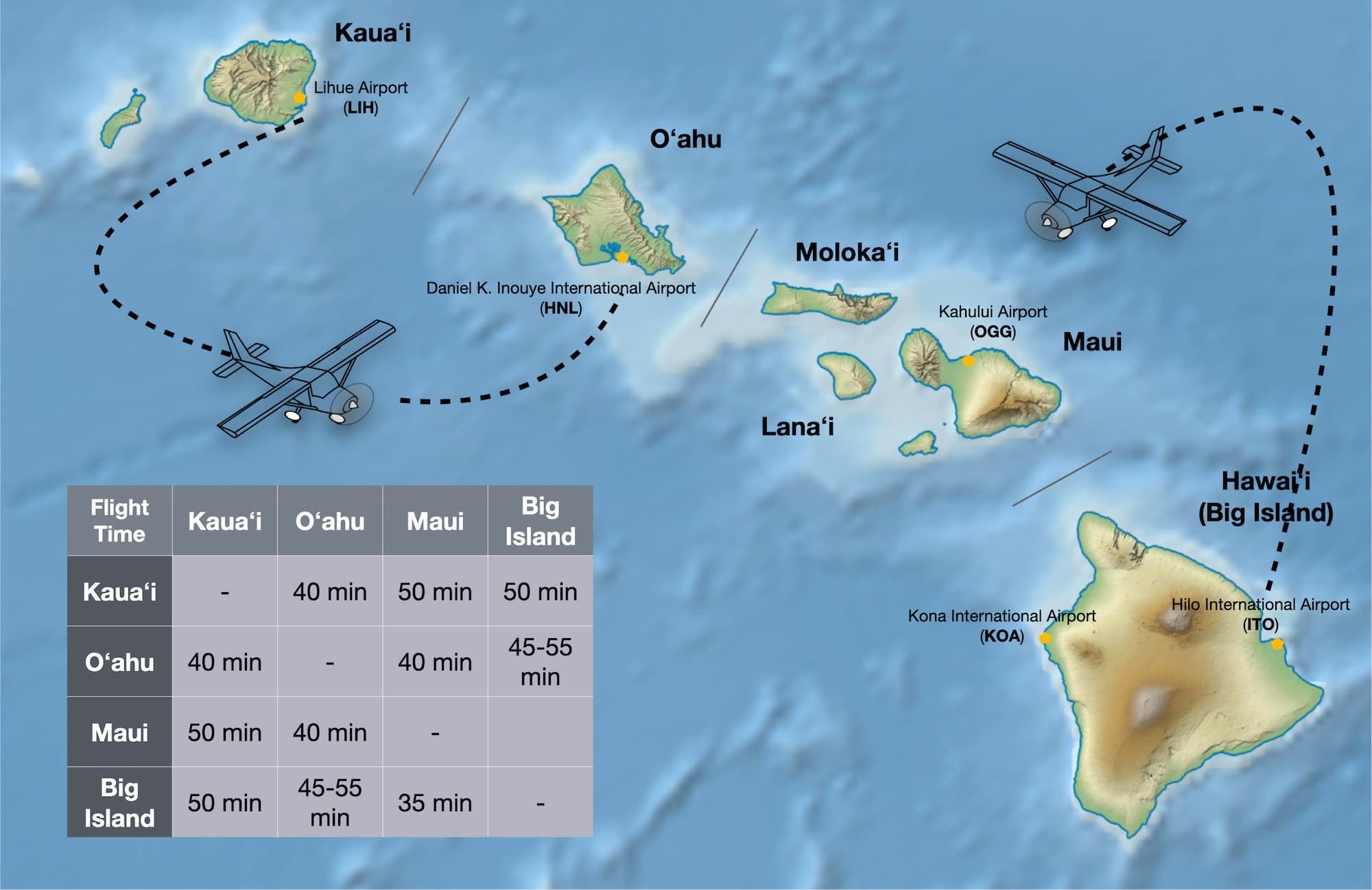
Approximate flight times between Hawaiian islands.
Flying to Hawaiʻi
Airfare to Hawaiʻi varies widely by season and how far ahead you book. Fares usually run lowest in the fall shoulder season and highest over summer and the winter holidays. Our flying to Hawaiʻi guide breaks down both, drawing on our own fare tracking.