
2025 is a good year for stargazing here on Hawaiʻi with a total lunar eclipse and several well-timed meteor showers.
These are the most important 2025 stargazing dates for Hawaiʻi:
If you are in the mood of planning ahead you should reserve the following dates in your calendar for stargazing:
Table of contents
- January 3: Quadrantids meteor shower
- March 13: Total Lunar Eclipse
- April 21: Lyrids meteor shower
- May 5: Eta Aquariids meteor shower
- May 18-30: lahaina noon (1/2)
- June 20: Summer solstice
- July 11-24: lahaina noon (2/2)
- August 12: Perseids meteor shower
- October 21: Orionids meteor shower
- December 13: Geminids meteor shower
- December 21: Winter solstice
This stargazing calendar will help you plan your nights to make the best of the biggest celestial events of 2025. To make the most of your time we recommend that you go to one of our favorite stargazing spots and read our Meteor shower guide for more viewing tips and background information about shooting stars.
Newsletter reminders for stargazing events
Subscribers receive a monthly newsletter that includes upcoming local events, volcano updates, new and noteworthy places and restaurants and other venues, and all the important astronomy events.
Also, don’t forget to have a look at our guide: stargazing on the Big Island. The MaunaKea volcano hosts some of the best telescopes of the world, and a visit to these telescopes is a must if you are into stargazing!
Stargazing events for Hawaiʻi (2025)
Stargazing highlights for Hawaiʻi in 2025 are the total lunar eclipse on March 13 (here), and the Geminids Meteor Shower in December (here).
January 3rd: Quadrantids Meteor Shower #
Active: December 28–January 12; Maximum: January 3, 5:00 AM HST, ZHR = 80 (can vary ≈ 60 − 200).
The year starts with the Quadrantid peak for the northern hemisphere observers on January 3 early in the morning. An early moonset means that both the very early morning of January 3rd and the night of Jan 3 on Jan 4th are good times to see the shooting stars.
On January 2nd the moon sets already at 9 pm, but the best time to watch the quadrantids is from midnight to ~5 am – the later the better!
On January 3rd, the moon sets around 10 pm, and the best viewing hours are between midnight and approx 3 am.
Activity for the shower extends until about January 12th and even a few days after the actual peak, bright fireballs have been observed.
Quadrantids trivia
The Quadrantids meteor shower is named after an abandoned constellation named Quadrans Muralis. This constellation was invented in 1795 by the astronomer Joseph Jérôme de Lalande to honor the wall-mounted instrument which he used for measuring star positions (a “Quadrant” is an improved astrolabe, and is used to measure angles up to 90°; “muralis” is Latin for wall). The constellation never really “caught on” and its use was quickly abandoned. However, it now is the most well known out-of-date constellation because it gives its name to the Quadrantids meteor shower.
The Quadrantids are special among meteor showers because this shower has a very ‘sharp’ peak intensity. The shower is most active for only a short amount of time (the meteor rates exceed one-half of their highest value for only about 8 hours). This means that the space debris that causes this shower has been left ‘on location’ pretty recently, within the last ±500 years.
March 13: Total Lunar Eclipse #
Mark Your Calendar: A Total Lunar Eclipse is Coming!
On the evening of March 13, 2025, a total lunar eclipse will be visible from all Hawaiian Islands. The eclipse will last from 8:26 PM to 9:31 PM, offering a stunning celestial display.
The moon will already be high in the sky when totality begins, positioned 24 degrees above the horizon—rising to 39 degrees by the time the eclipse ends. For perspective, if you stretch out your arm and make a fist, the height of your fist represents about 10 degrees of the sky.
To get the best view, choose a location with an unobstructed view toward the east. Since the moon will be bright and prominent, most open areas will do. But why not make it an experience? Head to one of our favorite sunrise viewpoints for an unforgettable sight!
Read more about this eclipse on the Time and Date website.
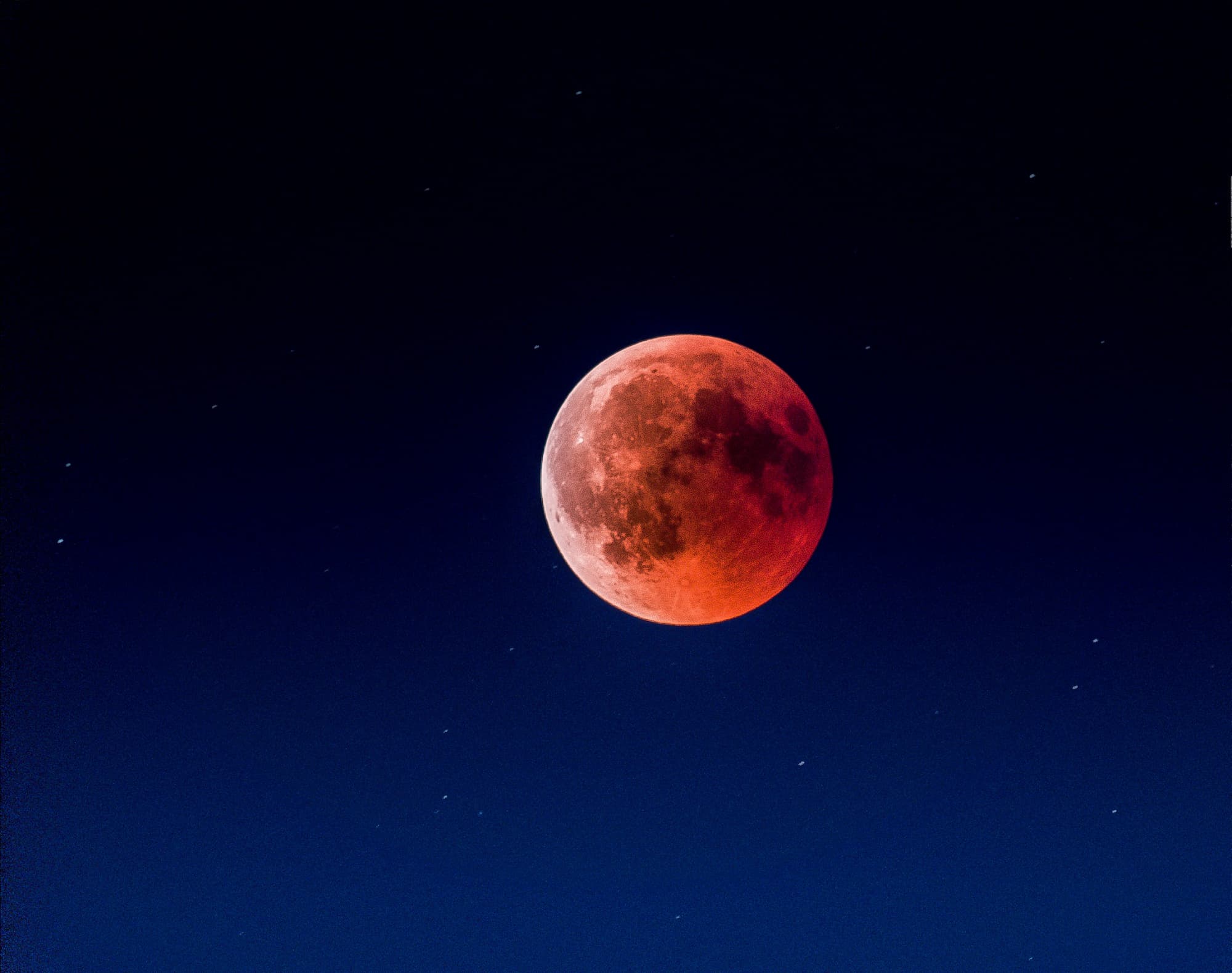
During a lunar eclipse the moon gets blood-red as it dips into earth’s shadow. Photo by Martin Adams on Unsplash
April 21: Lyrids Meteor Shower#
Active: April 14–30; Maximum: April 22, 3:30 AM HST; ZHR = 18 (can be variable, up to 90).
2025 is not a good year to observe the Lyrids as the moon rises at 02:30 AM on April 22nd. If you want to go out and catch a few shooting stars we recommend you do so in the hours around midnight.
Fun Facts about the Lyrids meteor shower
The shooting stars of the Lyrids are small parts of space-debris left behind by the comet Thatcher (C/1861 G1). They are (arguably) the first documented meteor shower with reports going back possibly up to 2600 years (687 BC, two years after King Sennacherib of Assyria sacked Babylon).
most years you can see between 10 and 20 shooting stars/hour at peak intensity, but there have been years where a true meteor shower took place, and peak rates of 90/hour were reported. The last time this happened was in 1982, but there is also a very interesting report from a newspaper in Richmond, Virginia on April 23rd, 1803. This newspaper described the shower as follows:
…Shooting stars. This electrical phenomenon was observed on Wednesday morning last at Richmond and its vicinity, in a manner that alarmed many, and astonished every person that beheld it.
From one until three in the morning, those starry meteors seemed to fall from every point in the heavens, in such numbers as to resemble a shower of sky rockets…
These outburst are quite rare, but the point we want to make is that you never know what to expect with the Lyrids.
May 5: eta-Aquariids Meteor Shower#
Active: April 19–May 28; Maximum: May 5, 5 PM HST; ZHR = 50 (can be variable, 40 to 85).
The moon is getting bright during the peak of the Eta Aquariids so it is best to time your stargazing in the hours between moonset (02:31 AM on My 6th) and an hour before sunrise (05:57 on May 6th).
Eta Aquariids Trivia
Did you know that the Eta Aquariids have a sister meteor shower? The Eta Aquariids meteor shower happens when earth passes through the space-debris left by Halley’s Comet. Because Halley’s comet and our planet orbit the sun in the same plane, there is another point in space where earth crosses the debris from this comet. When this happens, we see the meteor shower the Orionids (and not the Delta Aquariids as people often think).
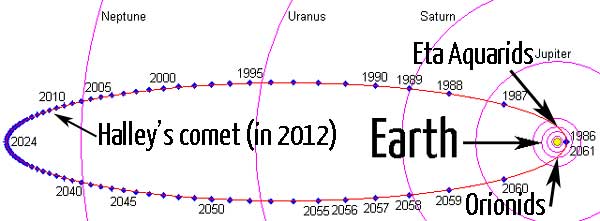
Current position and orbit of Halley’s comet around our solar system. Every blue dot shows you where the comet is in that year. You can see the comet passes twice (in 1986 and 2061) close to earth, leaving enough space-debris to cause two meteor showers: the Eta Aquariids (early May) and the Orionids (late October). Image adapted from source.
Halley’s Comet is the most famous short period comet of our solar system, and returns every 75 or 76 years. The last time it flew by was in 1986, the next time will be in 2061. Right now Halley’s Comet is deep in the outer solar system (beyond Neptune!) but you will still be able to see little particles of it burn up into earths atmosphere twice a year during the Eta Aquariids and the Orionids meteor showers.
Each time it swings by the sun, solar heat vaporizes about 6(!) meters of ice and rock from the nucleus. The debris particles, about the size of sand grains, spread along the comet’s orbit, filling it with tiny meteoroids.
May 18-30: lāhainā noon#
Hawaiʻi is the only tropical state in the USA. This comes with certain perks such as tropical weather and the two times each year when the sun is directly overhead and you don’t cast any shadow!
Lāhainā noon is a recent (1990) term, introduced to give a name to the time of day on which the sun is directly overhead. “Lā haina” means “cruel sun” in the Hawaiian language, but don’t worry, the sun isn’t that cruel here! Unless you are on the hot lava plains without enough water to drink that is.
On the Hawaiian islands the 2025 lāhainā noon will happen at the following times for these cities:
- Honolulu (Oʻahu): 12:28 PM (May 26)
- Kahului (Maui): 12:22 PM (May 23+24)
- Līhuʻe (Kauaʻi): 12:35 PM (May 30)
- Hilo: 12:16 PM (May 17+18)
- Kona: 12:20 PM (May 17)
If you’d like to look up the lāhainā noon for any other place the easiest way to do so is to look up the time and date of solar noon on which the altitude of the sun is exactly 90 degrees. You can do this for example on the timeanddate website. Alternatively you can go to this website to see the point on out planet where lāhainā moon is happening right now.
June 20: Summer Solstice and Midsummer Night#
Happy Summer Solstice, today is the first day of astronomical summer! The 2025 summer solstice takes place in Hawaiʻi at June 20 at 4:42 am HST (calculated for Honolulu).
The Hawaiian term for summer solstice is “Ka māuikiʻikiʻi o ke kauwela” [source].
Midsummer night is the shortest night of the year, and you could try to make your midsummer night a special one. What better excuse is there for a celebration? Many cultures have festivities linked to the summer solstice, so what about organizing your own midsummer night party or pau hana’s?
July 11-24: lāhainā noon (2/2) #
Lāhainā noon is the moment when the sun is standing directly above you. This means that the only shadow you cast is directly below you, and that tall vertical objects. such as for example phone poles and beer bottles, won’t cast a shadow at all!
You can read a more elaborate explanation about the lāhainā noon at the may listing of this event(1/2).
On the Hawaiian islands, the 2025 lāhainā noon will happen at the following times for these cities:
- Honolulu (Oʻahu): 12:37 PM (July 15)
- Kahului (Maui): 12:32 PM (July 17+18)
- Līhuʻe (Kauaʻi): 12:43 (July 11)
- Hilo: 12:26 PM (July 23+24)
- Kona: 12:30 PM (July 24)
August 12: Perseids Meteor Shower#
Active: July 17–August 24; Maximum: August 12; ZHR = 100.
The Perseids are one of the “Big 3” meteor showers but 2025 is not a good year to watch them. The Perseid maximum on August 12 occurs shortly after the Full Moon and the gibbous moon will be badly affecting the visible rates as it gains height together with the radiant.
Perseids Trivia
The Perseids happen each year as earth passes by a trail of dust, gas and ice left behind by the comet Swift-Tuttle. This comet was first documented in 1862, and returns to the sun every 130 years (the next time it will be visible from the earth will be in 2122). The earliest recorded sighting of Perseids dates back to 36 AD, when mention was made of “more than 100 meteors” in Chinese annals (source).
The Perseids are also referred to as the “tears of St. Lawrence”, because the festival of this saint is very close (August 10th) to the peak of the Perseids. The story of Laurentius (Lawrence), a Christian deacon, is the following: Laurentius was martyred by the Romans in 258 AD on an iron outdoor stove. It was in the midst of this torture that Laurentius cried out: (source)
I am already roasted on one side and, if thou wouldst have me well cooked, it is time to turn me on the other.
In honor of this history, one very appropriate midnight-snack to take out is the typically Hawaiian “Huli-Huli” (= turn-turn in Hawaiian) Chicken.
In Polynesia, Perseus was not commonly recognized as a separate constellation; the only people that named it were the people of the Society Islands, who called it Faa-iti, meaning “Little Valley” (more).
October 21: Orionids Meteor Shower #
Active: October 2–November 7; Maximum: October 21; ZHR = 20.
The maxima of the Orionids meteor shower is free of moonlight, making 2025 a good time to look for Orionids.
How to best see shooting stars from the Orionids meteor shower
Shooting stars from the Orionids meteor shower are easy to find: just find the Orion constellation, look in its general direction, and relax your gaze.
To find the Orion constellation you should look for the three bright stars in a line that make up the belt of Orion. These stars rise over the Eastern horizon just after sunset and will keep rising towards the east-south-east until they are almost overhead at dawn [how-to guide].
You can read more viewing tips in our meteor shower guide.
Orionids Trivia
The Orionids are the brighter sibling of the Eta Aquarids meteor shower (early May). Both showers are caused by debris left by Halley’s comet.
Current position and orbit of Halley’s comet around our solar system. Every blue dot shows you where the comet is in that year. You can see the comet passes twice (in 1986 and 2061) close to earth, leaving enough space-debris to cause two meteor showers: the Eta Aquariids (early May) and the Orionids (late October). Image adapted from source.
Halley’s Comet is the most famous short period comet of our solar system, and returns every 75 or 76 years. The last time it flew by was in 1986, the next time will be in 2061. Right now Halley’s Comet is deep in the outer solar system (beyond Neptune!) but you will still be able to see little particles of it burn up into earths atmosphere twice a year during the Eta Aquarids and the Orionids meteor showers.
Each time it swings by the sun, solar heat vaporizes about 6(!) meters of ice and rock from the comet. The debris particles, about the size of sand grains, spread along the comet’s orbit, filling it with tiny meteoroids.
December 13: Geminids Meteor Shower#
Active: December 4–17; Maximum: December 13, 10 PM HST; ZHR = 100.
2025 is a great year to see the Geminids. This meteor shower has a broad peak that lasts throughout the night of 13 to 14 December. The moon rises on December 14th at 03:30 am, making the hours between 10 pm on December 13 and 2 am on December 14 the best viewing window.
2025 is a good year to watch the Geminids meteor shower.
December 21: Winter solstice#
This year the winter solstice will take place on December 20th at 05:03 AM HST (calculated for Honolulu).
The winter solstice represents the shortest day and thus the longest night on the Northern hemisphere. A solstice is an event that occurs twice each year as the Sun reaches its highest or lowest point relative to the celestial equator on the celestial sphere. You can find a good explanation of exactly what a solstice is here.
The Hawaiian term for winter solstice is “Ka māuikiʻikiʻi o ka hoʻoilo” [source].
Resources used to compile the 2025 stargazing calendar
All dates were selected from the International Meteor Organization Shower Calendar for 2025 (PDF). Moon rise and moon set times were retrieved from the timeanddate lunar calendar.