
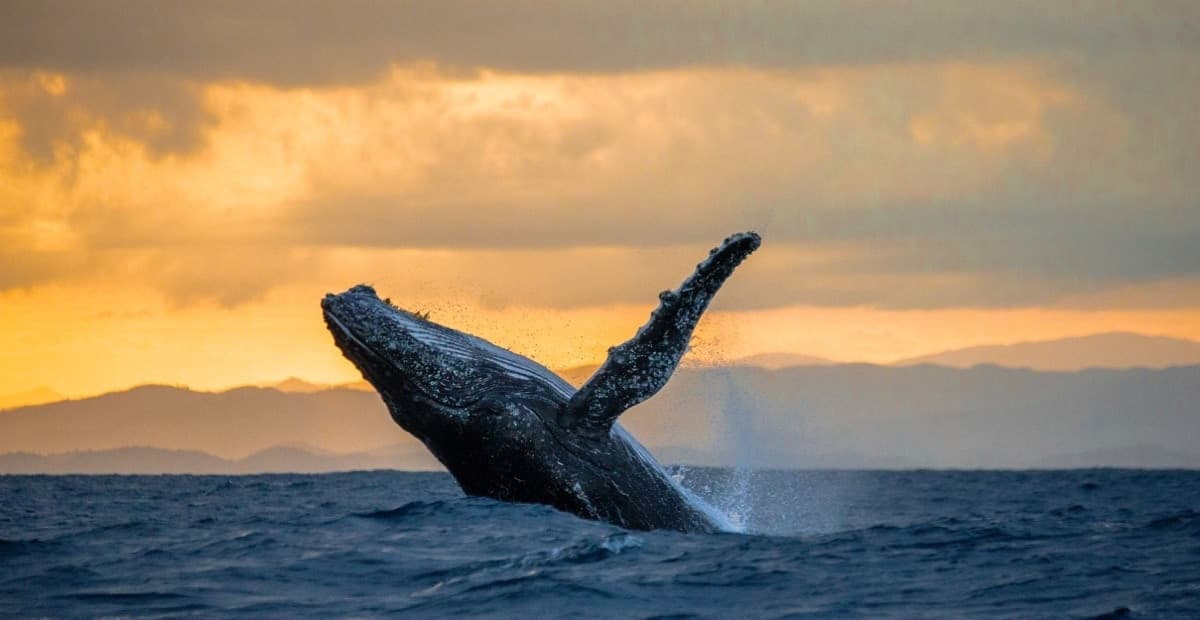
Shore counts on the Kohala coast record two to three times more humpbacks than any other shore site on the island, and three of those spots are free: Puʻukoholā Heiau, Lapakahi State Historical Park and Kapaʻa Beach Park. Humpbacks are in Hawaiian waters from November through April, with numbers peaking January through March. Between June and October there are none here at all.
Shore counts record about 50% more whales at 8:00 a.m. than at noon, so we go early, and take water and a hat for Lapakahi, which is hot and dry. Body Glove’s 2.5-hour trip out of Kailua Pier is $139.99 per adult and $119.99 for ages 6 to 17, and carries hydrophones so passengers can listen in.
Table of contents
- Whale Watching FAQ
- Whale Watching Tours (including off-season tours)
- DIY whale watching from the shore, including best viewing locations
- Our 4 best whale watching tips
- About Humpback Whales (why we such big fans!)
- And why do the whales come to Hawaiʻi?
Reading this in summer? There are no humpbacks in Hawaiian waters between June and October. A pelagic tour out of Kona still runs in those months, and the crew looks for pilot whales, sperm whales and beaked whales instead.
Whale watching FAQ
Below we list the answers to questions that we are often asked. Please get in touch with us if you have a whale watching question that we have not yet answered.
Q: What are the best places to go whale watching on the Big Island?
You can see most whales off the north-western coast of the Big Island. If you want to watch them from the shore we recommend these 3 viewing locations. For whale watching tours those departing from Kona are preferable.
Q: What is the best whale watching tour in Kona?
The most important distinction between whale watching tours is the size of the vessel. Small boats give a more personal experience and offer more flexibility but often lack in amenities. Because of this, whale watching tours from larger vessels (such as this one) have our preference.
Q: What is the best whale watching tour on the Kohala coast?
The closest whale watching tours to the Kohala resorts depart from Kawaihae harbor. Have a look at this sunset whale watching cruise that offers free pickup from the Kohala resorts for a good option.
Q: What are the best months to go whale watching on Hawaiʻi?
The first whales start arriving to the Big Island late November and more arrive as the season progresses, until their numbers peak in the months of January, February, and March (source). The whales depart Hawaiʻi again late April / early May. This means that January, February, and March are the best months to see whales
Q: What is the best time of day to go whale watching?
Even though whales are active all day long we have a slight preference for whale tours that take place early in the day because that is when the ocean is most calm. A calm ocean makes it easier to spot whales.
Q: What is the best island to go whale watching?
While we have a strong preference for everything Big Island, we must give well-deserved credit to Maui as the best island for whale watching tours. This is because more than half of all local whales prefer the calm, shallow water of the ʻAuʻau channel between Lānaʻi, Maui, Molokaʻi and Kahoʻolawe.
Whale watching tours
Jump to:
- Tours on larger (pontoon or catamaran) style boats
- Tours on medium-sized vessels
- Tours on smaller (speed) boats
- Off-season tours (April to November)
Almost every Big Island whale watch leaves from Kailua-Kona and runs about two and a half hours. Body Glove’s costs $139.99 per adult, $119.99 for ages 6 to 17 and $49.99 for under-6s. The boats differ far more than the prices do.
The tour season is shorter than the whale season. Boats put whale trips on sale around mid-December and stop in early April. That is narrower at both ends than the November-to-April window the whales themselves keep, so a late-November or mid-April visitor can find humpbacks offshore and no boat going out to them. Shore watching still works in those weeks.
Big boats are more comfortable; rafts get you closer to the water. A big pontoon boat or catamaran gives you a bathroom, shade, a bar and a hydrophone, and it moves slowly. A raft puts you at eye level with the whales and covers more water in the same time, and it will shake you about. A mid-size boat falls between the two.
Nothing about the size changes how close you get: federal rules keep every vessel the same distance off a humpback, so a raft is a different ride, not a closer one.
Location barely matters on this island, because nearly everything leaves from the same two harbors. Most boats sail the Kona and Kohala coast, where the whales concentrate. Hilo has its own short season and a much thinner schedule.
Tours on larger (pontoon-style or catamaran) boats
- Larger boats have more amenities such as toilets and a bar on board
- Larger boat often have better equipment such as hydrophones (to listen to the whales) and a whale cam on board.
- Larger boats often provide more shade. For those people that want to get (or stay) out of the direct sun if they want, larger boats often are a good choice.
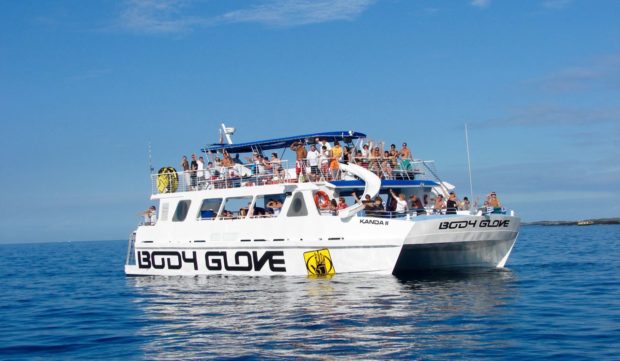
- Pontoon type boats and stable catamarans like the one used by Body Glove (See the tour below) are more stable, which makes seasickness less of an issue.
Our first suggestion is Body Glove’s 2.5-hour Whale Watch. It sails from Kailua Pier with a marine naturalist aboard and working hydrophones you can listen through, light snacks and drinks are included, and cancellation is free with 48 hours’ notice.
$139.99 per adult, $119.99 for ages 6 to 17, $49.99 for under-6s. Check in at the Ilima Court Shopping Center on Kuakini Highway 30 minutes before departure, where the parking is free, then board at Kailua Pier.
Whale Watching Cruise from Kona
2.5 hour Whale Watching Excursion with free snacks, guaranteed whale sightings (or come again!), an on-board marine life naturalist, and underwater hydrophones so you can hear the whales sing.
from:
$140
What is a suggested tour?Our suggested tours are hand-picked tours that receive consistent good reviews, give back to the community, and work hard to minimize their impact on the environment. Read more about these tours on our website.Tours on Medium-sized boats
Medium-sized boats fall between the larger boats’ comfort and capacity and the smaller ones’ speed and maneuverability.
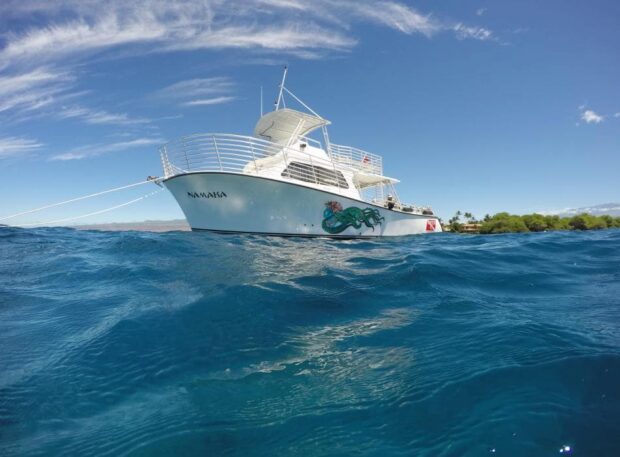
The following small-group tour takes place on a 46′ Newton dive boat, big enough to provide comfortable seating and amenities such as a private bathroom and a smooth ride for all ages, but still small enough tours to feel intimate with 24 people max. It is also one of the few whale watching cruises that sails at sunset, which puts the Kona and Kohala coastline in low golden light for the second half of the trip.
Sunset Whale Watching Cruise off the Kohala Coast 🌅
Combine a sunset cruise with whale watching and go in search of visiting humpback whales and resident spinner dolphins.
from:
$145
What is a suggested tour?Our suggested tours are hand-picked tours that receive consistent good reviews, give back to the community, and work hard to minimize their impact on the environment. Read more about these tours on our website.Tours on (often the fastest) small boats
- You sit low, at the whales’ own level. On a raft a spout is at eye height; on a catamaran you look down at it.
- The ride is faster, bumpier and wetter. A raft covers more water in the same two and a half hours.
- Skip it if anyone in your group has neck or back trouble, is pregnant, or would find climbing aboard from a pier difficult.
- Fewer facilities, but not none. There is less shelter and less room to move around than on a catamaran.
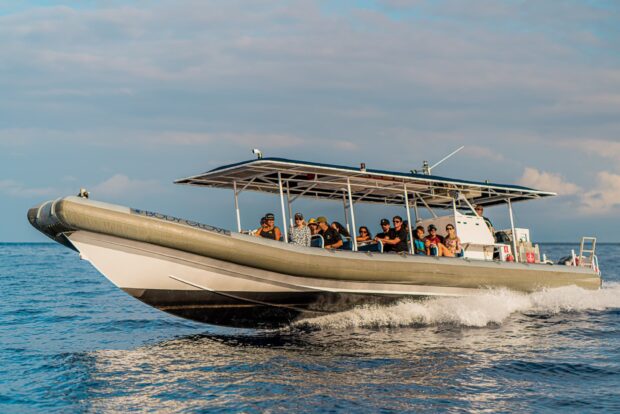
Body Glove’s Super-Raft is the same 2.5 hours out of Kailua Pier on a 41-foot rigid raft, leaving at 1:30 p.m. daily from December to April, and it does have seats, shade and a bathroom on board. It is the one Kona whale trip that never goes out in the morning, so you get the eye-level view but give up the calmer morning water the 8:00 a.m. counts record.
It carries a sighting guarantee: no whales, and you ride again free. The operator will not take children five and under, anyone pregnant, or anyone with regular neck or back pain, and boarding takes a bit of agility.
Super-Raft Speedboat Whale Watch
Enjoy the thrill of a sea raft ride with none of the drawbacks. Other than most rafts, our vessel is equipped with comfortable seating, shade, and a bathroom!
from:
$125
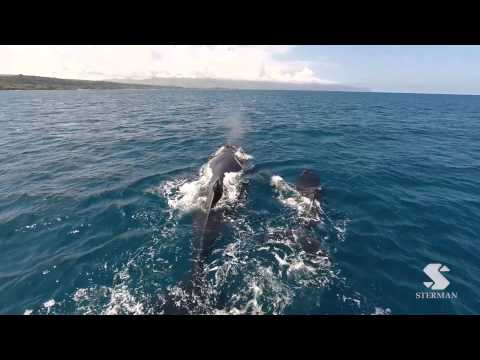
What is a suggested tour?Our suggested tours are hand-picked tours that receive consistent good reviews, give back to the community, and work hard to minimize their impact on the environment. Read more about these tours on our website.Keep a wrist strap on the camera. Our 6 whale watching tips cover what else to bring. The following video shows humpback whales playing in the waters of Oahu’s North Shore:
Off-season whale watching tours (April to November)
Pilot whales, sperm whales, beaked whales and spotted dolphins are in the deep water off Kona after the humpbacks leave.
From April through November, Hawaiian Adventures Kona runs a 3 to 4 hour pelagic trip out of Honokōhau Harbor, far enough offshore to look for pilot whales, sperm whales, beaked whales, spotted dolphins and the occasional whale shark. It is the only whale trip on the island that runs in summer.
$129 per person, or $109 if you book more than 30 days ahead, and there is no separate child rate because the minimum age is 10 and the operator will not bend it. Going that far out means open ocean, so take something for seasickness the night before if you are prone to it.
The same operator runs a shorter humpback trip from December to March, 2.5 to 3 hours for $129, down to $119 booked a month out, with a minimum age of 8. They also publish a dated weekly log of what each trip saw.
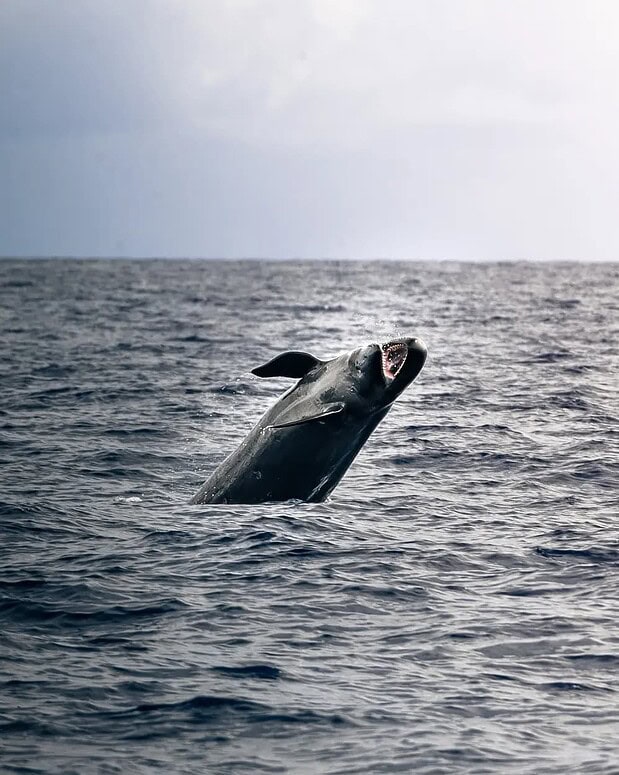
Off-Season Whale Watching Tour (April–November / Big Island)
See whales in Hawaiʻi even after humpback season ends! Head far offshore to find rare open-ocean whales and other species.
from:
$129
What is a suggested tour?Our suggested tours are hand-picked tours that receive consistent good reviews, give back to the community, and work hard to minimize their impact on the environment. Read more about these tours on our website.Whale Watching Tours from Maui, Oʻahu, Kauaʻi, and Hilo
The warm, shallow water around the Hawaiian Islands is where a large share of the North Pacific humpback population spends the winter. NOAA’s abundance estimate for the segment that winters here is about 11,400 animals, and they come to breed, calve and nurse rather than to feed.
This means that you can also go whale watching from other islands:
Oʻahu whale watching tours
Most whale sightings on Oʻahu take place along the eastern point of the island and all along the northern and western shores. During whale season the hike out to the Makapuʻu lighthouse offers great opportunities for DIY whale watching.
If you are looking for a whale watching boat tour or cruise, you have many options of operators that depart from various ports along Oʻahu’s southern and western (leeward) harbors. Have a look at our guide to whale watching on Oʻahu for our recommendations.
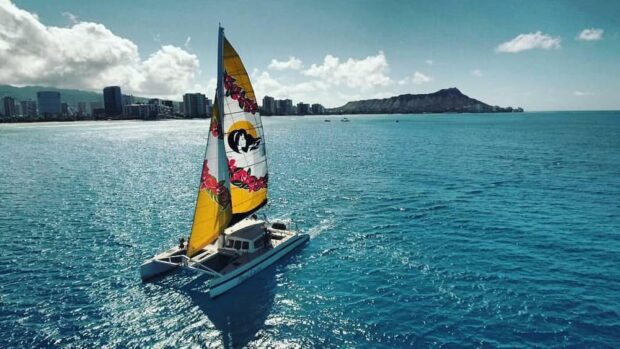
Waikiki Whale Watch with a Sailing Catamaran
See humpback whales during their annual migration in the waters off Oʻahu from a catamaran on a whale-watching cruise from Waikiki. Enjoy great photo ops of these massive mammals as well as panoramic views of Honolulu and Diamond Head
from:
$99
What is a suggested tour?Our suggested tours are hand-picked tours that receive consistent good reviews, give back to the community, and work hard to minimize their impact on the environment. Read more about these tours on our website.Maui whale watching tours
Maui has the densest whale water in the state. The shallow Maui Nui basin between Maui, Lānaʻi, Molokaʻi and Kahoʻolawe is where a large share of the Hawaiʻi population goes to breed and calve, and boats there spend less time traveling to find whales than boats anywhere else.
Check the harbor on your booking. Lāhainā Harbor was destroyed in the August 2023 fire. It reopened to limited commercial operations in December 2025 and has been filling back up since: eight companies held harbor access permits by June 2026, the Pacific Whale Foundation resumed sailing from Lāhainā on 1 June, and Atlantis Submarines is running five days a week there.
Sailings are daylight only, 6 a.m. to 6 p.m., because the harbor still has no power, and everything is pre-booked. Māʻalaea on the south shore remains the larger base, and some Kāʻanapali trips launch straight off the beach. Check out our Maui whale watching guide for more tips, tricks and recommendations.
Saltwater Sail With the Whales on Maui
Maui is the place to see humpback whales! Set sail in the Hawaiian tradewinds and join the Captain and Crew in keeping a look out for humpback whales
from:
$90
What is a suggested tour?Our suggested tours are hand-picked tours that receive consistent good reviews, give back to the community, and work hard to minimize their impact on the environment. Read more about these tours on our website.Kauaʻi whale watching tours
Kauaʻi’s whale season overlaps with its Nāpali Coast boat season, so you can often do both on one boat trip.
You can also watch from land between December and May. Poʻipū Beach, Kīlauea Lighthouse, Keālia Beach and Kapaʻa all work. The boats have the advantage on Kauaʻi though: most of the sailing and snorkeling cruises that run the Nāpali coast year-round shift their route toward the whales in season.
Curious? Read more in our guide to Kauaʻi whale watching.
Whale watching tours from Hilo (Big Island)
Most sightings happen along the western coast, but humpbacks do come into Hilo Bay, and a Hilo trip runs against the green backdrop of the Hāmākua coast rather than the dry Kona lava.
The Hilo season is shorter and the schedule thinner. Mālama Charters runs its whale trips out of Wailoa Harbor from January through April only, at 8:00 a.m. and 11:00 a.m., for ages 7 and up, and needs four people booked before a trip sails. It costs $125 to $139 per person. Book it on the Mālama Charters booking page.
How to see Humpback whales from the shore
You can easily see humpback whales from the shore of the Big Island during the winter months. For shoreline whale spotting, find a comfortable spot to watch the ocean and give it time.
- A good place where you can relax for a while and keep your eyes on the ocean.
- Some luck.
- Patience.
Good to know: you can combine trying to see whales from the shore with volunteering. Read more about the Sanctuary Ocean Count
A big spout of water at the surface is usually the first sign of a whale. This spout comes from a whale breathing out and in again and is visible from relatively large distances. Keep your eyes on/near this spot and you are likely to see more whale action.
In general, the best places to see whales from the shore are along the North Kona, Kohala, North Kohala, and Hilo coasts. More specifically 3 very good places to see whales from the shore on the Big Island are: Puukohola Heiau National Historic Site, Lapakahi State Historical Park and Kapaʻa Beach Park.
All three sit on Highway 270 north of Kawaihae, within about ten minutes of each other, and are marked on the map.
Puʻukoholā Heiau National Historic Site
Puʻukoholā literally means “hill of the whale” in Hawaiian,. It sits high enough to see a long way, with wide views over Kawaihae Harbor.
The Puʻukoholā Heiau site itself is worth an hour. It sits next to Spencer Beach Park, which has picnic tables, showers and a campground, so plan for half a day here, not a quick stop.
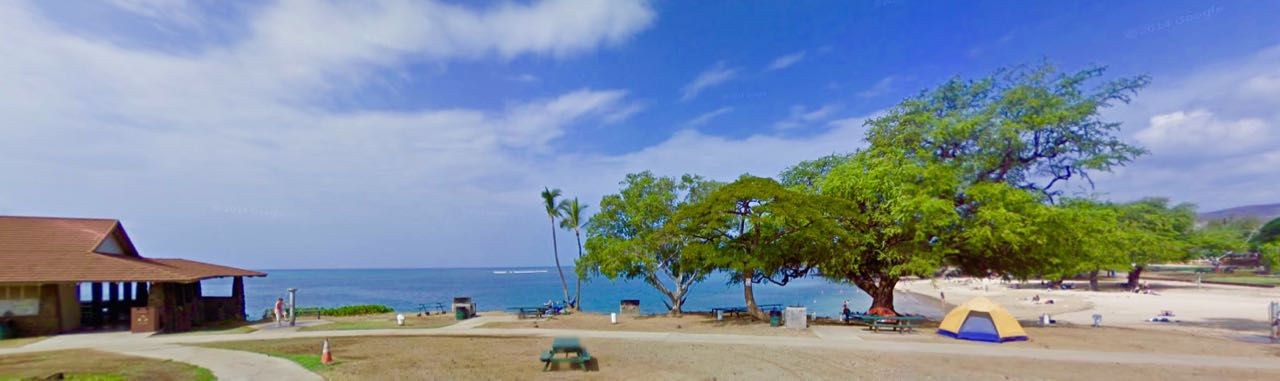
Spencer beach park offers good whale watching conditions through the tables next to the seaside. Image credit: Google street view.
Lapakahi State Historical Park
This park sits on the northwestern coast, and its 100 ft elevation lets you scan more water: the extra height widens how much water you can scan. Lapakahi State Historical Park is on Highway 270 north of Kawaihae at mile marker 14. The viewing site is about 100 yards (90 m) past the gate, at the top of the hill, roughly half a mile back from the shoreline.
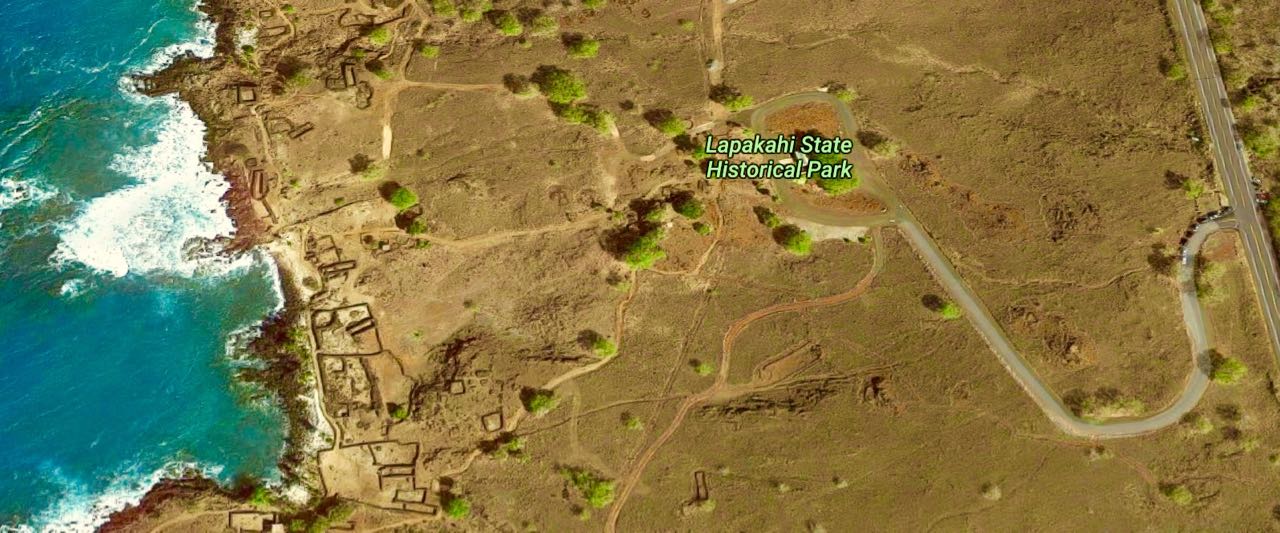
Aerial view of the Lapakahi State Historical Park. Image credit: Google Maps.
Kapaʻa Beach Park
Kapaʻa Beach Park is very close to Lapakahi Park and the best spot for whale watching is about 20 feet lower. However, it has one big advantage to make up for the slightly lower elevation: covered picnic pavilions!
Follow Highway 270 north and turn left on the one-lane paved road just past mile marker 16 to get to Kapaʻa Beach Park. The viewing site is at the end of the road.
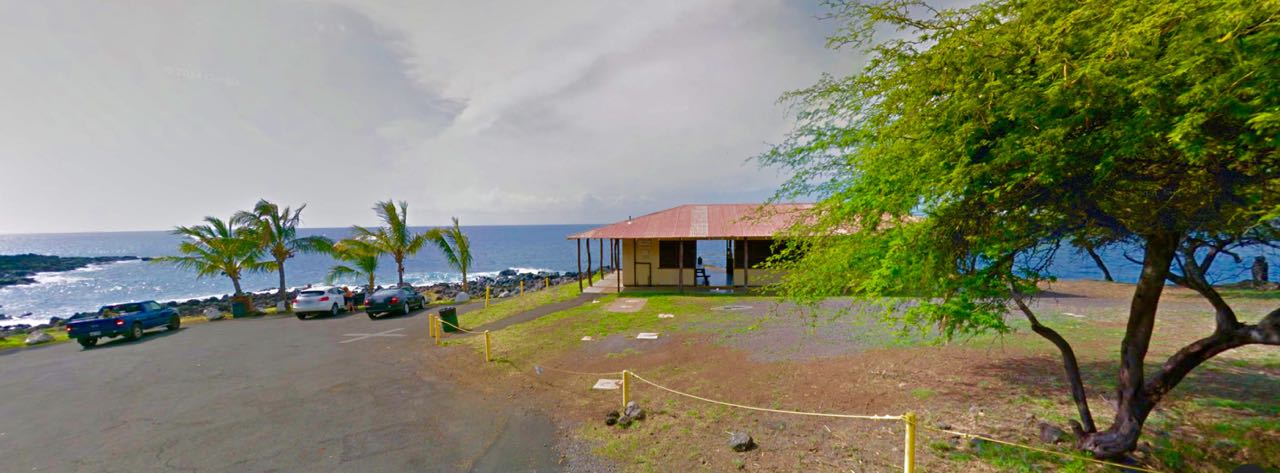
Ocean view and the covered picnic pavilion at the Kapaʻa beach park. Image credit: Google Street View.
Have a look at our humpback whale 101 for an identification chart of all possible humpback whale acrobatics such as the breach, the tail slap, the fluke up dive or the head lunge.
Whale watching as volunteer
If your timing is right you can spend half a day counting whales instead of just watching them.
The Sanctuary Ocean Count is a shore-based humpback count run by the Hawaiian Islands Humpback Whale National Marine Sanctuary, open to residents and visitors alike, from sites on Oʻahu, Hawaiʻi and Kauaʻi. Maui, Molokaʻi and Lānaʻi run the Pacific Whale Foundation’s Great Whale Count on the same dates instead. 2026 was its thirtieth year.
It runs three times a season, on the last Saturday of January, February and March, from 8:00 a.m. to about noon. Registration opens on the first Monday of each count’s month and closes around the middle of it, roughly two weeks ahead, and you register per person and per date. Places are limited and not every site runs every year, so do it the day registration opens. The official site is oceancount.org, and the sanctuary’s own page is here.
Whale Watching Tips
Month, time of day and stretch of coast matter most, per the shore counts, and then whether you get in the water.
- Look for whales during humpback whale season
- Four lessons from 30 years of shore counts and tens of thousands of sightings
- Where do most whales hang out?
- How to hear a humpback whale sing (with audio)
Whale Watching Cruise from Kona
2.5 hour Whale Watching Excursion with free snacks, guaranteed whale sightings (or come again!), an on-board marine life naturalist, and underwater hydrophones so you can hear the whales sing.
from:
$140
What is a suggested tour?Our suggested tours are hand-picked tours that receive consistent good reviews, give back to the community, and work hard to minimize their impact on the environment. Read more about these tours on our website.#1: When is whale watching season in Hawaiʻi?
Humpback whale season on the Hawaiian islands is between November and April, but some months are better than others.
The first whales start arriving to the Big Island in late November, and more arrive as the season continues, until their numbers peak in the months of January, February, and March. The whales depart Hawaiʻi again late April / early May. The best months for whale watching are summarized in the following table:
| Month | Probability of seeing whales |
|---|---|
| January | High |
| February | High |
| March | High |
| April | Medium (early April) to Low (late April) |
| May | Very low |
| June to October | None. The humpbacks are feeding in Alaska |
| November | Low |
| December | Medium (whale watching tours start mid-December) |
#2: 4 lessons learned from tens of thousands of whale sightings:
Volunteers have counted whales from shore sites across the Hawaiian islands every year since 1996 for the Sanctuary Ocean Count. Thirty years of it, hundreds of volunteers, tens of thousands of sightings. The 2025 season alone drew more than 1,300 volunteers across 44 sites.
The published results for the Big Island:
- The Kohala coast is by far the best place to see humpback whales. Sightings here are sometimes two or three times more frequent than at other locations on the island.
- January and February are the best months to see whales at the Kohala coast. In March the total count number goes down by half, but there seem to be slightly more sightings on the Hamakua (northeast) coast.
- Early in the morning is the best time to see whales. The number of whale sightings on the Big Island at 8:00 am is ~50% higher than the amount spotted just a few hours later at noon. Another good reason for an early whale watch is the weather, as mornings are often calmer, meaning that the ocean surface is more glassy.
- Average numbers for whale sightings fluctuate a lot. On average over all locations, between 3 and 6 whales were seen per 15-minute period in January and February. However, this average includes some sites with zero sightings and other sites with as many as 15-20.
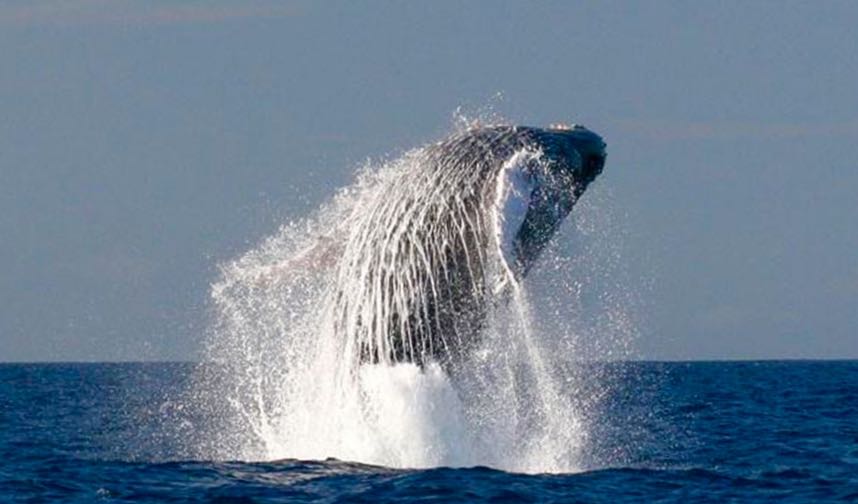
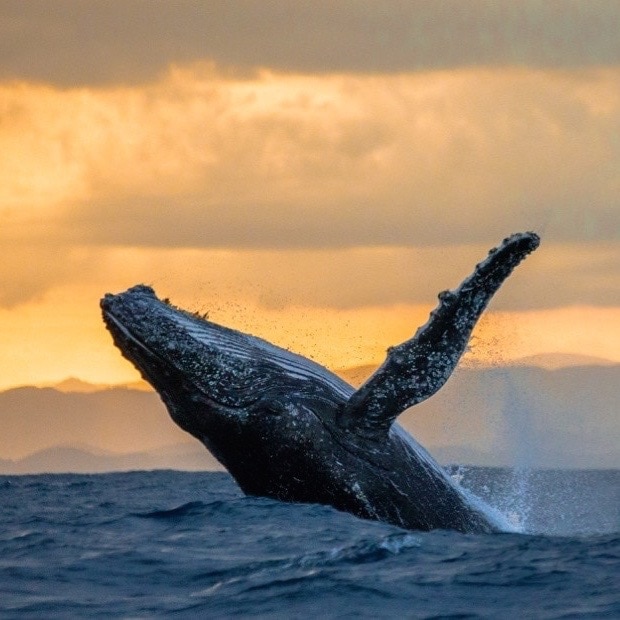
A humpback whale breaches off the coast of Oʻahu. Photo Credits: NOAA’s National Ocean Service on Flickr. See also the Hawaiian Islands Humpback Whale National Marine Sanctuary, the Office of National Marine Sanctuaries and NOAA’s National Ocean Service. (Original source: NOS Image Gallery
#3: How to hear the Humpback Whale song yourself
A boat with a hydrophone is the easy way to hear the whales. You can also do it yourself, with no equipment at all, because sound carries so well under water.
Song is a male behavior: the long, structured sequences you hear through a hydrophone come from lone males on the breeding grounds. What the song is for is still unsettled, and the research does not support the tidy answer that it attracts females. Whales sharing an area sing near-identical songs, whales from separate regions sing different ones, and the songs change from year to year.
You can listen to a 13-minute recording of Hawaiian humpback whales singing by playing the audio fragment below. Don’t they sound a bit like cows?
As male humpback whales perform these songs most often during the mating season, you can think of them as a form of whale flirting or a courtship ritual.
Because sound carries further under water than on land, you can hear these songs even if they are performed several miles off shore. If you are swimming and are lucky enough to see whales out in the ocean, you need only to do the following:
Listen to the whales while swimming
- Swim out into the ocean, just past the point where the surf breaks. (careful, only do this when you are together with someone else, when the currents are low, and if you are a strong swimmer).
- Take a deep breath and swim to the bottom, dig your hands in the sand, or hold onto something under water like a rock (but be careful not to touch any corals).
- Clear your ears by closing your nose with your fingers and blowing air out of your nose. You should hear your ears “pop”.
- Listen and enjoy the whales serenades.
Listen to the whales while snorkeling
Snorkeling makes listening to the whale songs much easier, though of course, there still have to be whales within a couple of miles of your snorkeling spot. If this is the case (for example, if you see a telltale white water spout off shore), try the following:
- Find a spot that is more than 5 ft deep and away from the surf. You preferably want deeper water or a sandy ocean floor.
- Take a deep breath of air, dive down to the ocean floor and hold onto something. You will be deep enough when you can remain with your head a few feet under water without breaking the surface.
- Clear your ears by closing your nose with your fingers and blowing air out of your nose. You should hear your ears “pop”.
- Listen and enjoy!
#4: Where can you see the most whales in Hawaiʻi?
The aerial survey below, flown between 1993 and 2003, still gives the clearest picture of where the whales concentrate. Boat tours sail these same waters, and those wanting to catch a glimpse of the whales from shore can use the same map to pick shore viewing spots.
For the Big Island you will have best chance of seeing whales in the North Kona, and north and south Kohala districts.
If you would rather not take a boat, the Pololū valley lookout and a sunset picnic at Holoholokai Beach Park both put you high enough, and far enough north, to be looking at the right water. Waipiʻo is not on this list any more: access to the valley floor is restricted under a county emergency rule, so check our Waipiʻo page before planning anything there.
Below are the results of an aerial survey for whales performed between 1993 and 2003. The red zones are the best spots for whale spotting.
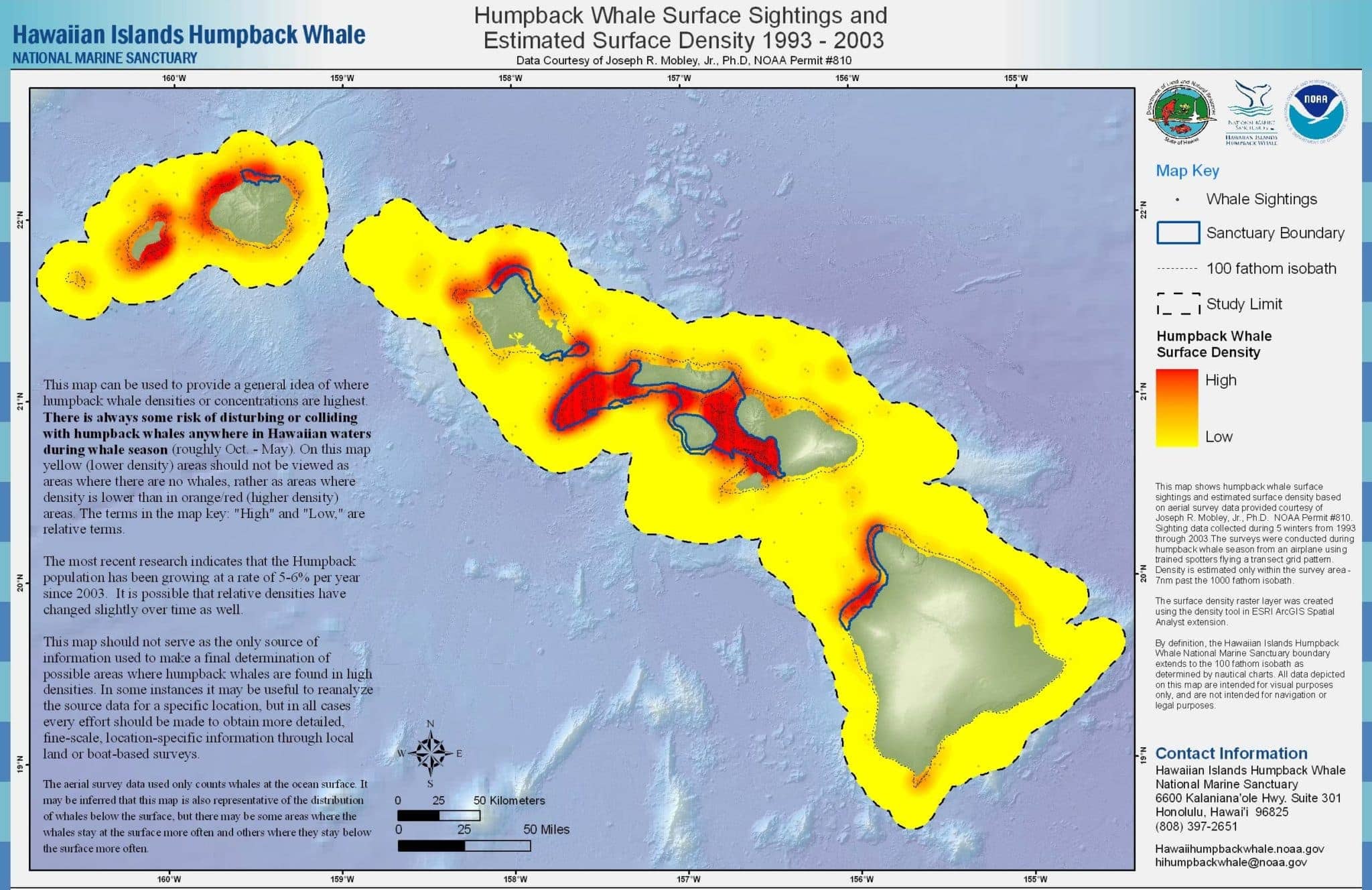
Red marks the highest humpback surface density, yellow the lower. Aerial survey data collected by Dr. Joe Mobley of the University of Hawaiʻi between 1993 and 2003 and the density surface was developed by the Hawaiian Islands Humpback Whale National Marine Sanctuary.
What to know about the whales themselves
Humpbacks (nā koholā) average about 45 feet and reach 60, and commercial whaling cut the species by more than 95 percent before the 1985 moratorium. The recovery here has been good enough that the Hawaiʻi population is no longer listed as endangered: NOAA split the species into fourteen distinct population segments in 2016 and concluded that the one wintering in Hawaiʻi did not warrant listing. Four segments elsewhere are still endangered, and one is threatened.
That is a change in legal status, not in protection. Every humpback in Hawaiian waters is still covered by the Marine Mammal Protection Act and by the sanctuary rules, including the 100-yard approach rule above. NOAA’s own abundance figure for the Hawaiʻi segment is about 11,400 animals, from its 2016 status review, which rests on survey work done between 2004 and 2006. There is no annual count, so treat that number as the best available rather than as current.
Humpbacks often throw their whole 45-foot body clear of the water, and humpbacks do it often, along with slapping their tails and pectoral fins on the surface. They are also the whale that sings, at length and in structured phrases.
To Native Hawaiians the whale represents Kanaloa, the god of all ocean life.
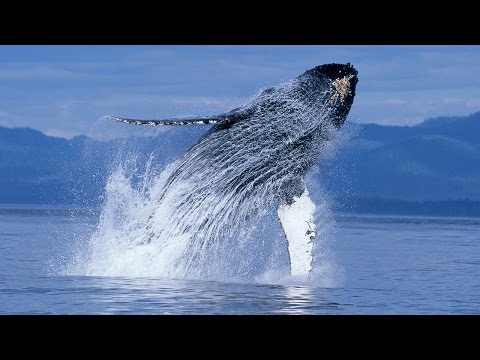
The following trailer, filmed partly in Hawaiian waters, offers an up-close look at how humpback whales communicate, sing, feed, play and care for their young.
Why the whales come to Hawaiʻi
Humpback whales are a migratory species which means that they migrate every year between the cool waters close to the poles and (sub)tropical waters. Whales belonging to the North pacific whale population swim an average of 6,000 miles a year, but migrations of up to 16,000 miles a year have been documented! This makes Humpback Whales one of the best-traveled mammals in the world.
They come for the same reason many of our other visitors do: to take a break.
Humpback Whales spend their summers feeding and building up fat reserves in the cool higher latitude waters and then spend cold winters in our warmer tropical waters to mate, give birth, and to raise their calves (children) in a safe environment and far from natural predators.
Because there is very little food for the whales in (sub) tropical oceans they instead fast during their Hawaiian vacations and live off their fat reserves. The advantage of warm, food-poor water is that it holds few large predators that would take a calf. Hawaiʻi is a nursery, not a feeding ground.
That is why we can see whales in Hawaiʻi:
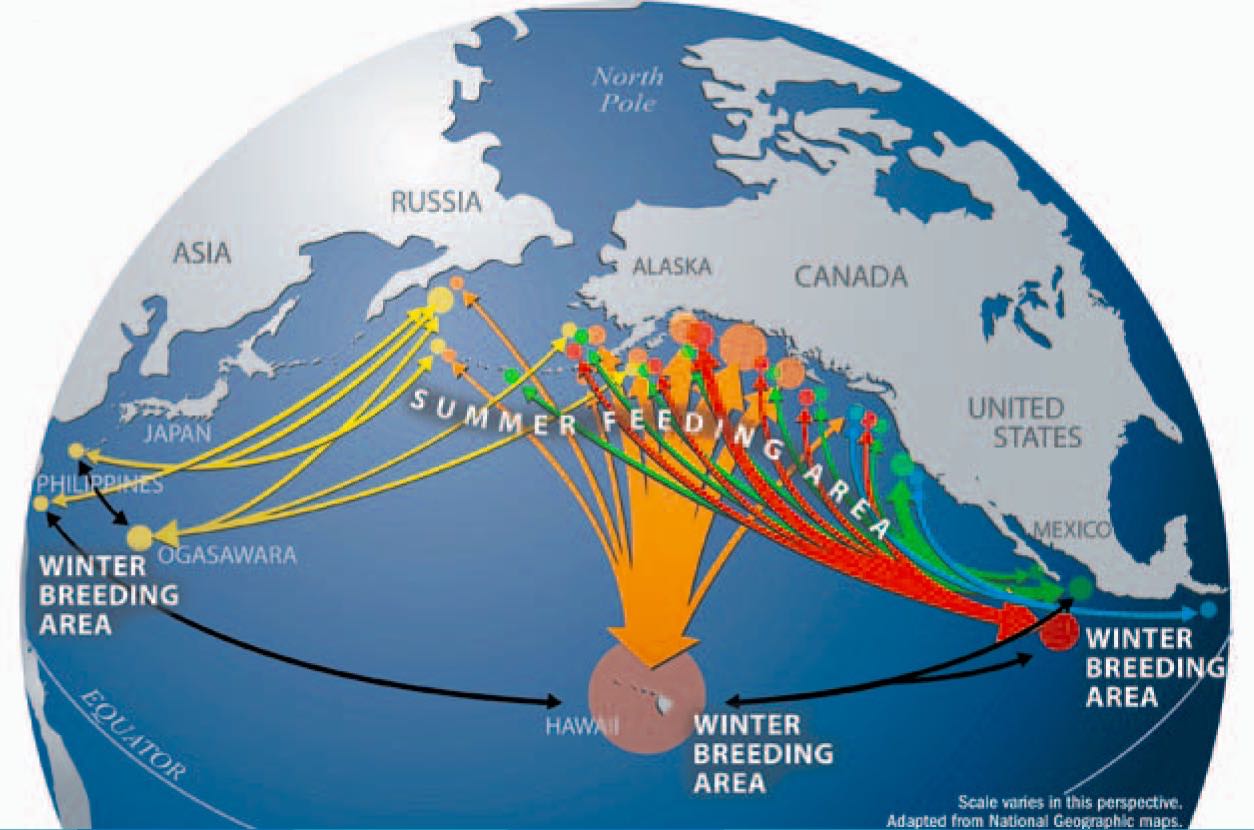
Migration Patterns for north pacific humpback whales. More than half of the population spends their winter around Hawaiʻi. The data for this graph was gathered for the SPLASH (Structures of Populations -Levels of Abundance -Status of Humpbacks) project, image credits: NOAA.
Putting it together
If you are here between January and March, book a morning boat out of Kailua-Kona and give yourself a second morning at Puʻukoholā Heiau or Kapaʻa Beach Park in case the first one is flat. If you are here in November, early December or late April, skip the boat and watch from the Kohala coast: the whales are around, the tours mostly are not.
Between June and October, there is nothing to wait for. Take the pelagic trip out of Honokōhau if you want to be on the water, or come back in the winter.