More than half of the humpback whales in the North Pacific spend part of the year in Hawaiian waters, about 11,300 animals by NOAA’s latest count. They arrive in November and the last of them leave at the end of May, but the window worth planning around is January through March, when the population peaks. NOAA’s tightest statistical peak is narrower still: roughly mid-February to mid-March.
Book outside that window and you’ll still see whales, just fewer of them. Book inside it and you get busier months and peak-season pricing, though not the island’s busiest: by HTA’s daily visitor census, the fullest months are December and midsummer. One rule to know before you decide either way: federal law keeps you 100 yards off a humpback, and that applies to swimmers, kayaks, paddleboards, and drones alike.
Table of contents
- Time it for the January to March peak
- Know where the whales gather
- Pick a calm day
- Pack the right gear
- Learn the whale behaviors
- Know the 100-yard rule before you book
A whale is more closely related to a giraffe than to a fish. If that’s the kind of thing you want more of, our Humpback Whale 101 guide covers the biology and the listening tips. Looking for tours or the best spots to watch from shore? Start with our Big Island whale watching guide.
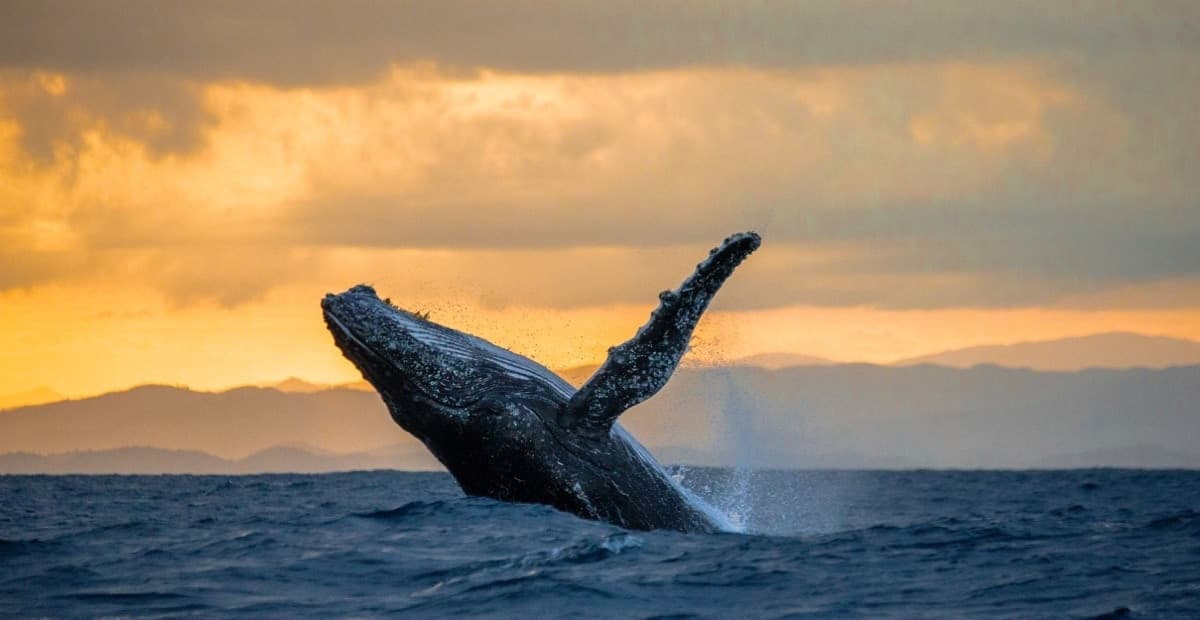
A humpback whale breaches the surface.
1. Time it for the January to March peak
Humpback season in Hawaiʻi runs November through May, but the months are not equal. The January to March peak, and the tighter mid-February to mid-March window inside it, both come from NOAA’s Hawaiian Islands Humpback Whale National Marine Sanctuary.
Boats still run in November and in May, and you’ll still see whales on them. You’ll just see fewer. If your dates are fixed outside the peak, that’s the trade you’re making, and it’s a reasonable one: the shoulder weeks are quieter on the water as well as in the water.
2. Where the whales gather: shallow water under 600 feet
Humpbacks congregate in water less than 600 feet deep, so the boats work the shallow shelf that rings each island. Aerial survey density mapping by Dr. Joseph R. Mobley Jr. of the University of Hawaiʻi at West Oʻahu found the densest Big Island sightings off the Kohala coast and North Kona.
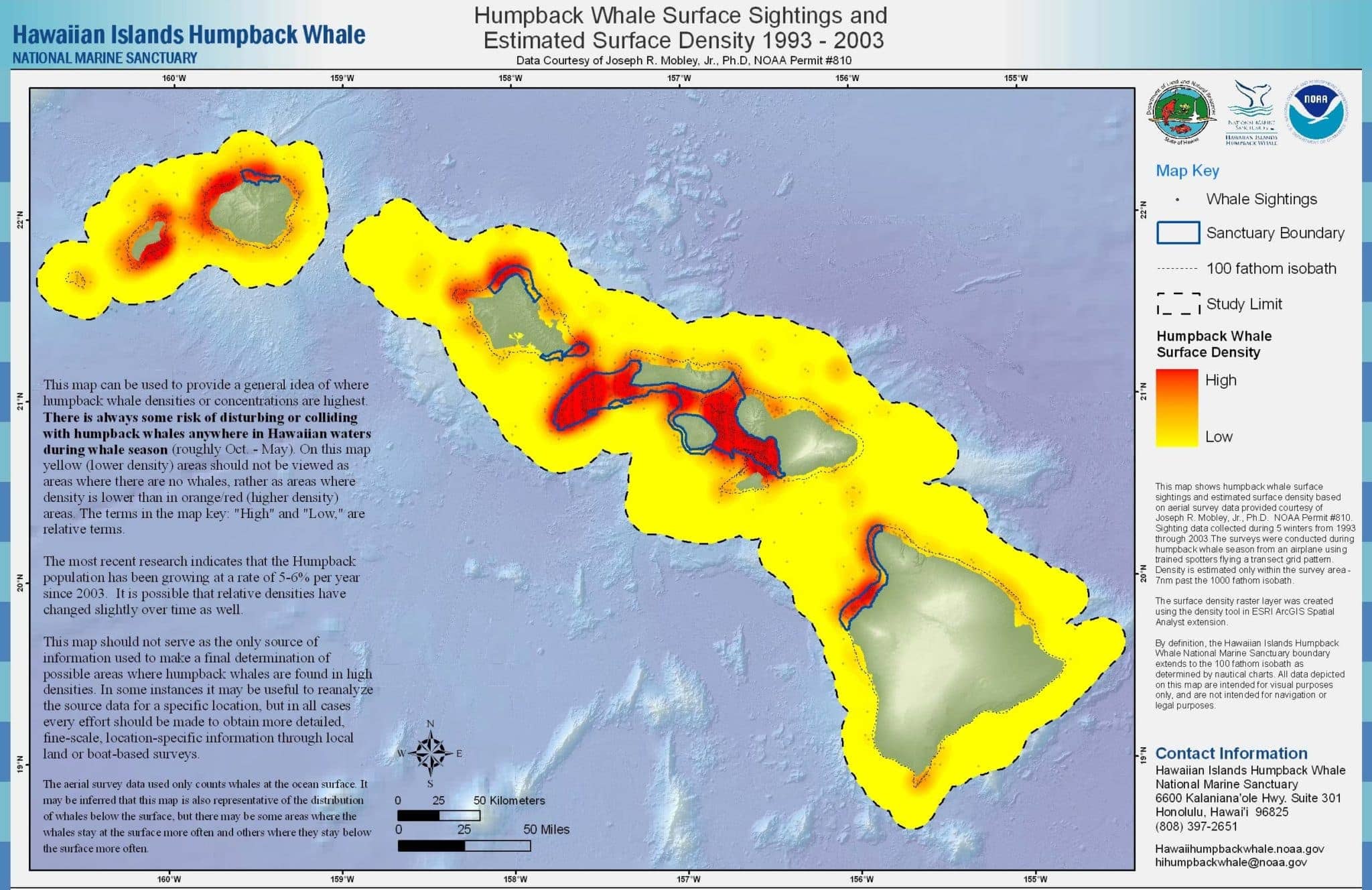
Where to see whales in Hawaiʻi. Red zones are the best spots, yellow zones have sightings but fewer of them. Aerial survey data collected by Dr. Joseph R. Mobley Jr. (University of Hawaiʻi at West Oʻahu), 1993 to 2003. Density surface developed by the Hawaiian Islands Humpback Whale National Marine Sanctuary.
Mobley’s map puts the Kohala coast and North Kona well ahead of the rest of the Big Island, with sightings sometimes two to three times more frequent than elsewhere on the island. On the east side, Hilo Bay is worth trying.
Our whale watching guide covers three shore-based spots with directions and what to expect at each one.
- On the Big Island, the Kohala coast and North Kona. Hilo and the green sand beach are the fallbacks.
- On Oʻahu, head for the north shore.
- On Maui, the west coast, which faces the shallow channel between Maui, Lānaʻi, and Molokaʻi (see our guide to Maui whale watching tours).
- On Kauaʻi, the north and west coasts.
3. Pick a calm day
Rough seas and high wind make whales much harder to see. You’re scanning for a blow or a splash, and in whitecaps a blow looks like every other patch of white water out there. Check the marine forecast rather than the land forecast, and take the calmest day your schedule allows.
4. Pack the right gear
Most of this is what you’d take on any small boat. Two things earn their space even if you pack nothing else: polarized sunglasses and seasickness medicine.
Sun protection
On the water you need better sun protection than you do on land, because the sunlight reflects back up off the surface. Bring a hat, sunglasses and sunscreen. Make the sunglasses polarized ones: they cut the glare coming off the water, and that glare is exactly what hides a distant blow.
Camera
Photographing whales is harder than it looks. They’re often far off, and the behaviors last seconds. You want a camera with real zoom and the reflexes to aim and focus fast. Shooting video is often the easier call, because it forgives the timing that a still photo does not.
Just as important: don’t spend the whole trip behind the camera.
Binoculars
Bring binoculars if you own a pair. They turn a distant splash into an animal you can identify, and then they make you queasy, because a long stretch through binoculars on a moving boat is a fast route to feeling ill. Use them in short bursts.
Food and beverages
Water and snacks, plus a bag for your trash. Most boats carry water and something light to eat, but bring your own if you are particular.
Clothing
Bring a light jacket. The wind on the water runs colder than it looks from the harbor parking lot.
Seasickness remedies
If you’re prone to seasickness, take the medicine before you board rather than once you feel it coming on: it needs time to work, and by the time you need it, it’s too late to start. On the boat, stay outside where you can keep your eyes on the horizon, and stay out of the heat. Sipping a carbonated drink helps, and so does eating something with ginger.
5. Learn what a breach and a spyhop look like
Spotting a whale is the easy part. Naming what it just did is the part most people are unprepared for. A breach is the animal throwing itself clear of the water. A spyhop is the head coming straight up for a look around, and a tail slap is the fluke coming down hard on the surface, often over and over. Our Humpback Whale 101 guide walks through the behaviors, and through the fluke markings that tell individual whales apart.
6. Know the 100-yard rule before you book
Federal law says you may not approach a humpback within 100 yards. That’s a full football field, and it applies to everyone: swimmers, kayaks, canoes, paddleboards, boats, and drones. Aircraft have to stay 1,000 feet up. The rule runs year-round, across all Hawaiian waters out to 200 nautical miles.
For a boat, that means 100 yards minimum, and no more than six knots inside 400 yards. A whale is free to approach a boat that has cut its engine. A boat is not free to chase a whale. So if an operator promises to get you close, they’re telling you they break the rule, and you should book someone else.
Ask about their policy before you book, and read NOAA’s approach regulations if you want the exact wording. Our whale watching guide lists the Big Island operators we send people to.