
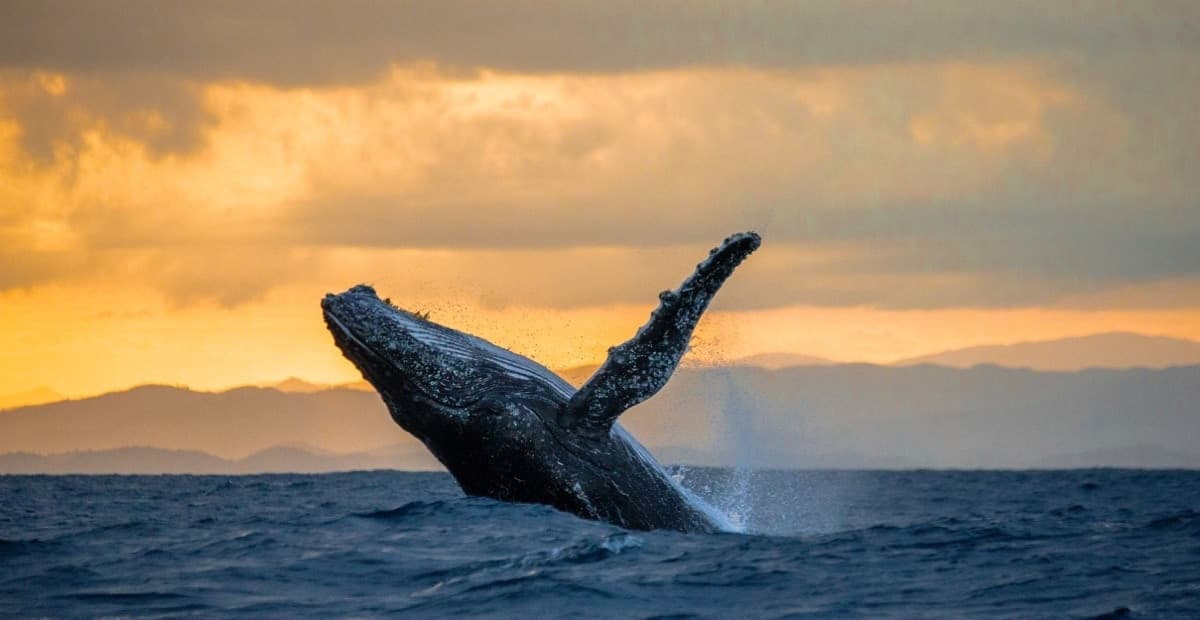
More than half of the North Pacific’s humpback whales spend the winter in Hawaiʻi, according to NOAA. They’re here from November to April, with the most whales in January and February and fewer by late March.
Only males sing. With your head underwater, you can hear the song from a couple of miles away. At the surface, a spy hop lifts the head straight out of the water, and a tail slap brings the fluke down on the surface. Our Big Island whale watching guide lists the shore spots and boat tours on this island, and our whale watching tips cover where to look on each island and the 100-yard approach rule.
Table of contents
- Why humpbacks migrate thousands of miles a year
- When and where you are most likely to see whales
- How to recognize whale behaviors at the surface
- How to listen to live whale songs
- Why whales are more closely related to hippos and giraffes than to fish
- How to help protect humpback whales
Humpback Whale Size and Feeding
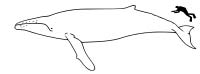
Size comparison of an average human and a humpback whale
Adult humpbacks measure 40 to 50 ft and weigh 25 to 40 tons, and the females are a bit larger than the males. Every winter they return to the Hawaiian Islands to mate and give birth.
They feed on very small animals: krill (small shrimp-like crustaceans) and small fish. Humpback whales eat up to 1.5 tons of food a day. A whale swims open-mouthed through a school of prey, then pushes the water back out through the baleen plates in its mouth, which trap the food. They are social hunters with several techniques, one of them the “bubble net”.
A group of whales swims in a shrinking circle below a school of prey while blowing bubbles. The bubbles push the prey into a tighter and tighter cylinder, and once it is small enough the whales swim through it and take in the prey.
The humpback whale has a distinctive body shape, with unusually long pectoral fins and a knobbly head. The shape and color pattern on the humpback whale’s dorsal fin and flukes (tail) are as individual in each animal as are fingerprints in humans.
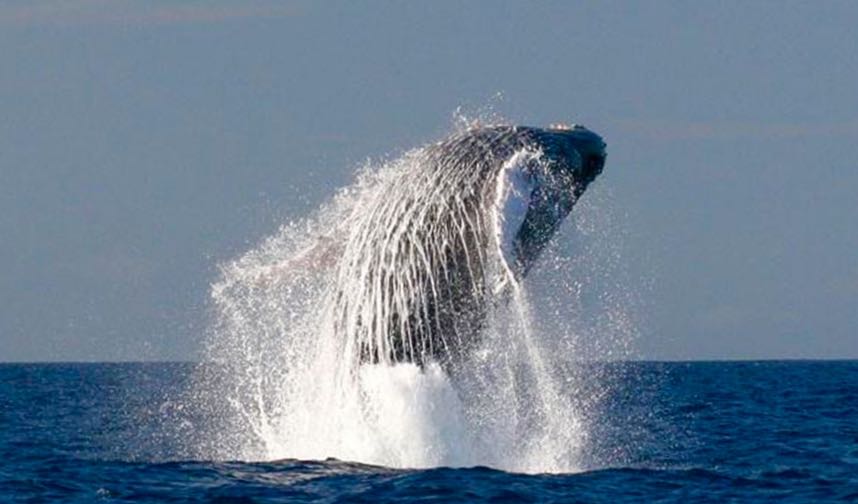
A humpback whale breaches off the coast of Oʻahu. Photo Credits: NOAA’s National Ocean Service on Flickr. See also the Hawaiian Islands Humpback Whale National Marine Sanctuary, the Office of National Marine Sanctuaries and NOAA’s National Ocean Service. (Original source: NOS Image Gallery)
Humpback whales breathe air and come up every 7 to 20 minutes to take a breath. In total, they spend about 10% of their time at the surface.
Why Humpback Whales Migrate to Hawaiʻi
Humpback whales migrate twice a year between (mostly polar) cold-water feeding grounds and subtropical mating and calving areas. More than half of the North Pacific population spends its mating and calving season around the Hawaiian Islands. A 2024 study led by Ted Cheeseman estimated about 18,700 humpbacks wintering in Hawaiʻi in 2013 and about 12,300 in 2021, a drop that followed the 2014–2016 marine heatwave (Royal Society Open Science).
The distance record for humpback whale migration is 25,000 km (16,000 mi) in one year, and North Pacific humpbacks cover about 6,000 miles a year. Food is the biggest reason for the migration. Water temperature, salinity and predators are smaller ones.
Most of the food is in polar waters, but that food also attracts large predators such as killer whales, which can prey on young whales. To keep their young (calves) safe during their first (most vulnerable) months the whales migrate to food-poor subtropical waters. A good way to remember this is “summer-feeding, winter-breeding”.
From shore, calves are a steady share of what counters see: between about 7% and 22% of the whales counted in a season on each island since 2002, with no rise into March.
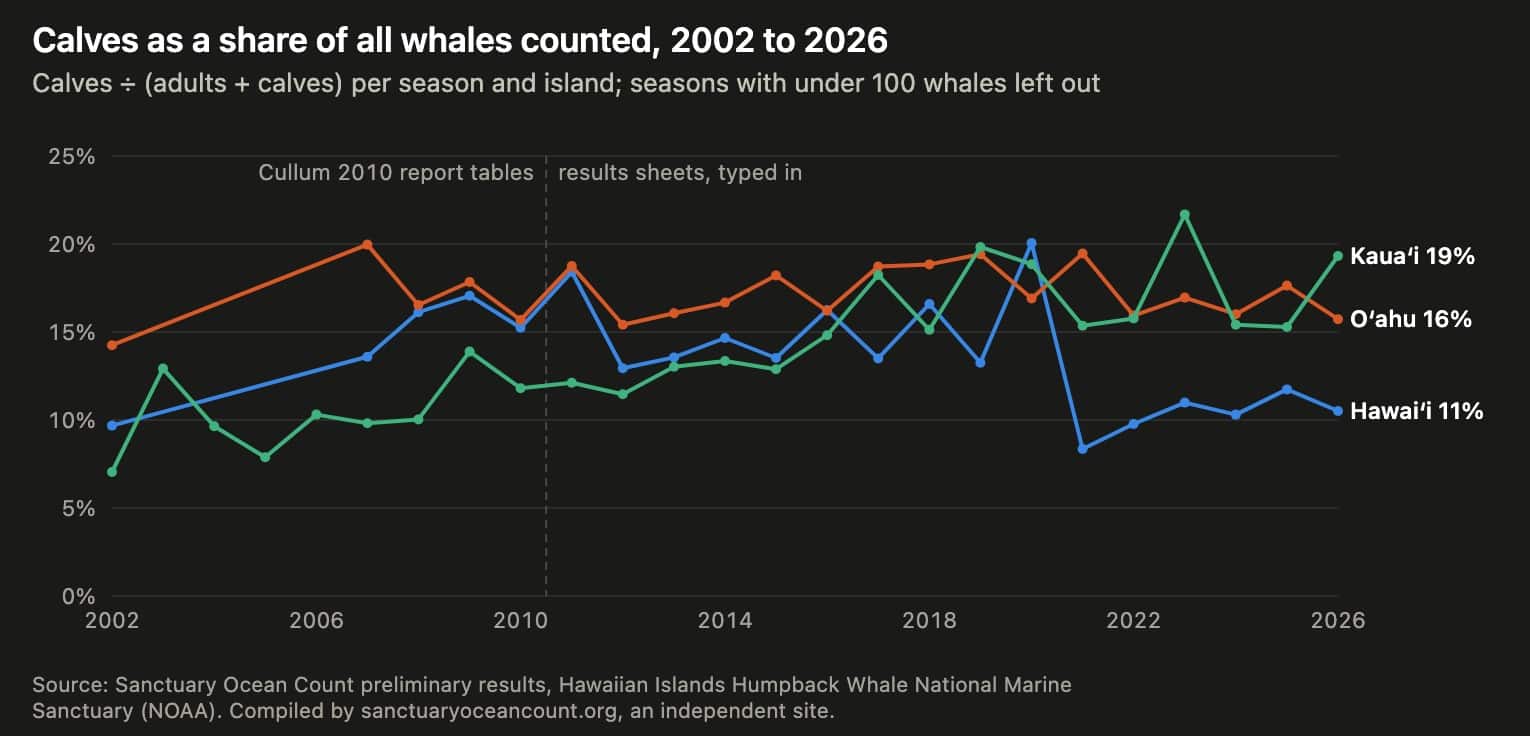
Calves as a share of all whales counted per season on Hawaiʻi Island, Oʻahu and Kauaʻi, 2002 to 2026, from the sanctuary’s 2010 report (2002 to 2010) and its results sheets (2011 to 2026). Compiled by sanctuaryoceancount.org.
The North Pacific’s two other winter breeding areas, both smaller than Hawaiʻi’s, are near Japan and near Mexico.
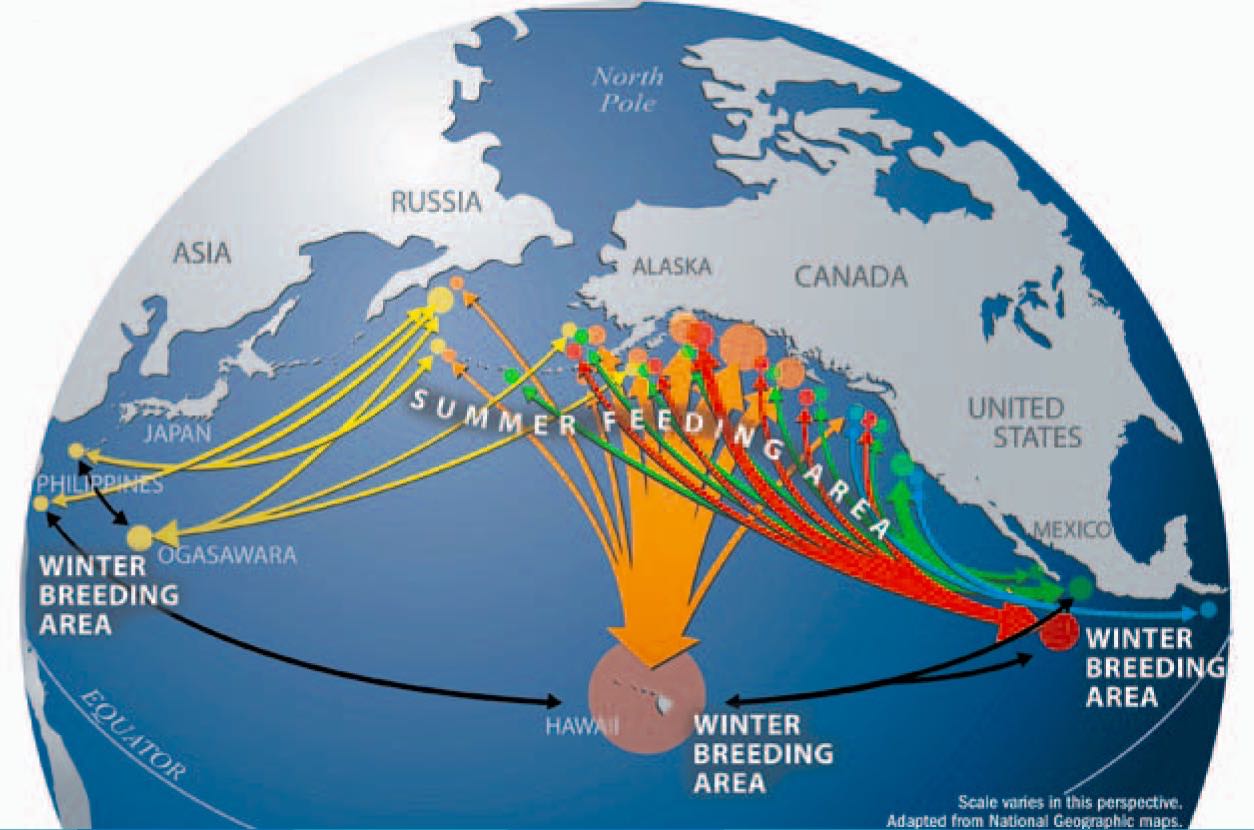
Migration patterns of North Pacific humpback whales. More than half of the population winters around Hawaiʻi. The data for this graph was gathered for the SPLASH (Structures of Populations -Levels of Abundance -Status of Humpbacks) project, image credits: NOAA.
Where and When to See Humpback Whales in Hawaiʻi
Humpbacks are in Hawaiian waters from November to April. Most whales are here in January and February, and by late March the numbers are thinning. From shore you can spot whales within a few miles of the coast by their blows and by surface stunts such as tail slaps.
If you visit outside that window, from May through October, your chances of seeing a whale are very slim.
During the season you can see whales from every coastline in Hawaiʻi, though some stretches get far more whales than others.
The gray on the map below comes from aerial surveys flown between 1993 and 2003 by Dr. Joe Mobley of the University of Hawaiʻi at West Oʻahu: the darker the water, the more whales. The colored dots and coastline are the sanctuary’s shore counts from 2007 to 2026, and bigger dots and a redder coast mean more whales seen per 15-minute scan.
Maui is the best place to see whales (our Maui whale watching guide compares its tours and shore spots). The survey’s Big Island hot spots sit off North Kona and the Kohala districts. On the Big Island, shore counts on the Kohala coast run three to five times higher than on any other coast (compiled from the sanctuary’s count results). For an evening on that coast, organize a sunset picnic at Holoholokai Beach Park.
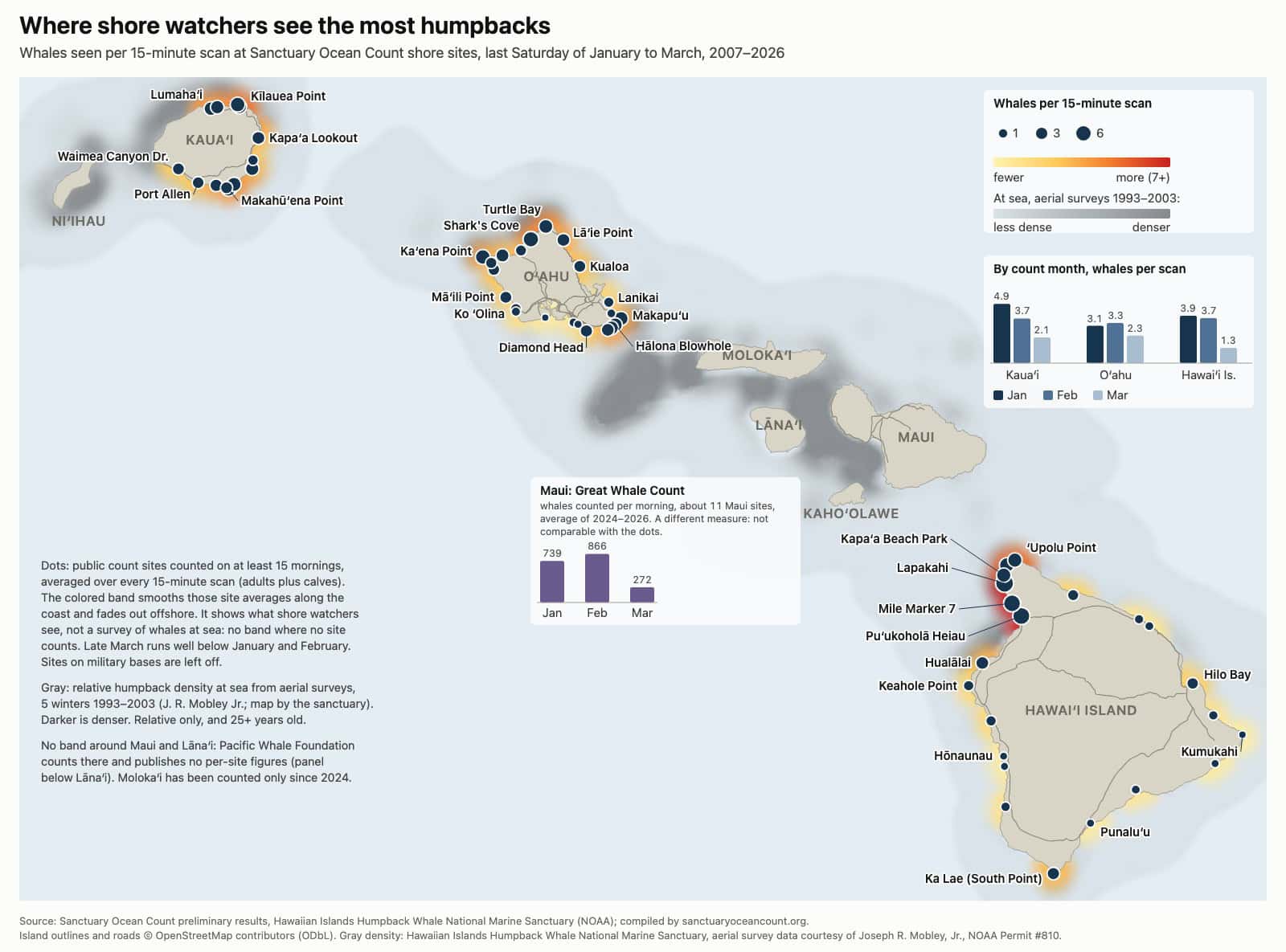
Whales seen per 15-minute scan at shore count sites, 2007 to 2026 (dots and colored coast), over whale density at sea from the 1993 to 2003 aerial surveys (gray). The month inset shows late March well below January and February on every island. The Maui panel is Pacific Whale Foundation’s Great Whale Count. Compiled by sanctuaryoceancount.org from the sanctuary’s count results; aerial survey data courtesy of Joseph R. Mobley Jr.
Humpback Whale Surface Behaviors
When humpbacks come up they often slap the water, lunge and breach, so you can spot them from shore. The stunts may be play, but they probably help humpbacks communicate. These are the behaviors you’re most likely to see around Hawaiʻi:
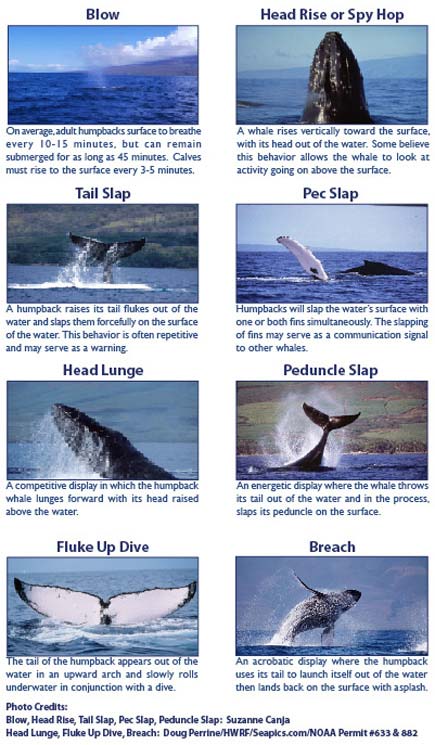
These are the most common “stunts” the humpback whales perform. Image credits: NOAA, Suzanne Canja and Doug Perrine
- Blow: the most common way to spot a whale. It happens each time a whale comes to the surface to breathe.
- Head rise or spy hop: a whale rises vertically with its head out of the water.
- Tail slap: a whale slaps its fluke (tail) on the surface.
- Flipper slap or pec slap: a whale slaps the water with one or both of its pectoral fins.
- Head lunge: like the head rise, but the whale lunges forward.
- Peduncle slap: the whale throws its tail out of the water and slaps its peduncle (the muscular tail stock) on the surface, exposing more of its body than a tail slap.
- Fluke-up dive: the tail rises as the whale dives, and it is the last you will see of that whale for 3 to 10 minutes.
- Breaching: the biggest stunt of all, when the whale throws itself completely out of the water.
- Swimming upside down: a whale swims on its back with both flippers in the air.
Humpback Whale Song: Who Sings and How to Hear It
Humpback songs are long and complex: one song usually lasts 10 to 20 minutes, and a singer can repeat it for hours.
Song is a male behavior. Whales sharing an area sing near-identical songs, whales from separate regions sing different ones, and the songs change from year to year. What the song is for is still unsettled.
If you’re in Hawaiʻi during whale season, you can listen to these songs live. Sound carries far underwater, so you can hear the songs a couple of miles from the singing whales.
When you see whales close to the coast, get in the water and put your head under, clear your ears (pinch your nose and blow gently until they pop), float, and listen. It works while snorkeling too. Only get in where the water is calm enough for you to swim. Our Big Island whale watching guide has step-by-step listening instructions.
The player above plays a humpback song recorded by NOAA (the public-domain file on archive.org). Don’t they sound like underwater cows?
Whale Ancestors: Hippos, Giraffes and a Deer-Like Indohyus
Whales are mammals, and fish are only distant relatives. Humpback whales are baleen whales, and all whales belong to the order Cetacea together with dolphins and porpoises. The ancestors of all Cetacea used to live on land and took to the water less than 50 million years ago. Their closest living relative is the hippo, and the giraffe and the pig are more distant relatives.
Extinct animals were even closer relatives of today’s whales, and the closest one known is Indohyus (Greek for Indian pig). This animal was a fox-sized deer-like mammal that lived about 48 million years ago [source]. The chart below shows the humpback whale’s family tree as determined by Spaulding and colleagues in 2009 [1].
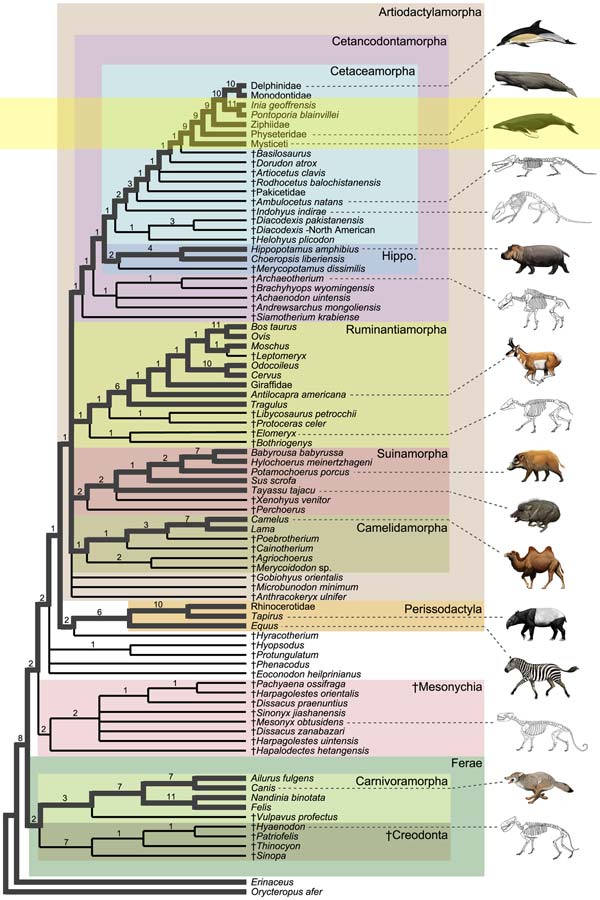
The closest living (thick gray lines) and extinct (thin gray lines) relatives of Whales in a phylogenetic tree. From Spaulding M, O Leary MA, Gatesy J, 2009 Relationships of Cetacea (Artiodactyla) Among Mammals: Increased Taxon Sampling Alters Interpretations of Key Fossils and Character Evolution. PLoS ONE 4(9): e7062. doi:10.1371/journal.pone.0007062
How to Help Protect Humpback Whales
Whaling sharply reduced humpback numbers in the last century, and they still need protection. Economic value is still the biggest motivator for preservation, so joining a responsible whale watching tour will, in the long run, help these animals survive.
You can also adopt a whale through Whale and Dolphin Conservation, for yourself or as a gift for a friend.