
With the 2015 astronomy calendar for Hawaiʻi you will always be up to date on the most exciting astronomical events in the Hawaiian skies in 2015. To make the most of your time we recommend that you read our Meteor shower guide, which is filled to the brim with viewing tips and background information about shooting stars.
Also, don’t forget to have a look at our guide: stargazing on the Big Island. The Mauna Kea volcano on the The Big Island hosts some of the best telescopes of the world, and a visit to these telescopes is a must if you are into stargazing!
These are the most important 2015 stargazing dates for Hawaiʻi:
To be sure you don’t forget, you mark reserve the following dates in your calendar for stargazing:
- January 3: Quadrantids Meteor Shower
- March 19 – 20: Solar Eclipse (not visible from Hawaiʻi)
- April 4: Partial Lunar Eclipse
- April 22-23: Lyrids Meteor Shower
- May 5: Eta Aquariids Meteor Shower
- June 21: Summer solstice
- August 12-13: Perseids Meteor Shower
- September 27: Partial Lunar Eclipse
- October 21: Orionids Meteor Shower
- November 17: Leonids Meteor Shower
- December 14: Geminids Meteor Shower
- December 21: Winter solstice
January 3rd: Quadrantids Meteor Shower
The Quadrantids in 2015 will unfortunately be mostly drowned out by the almost full moon. Shooting stars from this shower are visible between December 28th and January 12th, and the shower peaks at January 3rd at 09:30 Hawaiian time.
We recommend to watch the Quadrantids after midnight on the night between January 3nd and 4th. However, don’t get your hopes up because the full moon will be out almost all night. This years other two major meteor showers, the August Perseids and the December Geminids, are far better showers to watch.
March 19 – 20: Solar eclipse (not visible from Hawaiʻi)
This solar eclipse will take place during the night on the Hawaiian islands (between ~ March 19th 22:00 and March 20th 02:00). This means that stargazers on Hawaiʻi (our sun is also a star) that want to see this eclipse will have to do so online.
Solar and lunar eclipses then to happen (when they do) in pairs. Two weeks after this eclipse, on April 4th 2015, there is a lunar eclipse that *will* be visible from Hawaiʻi!
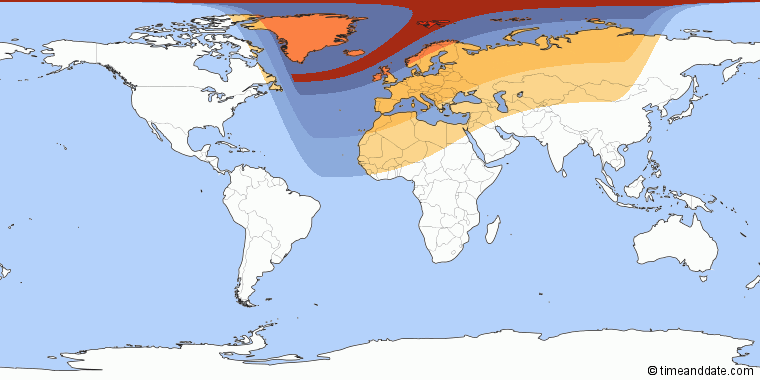
This solar eclipse is not visible from Hawaiʻi. Image credits: timeanddate.com
April 4th: Partial lunar Eclipse
This year Hawaiʻi is the host of two(!) lunar eclipses: One at April 4th and one at September 28th. This eclipse is the most spectacular of the two, since it is *almost* total. The lunar eclipse in September is only partly visible from Hawaiʻi with the moon very close to the horizon. That makes this lunar eclipse your best viewing opportunity for 2015.
This lunar eclipse starts just after midnight on April 4th, at 00:17, and ends at 03:44. The moon will be almost totally eclipsed between 01:57:54 and 02:02:37 HST.

The moment of maximum eclipse will happen on the Big Island at 02:00 in the morning on April 4th. this is what the moon will look like from Hilo. Image adapted from this website
All in all, this is an eclipse that is very easy to watch. All you have to do is stay up to after midnight, look up, and hope for a clear sky!
If you want to learn more about how a lunar eclipse works, why the moon becomes red during an eclipse (hint: for the same reasons sunsets turn red), and more lunar eclipse trivia, visit our lunar eclipse 101.
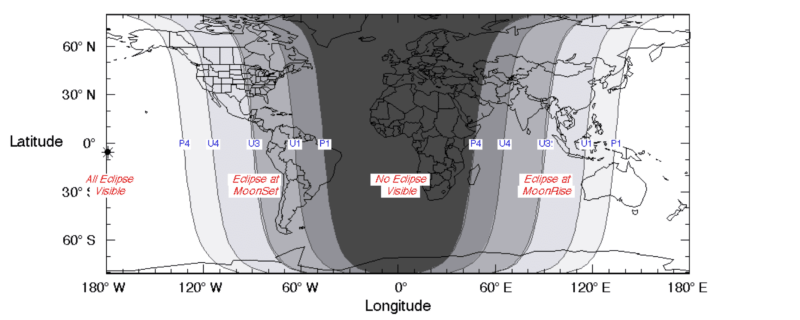
Part of the NASA lunar eclipse map April 4 2015. See the original version here
If for any reasons you cannot go out to watch the lunar eclipse, you can follow the event at a live webcast hosted by virtualtelescope.eu.
April 22-23: Lyrids Meteor Shower
The Lyrids are one of the minor meteor showers of the year, and even under the best circumstances you should not expect to see more than ± 18 meteors / hour.
The peak of this meteor shower for 2015 falls during daytime on April 22nd, between 06:00 AM and 17:00 PM. The moon is not bright the 22nd (22.3% of full brightness), rises during daytime at 09:31 and sets that night at 22:53. Lastly, the sun rises that day at 05:57 AM.
This means that the best times to look for shooting stars belonging to this meteor shower for people in Hawaiʻi is the very early morning of April 22nd between midnight and ~ half an hour before sunrise, up to 05:27 AM.
May 5: Eta Aquariids Meteor Shower
Shooting stars from the Eta Aquariids will be visible between April 19th and May 28th. In 2015, the Eta Aquariids are an o.k. meteor shower to watch, but in Hawaiʻi only the ‘aftermath’ will be visible. The meteor shower reaches peak activity around 21:00 PM Hawaiian time on May 5th, a couple of hours before it rises above the Hawaiian horizon at 01:00 AM on May 6th. Bad news for this shower is the almost full moon, which will outshine the weaker shooting stars leaving only the brightest ones visible.
The best time to watch this meteor shower is on May 6th between 01:00 and ±05:00 (twilight). The closer you are to dawn the better.
June 21st: Summer Solstice and Midsummer Night
Make your midsummer (short) night a special one and make the best out of this longest day. What better excuse is there for a celebration? Many cultures have festivities linked to the summer solstice, so what about organizing your own midsummer night party or pau hana’s?
The summer solstice in 2015 takes place in Hawaiʻi at 06:38 AM local time on June 21th.
August 12-13: Perseids Meteor Shower
The Perseids are probably the best meteor shower to watch in 2015 from Hawaiʻi. Some shooting stars from this shower will be visible during July 17th and August 24th, but to get the most out of your viewing time you have to wait for the peak of this meteor shower. On Hawaiʻi, peak activity occurs between 15:30 on August 12th and 04:00 August 13th 2015.
The news for this meteor shower is even better in 2015, since the almost new moon (very dim) only rises above the horizon at 05:17 HST on August 13th. This means viewing conditions will be near perfect! At its peak and under perfect viewing conditions, you can expect to see between 60 and 100 shooting stars per hour.
Make sure to watch the Perseids at a dark place and keep your fingers crossed for clear skies (or go to a place that is known for its dark and clear skies).
Read our Meteor shower guide to make the most of your time. You can read up on meteor shower viewing tips and find background information on shooting stars.
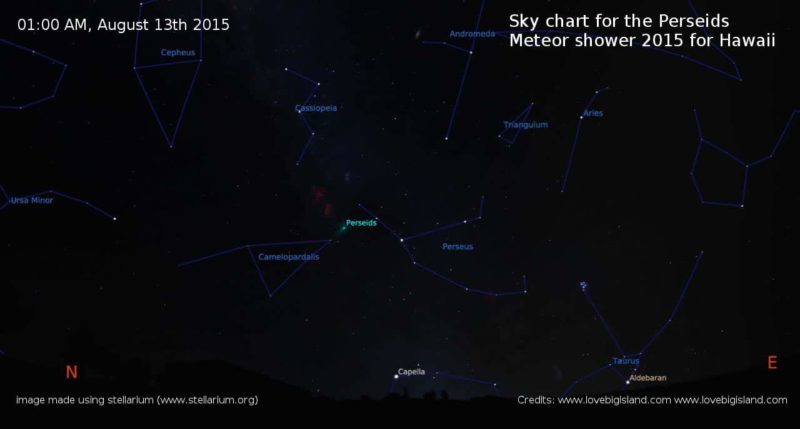
Skymap for Hilo during the peak of the Perseids meteor shower, at 01:00 am on August 13th, 2015. The radiant of the meteor shower is marked ‘Perseids’.
-
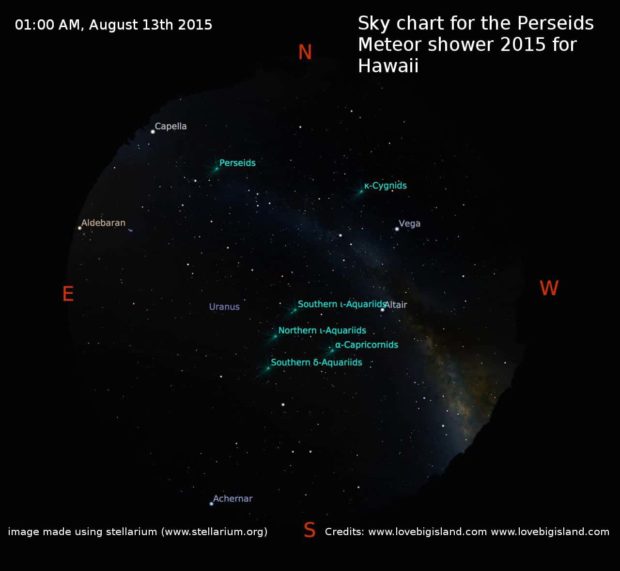

- Skymap for Hilo during the peak of the Perseids meteor shower, at 01:00 am on August 13th, 2015. The radiant of the meteor shower is marked ‘Perseids’.
-
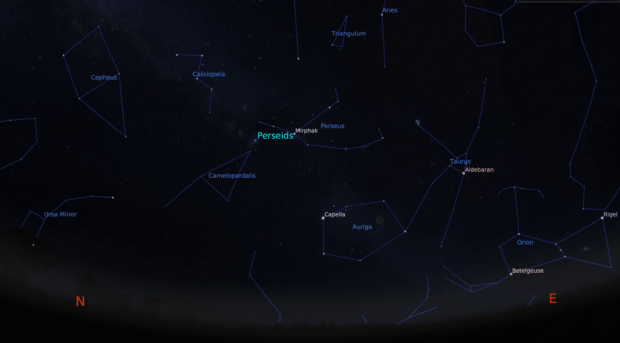

- Skymap for Hilo during the peak of the Perseids meteor shower, at 03:00 am on August 13th, 2015. The radiant of the meteor shower is marked ‘Perseids’. We also show theconventional (western) constellations to guide your eye.
-
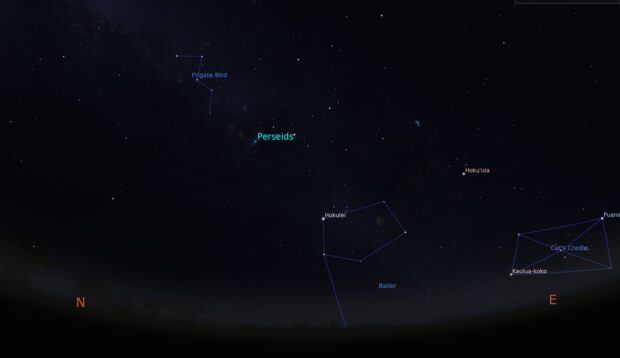

- Skymap for Hilo during the peak of the Perseids meteor shower, at 03:00 am on August 13th, 2015. The radiant of the meteor shower is marked ‘Perseids’. We also showthe location of several polynesian constellations.
September 27: Partial lunar Eclipse
Although this lunar eclipse technically is visible from Hawaiʻi, you shouldn’t hope on a big show. Most of the eclipse happens while the moon is still below the horizon as seen from Hawaiʻi. Only when the moon rises above the horizon, at 18:15 local time, you can see the last part of the eclipse. If you really want to see this eclipse, go to a high spot with a clear line of sight towards the east to maximize your chances.
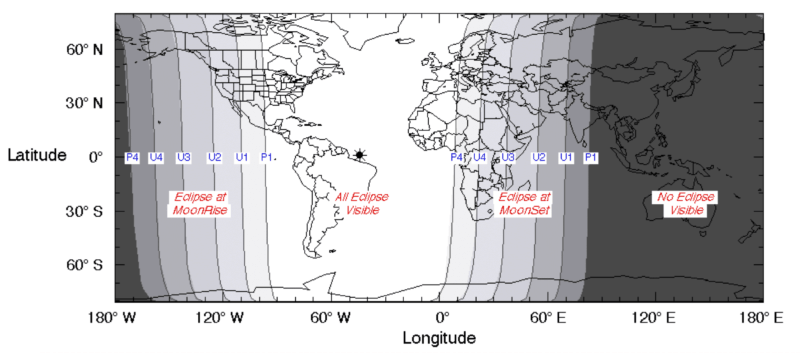
Part of the NASA lunar eclipse map September 28 2015. See the original version here
To learn why the moon becomes during an eclipse (hint: for the same reasons sunsets turn red) and find out more about lunar eclipses, visit our lunar eclipse 101.
October 21: Orionids Meteor Shower
2015 is a good year to look for the Orionids. Shooting stars from this meteor shower are visible between October 2nd and November 7th, and the shower peaks at October 21st. During the peak, you can expect to see between 14 and 30 shooting stars / hour under perfect viewing conditions.
The best time to watch the Orionids is just after midnight on the night between October 21st and 22nd. The moon sets just after midnight, at 00:25, leaving stargazers with a perfectly dark sky afterwards.
November 17: Leonids Meteor Shower
The Leonids are one of the minor meteor showers visible from Hawaiʻi, and have a peak rate of about 15 shooting stars / hour under perfect viewing conditions. However, this is one of the meteor showers that could give a surprise, since it is called “fascinatingly variable” by experts.
In 2015, the Leonids peak on November 17th at 18:00 local time on Hawaiʻi. For the best stargazing, we recommend waiting until ~midnight. This is because the moon sets at 23:16 on November 17th, leaving the sky perfectly dark afterwards.
December 14: Geminids Meteor Shower
The Geminids will make sure that your stargazing year goes out with a bang! The Geminids are one of the most reliable and active meteor showers there is, and viewing conditions in 2015 are near perfect!
You can see shooting stars from the Geminids between December 4th and 17th, but the meteor shower peaks the early morning of December 14th – during the Hawaiian sunrise. Luckily, the moon is below the horizon all night.
This means that for Hawaiʻi, the best time to see shooting stars from this meteor shower between midnight and ~ half an hour before sunrise on December 14th. If you are unable to go out on that night, you should try to catch some Geminids the night before or after.
Read our Meteor shower guide to make the most of your time. You can read up on meteor shower viewing tips and find background information on shooting stars.
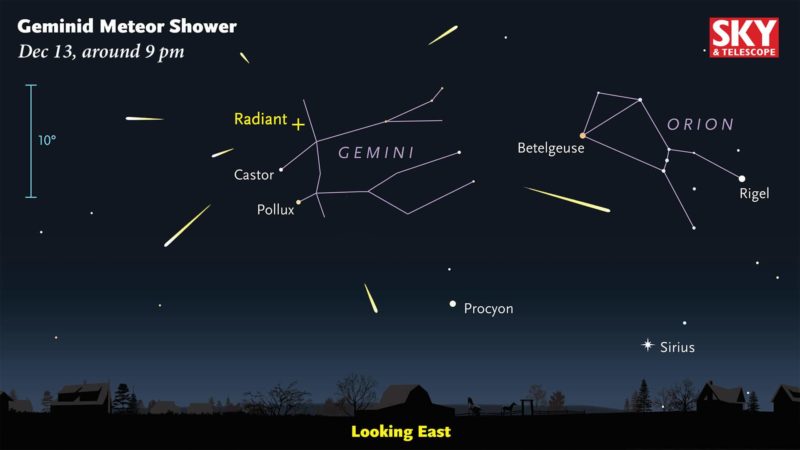
Geminid meteors can flash into view anywhere in the late-night sky. But if you follow their paths back far enough, they all appear to diverge from a point in the constellation Gemini. The meteors’ perspective point of origin is called the shower’s radiant. Don’t expect to see several meteors at once! This diagram is meant only to show their divergence from the radiant point. Image from skyandtelescope.
December 21: Winter solstice
The winter solstice (shortest day, longest night) will take place on December 21st. The exact time of the solstice at Hawaiʻi is 18:48 PM on December 21st.
Resources used for the 2015 stargazing calendar
All dates were selected from the International Meteor Organization Shower Calendar for 2015 (PDF, link). Sky maps and constellation images have been created using the free planetarium software stellarium.