
The Big Island has the planet’s most active volcano, Kīlauea, and its most massive active one, Mauna Loa. Six overlapping shield volcanoes built the island over roughly the last million years, and it’s still growing: a seventh, Kamaʻehuakanaloa, is forming underwater off the southeast coast. From oldest to youngest, the six are Mahukona, Kohala, Mauna Kea, Hualālai, Mauna Loa, and Kīlauea.
For anyone driving the island, these volcanoes are the ground under every stop. They line up by age, oldest in the north to youngest in the south, because the Pacific plate keeps drifting over a fixed hotspot deep in the mantle.
Q: Is there a volcano erupting now on Hawaiʻi?
Usually, yes. Kīlauea has been erupting in episodes at its summit since December 2024, with lava fountains that come and go over days. Whether lava is visible right now changes constantly, so check our often-updated viewing tips before you go.
Why Hawaiʻi’s volcanoes sit so far from any plate boundary
Hawaiʻi’s volcanoes are unusual because they sit far from where volcanoes normally form: tectonic plate boundaries, about 3,200 km (2,000 miles) away. They exist because the Pacific plate drifts at roughly 4 inches (10 cm) a year over a deep, stationary hotspot in the mantle. That hotspot sits beneath the present-day Island of Hawaiʻi (read more about the Hawaiian hotspot). A similar hotspot drives the volcanism at Yellowstone.
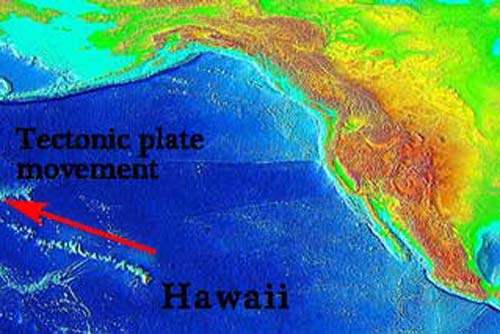
The trail of underwater mountains created as the Pacific plate moved across the Hawaiʻi hotspot over millions of years. Courtesy of the National Geophysical Data Center / USGS.
As the Pacific plate moves over the hotspot, the islands line up by age on a map: which formed first, which is newest (the Big Island), and where the next will appear (Kamaʻehuakanaloa).
That hotspot is also behind so much seismic activity that it makes Hawaiʻi the state most likely to feel an earthquake.
The Big Island’s 6 volcanoes
The Big Island is the youngest in the Hawaiian chain. Six volcanoes built it over roughly the last million years, forming one after another and partially overlapping so their lava flows interlock.
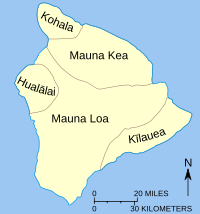
The six volcanoes of the Big Island: Kohala, Mauna Kea, Hualālai, Mauna Loa and Kīlauea. Mahukona is below sea level to the NW of this image. Image courtesy of the U.S. Geological Survey
These six volcanoes hold several world records:
- The most active volcano (Kīlauea)
- The most massive active volcano (Mauna Loa), and
- The tallest sea mountain (Mauna Kea)
Three of the six can still erupt: Hualālai, Mauna Loa, and Kīlauea. Kīlauea is by far the most active, while Mauna Loa and Hualālai could stir again at any time. Mauna Kea is dormant, Kohala is inactive, and Mahukona probably never breached the ocean surface. The Big Island is not the only Hawaiian island with a live volcano: the Haleakalā volcano on Maui could erupt again too.
They range from long dead to still erupting, oldest first:
1: Mahukona: never an island?
Mahukona sits off the northwest coast of the Big Island, named after the nearby town of the same name. It was the first volcano to start building the Big Island, and also the most recently discovered. J.D. Dana predicted it in 1890 from a ‘gap’ in the volcanic loa chain (Hawaiʻi has at least two separate chains, the “loa” and the “kea” chains, which the USGS explains here), but his theorized volcano was not confirmed until 1987.
By Hawaiian standards Mahukona is a small volcano (about 6,000 cubic kilometers, more than 13 times smaller than Mauna Loa) that stopped erupting around 350,000 years ago. It probably never breached the ocean surface at all, stalling while its summit was still about 900 feet underwater.
You can find out more about Mahukona in Garcia et al. (2012) in the Bulletin of Volcanology.
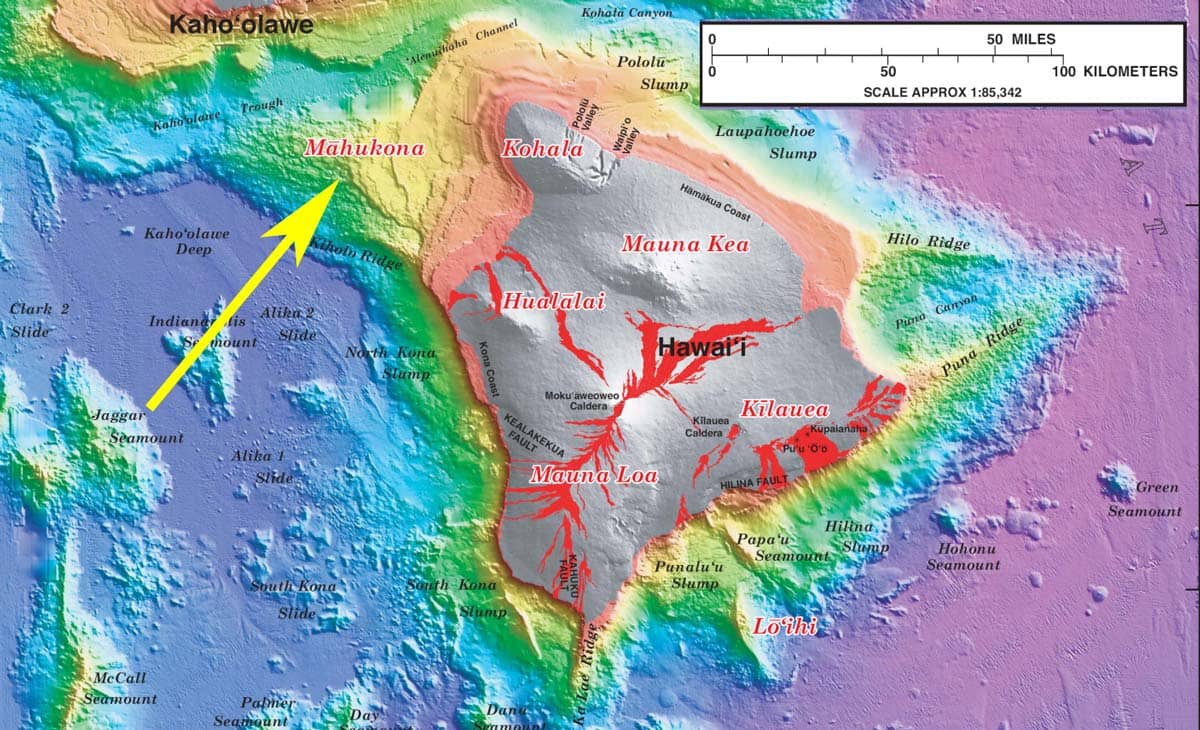
Bathymetric (the underwater equivalent of topographic) map of the Big Island. The Mahukona volcano is indicated with a yellow arrow. Image adapted from USGS
2: Kohala: the oldest
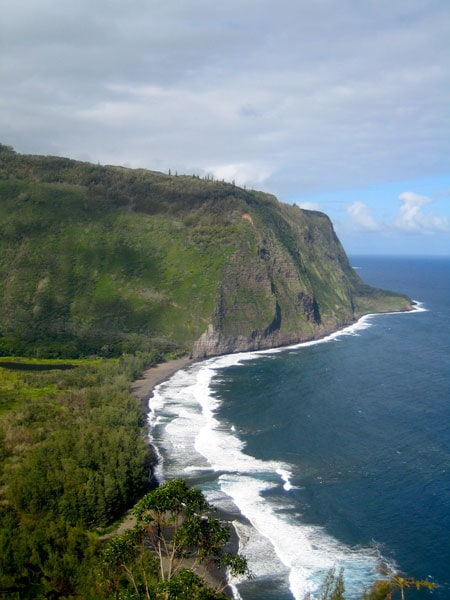
The sea cliffs of Waipiʻo Valley are the remains of a landslide that triggered a tsunami
Kohala is the oldest volcano on the island, about one million years old, and it last erupted around 120,000 years ago. It makes up the northern part of the Big Island (think Waipiʻo Valley), with deep sea cliffs and green rolling hills. For visiting the north of the island, see our guide to the Kohala region.
Kohala used to be much larger, but parts of its flanks have been crumbling into the ocean for over 100,000 years. When a large enough section collapses, the landslide can trigger a tsunami. That’s rare, but the results are catastrophic: one ancient Kohala landslide sent up a wave that reached 500 m (1,640 ft).
Bonus science-geek trivia: Kohala is so old that it recorded the last reversal of Earth’s magnetic field, about 780,000 years ago.
3: Mauna Kea: the tallest sea mountain in the world
Measured from its base on the ocean floor to its summit, Mauna Kea is over 10,000 m (33,000 ft) tall, taller than Mount Everest. The Big Island is so heavy that it presses a depression into the ocean floor, much like an iron ball on a rubber sheet, so most of the volcano sits below the waterline and only 4,205 m (13,796 ft) rise above the sea. That is still enough to make Mauna Kea the tallest sea mountain in the world.
Mauna Kea is dormant, last active about 4,600 years ago. Earthquake swarms still originate inside it now and then, but these are most likely structural readjustment rather than signs of magma on the move.
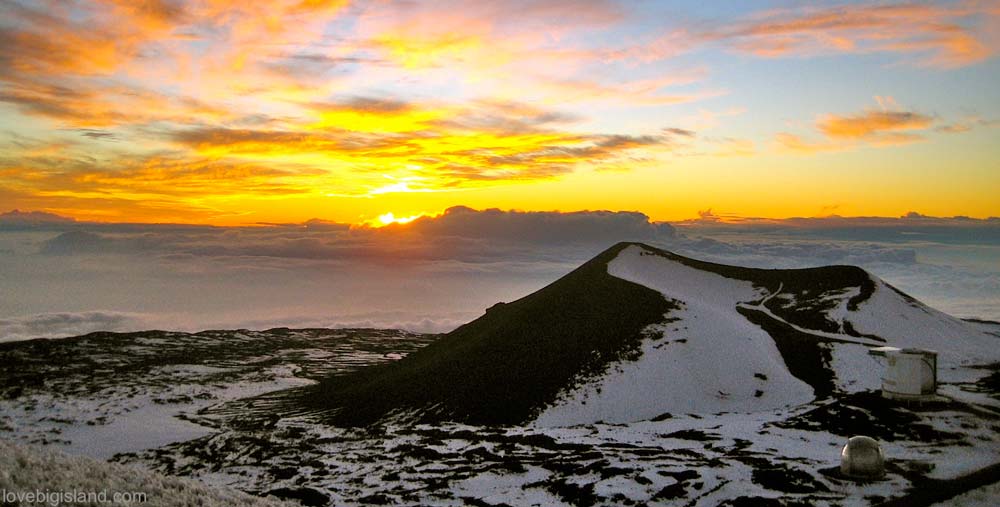
Two telescopes, a dormant volcano, and sunset from Mauna Kea.
The dry, steady air at the summit is why some of the world’s major observatories are built there. If you are on the Big Island, stargazing on Mauna Kea is worth an evening.
4: Hualālai: got Kona coffee?
Kona coffee grows on Hualālai’s slopes. The volcano is active, though it has been quiet for a long time. Its last lava eruption was in 1801, and its last damaging earthquake swarm, probably from a shallow intrusion of magma, hit in 1929.
Hualālai has erupted often over geological time: scientists estimate that about 80% of its surface is younger than 5,000 years. In the century before 1801, at least six separate vents were active on it. Kona International Airport sits on a large lava flow from one of those vents, and you can still see lava tubes in that flow as you drive between the airport and Kona.
Hiking Hualālai
Hualālai’s slopes have native cloud forests, craters, fissures, and lava tubes. From up there you get wide views over the Kona coast.
Large parts of Hualālai are privately owned and off limits. You can explore the lower slopes by hiking Puʻu Waʻawaʻa, but the upper slopes are reachable only with the landowners’ permission, for example on the guided “Hidden craters” hike.
5: Mauna Loa: the largest active volcano on the planet
Mauna Loa means “long mountain”. By volume and surface area it is the largest active volcano on the planet. Its summit rises more than 4 km above sea level, the volcano extends another 5 km below the waterline, and its mass presses the sea floor down a further 8 km. Add those up and Mauna Loa stands about 17 km (56,000 ft) from base to summit.
Mauna Loa is also very active: it has erupted 34 times since written records began in 1843. Its 2022 eruption, from November 27 to December 10, was its first since 1984.
Eruptions from Mauna Loa have often threatened Hilo. In 1935, with a flow heading toward the city, the U.S. Army Air Corps tried to divert it from the air: five bombers of the 23d Bombardment Squadron dropped bombs in the lava’s path. The bombing did little, but the eruption stopped six days later and Hilo was spared.
In 2022, lava from Mauna Loa’s Northeast Rift Zone advanced toward the Daniel K. Inouye Highway, the road that crosses the island’s center, and stopped about 1.7 miles (2.8 km) short before the eruption ended after 13 days.
Since then Mauna Loa has been quiet (check our Mauna Loa updates for the latest). You can follow the current status on the USGS Mauna Loa updates page or read the USGS fact sheet “Mauna Loa: History, Hazards, and Risk of Living With the World’s Largest Volcano”.
Even more massive than Mauna Loa: Pūhāhonu
Just one shield volcano on the planet is larger than Mauna Loa: Pūhāhonu (meaning “turtle rising for breath” in Hawaiian). This extinct volcano, roughly 12 to 14 million years old, is part of the Northwest Hawaiian Ridge and lies 511 nautical miles (946 km; 588 mi) northwest of Honolulu.
One study measured it at almost twice the size of Mauna Loa (source). Pūhāhonu is so large that its summit still breaks the surface, long after the older volcanoes around it slipped underwater. That summit is the “Gardner Pinnacles“, and it looks like this:

The Gardner Pinnacles are the only part of Pūhāhonu that is left above sea level. Credit: NOAA.
6: Kīlauea: the most active volcano on the planet
Good to know: Kīlauea is in eruption more often than not. Read the latest on this volcano and learn how to see it in our guide to seeing lava on the Big Island.
Kīlauea is the youngest of the Big Island’s six volcanoes. It erupted almost continuously from 1983 to 2018 along its East Rift Zone, and since December 2024 it has erupted in episodes at its summit, inside Halemaʻumaʻu crater, with lava fountains that start and stop over days. Kīlauea means “spewing” or “much spreading” in Hawaiian: since 1952 it has erupted more than 30 times, and about 90% of its surface is younger than 1,000 years.
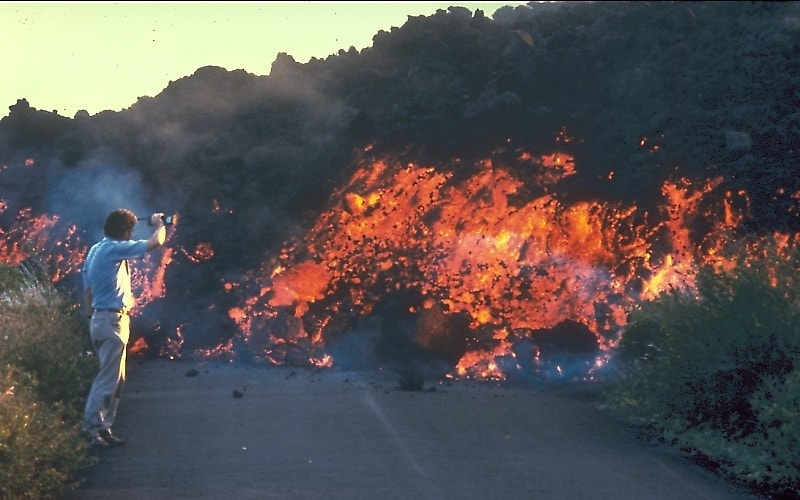
The Kīlauea volcano erupted along its East Rift Zone from 1983 to 2018. Image credit: USGS
Kīlauea is one of the most reliable places in the world to see an active volcano. Between 1983 and 2018, lava repeatedly reached the sea and built new coastline, adding hundreds of acres of land to the island. The summit eruptions since 2020 stay inside Halemaʻumaʻu and do not reach the ocean.
That creation comes with destruction. The 2018 eruption in lower Puna alone covered more than 700 structures, along with roads, historical sites, and beaches.
When Kīlauea is active, you can sometimes see the lava with your own eyes. Depending on the eruption, that might mean a marked overlook near the summit or the glow above Halemaʻumaʻu crater at night. When there is no safe view on foot, a helicopter tour can fly you over the craters.
The newest Hawaiian island: Kamaʻehuakanaloa (Lōʻihi)
Good to know: in 2021 the Hawaiʻi Board on Geographic Names (HBGN) voted unanimously to rename the volcano Lōʻihi to “Kamaʻehuakanaloa”. Read more about the name change here.
Kamaʻehuakanaloa is the newest volcano in the Hawaiian chain and lies about 35 km (22 mi) off the southeastern coast of the Big Island.
With every eruption, Kamaʻehuakanaloa rises a little closer to the surface. Its peak is currently about 1 km (0.6 mi) underwater, and scientists estimate it will take another 10,000 to 100,000 years to become a ‘real’ island.
Fun fact: Kamaʻehuakanaloa (then still called “Lōʻihi”) shows up in season 7, episode 2 of Futurama, set 1,000 years from now. Leela mistakes Lōʻihi for the second Garden of Eden, a fitting comparison for present-day Hawaiʻi.
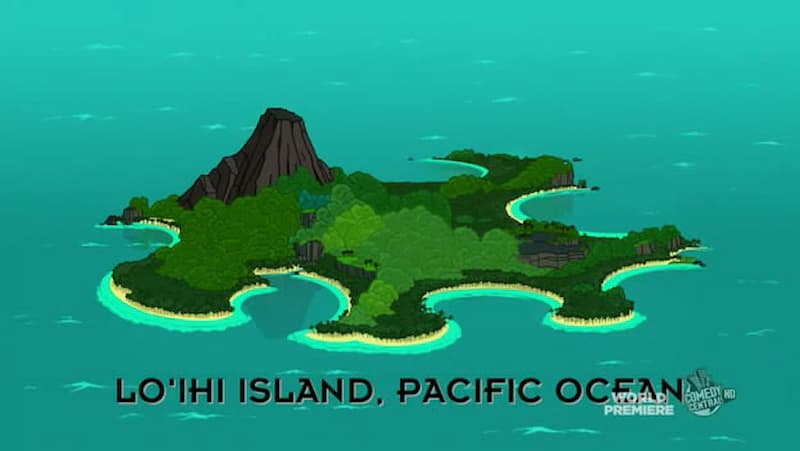
The island of Lōʻihi, as it appeared in Season 7 Episode 2 of Futurama. Credit: The Futurama Wiki (source), shared under a CC BY-SA 3 license.
Read more about Kamaʻehuakanaloa on the USGS website.
Volcano Cheat Sheet
A few volcano records from beyond Hawaiʻi. Please add your own in the comments if you have one for the list.
- Most destructive (recent history): Mt. Tambora, Sumbawa, Indonesia. 10,000 deaths from the 1815 eruption, plus an estimated 110,000 more from the starvation and disease that followed.
- Most active: Kīlauea, Big Island, Hawaiʻi.
- Fastest growing: Mt. Paricutin, Mexico. Grew from 0 to 300 ft. in just 5 days (1942), and stopped erupting in 1953 when a height of 1,391 ft was reached.
- The Hawaiian words for lava, “pāhoehoe” (smooth, unbroken lava) and “ʻaʻā” (rough, broken lava), are now used worldwide for two of the three basic kinds of lava flow. Read more about these two kinds of lava.