
The 2018 Kīlauea eruption covered the Kapoho tide pools and cut Puna’s coast road, which now runs about 11 miles from Kalapana and dead-ends at Pohoiki. That leaves a district you drive out into and back from, with Pāhoa town inland and a new black sand beach at either end of the coast road. The last stretch in crosses the 2018 lava itself.
Pāhoa is the district’s only town: one main street of false-front stores with a raised wooden sidewalk running past them. Makuʻu Farmers Market runs Sundays and Uncle Robert’s in Kalapana stays open late on Wednesdays,. Leilani Estates, where the eruption started, is still lived in and is not a stop.
Table of contents
One request: the communities here are still rebuilding from 2018, and several of the places on this page sit within sight of houses that burned. Watch for posted signage, do not park on residential streets, and take direction from residents when you get it.
Kumukahi, the plover god of Cape Kumukahi
The easternmost point of the island belongs to Kumukahi, a plover god who came from Kahiki and settled at the cape that still carries his name. The old story tells how Pele chased him into the sea and buried him in lava, and how the kōlea, the plover you see here all winter, are his. Read the full legend: Kōlea, the plover god Kumukahi
Why Puna stays undeveloped
Puna sits on the East Rift Zone of Kīlauea, one of the most active volcanoes on Earth, so lava can arrive here with little warning. Little permanent infrastructure has been built here. The same volcanic soil makes this some of the best farmland in the state, thick with nurseries and papaya farms.
The district covers about 500 square miles, a little smaller than Kauaʻi, and borders South Hilo to the north and Kaʻū to the west. The built landscape is a scattered, improvised mix of homes and small businesses spread across a lot of empty land.
On May 3, 2018, a fissure opened on a residential street in the Leilani Estates subdivision. Lava was last visible in fissure 8 on September 5, just over four months later. By then the 2018 LERZ eruption had covered 13.7 square miles, buried more than 700 structures and 30 miles of road, and added 875 acres of new land to the coastline.
What 2018 changed, and what you can still reach
If you’re working from a guidebook printed before 2018, several of its best entries are under rock, and the coast road it describes doesn’t go where it says.
Kapoho is gone
Lava from fissure 8 reached the ocean at Kapoho Bay on June 3, 2018 and filled it in. ʻAhalanui Beach Park and the Kapoho tide pools went with it, and those tide pools were the easiest good snorkeling on this side of the island. The warm pond at Pohoiki is now the only easily reached hot spring left on the Big Island.
The coast road no longer goes through
Highway 137 runs from Kalapana up the coast to Pohoiki and stops. The 3.6-mile stretch north from Pohoiki to the Four Corners junction has been an active reconstruction site since January 2025, with no-trespassing signs and no public access, and the county expects that work to finish in the third quarter of 2026. Check the status before you plan a route through it. Pohoiki Road, the inland route down, is a separate rebuild running into 2027.
Highway 132 is the one that did get rebuilt. It reopened in November 2019 over the still-cooling flow and now carries two paved lanes out to the Four Corners junction. You can’t continue from there: Highway 137 south is the construction zone, and Lighthouse Road east is barriered where about 900 feet of it was buried. It’s one corner and the end of the road, with a view of miles of new lava.
Do not walk out on the new land
In August 2025 Hawaiʻi DLNR warned specifically about the new coastal lava on this side of the island, Kapoho, Pohoiki and Kalapana among the places named. The ground is still settling and unpredictable, and a large crack in the Kapoho delta may be a sign of imminent collapse. A collapsing delta can throw rock and debris hundreds of yards inland and out to sea. Stay on the road and on the marked beach areas.
Leilani Estates is not a viewpoint
Ground zero of the eruption is still a residential neighborhood. Every road except Leilani Avenue is private, there’s no parking on Leilani Avenue, and this is a street people live on rather than a viewpoint. You can see the scale of what happened from Highway 130 heading south from Pāhoa, or from Lava Tree State Monument.
For the human story rather than the geology, the Pahoa Lava Zone Museum at 15-2833 Pahoa Village Road opens daily from 11am to 4:30pm. It holds photographs taken by residents during the eruption and exhibit props rescued from the Jaggar Museum at Hawaiʻi Volcanoes National Park, which the 2018 earthquakes damaged and which is now permanently closed.
Kīlauea itself is still active, in episodes, at its summit rather than out here in Puna. Check the USGS Hawaiian Volcano Observatory update for the current status before you build a day around it.
Our 9 Favorite Places to See in Puna
You could spend days working through the back roads here. For an afternoon or a full day, these are the nine stops we’d prioritize, in the order you’d drive them from Pāhoa.
| Stop | What it is | Suggested time |
|---|---|---|
| Pāhoa | The district’s only town, and where the restaurants are | 1 hour |
| Star of the Sea Painted Church | Small 1928 folk-art church, hauled up the road ahead of the 1990 flow | 15 minutes |
| Kalapana | Lava field over the buried village, with a few rebuilt houses standing on it | 20 minutes |
| Kaimū and Uncle Robert’s | Black sand beach from the 1990 flow, 15 minutes’ walk in, plus a kava bar and market open late on Wednesdays and closed Fridays | 1 to 2 hours |
| The Red Road | 11-mile coastal drive that dead-ends at Pohoiki, so it is out and back | 1 to 2 hours return |
| MacKenzie State Recreation Area | Ironwood grove on low sea cliffs, with picnic tables and restrooms but no drinking water | 30 minutes |
| Pohoiki (Isaac Hale) | Black sand beach created in 2018 and the warm pond behind it | 1 to 2 hours |
| Lava Tree State Monument | 0.7-mile loop past the lava molds of trees a 1790s flow burned through | 30 minutes |
| Makuʻu Farmers Market | More than 170 vendors on 5 acres, Sunday mornings only | 1 hour |
Suggested times are ours, worked out from trail lengths and how much there is to do at each stop, not published figures. Trail distances, park hours and facilities come from Hawaiʻi State Parks; market and venue hours from the operators.
All nine is a full day. For an afternoon, the coast road with Kaimū, Pohoiki and MacKenzie is the strongest half of it.
Pāhoa
Lava has come close to Pāhoa twice. A 2014 flow advanced on the town for weeks, starting and stalling, before halting a few miles short of the main road. In 2018 the glow from the Leilani Estates fissures, south of town, was visible from the main street at night.
Every shop and place to eat in the district is on that main street or a short drive off it, so plan a stop here whether or not you meant to.
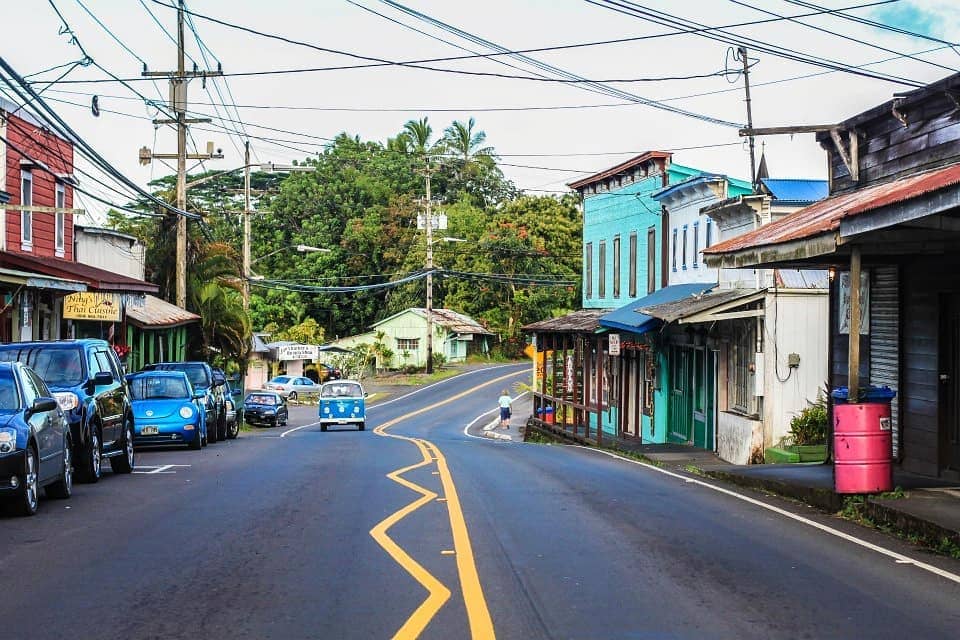
Downtown Pāhoa, with its raised wooden sidewalk and false-front stores. Image Credit: Joey Gutierrez.
The Painted Church
From the end of Pāhoa’s main street, Highway 130 runs south about 10 minutes to the Star of the Sea Painted Church, between mile markers 19 and 20.
It’s a small wooden building, put up in 1928 under the Belgian missionary priest Father Evarist Gielen, with Hawaiian folk-style painting on the interior walls and ceiling. In 1990 the congregation strapped it to a trailer and hauled it up the road ahead of the flow that took the rest of Kalapana.
Good to know: the church has been decommissioned and mass is now said only once a month by visiting priests, so nobody posts visiting hours. There is also another painted church in the south Kona district, St. Benedict’s, which is a different building entirely.
Kalapana
Kalapana is a lava field with houses on it. Flows from the Kūpaʻianahā vent buried most of the village in 1990, along with the Kalapana Gardens and Royal Gardens subdivisions and the town and bay of Kaimū, which sit under more than 50 feet of rock. It was the worst flow to hit a residential area in the islands until Leilani Estates in 2018.
You can drive out to where the village was and look up the slope of Kīlauea toward Puʻu ʻŌʻō. Some of the old homeowners rebuilt directly on the new rock, so a handful of houses now stand on bare black lava.
Pop trivia: Kamoamoa Beach was the shooting location for the music video of Chris Isaak’s Wicked Game in 1989. Lava covered the beach less than a year later.
Kaimū and Uncle Robert’s
Backtracking a little brings you to the turnoff for Kaimū, the small neighboring town destroyed in 1990. In Hawaiian, Kaimū means roughly “gathering by the sea”, for the crowds who watched surfing here.
A 15-minute walk from the parking area over the old flow brings you out at a new black sand beach forming in Kaimū Bay. The sand is coarse, and up close you can see it is made of broken fragments of lava rather than anything worn smooth.
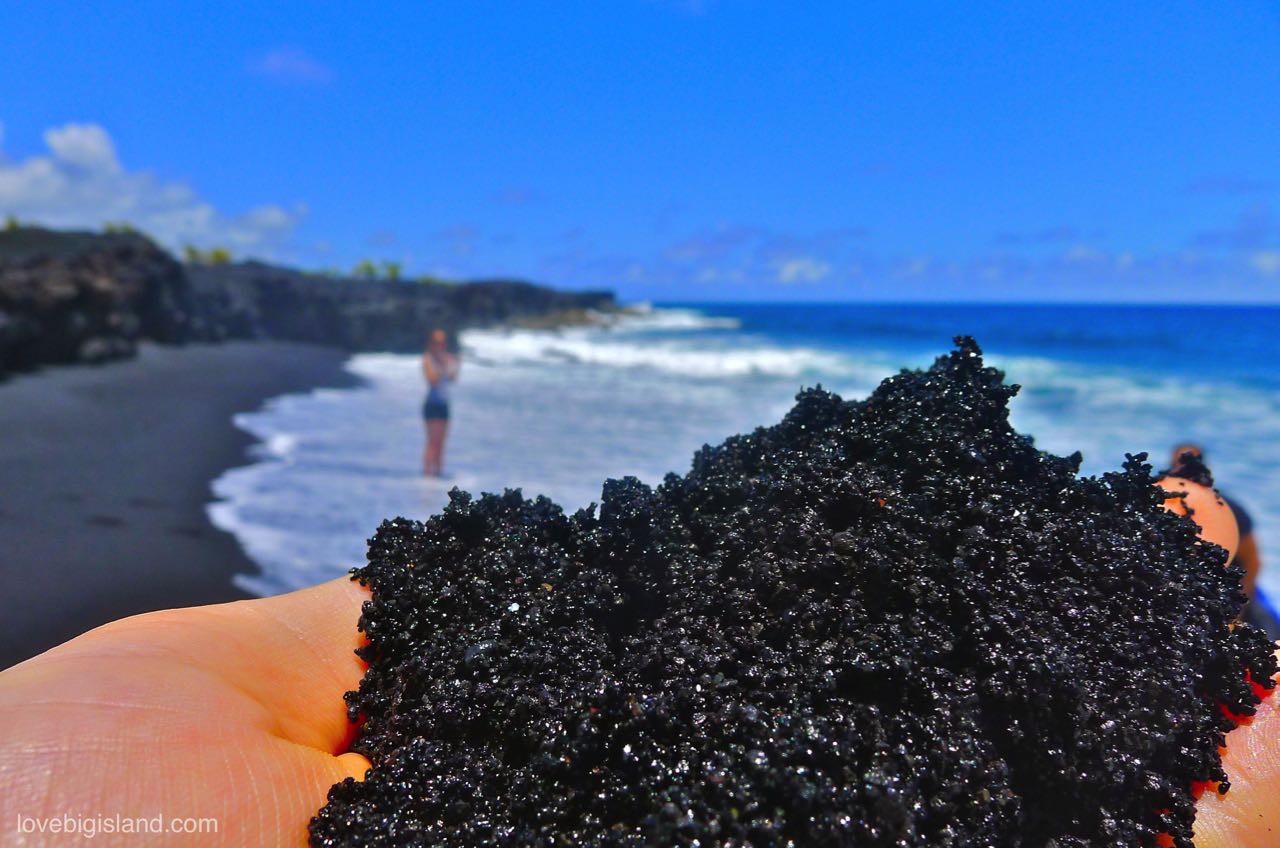
If you look closely you can see that the black sand at the beach consists of fragments of solidified lava.
A few minutes back up the road is Uncle Robert’s, a collection of vendors, eateries and a kava bar. Their posted hours are 7:30am to 7:30pm most days, closed Friday, and 7:30am to 10pm on Wednesday, which is the night with live music and the fullest turnout. Those are the venue’s hours rather than the vendors’, so stalls may pack up before closing.
The Red Road
Highway 137, the Red Road, runs about 11 miles northeast from Kaimū and then stops. The 2018 flow cut it at Isaac Hale Beach Park in Pohoiki, so this is an out-and-back: you turn around at Pohoiki and return the way you came. We were down there in July 2026 and it still ends at Pohoiki.
The drivable stretch runs close to the water anyway, through tree tunnels dense enough to drop the light, with pull-offs where you can stop and look at the coast. The last stretch into Pohoiki crosses the 2018 flow itself, so the roadside goes from forest to bare black rock in a couple of minutes. It is one of the best scenic drives on the island.
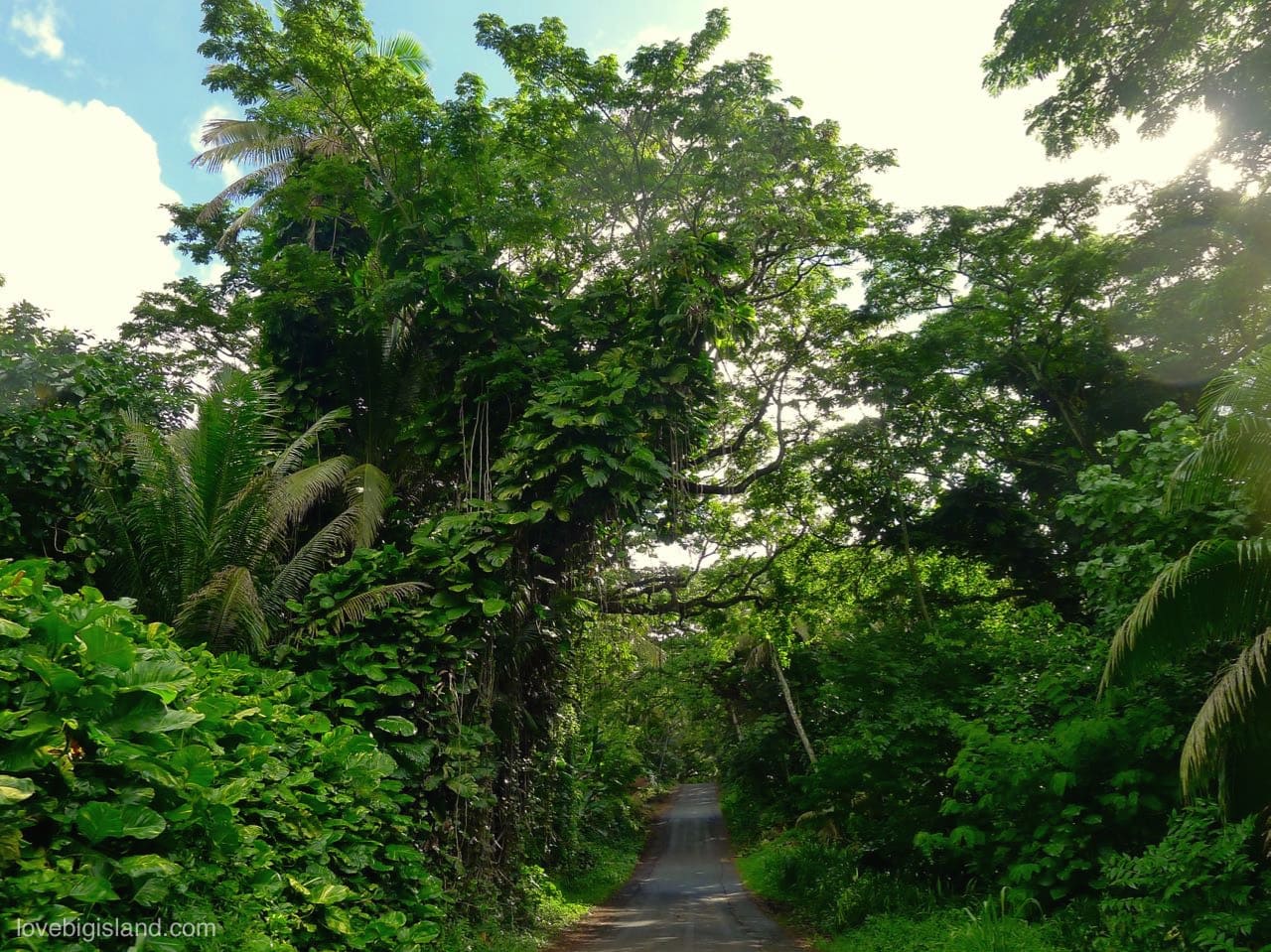
The Kalapana-Kapoho road, better known as the Red Road, running under one of its tree tunnels.
MacKenzie State Recreation Area
MacKenzie State Recreation Area is a spooky, wind-battered 13-acre strip on the low lava sea cliffs along the Red Road. It holds the largest stand of ironwood trees in the islands, and an old Hawaiian coastal trail runs through it.
Entry is free and it’s open daily during daylight hours. There are restrooms and a covered picnic pavilion but no drinking water, so bring your own. Camping and pets are both prohibited. The waves break directly onto the ledge and the current is strong: heed the danger signs, and keep back from the edge.
Pohoiki (Isaac Hale Beach Park)
For decades the boat ramp and surf break at Pohoiki Bay were the center of the Puna coast. Over the summer of 2018 the lava crept closer, and when it stopped, currents had swept enough new sand into the bay to close the harbor off from the ocean. That sand is what created both the black sand beach and the warm pond behind it, which is also volcanically heated.
The boat ramp hasn’t come back. A dredged channel opened on October 10, 2025 and refilled with volcanic debris within a week, and the state’s own listing has the ramp closed until further notice while it looks at longer-term options. The park has also had no piped water since 2018; the county’s Pohoiki Road rebuild is what will restore it, and that is running into 2027.
A short walk from the water takes you to the edge of the 2018 flow. We wouldn’t swim here: the dredged boat channel refilled with volcanic debris within a week of opening, and the DLNR warning about unstable new land applies to the rock at the flow’s edge.
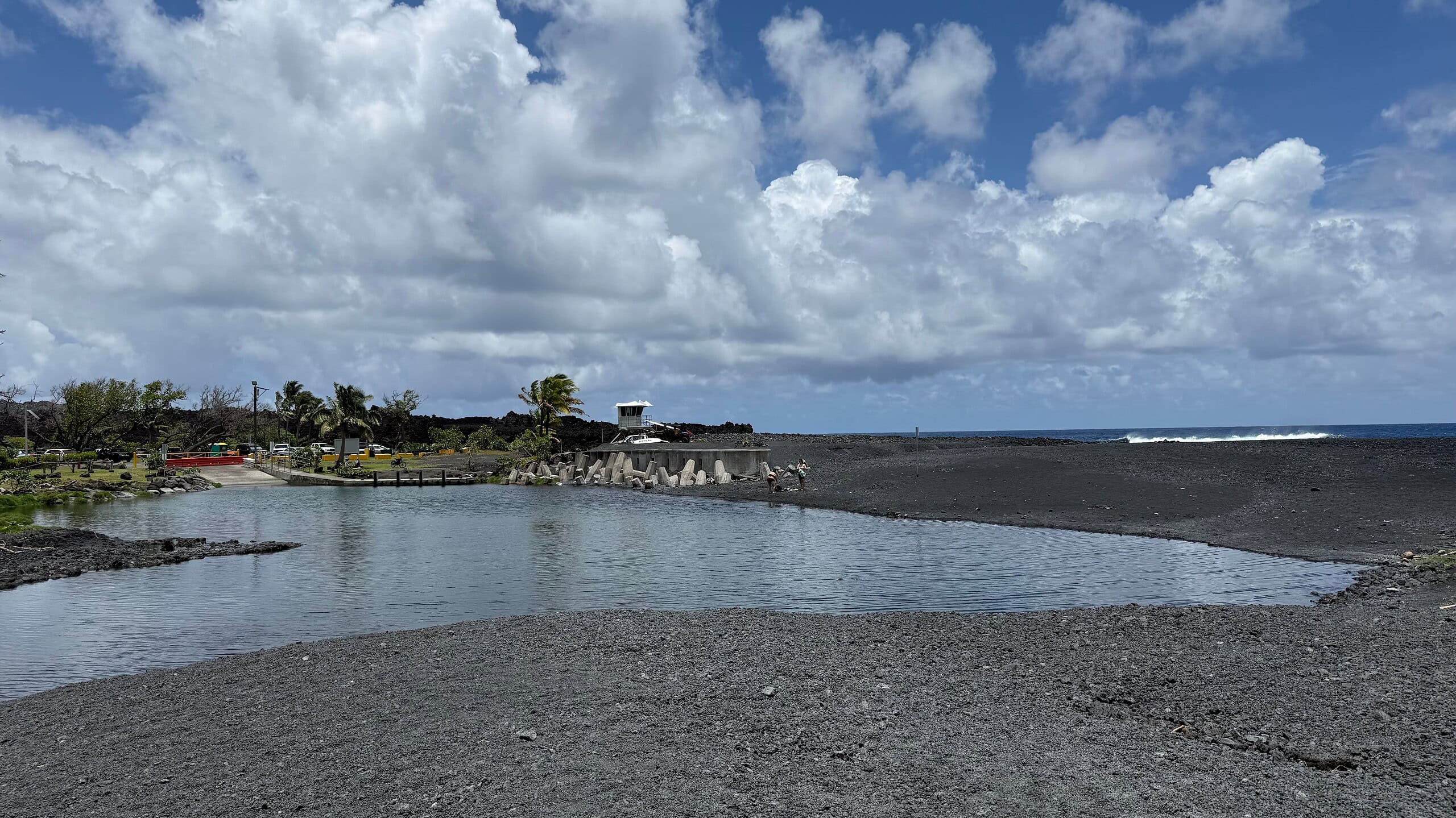
Looking back from the black sand at Isaac Hale Beach Park: the lifeguard tower, the warm ocean thermal pond near the boat ramp, and the parking area are all visible. The solidified lava along the coastline marks the edge of the 2018 Kīlauea flow that created this beach.
Lava Tree State Monument
Lava Tree State Monument sits off the Pāhoa-Pohoiki Road just outside town, a 17-acre park built around a 0.7-mile loop trail. The lava molds along it formed in the 1790s, when a flow swept through a stand of ʻōhiʻa and hardened around the trunks before the wood burned away.
The loop is level and ADA accessible. Entry is free and it’s open daily during daylight hours, and there are restrooms and picnic tables but no drinking water, so fill a bottle in Pāhoa on the way past. State Parks lists a hazardous cliff along part of the loop, so keep to the trail.
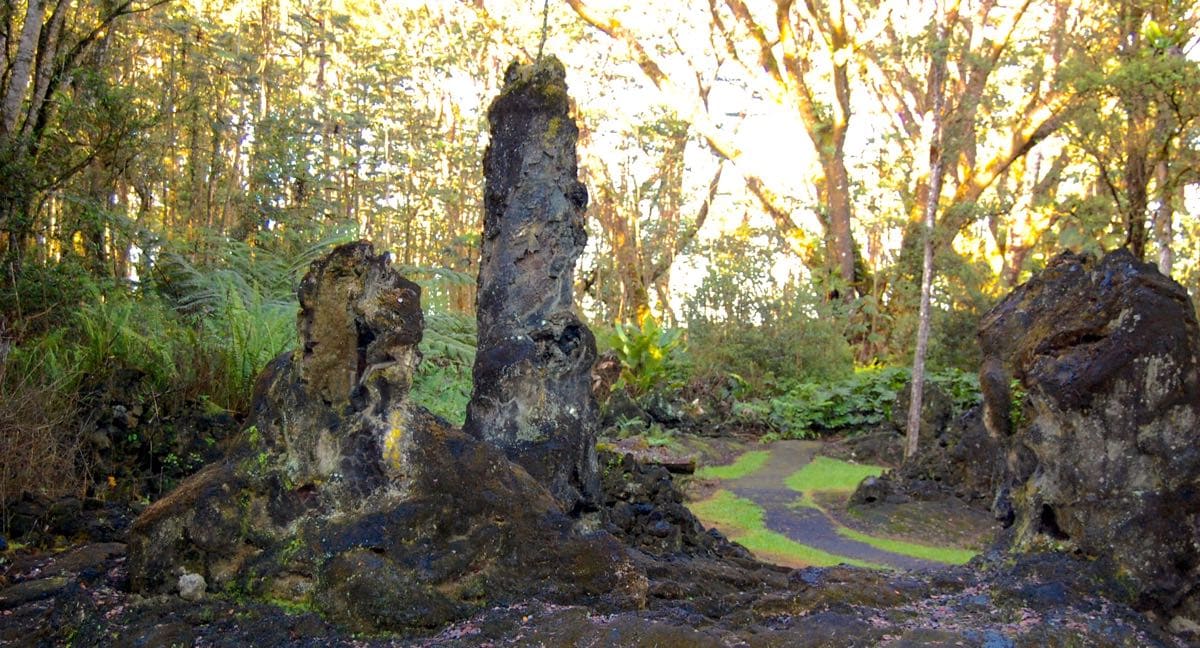
Lava trees, such as these at Lava Tree State Monument, are the result of a lava flow that swept through this forested area and left behind lava molds of the trees. By Sean A. Clevenger [CC BY-SA 3.0], from Wikimedia Commons
Makuʻu Farmers Market
The Makuʻu Farmers Market runs on Sundays at 15-2131 Keaʻau-Pāhoa Road, on a 5-acre site outside Pāhoa. The market puts its own count at more than 170 vendors and around 3,000 visitors on a market day.
Alongside the food stalls there is produce from farms nearby, plus Puna goat cheese, lehua honey, coffee, vanilla, macadamia nuts and chocolate, and a craft side selling soaps, jewelry, clothing and pottery. There is usually live music, and local families come out to it as much as visitors do.
Note: the market’s own site (makuu.org) says Sunday but doesn’t post a closing time, and the times listed elsewhere disagree with each other. Treat it as a morning market and go early. The site also has renovations coming, including paved paths and upgraded bathrooms.
Where to eat in Pāhoa
Pāhoa has the district’s only cluster of places to eat. Check hours: Kaleo’s opens four days a week and Pele’s Kitchen shuts at noon. Three of the five are on Pahoa Village Road; the other two are a short drive off it.
- Kaleo’s: Hawaiian-style Asian-American cooking in a relaxed room with live music. 15-2969 Pahoa Village Road, (808) 965-5600. Thursday to Sunday, 4pm to 8pm only.
- Ning’s Thai Cuisine: Family-run Thai, cooking here since 2002. 15-2955 Pahoa Village Road, (808) 965-7611. Noon to 9pm most days, noon to 6pm Sunday, closed Wednesday.
- Pele’s Kitchen: Breakfast with local fruit and Puna coffee. 15-2923 Pahoa Village Road. Open daily, 7:30am to noon, so it’s breakfast or nothing.
- Luquin’s: Generous plates of tacos, burritos and other Mexican standards. 15-1448 Kahakai Boulevard, (808) 333-3390. Open seven days, 10am to 10pm.
- Island Naturals Market and Deli: The place to build a beach lunch, with a hot bar, salads, sandwiches and sushi. 15-1870 Akeakamai Loop, (808) 965-8322. Monday to Friday 8am to 6pm, weekends 9am to 5pm.
On Wednesday, the night the Kalapana market runs late, Kaleo’s and Ning’s are both closed. After 6pm that leaves Luquin’s and Uncle Robert’s own kitchen.
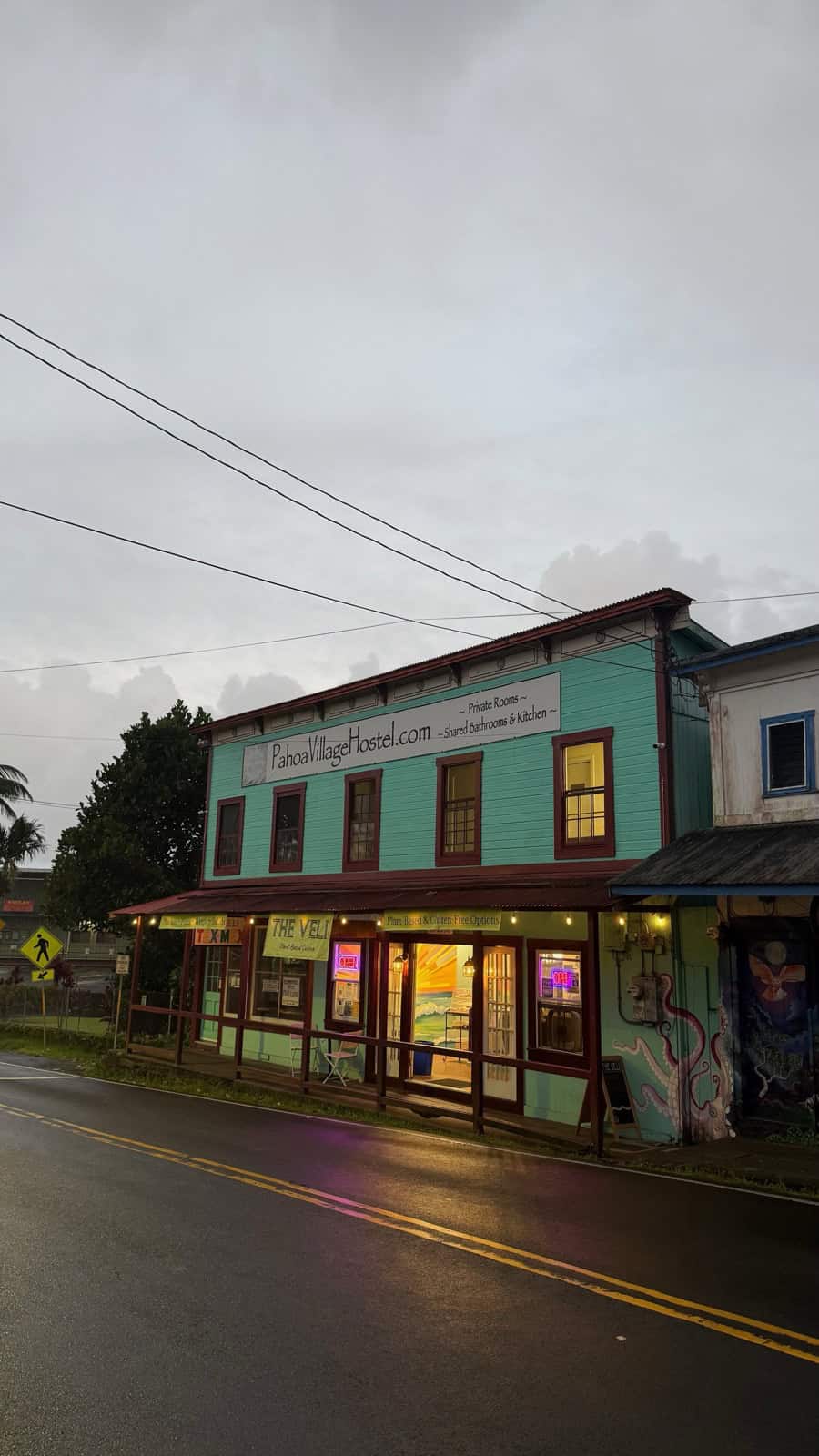
The Pāhoa Village Hostel along Pāhoa’s main street is the cheapest place to stay in town.
Getting to Puna, and what to plan around
Puna is the least developed district on the island. Sort out the drive time and the weather before you leave, and know about the little fire ants before you walk into any vegetation.
Drive times
Pāhoa is about 20 miles from Hilo, roughly half an hour on Highway 130, so Hilo is the natural base for a Puna day. From Kailua-Kona it’s about 95 miles and closer to two and a half hours, because the route runs through Hilo either way. Do your stopping in Pāhoa: it’s the last cluster of shops before the coast road.
Weather
Lower Puna runs from sea level to about 650ft (200m) at Pāhoa. It’s warm year round, showers and sun alternate through the day, and humidity sits high enough that nothing you hang up dries. Bring layers you can peel off, plus sunscreen and insect repellent for the forested stretches near the water.
Little fire ants
The main nuisance in Puna is the little fire ant (Wasmannia auropunctata). The ant is tiny; the sting is an intense burning rash that can spread across an area the size of your hand, and that itches for a good while afterward.
They live in vegetation and drop out of it, so take care brushing against trees and low growth. If you get stung, brush the ants off, cool the skin with a damp towel, and use an over-the-counter hydrocortisone cream if the itching persists. A small number of people react badly enough to go into anaphylactic shock, so treat a serious reaction as an emergency.
If you are traveling with a dog, little fire ants are drawn to the moisture of an animal’s eye and sting when the animal blinks, and repeated stings cause a clouding of the cornea that has left cats, dogs and livestock partly blind. Keep pets out of dense vegetation here, and stand a food bowl in a tray of soapy water if you are staying in the area.
They also hitch rides on cars, shoes, plants and produce, so check what you are carrying when you leave.