
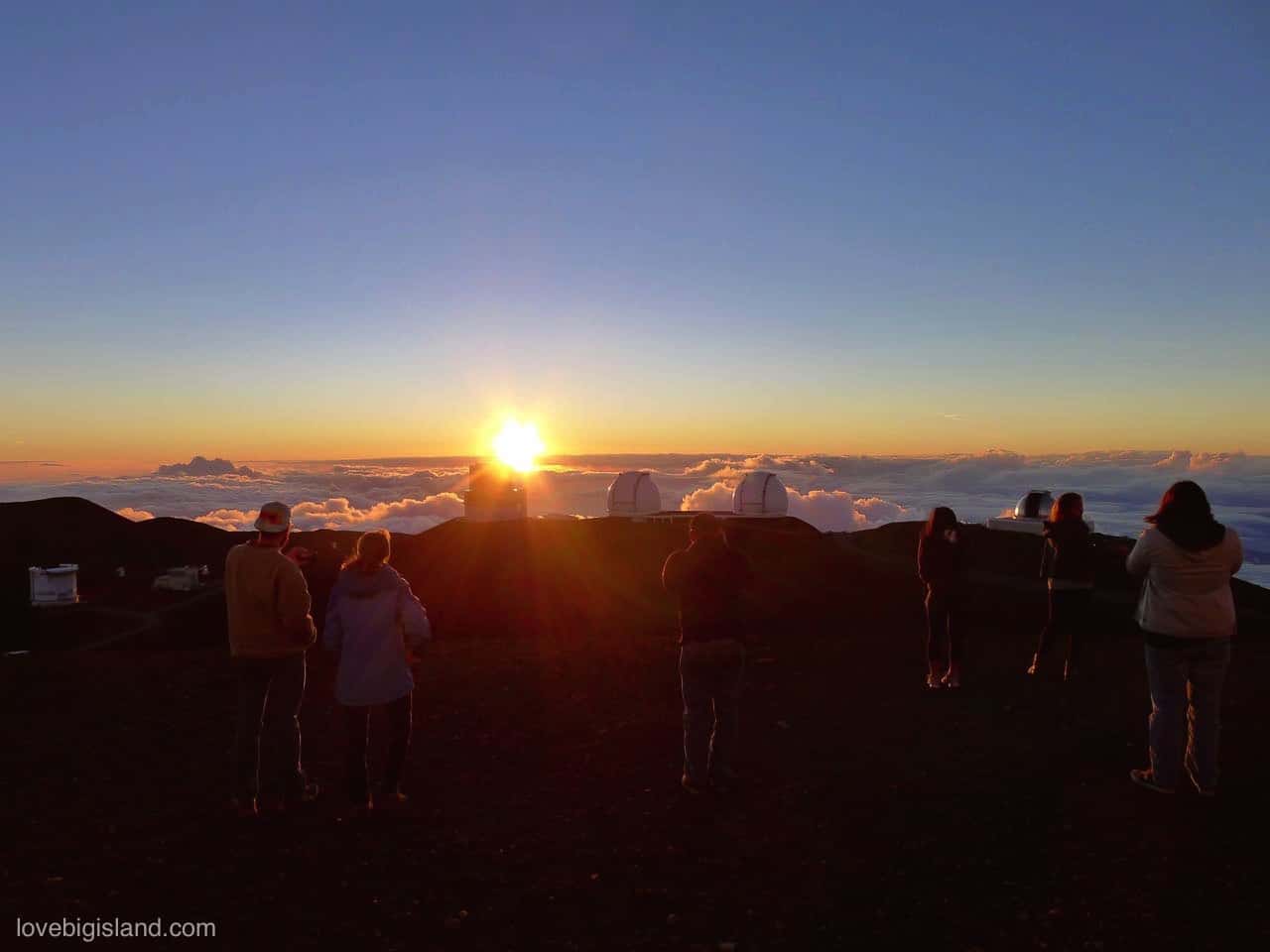
Stargazing in 2016 features highlights such as a partial solar eclipse in march and a possible good show from the Perseids in August. The forecast for the other two strongest meteor showers: the Geminids and the Quadrantids, are not as good due to interference from the moon.
This stargazing calendar will help you plan your nights to make the best of the biggest celestial events of 2016. To make the most of your time we recommend that you read our Meteor shower guide, which is filled to the brim with viewing tips and background information about shooting stars.
Also, don’t forget to have a look at our guide: stargazing on the Big Island. The Mauna Kea volcano on the The Big Island hosts some of the best telescopes of the world, and a visit to these telescopes is a must if you are into stargazing!
These are the most important 2016 stargazing dates for Hawaiʻi:
To be sure you don’t forget, you mark reserve the following dates in your calendar for stargazing:
- January 3: Quadrantids Meteor Shower
- March 8: Partial solar Eclipse
- March 22-23: Penumbral Lunar Eclipse
- April 21-22: Lyrids Meteor Shower
- May 5: Eta Aquariids Meteor Shower
- June 20: Summer solstice
- August 12-13: Perseids Meteor Shower
- October 20: Orionids Meteor Shower
- November 17: Leonids Meteor Shower
- December 14: Geminids Meteor Shower
- December 21: Winter solstice
January 3rd: Quadrantids Meteor Shower
2016 is an OK year to try to catch the Quadrantids shooting stars. This meteor shower is expected to peak at January 3rd at around 22:00 HST (Hawaiian Standard Time), and at that time the skies will be dark. Unfortunately, in general the best time to see meteors is during the early hours of the morning, and these hours will be illuminated by a waning moon rising above the horizon at 02:10.
March 8th: Partial solar eclipse
You can see a partial solar eclipse from Hawaiʻi on March 8th 2016 between 16:37 and 18:28. The peak of the eclipse (when the moon is closest to the center of the sun) will be at 17:37 HST. This partial eclipse will be visible from all Hawaiian islands, and lasts a bit less than 2 hours. Read more details about this partial solar eclipse at timeanddate.
A solar eclipse happens when the moon passes precisely in between the Sun and the Earth. When this happens, the Moon casts a shadow on the Earth, and if you happen to be this shadow, you will see the sun being eclipsed. This is the same principle as when you for example hold your hand between your eyes and a bright light source to block out the light. If you’d like to read more comprehensively about solar eclipses, we recommend this guide.
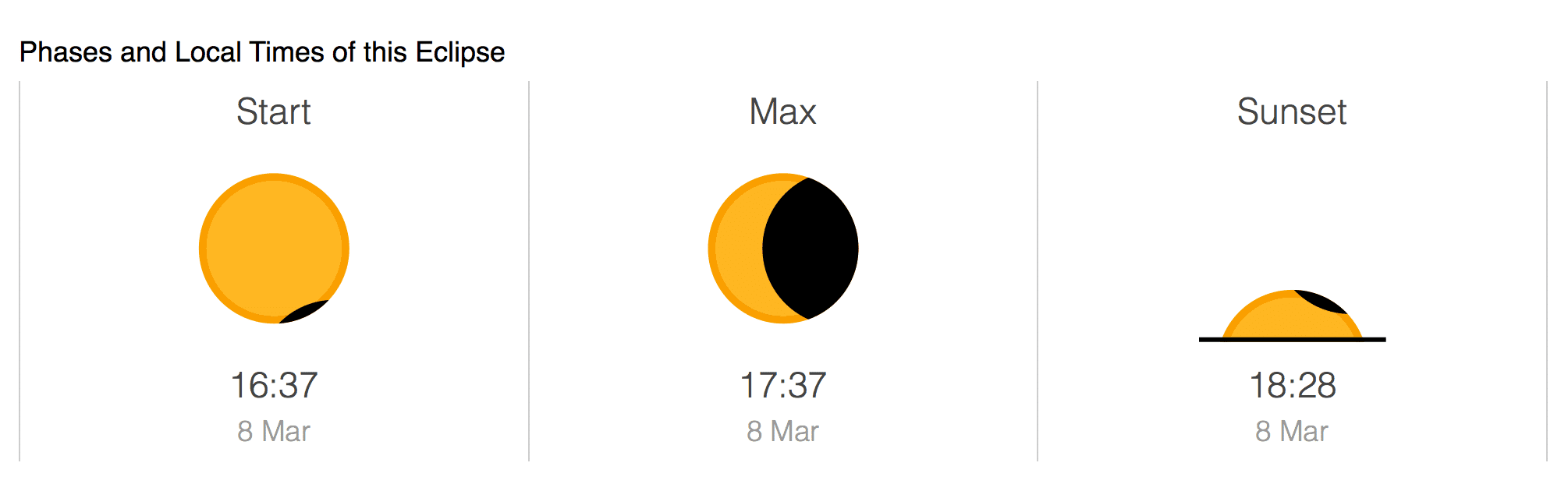
Cartoon of what the March 2016 partial solar eclipse will look like from Hawaiʻi. This image has been adapted from timeanddate.com (source)
Solar eclipse viewing safety information (important!)
Looking directly at the sun (even if it is partially eclipsed) is dangerous, and can permanently damage your eyes. For safe viewing “at home” you should wear eclipse glasses or consider indirect viewing methods such as building your own pinhole projector.
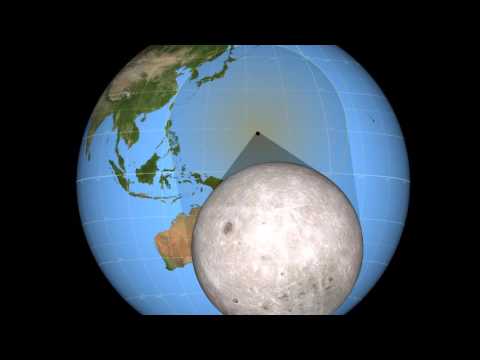
You can see a very interesting simulation from NASA about this solar eclipse in the video below. In it, you see the shadow cast by the moon move over the surface of the earth. It crosses the Hawaiian islands almost at the end of the video.
March 22-23: Penumbral Lunar eclipse:
A penumbral eclipse is very difficult to see, as the moon doesn’t pass through the Earths full shadow. “Penumbra” is a combination of the Latin words “paene” (almost, nearly) and “umbra” (shadow).
Because of this, the moon won’t turn red and will be only a bit less bright at those parts where is passes through the penumbra of the Earth.
For the motivated stargazer: This eclipse starts on March 22nd at 23:39 and ends on March 23rd on 03:45 in the morning. The peak eclipse is visible at 01:47 on March 23rd. More details can be found here.
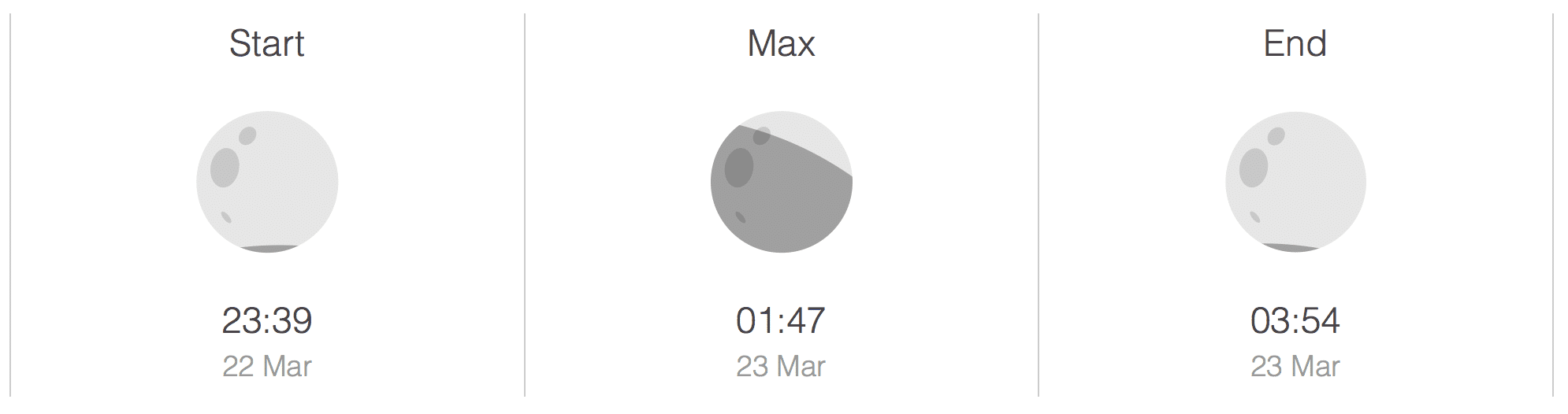
Cartoon of what the March 2016 penumbral lunar eclipse will look like from Hawaiʻi. This image has been adapted from timeanddate.com (source)
The next total lunar eclipse visible from Hawaiʻi will be on January 31st 2018.
April 21-22: Lyrids Meteor Shower
A full moon on April 21st almost completely ruins the Lyrids meteor shower in 2016. This shower peaks in the night between April 21st and 22nd, and given the brightness of the moon we expect very few shooting stars to be visible.
May 5: Eta Aquariids Meteor Shower
2016 is a very good year for the Eta Aquariids! The almost moonlight nights (May 4th with moon rise at 04:16 and an illumination of 5.8%, May 5th with a moon rise at 05:50 and an illumination of 1.4%) guarantee dark skies for perfect viewing conditions.
Under truly perfect viewing conditions, one can expect to see about 40 shooting stars per hour during the peak of this shower.
The best time to look for shooting stars belonging to this shower is in the early morning hours of May 4th, as the expected peak of this shower falls on 09:00 am the same day.
June 20th: Summer Solstice and Midsummer Night
The summer solstice in 2016 takes place in Hawaiʻi at June 20th just after midday, at 12:34 HST
Midsummer night is the shortest night of the year, and you could try to make your midsummer night a special one. What better excuse is there for a celebration? Many cultures have festivities linked to the summer solstice, so what about organizing your own midsummer night party or pau hana’s?
August 12-13: Perseids Meteor Shower
2016 is a good year to watch the Perseids meteor shower. This shower will peak in Hawaiʻi at the early hours of August 12th. Around this time in the month, the moon is getting brighter again, so you should try to plan your stargazing after moon set. The moon will set at August 11th at 00:23, at August 12th at 01:06, and at August 13th at 01:52 (times accurate for Kaʻū. In Hilo the moon will set a few minutes more early, in Kona a few minutes later).
Under perfect viewing conditions and at the right time, you can expect to see up to 150 (!) Perseids per hour.
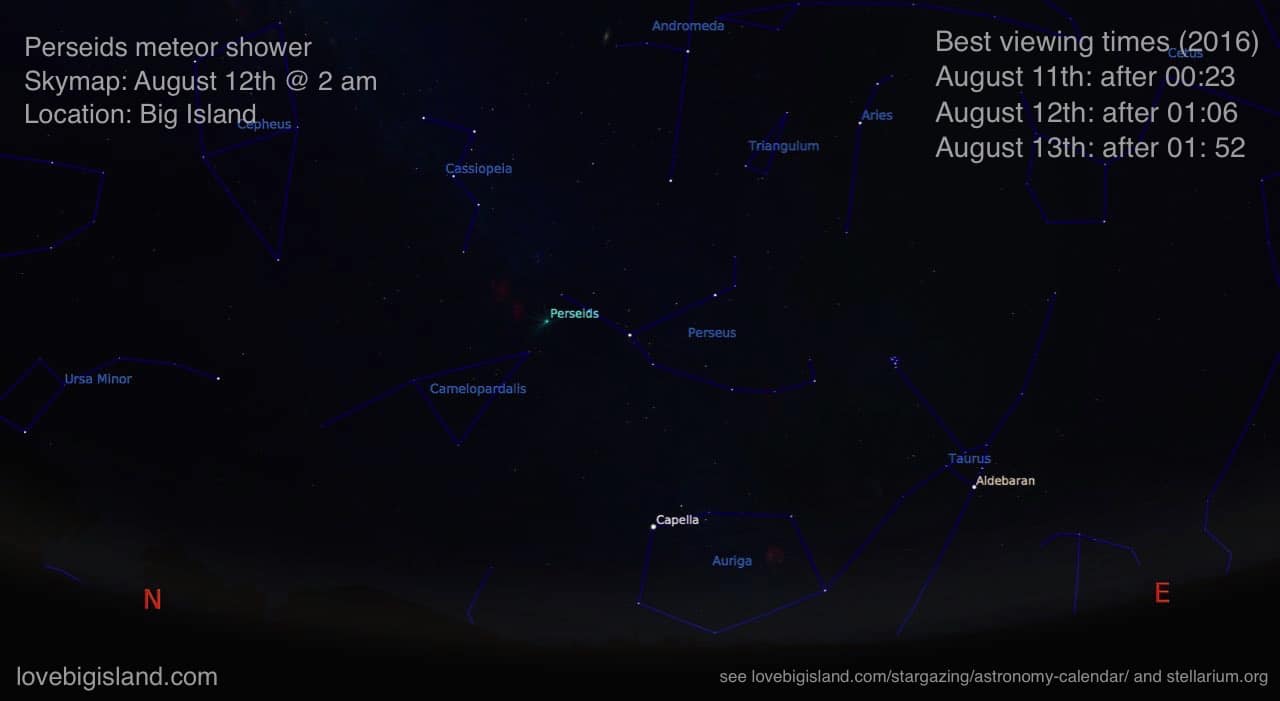
In Hawaiʻi, the best time to see the Perseids meteor shower in 2016 is after midnight. You can find the shower radiant (point of origin) in the north-east.
In 2016 we can expect an elevated activity of the Perseids, thanks to the planet Jupiter! This planet moves once every 12 years through the debris trail that causes the Perseids meteor shower (learn more about what causes a meteor shower), compared to once a year for our planet Earth. Because Jupiter is almost 318 times as massive as the earth, it’s gravitational pull makes the meteor swarm more compact, pushing more into Earths orbit. This crossing happened already in 2014, but ti takes a while to be noticeable in our orbit, which is now in 2016 [source]! The next time we can benefit from Jupiters gravity for stargazing is in 2028.
October 20: Orionids Meteor Shower
The radiant of the Orionids in 2016 at its peak on October 20th coincides with the last quarter moon, and therefore viewing conditions are far from good. Like the Lyrids in April, this is a good year to skip trying to see any Orionids shooting stars.
November 17: Leonids Meteor Shower
The Leonids are expected to give an even worse showing than the Orionids. Their maximum on November 17th around 01:00 falls 3 days after full moon. The moon will be very bright and is expected to outshine all but the brightest shooting stars belonging to this meteor shower
December 13+14: Geminids Meteor Shower
The Geminids are one of the three yearly “big” meteor showers, with peak rates (again, under perfect viewing conditions) of over 100 / hour.
However, 2016 is a very bad year for stargazers to see the Geminids. The peak at 14 December falls only 1 day after the full moon, and since the moon is up almost all night, it will be very difficult to find a dark sky.
Where can you see the 2016 Geminids?
You probably still will be able to see some shooting stars, but not nearly as much as would have been possible without the moon. The radiant of the Geminids rises about 1 hour after sunset above the eastern horizon, and will keep rising until it is almost straight overhead at 1 a.m. Afterwards it moves west and sets around sunrise.
In 2017 the Geminids will be back. That year the most likely will be the best meteor shower of the year! Curious? Check out our predictions for the 2017 Geminids.
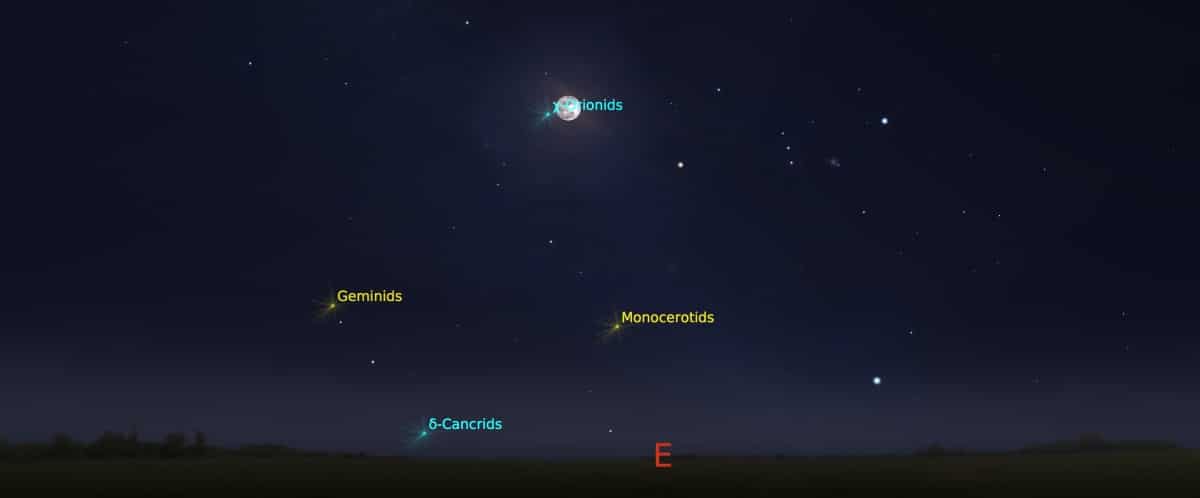
Map of the Hilo sky (looking towards the east) for December 14th 2016 at 21:30 in the evening. The moon is almost full, and rises just before the radiant of the Geminids. This unfortunately means the during the whole night the moon will outshine all but the brightest shooting stars. Skymap made using Stellarium.
December 21: Winter solstice
The winter solstice represents the shortest day and thus the longest night on the Northern hemisphere. A solstice is an event that occurs twice each year as the Sun reaches its highest or lowest excursion relative to the celestial equator on the celestial sphere. You can read a more palatable explanation of exactly what a solstice is here.
This year on Hawaiʻi, in 2016, it will take place on December 21st at 00:43 HST.
Resources used for the 2016 stargazing calendar
All dates were selected from the International Meteor Organization Shower Calendar for 2016 (PDF). Moon rise and moon set times were retrieved from the timeanddate lunar calendar.