
Of the ten Hawaiʻi waterfalls you can swim in, one has lifeguards: Waimea Falls on Oʻahu, where staff decide at 9am daily whether swimming is open. Life jackets are required and free, and adults pay $26. The other nine are unsupervised and harder to reach: Twin Falls on Maui costs $10 to park in one of 55 first-come spaces, and Hanakāpīʻai on Kauaʻi is 8 miles round trip on a trail DLNR calls unmaintained.
We assume you plan to swim anyway. The Hawaiʻi Department of Health says not to swim or wade in any freshwater stream or pond in Hawaiʻi, and leptospirosis enters through cuts, the mouth, nose and eyes, so going under raises the risk. Start with Twin Falls and Hanakāpīʻai, where parking and reservations are the first thing to sort out.
Table of contents
- Safety brief: what to do and what to avoid
- 1: Hanakāpīʻai Falls (Kauaʻi)
- 2: Maunawili Falls (Oʻahu)
- 3: Twin Falls (Maui)
- 4: Uluwehi Falls (Kauaʻi)
- 5: Waimea Falls (Oʻahu)
- 6: Upper Waikani Falls (Maui)
- 7: Kulaniapia Falls (Big Island)
- 8: Waimano Falls (Oʻahu)
- 9: Waipoʻo Falls (Kauaʻi)
- 10: Ginger Pool (Oʻahu)
More waterfall guides by island
Our island guides list more waterfalls on the Big Island, Kauaʻi, Maui, and Oʻahu:
- The best 5 waterfalls to visit on the Big Island
- 9 of the best Kauaʻi waterfalls
- Our 10 favorite waterfalls on Oʻahu
- 10 Maui waterfalls (+ how to get there)
Swimming under a waterfall: what to do and what to avoid
The Hawaiʻi Department of Health’s published advice is “do not swim or wade in any freshwater streams or ponds in Hawaii, especially when you have open cuts or sores.”
- Understand how leptospirosis gets in. The bacteria are present in many Hawaiian streams, and the Hawaiʻi Department of Health is specific about the route: they enter “through broken skin or through the soft tissues on the insides of the mouth, nose, or eyes.” Swimming with your head underwater raises your risk, so having no cuts does not make you safe. Cover any cuts or scrapes with a waterproof bandage, keep your head up if you can, and read the Hawaiʻi DOH leptospirosis page or the CDC’s before you decide.
- Skip it entirely after heavy rain. The CDC puts the risk highest after heavy rainfall and flooding, when runoff carries animal urine into streams. Heavy rain is also when the water is moving fastest and carrying the most debris,
- Treat stream crossings as the biggest hazard. Several of these hikes cross streams that flood fast, and DLNR lists flash flooding as a hazard on the Hanakāpīʻai, Maunawili and Judd trails by name. Water can rise from rain falling miles upstream under a clear sky above you. If a crossing looks stronger than when you came in, wait it out rather than pushing across.
- Don’t drink the water. Bacteria living in the water can make you sick. Boil or chemically treat it if you have no choice.
- Wear water shoes or secured sandals while in the water, as rocks can be slippery and sharp.
- Never jump from a cliff and avoid swing ropes. You’ll no doubt see locals jumping off rocks and swinging from ropes at some waterfalls. Locals are experienced and familiar with the pools, and you have no way to know what they know. Water levels change, debris moves, and what was deep last month may not be today.
- Keep your distance from the falls itself. While it is nice to swim in the pool below the falls, we don’t recommend swimming directly under the waterfall. The pressure of the water can be intense, and sometimes rocks and other debris come over the falls without warning and cause injury.
- Check the trail is open before you drive out. Several trails on this list have closed, reopened, or been rerouted in the past few years. The state’s Nā Ala Hele trail system lists the current status and posted hazards for every state trail.
1. Hanakāpīʻai Falls (Kauaʻi)
This is the biggest day of the ten. You hike eight miles round trip on the Nāpali coast to reach it: two miles along the coastal Kalalau Trail to Hanakāpīʻai Beach, then a turn inland to follow the stream two miles up the valley, past bamboo, to the falls at the back.
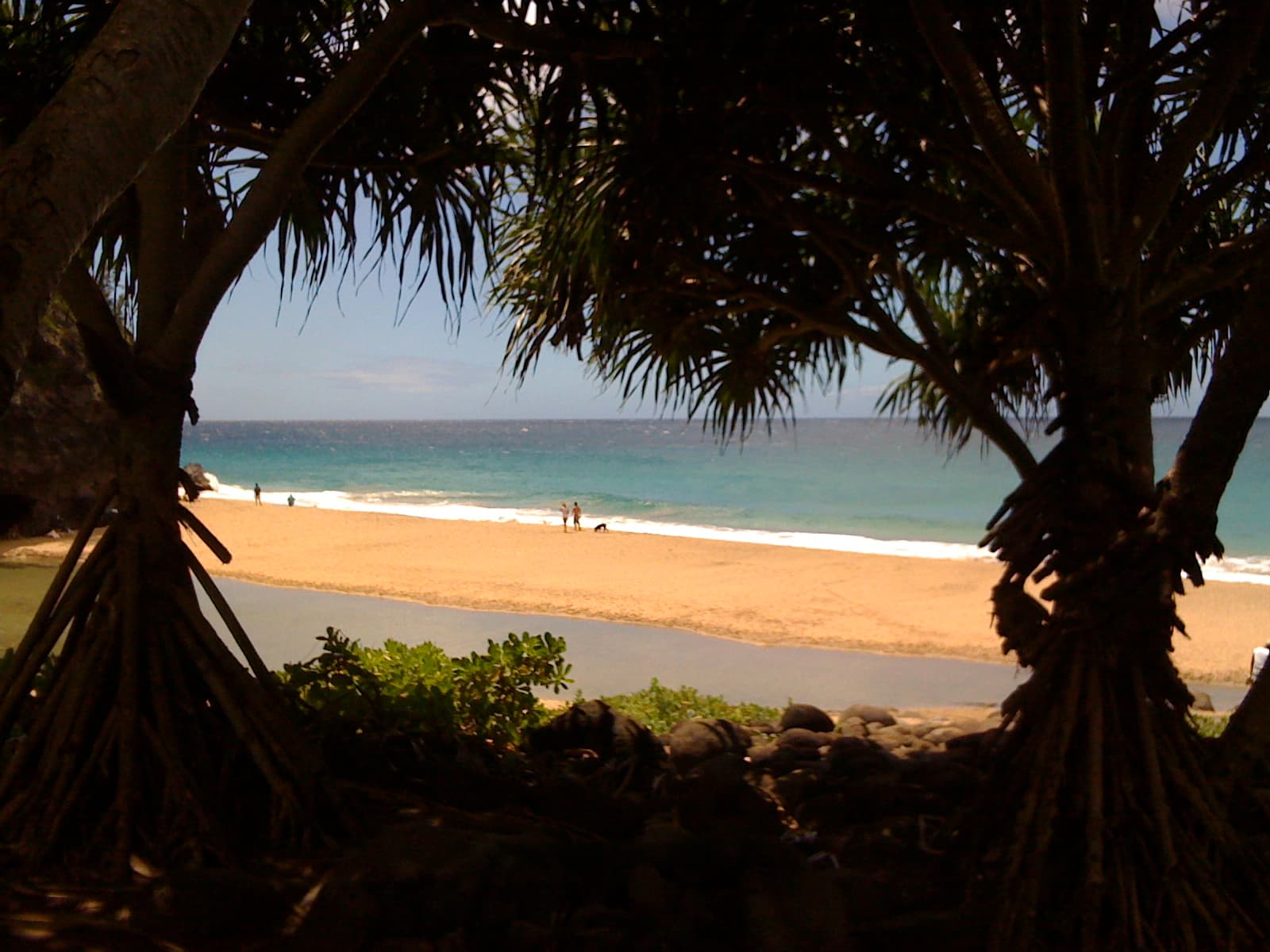
Hanakāpīʻai Beach on the Kalalau trail to Hanakāpīʻai Falls. Image credit: Sam Grover on Flickr.
Important: DLNR calls the valley trail to the falls unmaintained and recommends it “for experienced hikers only.” Past the stream crossing about a mile up the valley it gets harder, over rocks and fallen trees, and the state’s warning is explicit: hike the upper half only in good weather, to avoid flash floods and falling rocks. Don’t swim at Hanakāpīʻai Beach on the way, whatever the day looks like. The currents there are treacherous and DLNR’s own page says drownings occur regularly.
Good to Know: the trailhead is at Keʻe Beach in Hāʻena State Park, and entry is by reservation: non-residents pay $5 each plus $20 per car per parking time slot, booked through the Go Hāʻena website up to 30 days in advance. The North Shore shuttle from Hanalei is an alternative at $45 round trip for adults and $25 for children, park entry included. Hawaiʻi residents enter free with ID. Plan a full day and carry food and water.
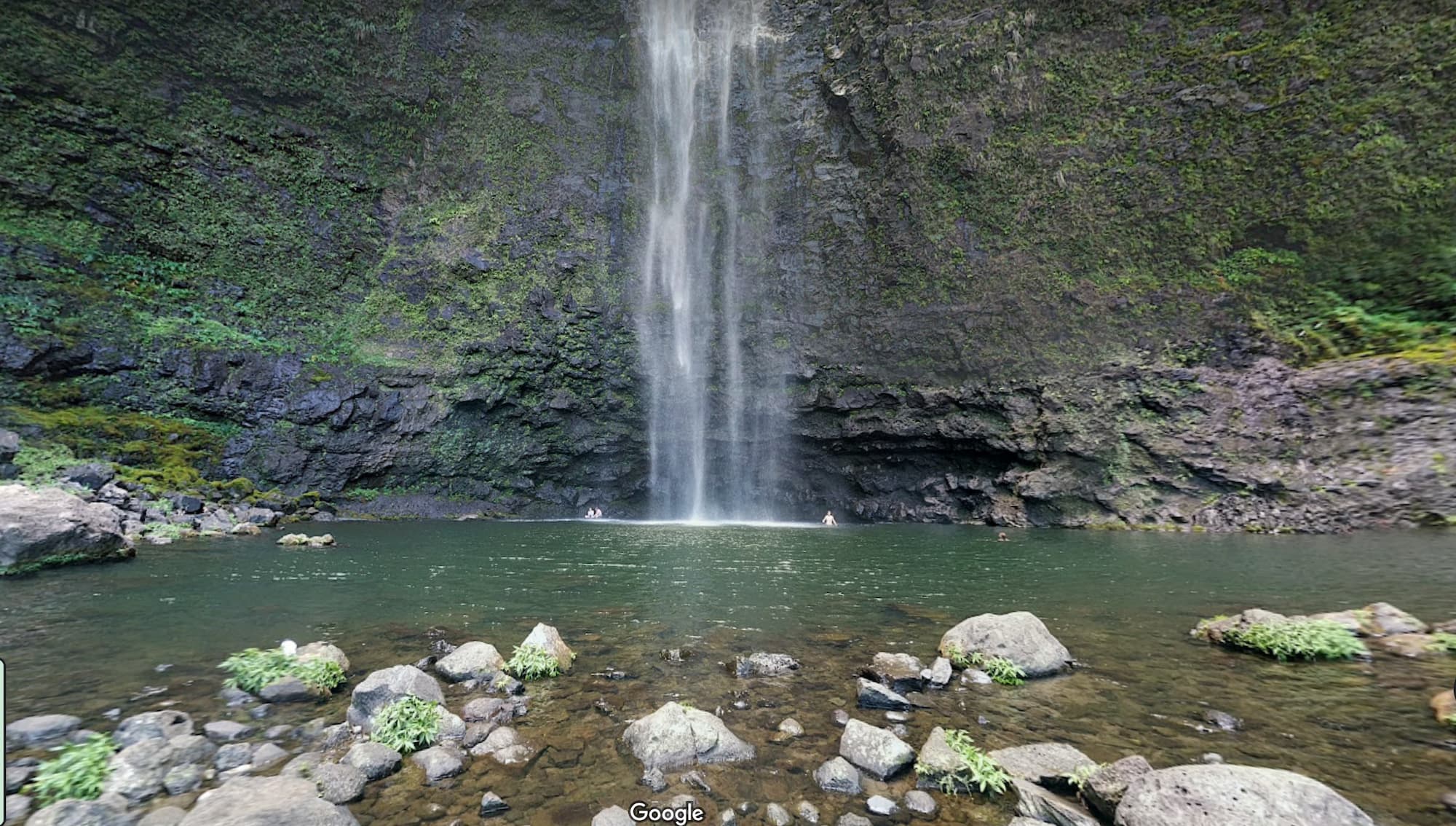
The pool at the base of Hanakāpīʻai falls, four miles up the valley from the trailhead. Image: Google Streetview
2. Maunawili Falls (Oʻahu)
Important: the Maunawili Road trailhead is closed. DLNR has shut the section of the Maunawili Falls trail that crosses private land while the trail is realigned to protect the valley’s natural and cultural resources, and there is no published reopening date. The short version of this hike, the one most articles still describe, no longer exists.
The falls themselves are still legally reachable, but by a much longer route: from the scenic overlook just past the hairpin turn on the Pali Highway, take the Maunawili Trail to the Maunawili Connector and then a short drop down to the falls, and return the same way.
Long-term parking isn’t allowed at that overlook, so you need to be dropped off, and there’s no exit through the private land at the bottom. Anyone telling you to park in the neighborhood and walk out the other side is describing a trespass.
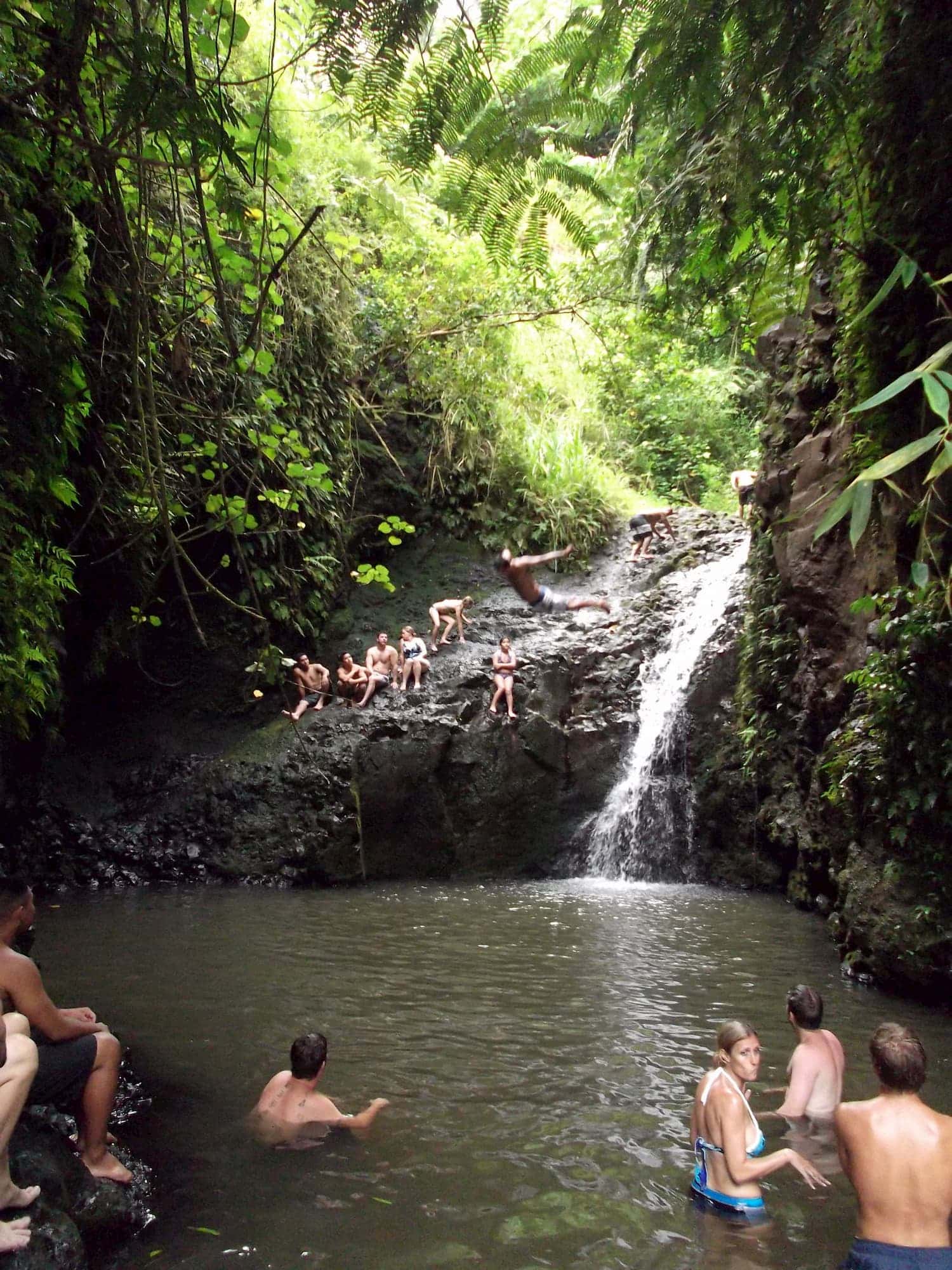
The pool below Maunawili Falls on Oʻahu. Water levels and submerged rocks here change between visits, so there is no way to know whether the jump in this photo is safe now. Image credit: RKCR, source.
Good to Know: it is a cascade of roughly 20 to 30 feet with a pool big enough to swim in. The trail is usually muddy, especially in winter, so keep a change of clothes and shoes in the car. DLNR lists flash flooding and stream crossings among the hazards here.
3. Twin Falls (Maui)
Twin Falls is the first waterfall you reach on the Road to Hāna, near mile marker 2 on the Hāna Highway. It is about 40 feet, ringed by rainforest, with a round swimming hole beneath it and a short hike in.
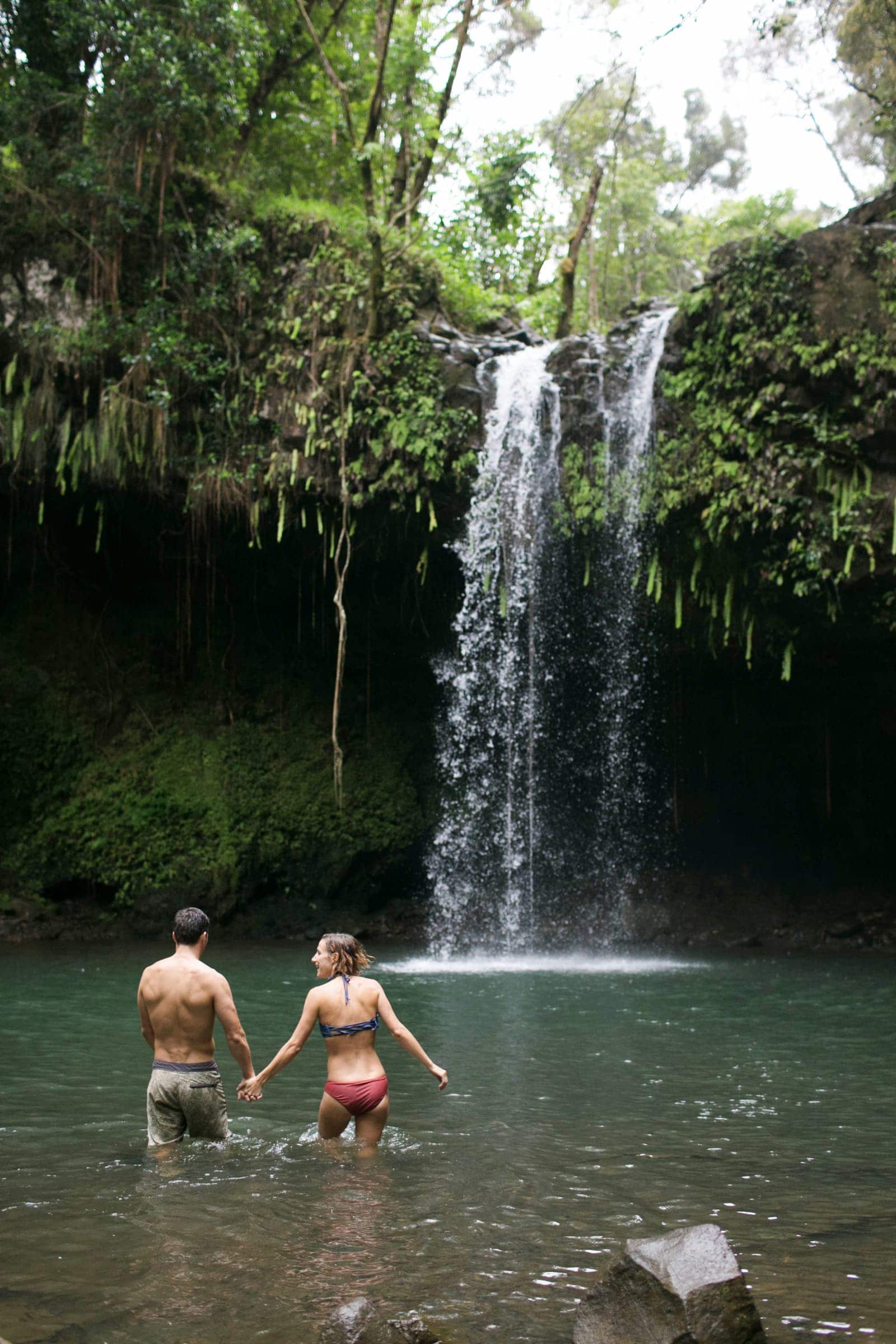
Near mile marker 2, Twin Falls is the first easily accessible string of waterfalls and pools on the Road to Hāna. Credit: Hawaii Tourism Authority (HTA)
Good to Know: access is gated. Parking costs $10 per vehicle. There are 55 spaces, first-come, no reservations. Your car has to be in that lot to reach the falls: no street parking or walk-in access, and no rideshare dropoffs.
Gates open at 7:10am, last entry is 4:30pm, and the farm closes at 5pm. It is closed to visitors on the first Saturday of every month, which is reserved for residents. The farm also posts warnings about vehicle break-ins, so take valuables with you.
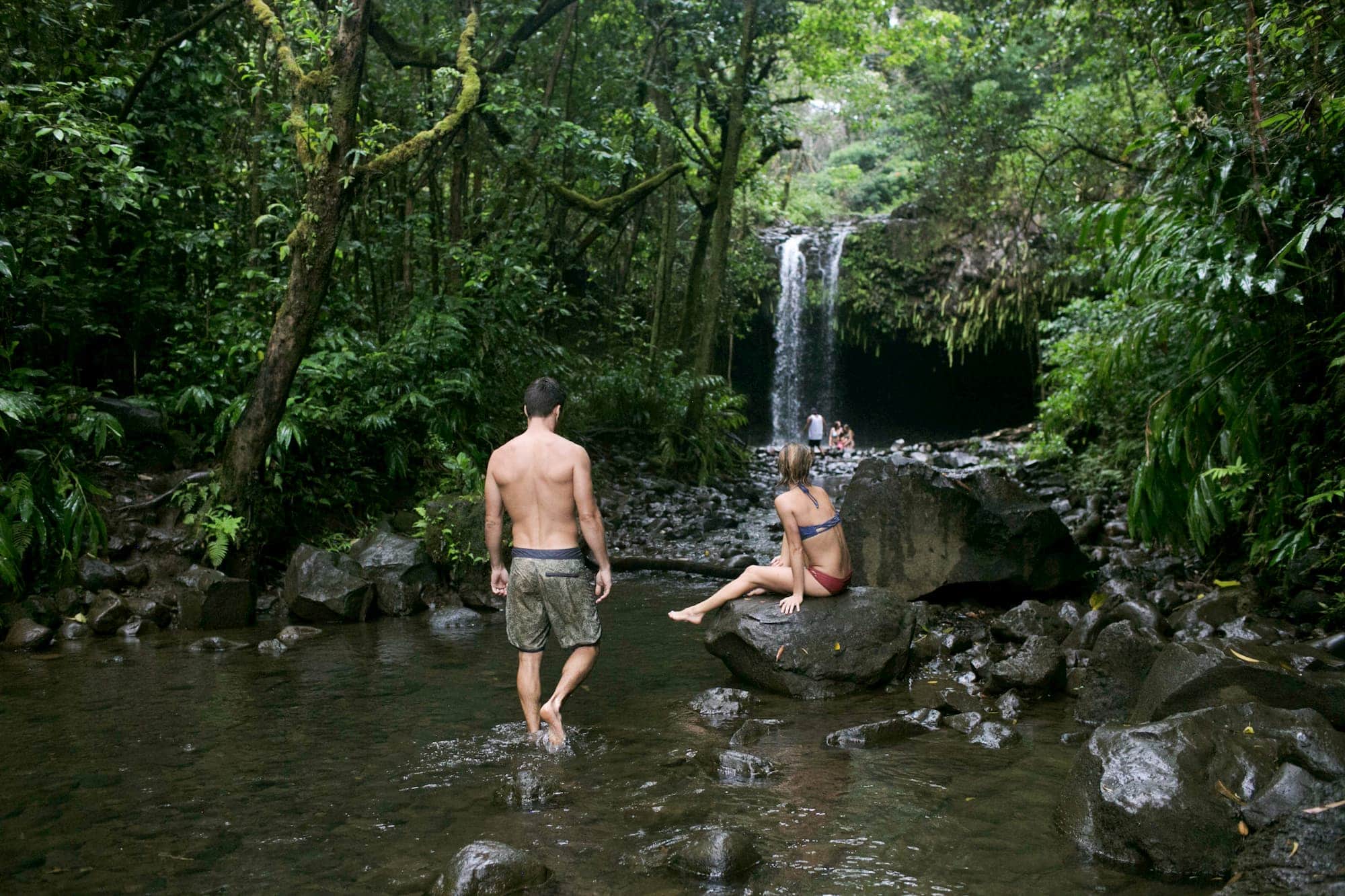
Bring a towel and wear swim gear when hiking to the Twin Falls. Credit: Hawaii Tourism Authority (HTA)
The falls sit close to the parking area, the easiest swim on this list for families and anyone who does not want a long hike. The fruit stand in the lot has been running since 1997. The farm posts trail closures for high water on its social accounts, so check before driving out after rain.
4. Uluwehi Falls (Kauaʻi)
Uluwehi sits in Wailua River State Park on Kauaʻi’s east side and was known as “Secret Falls” before the Internet made the name funny. Reaching it still takes work: you kayak up the Wailua River, then hike about 20 minutes through the jungle to a broad pool beneath the falls.
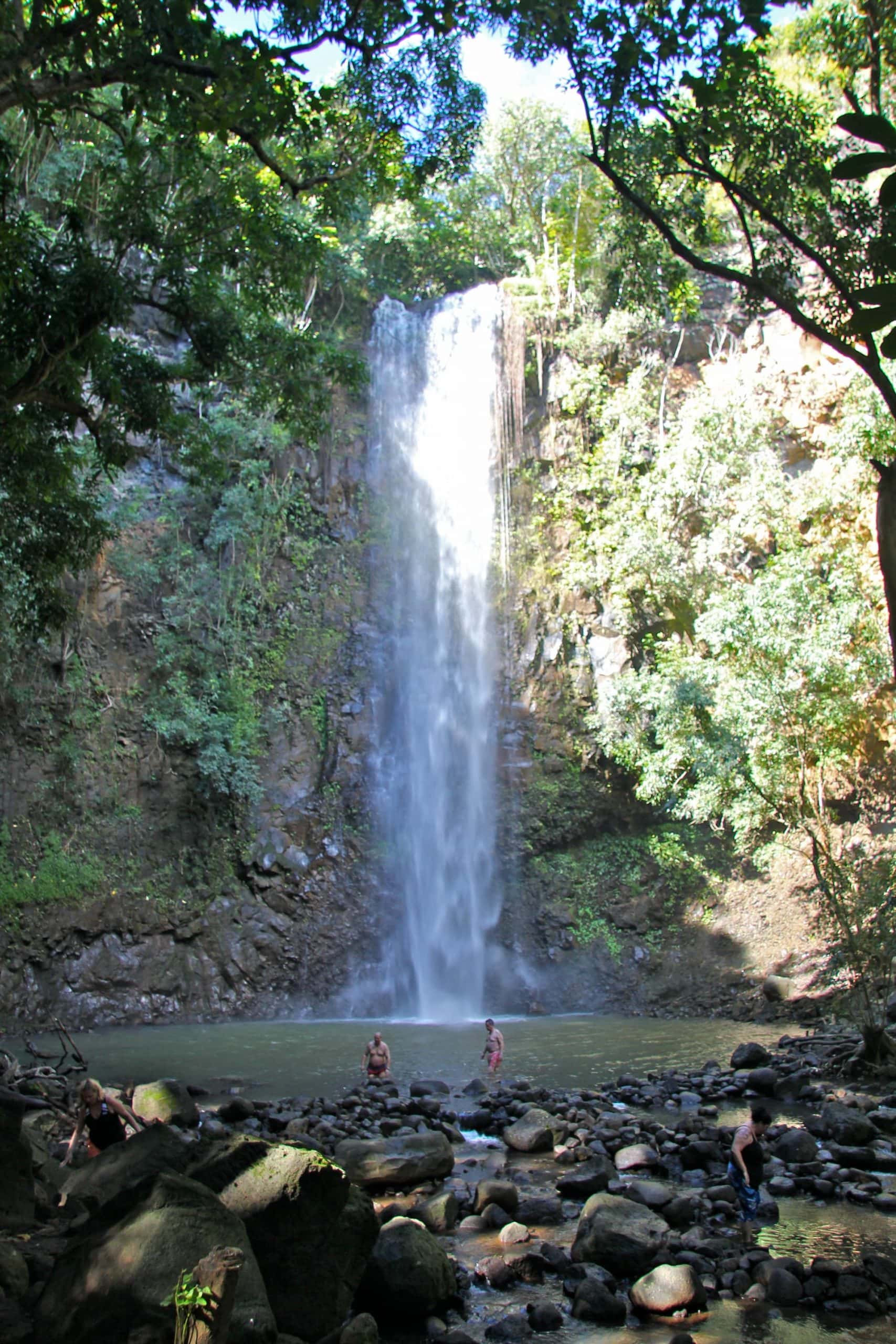
The Uluwehi (Secret) Falls. You can swim here, but stones can come down with the water, so stay out from under the falls. Image credit: Joe Baz, source.
Good to Know: commercial kayak rentals and tours may only use Wailua River State Park Monday through Friday, under the state permit that governs them, so the weekend is out unless you bring your own boat. And since February 2026 the park charges non-residents $5 per person to enter and $10 per vehicle to park, by credit card only, with the park open 7:00am to 7:45pm. Residents are free with ID.
You can paddle it yourself, but the river landing and the trail through the jungle are hard to find without a guide. Kayak Kauaʻi’s tour runs about five hours for roughly four miles of paddling and two miles of walking, at $130 per person, with park entry and parking paid separately at the gate. The state bars rental operators from launching when a flood advisory, watch or warning is in effect. Don’t launch your own boat under one either.
5. Waimea Falls (Oʻahu)
Waimea Falls is the one on this list with lifeguards, the safest swimmable waterfall in Hawaiʻi and the obvious pick if you are bringing children. It sits inside the Waimea Valley botanical gardens at the end of a paved 1.5 mile round-trip walk, and the pool below the 40-foot falls is monitored whenever it is open.
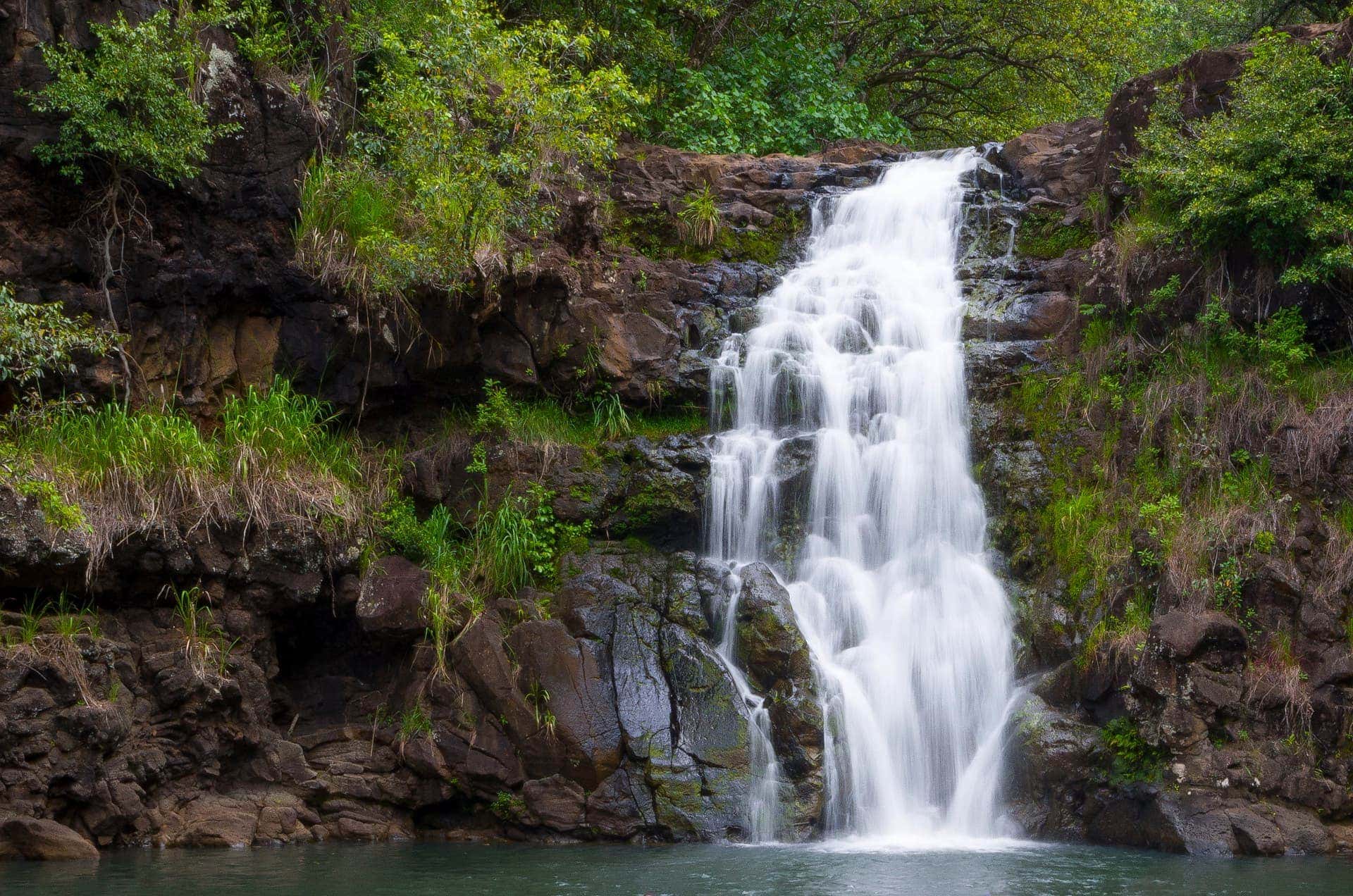
The Waimea Falls. Image credit: Thomas Shahan, source.
Important: swimming is not guaranteed on the day you visit. Lifeguards decide each morning at 9am whether the pool opens, and they close it for heavy rain, strong currents, water quality, drought and lightning. Call (808) 638-7766 the morning you plan to go. Life jackets are required for everyone in the water and the valley provides them free in all sizes. No diving, no climbing on the rocks, and no soaps or oils in the pool.
Good to Know: reaching the falls means paying garden admission, currently $26 for adults, $18 for children aged 4 to 12, and $20 for seniors and students. Kamaʻāina (Hawaiʻi resident) and military rates run $10 for adults and $6 for children with ID.
A shuttle runs between the visitor center and the falls at $10 one way or $20 round trip, if you would rather not walk the 1.5 miles. Give yourself time for the gardens and cultural sites rather than marching straight to the water. Across the road, Waimea Bay is one of the North Shore’s best-known beaches and swimmable in summer.
Honorable mentions
Five more waterfalls with swimmable pools. Each has a rougher trail, an unofficial route, or a fee the top five don’t. At Upper Waikani and Waipoʻo our advice is to look rather than swim.
Upper Waikani Falls (Maui)
Also known as “Three Bears,” Upper Waikani is a set of three side-by-side 70-foot waterfalls dropping into one plunge pool, at mile marker 19 on the Road to Hāna. You can see it from the road, but stopping is the hard part: the pullout is on a narrow, busy stretch of highway.
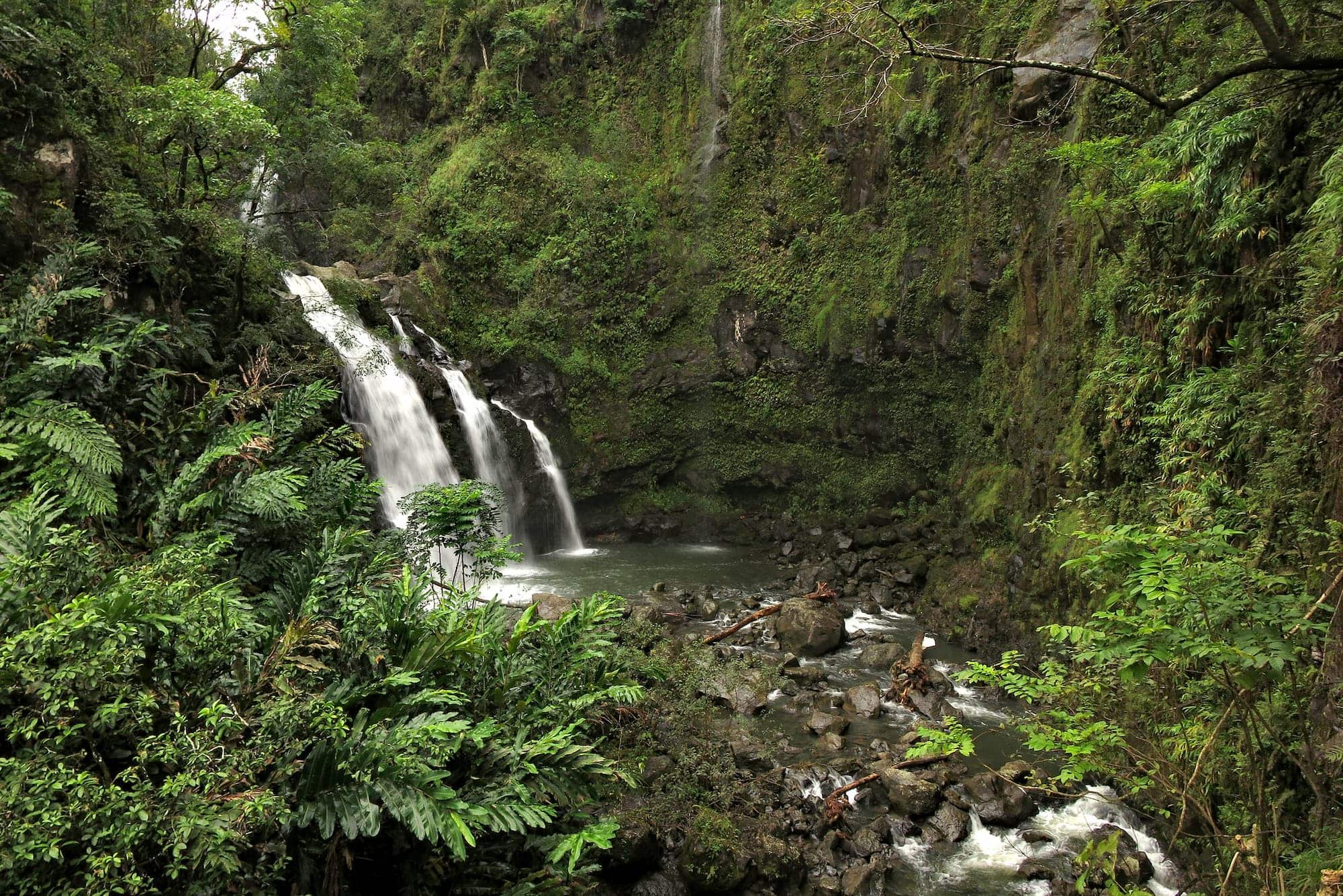
The upper Waikani Falls are three large waterfalls dropping side by side into one pool. Image credit: Thomas Jundt, source.
Good to Know: we would treat this as a viewpoint rather than a swim. There’s no state-designated trail down to the pool: Upper Waikani appears nowhere in the Nā Ala Hele trail system, so the scramble people take is unofficial and may cross private land. The pullout is on a narrow, busy stretch of the Hāna Highway where cars stop suddenly and sightlines are short. If there is room to pull over safely, look at it from the bridge. Swim somewhere with a trail.
Kulaniapia Falls (Big Island)
Kulaniapia Falls is a 120-foot waterfall on private property outside Hilo town, on the grounds of the Inn at Kulaniapia. It is the only entry on this list on the Big Island, and the simplest to reach: you buy a day pass and follow the property’s trails.
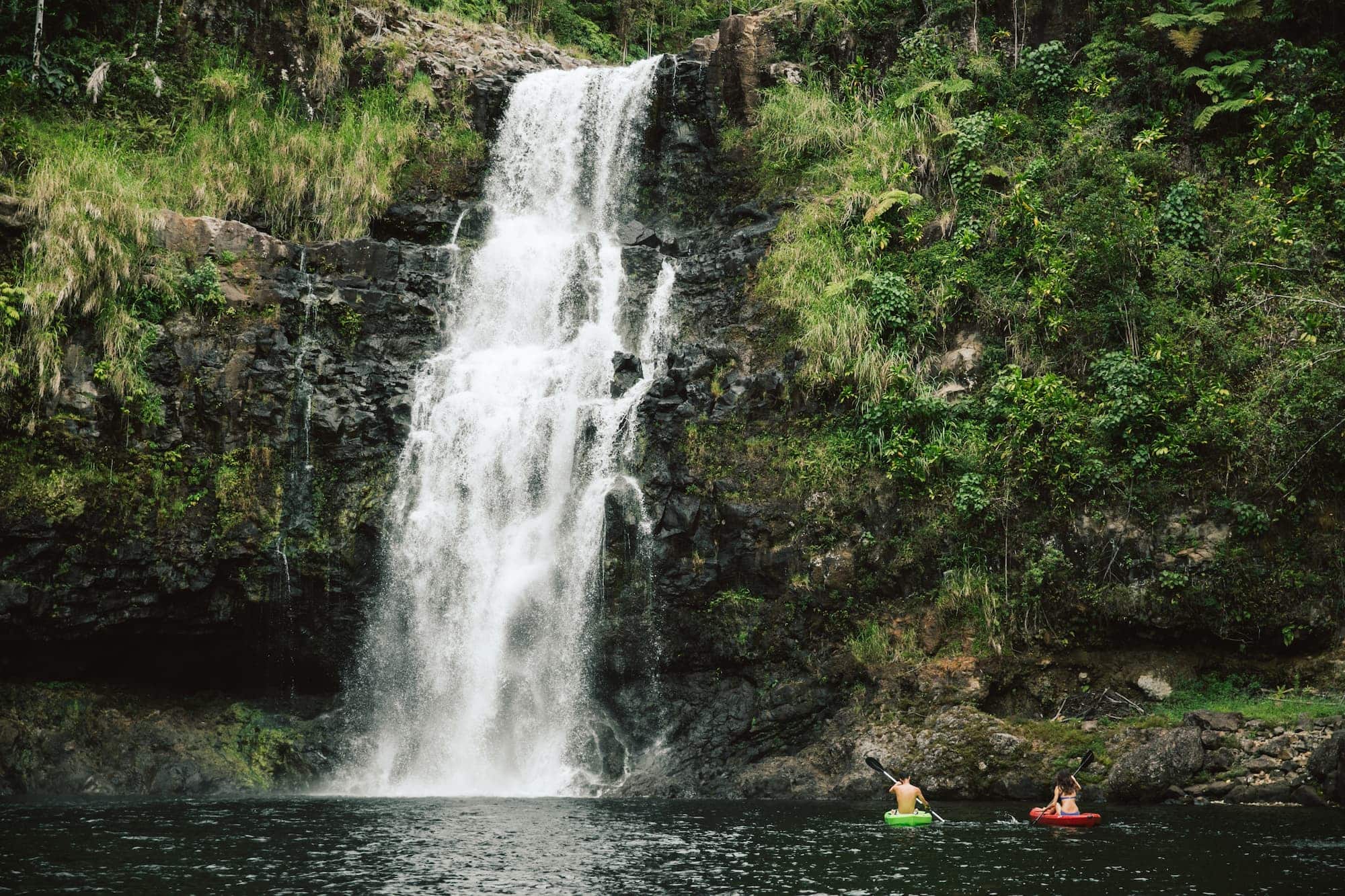
If conditions are suitable you can use on-property SUP and kayak equipment to explore the Kulaniapia waterfall. Credit: Hawaii Tourism Authority (HTA) / Heather Goodman
Good to Know: day visitors need a day pass to the grounds, which the inn sells to people not staying overnight. The property runs to more than 40 acres with four waterfalls and miles of trails, and it rents kayaks and paddleboards on site. Staying the night is worth pricing against the day rate if you want the falls early or late.
Waimano Falls (Oʻahu)
Few people hike to Waimano because it is hard: a 30-foot waterfall with a large pool at the end of a steep climb through thick rainforest and a lot of mud, and the climb back out is harder than the way in. It is popular with locals.
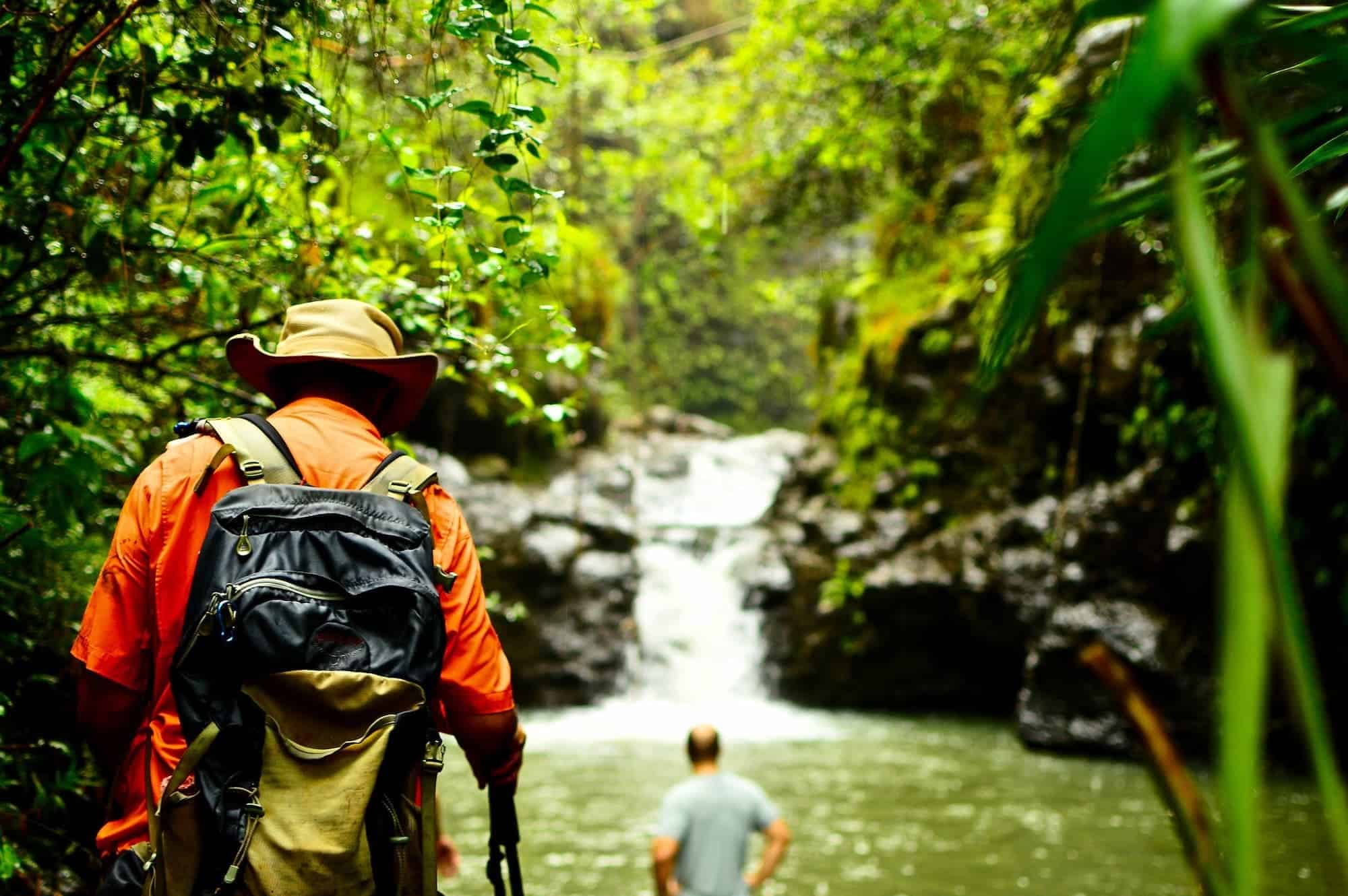
Waimano falls sits at the end of a roughly 3 mile round-trip hike off the Mānana Trail. Source: Jason Jacobs via Flickr CC BY-ND 2.0
Good to Know: the route starts on the Mānana Trail above Pearl City and runs about 3 miles round trip to the falls. The spur down to the pool is not itself a designated state trail, and DLNR’s standing warning applies: trails branching off a public route may cross private property, and using them without permission is trespassing.
The state also lists this as a hunting area, and the trailhead sits in a residential neighborhood, so park considerately and keep the noise down. Check the pool’s depth before entering, since water levels drop in summer.
Waipoʻo Falls (Kauaʻi)
Waipoʻo Falls drops in stages down the red walls of Waimea Canyon and nothing else on this list looks like it. It is also the one where we would tell you to skip the swim: the pools people use are upstream of a very long drop, and no state agency publishes guidance sanctioning swimming there.
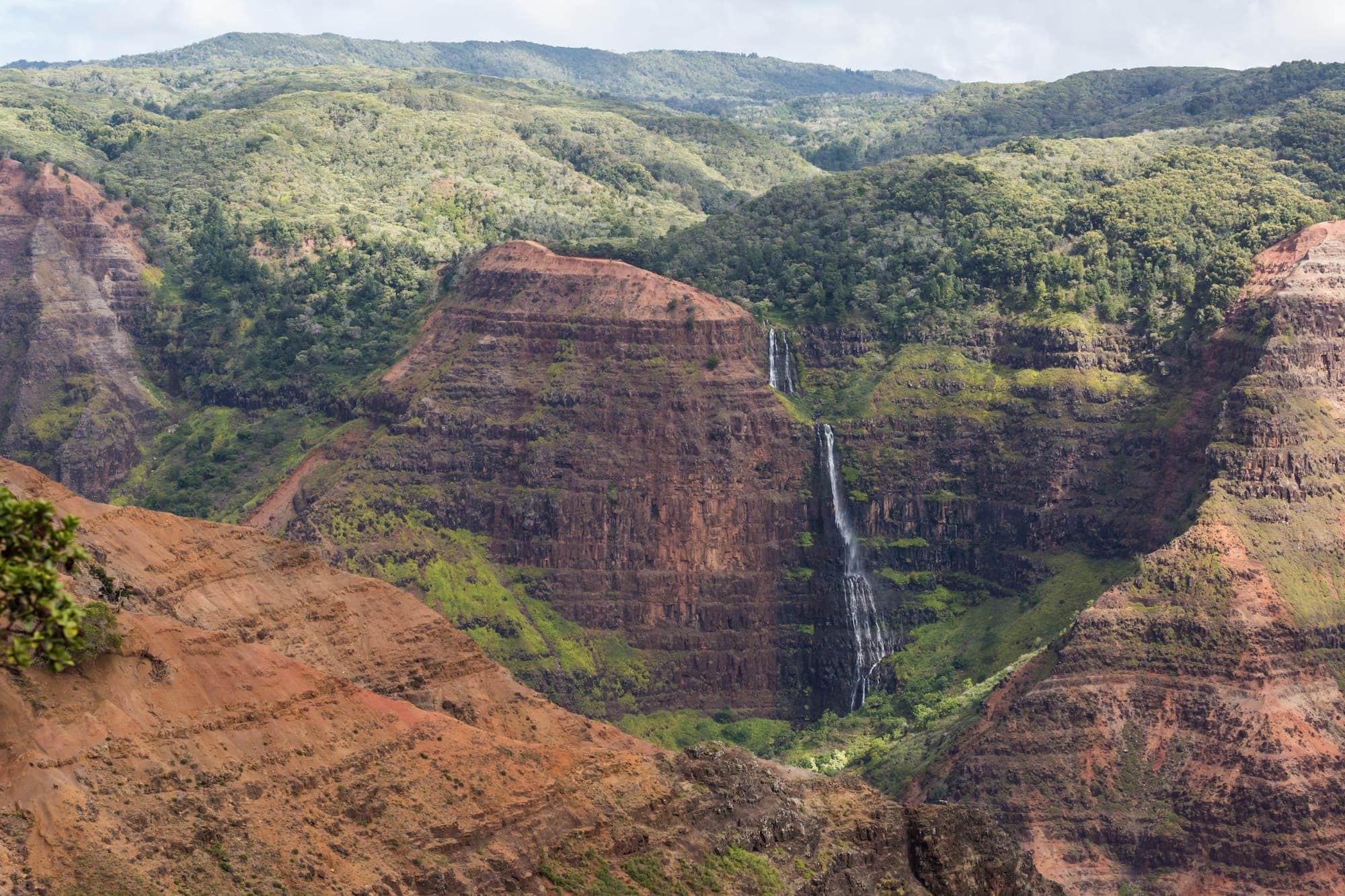
The Waipoʻo Falls as seen from a lookout along the canyon road. Image: Hawaii Tourism Authority (HTA) / Tor Johnson
Good to Know: the canyon lookouts give you the falls at their best and cost you nothing but the park fee, which is $5 per person and $10 per vehicle for non-residents, valid across both Waimea Canyon and Kōkeʻe state parks. Residents are free with ID.
Note that the route to the top of the falls is not a named, maintained trail in either the state parks system or Nā Ala Hele, and both parks have had lookout closures and roadwork for safety improvements recently, so check current conditions before you drive up.
Ginger Pool (Oʻahu)
If you’re in Honolulu and want fresh water without a day trip, the Ginger Pool is the shortest option here. The waterfall is small, about ten feet; people come for the round pool below it and the rainforest around it.
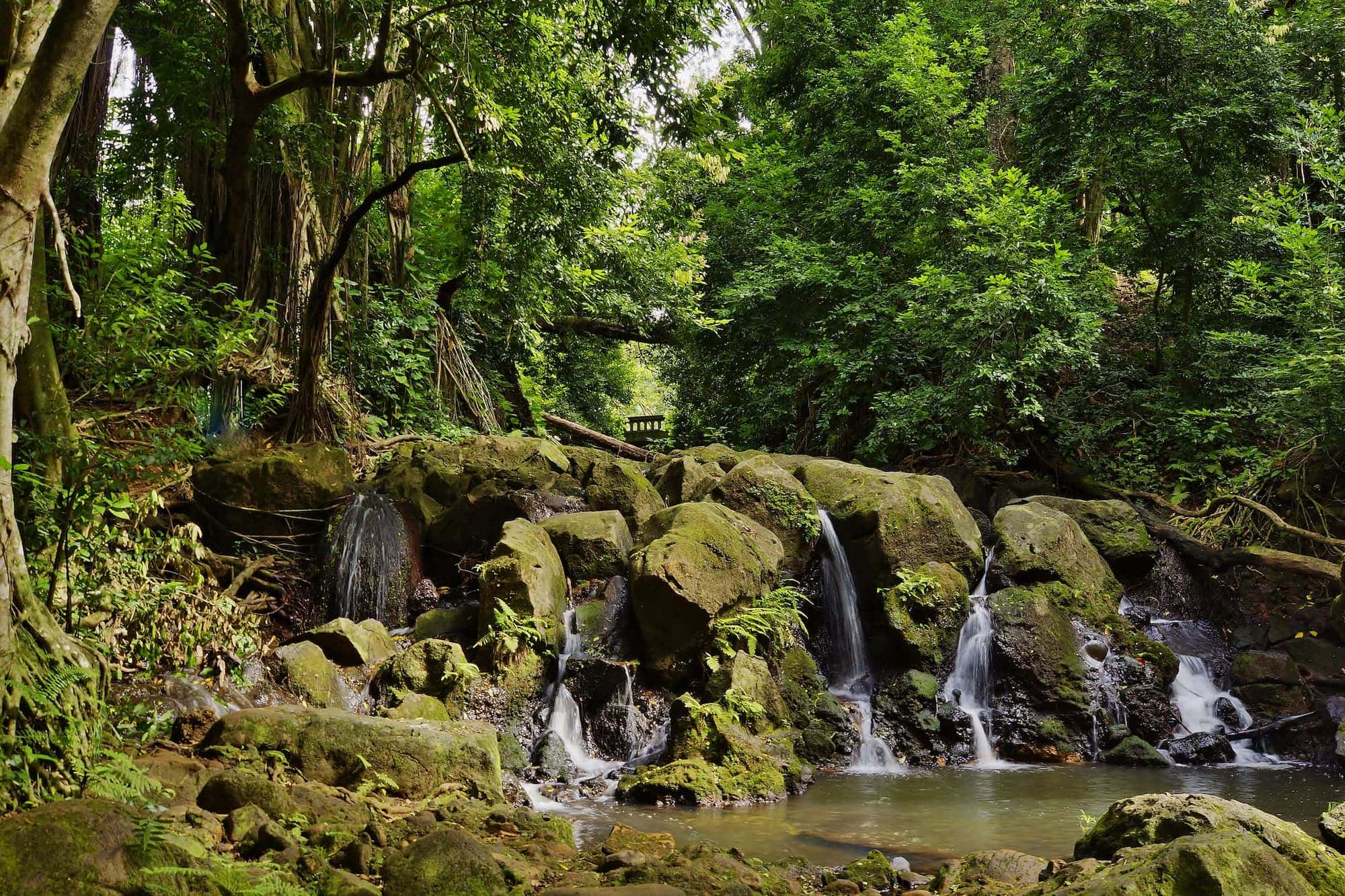
The small cascades known as the “Ginger Pool”, on the Judd Trail above Nuʻuanu. Source: Eric Tessmer via Flickr CC BY-2.0
Good to Know: it is on the Judd Trail, a 1 mile loop in the Nuʻuanu valley that starts just below the parking area and crosses Nuʻuanu Stream at the outset. DLNR warns that the crossing rocks are unstable and slippery, and lists flash flooding among the trail’s hazards.
The loop connects with the Nuʻuanu Trail about midway if you want to extend the walk. Dogs are allowed on a leash. Don’t confuse this with Lulumahu Falls nearby: Lulumahu is not a designated state trail, and the Judd Trail is the sanctioned way into this valley.