Most of what’s sold as “Kona coffee” in airport shops and hotel lobbies contains 10% Kona beans by weight. The rest is filler, typically Central American or other commodity beans. Hawaiian law allows this and requires only that the percentage appears on the label. The result is a lot of “Kona blend” packaging designed to look like the real thing.
100% Kona coffee is different. It grows only on the slopes of Hualalai and Mauna Loa, in a 20-mile belt between Kailua-Kona and Captain Cook. The growing conditions there, volcanic soil, morning sun, afternoon rain, mild nights, are unusual enough that the beans have been prized since the 1800s. The price reflects that: expect $45 to $60 per pound for genuine 100% Kona.
This guide covers the 200-year history, what drives the price, how to read the label, and three other Big Island coffees (Kaʻū, Puna, Hāmākua) that are grown under similar conditions, compete in the same cupping competitions, and cost considerably less.
Table of contents
Table of Contents
- The History of Kona Coffee (timeline between 1817 and now)
- Why is Kona Coffee so special?
- Why is Kona Coffee so expensive?
- Other (cheaper) Big Island coffees
- What is Peaberry coffee?
- Tips for buying Kona coffee
- Coffee tours and the Kona Coffee Cultural Festival
The guide you are now reading is all about the history and background of coffee on the Big Island. If you want to visit one of the (Kona) coffee farms on the Big Island you should have a look at our Kona Coffee Tours guide:
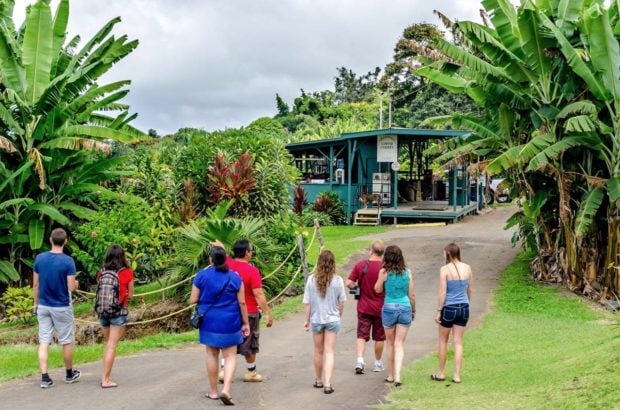
15 Best Kona Coffee Farm Tours: Free Tastings + $40 Deep Dives
Most Kona coffee farm tours are free; the rest cap at $50 with one $190 outlier. Compare 15 farms across Kona, Kaʻū, and the Hāmākua coast.
The history of Kona coffee
The first attempt to grow coffee in Hawaiʻi is credited to the horticultural experimenter don Francisco de Paula Marin. Marin introduced numerous plant species to the Hawaiian Islands but failed to do so for coffee plants in 1817.
Samuel Ruggles succeeded in bringing coffee to Hawaiʻi in 1828. During the subsequent 150 years coffee took the proverbial backseat to the sugar industry and has known many ups and downs. Kona coffee is now considered a specialty product, with prices and demand to match.
In the following timeline we highlight important milestones in the history of Kona Coffee. This whole timeline is summarized from the excellent book “A cup of Aloha”
- 1817: Don Francisco de Paula Marin brings the first coffee seedlings to Hawaiʻi, but the plants perish.
- 1828 – 1860: Samuel Ruggles plants the first coffee in Kona (1928). More and more coffee plantations open in the following decades, but in the 1850’s hard times begin due to lack of labor, bad weather, and pests. In 1860, coffee is all but gone from the Hawaiian islands.
- 1873: Henry N. Greenwell is honored at the World’s Fair in Vienna for the excellent Kona coffee. (Unrelated but interesting: this World’s Fair was widely considered a magnificent failure. It lost today’s equivalent of 170 million USD because of a devastating combination of the world’s first truly international financial crisis and Vienna’s last cholera epidemic.) [source]
- 1892: Hermann Widemann introduced the ‘Guatemalan’ coffee variety to Hawaiʻi from Guatemala. Today, this variety is known as “Kona Typica” and is the most generally preferred variety in Hawaii. Coffee productions starts to pick up again
- 1899: A severe drop in coffee prices again almost causing coffee to disappear from the islands.
- 1917-1918: World War I sharply increases the domestic demand for coffee, and a frost in Brazil destroys its coffee crops and causes a world shortage in coffee. Things are looking up again for coffee in Hawaiʻi.
- 1929: Start of the Great Depression. Coffee prices plummet. In the decade after debts continue to rise and coffee prices continue to drop. Dark times for Kona Coffee (and for the rest of the USA).
- 1941-1953: Both army purchases of Coffee as the US enters WWII and steadily increasing coffee prices after the war is over help Coffee on Hawaiʻi recover. This is supported by another frost in Brazil (1953) which yet again causes a worldwide coffee shortage.
- The 1960s: Coffee is on the rise again in Hawaiʻi with record harvests. The tourism industry starts to compete with the coffee plantations for labor.
- The 1970s: Low prices, high costs and a shortage of labor bring on the last great demise of coffee in Hawaiʻi.
- The 1980s: Coffee prices pick up again in the mid-seventies, and a new crop of coffee farmers rises. Kona coffee is now considered as a “specialty coffee” and starts picking up more and more fans.
- 1991: The 10% Kona coffee blend statute (HRS 486-120.6) was introduced (full text). This law allows blended coffee that contains only 10% Kona coffee to be labeled as “10% Kona coffee”.
That 1991 statute is still the governing law. It’s why most bags labeled “Kona coffee” at airport gift shops and souvenir stores contain a small fraction of actual Kona beans. If you’re buying coffee to take home, the label terminology in the buying guide below is what actually matters.
What makes Kona coffee so special?
Kona Coffee is a specialty coffee. These coffees set themselves apart from “normal coffee” by their use of special beans, perfect growing conditions and special ways of processing the beans from plant to cup. All these things contribute to the taste of the final cup of coffee, gives each cup a flavor worth paying attention to.
Five growing conditions that set Kona apart
The five most important things that make coffee special can all be found on Hawaiʻi:
- Lots of sunshine and temperatures around 70°F, but certainly not below 55°F.
- Protection from an overdose of sun by either cloud cover or shade
- Altitude! How high a coffee plant grows has a large influence on the taste of its beans. The elevations at which Kona coffee is grown (up to ~3000 feet) give the coffee a very mild taste.
- Lots of rain, regularly. Of course, it shouldn’t rain so much that the sun can’t come out anymore because coffee plants also really like the sun.
- Good soil drainage. Coffee plants don’t like to have their roots standing in the water.
All environmental conditions come together on the slopes of these Mauna Loa and Hualalai volcanoes.
The fertile porous and mineral-rich volcanic soil and the climate with of sunny mornings, cloud or rain in the afternoon, little wind and mild nights, make Kona coffee one of the most consistently expensive coffees in the world.
Why Kona Coffee Costs $40 to $70 a Pound?
Hawaiian coffee is relatively expensive compared to other coffees. The main reason for this is the cost of labor: Coffee picking is a very labor intensive process, and a farm worker in Hawaiʻi gets paid a lot more than a farmer in Guatemala or Ethiopia (which is a good reminder to buy fair-trade coffee when you can).
As this coffee farmer from the Big Island explains, getting the beans of the trees alone costs $8 / lb. Add to that other farming costs such as land use, fertilizers, and maintenance, and you can easily end up with costs around $14 / lb. That price doesn’t include his labor, marketing, electrical / gas for roasting, bags, a website, taxes, the farm mortgage, etc. When you add all things up, prices for 100% Kona Coffee average between $40 / lb. and $70 / lb.
This means that if coffee of similar quality would be grown in a country with lower wages, you would be able to buy the beans for less. The price reflects real labor costs, not marketing
Three Other Big Island Coffees: Kaʻū, Puna, and Hāmākua
Kona coffee makes up about 95% of all coffee being grown on the Big Island. The other 5% is mostly made up of beans grown in Ka’u, Puna and along the Hāmākua coast. There is even some coffee industry on the other Hawaiian islands. Each of these coffees has their own unique taste. Which coffee you will like most depends a lot on personal preference much like with beers and wines.
The following coffees do not have the rich history, outstanding marketing, or good public relations, as Kona coffee has. This means they are not as well know and thus (much) more affordable. Especially if you are planning to take some Hawaiian coffee home as a gift, consider getting some of these coffees. You can typically find these beans at farmers markets (in Kona, Volcano, Waimea or Hilo), in local retail stores, or online.
The table below compares the four main Big Island coffees on the factors that matter most for buyers. Detail on each one follows.
| Coffee | Price per lb (100%) | Flavor profile | Competition record | Where to find it |
|---|---|---|---|---|
| Kona | $40–$70 | Mild, smooth, low acidity | Long-established prestige; consistent top finishes in US specialty coffee | Farm direct, online |
| Kaʻū | ~$25–$45 | Floral, aromatic, smooth finish | Multiple top-10 finishes at SCA conventions | Kaʻū Coffee Mill, Silver Cloud farm, some online retailers |
| Puna | ~$20–$38 | Full-bodied, nutty, heavy | Scored 96/100 on Coffee Review (2016 — older data; still directionally accurate) | Sharky’s Coffee Farm; some online retailer |
| Hāmākua | ~$30–$60 | Rich, chocolaty finish | Smaller competition history; quality driven by individual farms | Farm direct; Hog Heaven Coffee |
Kaʻū coffee
Kaʻū coffee has a floral, aromatic profile with a smooth finish. It has won top-ten placements at the Specialty Coffee Association convention and is far less known than Kona which keeps the price down.
If you are curious about these Hawaiian beans but not on the islands, you can also order them online for example at the websites of the Kau Coffee Mill and the Silver Cloud coffee farm. There is even a special Kaʻū coffee festival in the Big Island organized every may. You can find the exact date and an event calendar at the event website.
Puna coffee
Coffee and the Puna district are no strangers to each other. In the mid-1800’s, there were 6000 acres of coffee being grown in the Puna district. With the rise of sugar cane the coffee disappeared from Puna, but now coffee is on the rise again. Currently, there are more than 125 acres where coffee is grown in Puna. Puna coffee is full-bodied with nutty overtones, comparable to a medium-roast mocca when roasted to that level.
You can buy this coffee for example at the web shop of Sharky’s coffee if you are not on the Big Island but would like to taste these Hawaiian beans.
Hāmākua coffee
The Hāmākua coast is known for its rolling hills and the Hāmākua coast’s scenic drives along Highway 19. The tropical slopes of the Mauna Loa volcano used to be sugar cane country but now, slowly, is transforming into coffee country. Most coffee farms on the Hāmākua coast are small (on average 5-7 acres) and the berries are hand picked. Hāmākua coffee is said to have a rich flavor with a chocolaty-smooth finish (but you are going to have to check this for yourself).
What Is Kona Peaberry Coffee?
When shopping around for coffee you will sometimes see the mention of peaberry beans. These beans are more expensive than the ‘normal’ coffee beans and taste better according to the experts. Why so?
Well, to start, a peaberry is a “double” coffee bean. Normally coffee beans grow two to a fruit. These two beans compete for space and flatten out in the middle, much like the two halves of a peanut. In about 5% of all coffee beans only one of the two seeds in the bean is fertilized. When this happens this one seed can grow in the whole fruit, and it develops into a larger, rounder bean.
These peaberry beans roast differently from the ‘normal” coffee beans and are therefore separated before the roasting process. According to coffee folklore peaberry beans taste better because of their higher bean density which improves heat transfer in the roasting process. They are also said to roast more evenly because their rounder shape minimizes sharp edges and allows the berries to roll about the roasting chamber more easily.
Kona Peaberry (the term you’ll see on bags) typically costs 20 to 30 percent more than standard 100% Kona. The reason is yield: peaberry beans make up only about 5% of each harvest, so they’re separated and sold as a premium product. If you’re already spending $50 a pound, it’s the best-roasting version of the same coffee. If you’re buying a bag as a gift, it’s worth the step up.
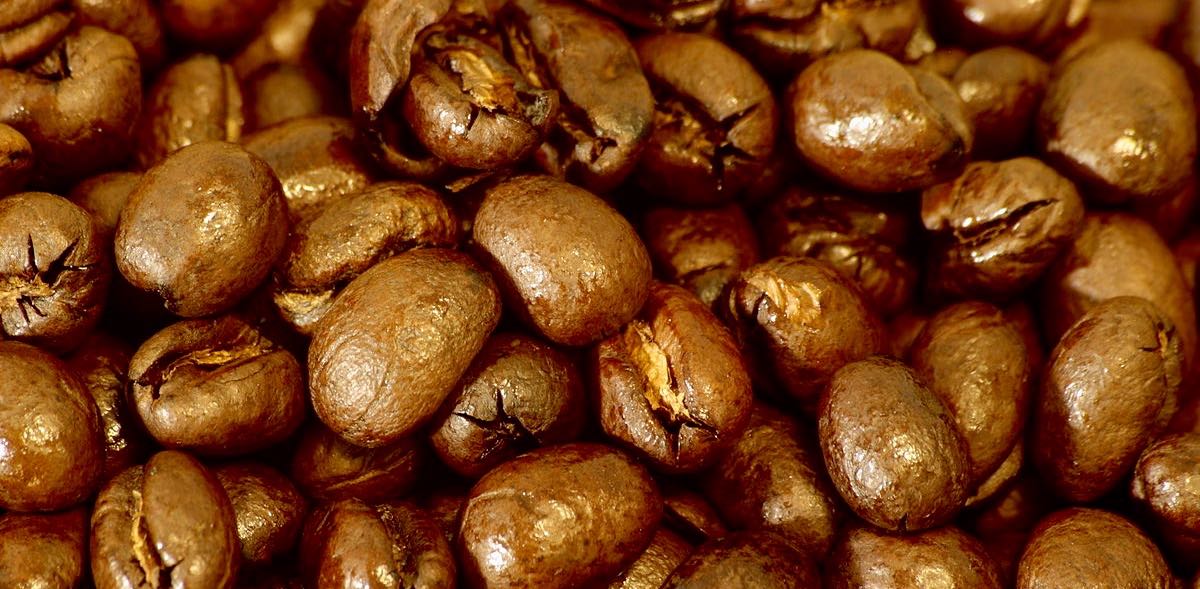
Roasted peaberry coffee beans. Notice how rounded the beans are! Image credit: Ragesoss – Own work, CC BY-SA 3.0, Link
How to buy Kona Coffee (and avoid the blends)
Only coffee grown on the slopes of the Hualalai and Mauna Loa volcanoes in the north and south Kona districts can be called “Kona coffee”. This coffee then is either sold in blends that carry only 10% Kona beans, or in more expensive ‘100% Kona Coffee’ packs.
The “Kona Blends” that carry only 10% Kona beans fit better into the average budget, but they are not the real deal. If you want to take home Kona coffee it is worth the splurge to go for the 100% Kona Coffee. The simplest approach: buy direct at the farm
(see our farm tour guide).
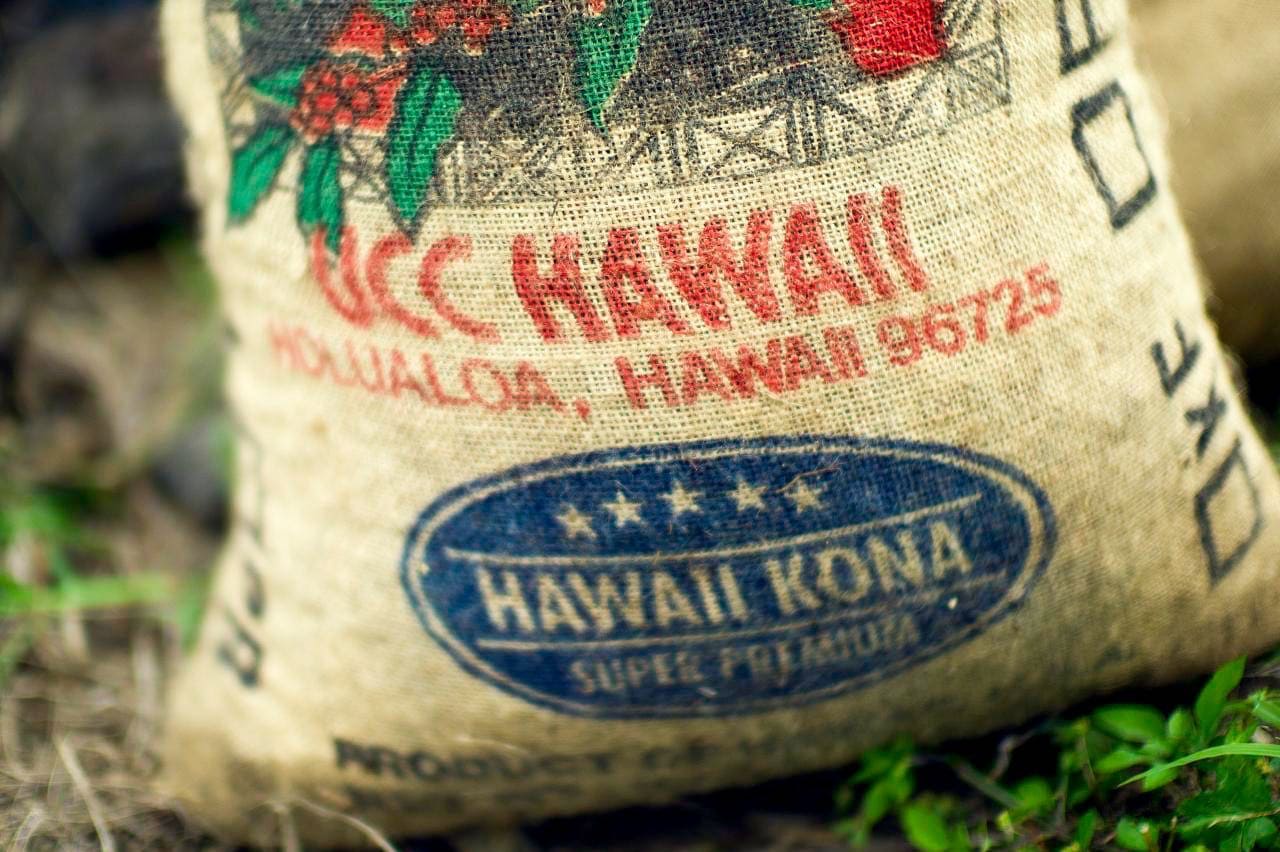
A full bag of Kona Coffee beans. Credit: Christopher Michel – Growing Kona Coffee, CC BY 2.0, Link
What the Label Actually Says: 100% Kona vs. Blends
You can buy your own Kona coffee beans at the local coffee plantations or in supermarkets around the Big Island. Be aware that some retailers sell “Kona Blends”. These blends contain a minimum of 10% Kona coffee and are cheaper than 100% Kona coffee, but obviously not the real thing and by far not as tasty.
Due to sometimes confusing (some say bordering on misleading) marketing techniques it is easy for the casual customer to mistake the blend for the real deal. Current Hawaiian law requires blends to state the percentage of Kona coffee on the label, and you can recognize “the real deal’ by the words “100% Kona Coffee” printed on the label. So be sure to stop a moment and carefully read the packaging before you buy your Kona coffee to avoid disappointments at home.
To make matters even more confusing you can also find ‘Kona Roast’ and ‘Kona Style’ coffee for sale. The main differences between all those “Kona coffees” are:
- Kona Roast: is not a protected term and can be made from any kind of coffee bean. Most likely contains 0% Kona coffee.
- Kona Style: same as the Kona Roast, probably has nothing to do with Kona coffee if no explicit mention (10% or 100% Kona coffee) is made on the package.
- Kona Blend: is by law required to contain at least 10% Kona coffee.
- 100% Kona Coffee: is the real deal. This coffee contains only Kona coffee beans.
If you’re ordering online rather than buying at a farm, the same rules apply: look for “100% Kona Coffee” on the label and buy direct from a named farm where possible. Farm websites ship directly, and that’s the most reliable way to know what you’re getting.
Kona Coffee Farm Tours and the annual festival
A very hands-on way of learning more about Kona coffee is to visit one of the many (650+) Kona coffee farms. Most of these farms organize tours, during which you typically will be shown around the orchard to see the growing coffee. Afterwards you can tour the processing area and also taste some of the coffee produced on the farm. These tours are sometimes free (but do buy some of their coffee in the shop), but often need to be scheduled ahead of time.
Read more about our 15 favorite Kona Coffee Tours.
The Kona Coffee Festival
The Kona Coffee Cultural Festival runs for 10 days each November, usually in the first two weeks of the month. It’s been going since 1970, one of the longer-running food festivals in the state.
The Cupping Competition is the anchor event for anyone who takes coffee seriously. Farms enter their beans and judges score them blind across aroma, acidity, body, and finish. It’s the most efficient way to taste the difference between farms side by side, and the results regularly surface smaller operations that don’t have wide retail distribution.
Other events worth planning around: Farm and Mill Tours give access to farms that don’t otherwise run public tastings. The International Lantern Parade moves through Kailua-Kona and draws a genuine mix of locals and visitors. The Coffee and Art Stroll is more casual — open studios and pop-up vendors along the main strip. For visitors who prefer to move at their own pace, there’s a self-guided driving tour through coffee country.
For the current year’s schedule and ticket information, see their website.