The Big Island has more accessible lava tubes than anywhere else in the US, and they cover a wide range. Some are free, flat, and lit. Others require a guide, a helmet, and a willingness to squeeze through gaps.
The easiest entry point is Nāhuku (Thurston Lava Tube) inside Hawaii Volcanoes National Park: free with park admission, well-lit, and big enough to walk through without ducking. For something rawer, Kaumana Caves in Hilo is also free and lets you go as far as your flashlight reaches. Guided options start at $35 at Kula Kai Caverns and go up to multi-hour expeditions in Kazumura, one of the longest lava tubes on the planet at 40+ miles.
This page covers eight accessible sites, with current prices, directions, and what to bring.
Table of contents
- Map of lava tubes
- List of Lava tubes on the Big Island
- Learn about lava tubes:
- Formation of lava tubes
- Geological features in lava tubes
- Safety (what to bring when visiting)
Please be respectful and use common sense while visiting the lava tubes. These caves are a limited resource and preserving them will let future generations share in the wonder then can evoke now. Please don’t break off rocks or take loose rocks out of the caves, don’t leave trash, and don’t vandalize the cave walls using spray paint or sharp objects.
Lava tube locations and prices
The map and table below cover all eight lava tube sites on the Big Island. Four are free to visit on your own; four require a guided tour ($35–$190). HueHue is currently closed.
Prices, details, and map locations below last verified April 2026.
| Name | Price | Note |
|---|---|---|
| 1Thurston lava tube (Nāhuku) (Details ↓) | Free | Free, but park entrance fee required |
| 2Kaumana Caves (Details ↓) | Free | Bring a flashlight and shoes with grip if you intend to travel beyond the cave entrances. |
| 3HueHue lava tube (Details ↓) | Free | Closed |
| 4Kalāhuipua’a shelter cave (Details ↓) | Free | Very short cave, used as a shelter in historice times |
| 5Kula Kai Caverns (Details ↓) | $35 | Only accessible with a tour |
| 6Kazumura Caves (Details ↓) | $60 | Only accessible with a tour |
| 7Pua Po‘o Lava Tube (Details ↓) | $75 | Only accessible with a tour |
| 8Hualalai lava tubes (Details ↓) | $190 | Only accessible with a tour |
Do you want to see more lava tubes? Check out our 9 favorite lava tubes on Hawaiʻi, which includes 2 lava tubes on the Big Island, 3 on Oʻahu, and 2 more on Kauaʻi and Maui.
Big Island lava tubes: 7 sites open to visitors
The Big Island has hundreds of lava tubes, most of them on private land or too unstable to enter safely. The seven sites below are the ones visitors can access, either on their own or as part of a guided tour. HueHue has been closed since 2019. Kalāhuipuaʻa is a short historical shelter cave rather than a full tube, but worth a stop if you’re already at Mauna Lani.
- Thurston lava tube (Nāhuku) (free entrance but park fee required)
- Kaumana Caves (free entrance)
- Kazumura Caves (only accessible with a tour)
- Kula Kai Caverns (only accessible with a tour)
- Pua Po‘o Lava Tube (only accessible with a tour)
- Kalāhuipua Shelter Cave
- Hualālai lava tubes (only accessible with a tour)
- HueHue lava tube (currently closed)
Thurston lava tube / Nāhuku (Hawaii Volcanoes National Park)
The preferred name for the Thurston lava tube is Nāhuku, which literally means “the protuberances” in the Hawaiian language.
Nāhuku is the most easily accessible of the lava tubes on the Big Island and is one of the main attractions of the Hawaii Volcanoes National Park. You can explore part of this large 500-year-old cave, that was left behind after a lava flow, with a stroll from the parking lot through the rainforest.
The ceilings are high (up to 20 ft in places!), the floor is flat, and there is lighting installed all along the 600 ft. stretch of the cave, which is open to the public. To get to and from the cave you will have to make a short hike through rainforest.
When we visited, the lighting along the main section made it easy to appreciate the solidified lava drips on the ceiling without needing a flashlight. The short rainforest hike in and out is worth slowing down for as the fern cover is dense and the contrast with the dark tube entrance is striking.
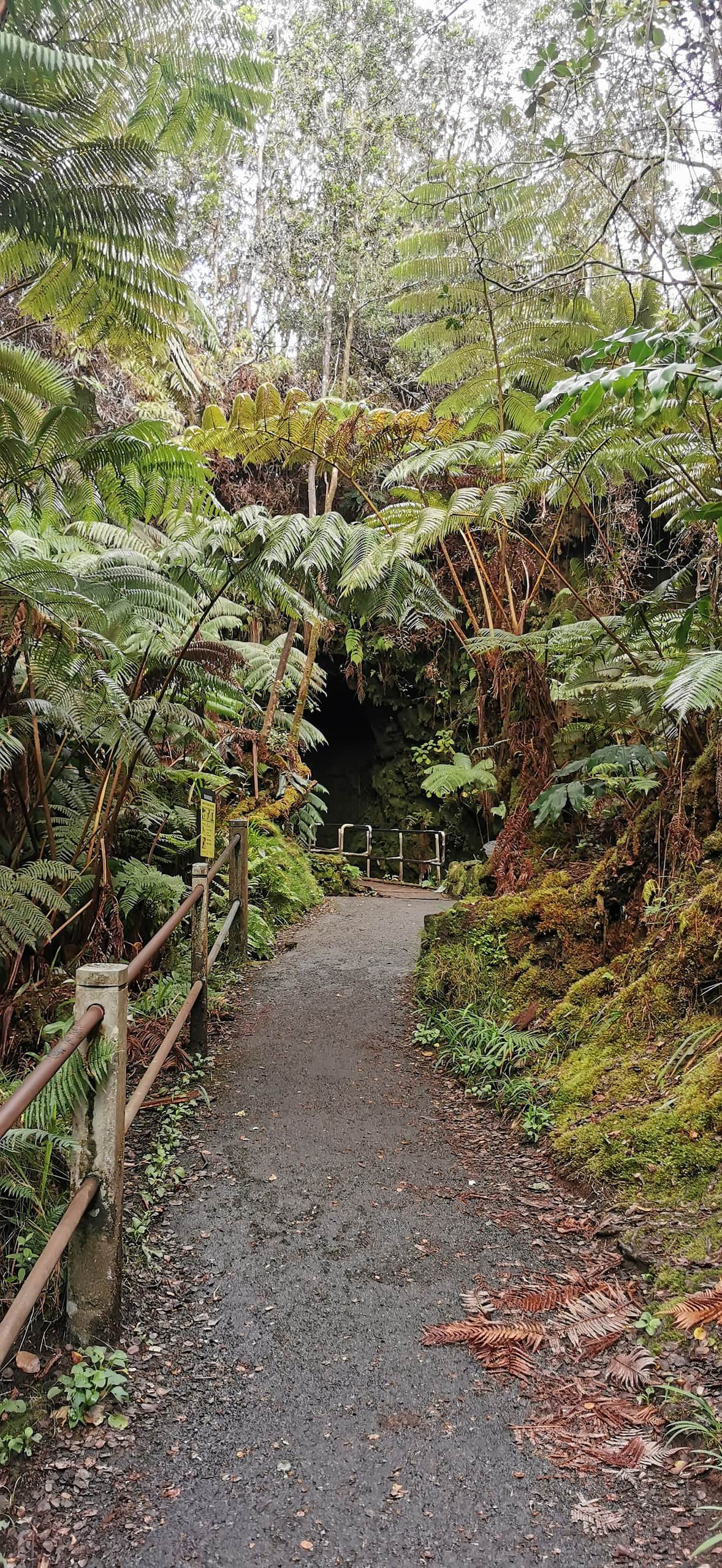
A fern-filled rainforest path leads to the dark entrance of Thurston Lava Tube (Nāhuku), where visitors can explore a natural tunnel formed by ancient lava flows in Hawaiʻi Volcanoes National Park.
The tube itself is a great introduction to lava tube geology. You can see the solidified drips and waves of once-liquid lava and the shapes and colors of minerals draining from the rocks.
- Official website: NPS website.
- Entrance fee: The lava tube is located inside the Hawaii Volcanoes National Park so you will need to pay the park entrance fee to visit.
- Good to know: Parking is very limited at the Nāhuku parking lot and it is very likely you won’t find a place to park at your first pass. Arrive early (before 9 am) or late (after 4 pm) to optimize your chances of finding a parking spot, or park at the Kīlauea Iki Overlook which is connected to the lava tubes by a very scenic half-mile hike.
- Getting there: Nāhuku is located inside the Hawaii Volcanoes National Park next to Volcano Village. Take a left after you enter the park and follow the Crater Rim Drive for 1.7 miles (2.7 km) to get to the Nāhuku parking lot.
You can experience walking through the Thurston lava tube yourself by viewing this 360 degrees video below. Click and drag the screen to look around while the video plays.

Kaumana caves (Hilo)
Kaumana Caves Park is a skylight in a 25-mile long lava tube that was created by a 1881 flow from Mauna Loa. You can explore the caves a short way in both directions before the lava tube enters private property. There are about 2 miles of lava tube here that are accessible to the public.
Important! Bring a flashlight and shoes with grip if you intend to travel beyond the cave entrances.
These caves are one step up from the Thurston lava tube and if you want you can spend quite some time exploring the dark tunnels. However, a short 15 minute visit will already give you a good feel of how massive lava tubes can get.
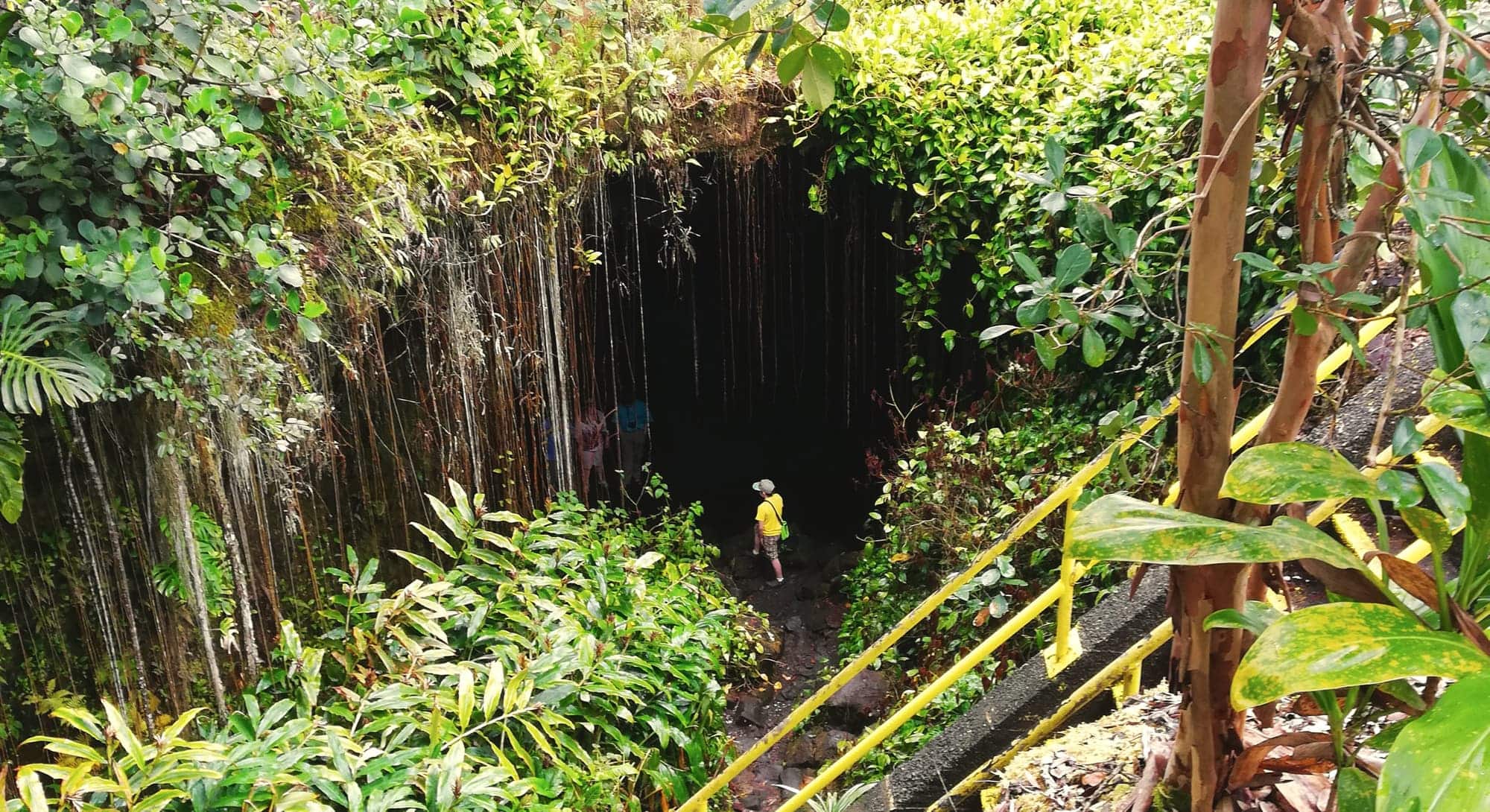
To get to the caves you need to climb ~20 ft. down steep stairs, after which you can enter either the left or the right tube.
The left starts with a big hall that appears to be a dead end. Look to your right to see a small (~4 to 5 ft) opening that you can work yourself through. The cave opens up afterwards and you can follow it for another ~15 minutes. The cave on the right is, at least at the start, more easily accessible and can be followed longer.
Use caution if you decide to explore the caves past the first few 100 feet, as low ceilings, ledges, and outcroppings make it easy to bump your head. The height of the cave varies from 30 feet to less than 3 feet in some deeper sections.
- Good to know: Bring appropriate clothing (long pants, sleeves) and bug spray, sturdy shoes, and a flash light.
- Official website: No official website but a good place for further reading is the Big Island Hikes website.
- Entrance fee: Free!
- Getting there: Follow Saddle Road (Hwy 200) from Hilo to between the 4 and 5 mile marker. The caves are located across the road from the parking lot. The park grounds also include picnic tables, a tap with drinking water, and restrooms.
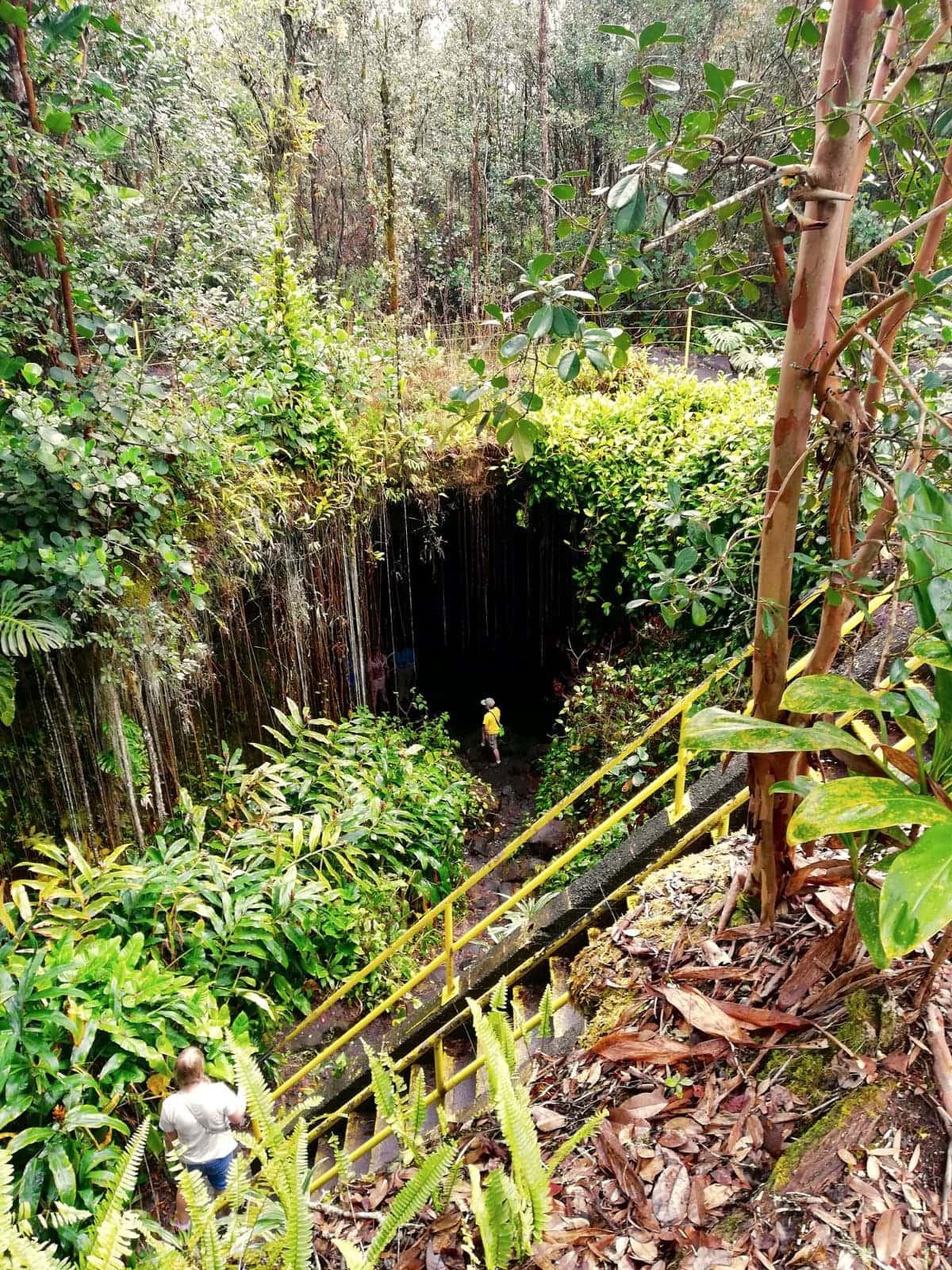
Climb down a steep ladder to get to the lava tube entrance of the Kaumana Caves
Kazumura caves (Puna District)
Kazumura Cave is one of the longest known lava tubes on our planet. It was formed during several eruptions of the Aila’au Lava Flow 500 to 600 years ago, on the flanks of the Kilauea volcano, and has many interesting features. These include canyon-like passages due to thermal erosion, multiple level tubes, lava falls, and ‘frozen’ lava lakes, some of which may not be accessible by a simple tour.
In the year 2002 the length of the cave was measured at 40.8 miles (65.6 km), roughly half of which are side branches. The cave drops 3,602 ft (1,098 meters) over its length, also making it one of the ‘deepest’ known lava tubes. Geologically speaking the Kazumura caves are referred to as a “master lava tube” because you can find nearly every type of lava tube feature in this cave.
For anyone interested in volcanic geology, Kazumura is in a different category from the other tubes on this list: canyon-like passages, multiple tube levels, lava falls, and frozen lava lakes all in one system.
- Official website: None, but see, for example, this Wikipedia page for a summary. Or read “Description of development and morphology of the Kazumura Caves” in the Journal of Cave and Karst Studies (pdf) for a full description.
- Entrance fee / Tours: Access to the Kazumura caves is possible as part of a tour. Two companies organizing such tours are Kazumura Cave Tours (Keaau) and Kilauea Caverns of Fire (Kurtistown).
- Getting there: The cave runs through a large part of the Puna district and there are over 100 entrance points to Kazumura that have been documented. All of these are on private lands but some of these landowners organize tours of the caves. See the websites for the tours listed above for directions.
Kula Kai Caverns (Kaʻu / Ocean View)
Kula Kai Caverns is the public access point for the Kipuka Kanohina Cave System, currently listed as the second-longest lava tube in the world. The system is highly braided and maze-like, with multiple levels, confusing passages, Hawaiian artifacts, evidence of ancient habitation, soda straw stalactites, large lava balls, gypsum deposits, and paleontological specimens.
For casual visitors, a one-hour guided tour covers the most accessible section for $35/person. Longer, more intensive tours are also available. All access is guided; there is no self-entry option.
- Official website: None, but find more info on the Kula Kai Caverns website.
- Entrance fee: Tours from $35/person. Reserve through the Kula Kai Caverns website.
- Getting there: 92-8864 Lauhala Drive, Ocean View, inside a gated community just off Hwy 11, roughly halfway between Kailua-Kona and Volcanoes National Park (about 1 hour from each).
Pua Po‘o Lava Tube in Hawaiʻi Volcanoes National Park
The Pua Po‘o Lava Tube is almost as large and open as the Thurston Lava Tube (Nāhuku) but far more exciting. Access to this tube is possible as part of a guided tour with the Friends of the Hawaii Volcanoes National Park. These tours sell out quickly and are not regularly organized. See this website for more details, and/or contact the Friends at [email protected] / call them at (808) 985-7373.
Kalāhuipua Shelter Cave (Waikoloa / Kohala coast)
You can find a lava tube shelter cave in the Kalāhuipuaʻa historical park on the grounds of the Mauna Lani resort. The park also contains petroglyphs and extensive fishponds. The lava tube was used as shelter by ancient Hawaiians and there are interesting skylights in the short cave. Bring a flashlight to avoid hitting your head on the sharp ceiling or stumbling over loose rocks.
Read more about visiting these caves on the Big Island Hikes website.
Hualālai volcano lava tubes
Hualālai is the 3rd active volcano on the Big Island and last erupted in 1801. The slopes of this volcano are covered in native (cloud) forests that hide a decent amount of lava tubes but unfortunately almost all of the upper slope area is privately owned and off limits for visitors without permission.
The only legal way to explore these tubes is to do so as part of a tour which has negotiated access , such as the following organized by Hawaii Forest & Trail:
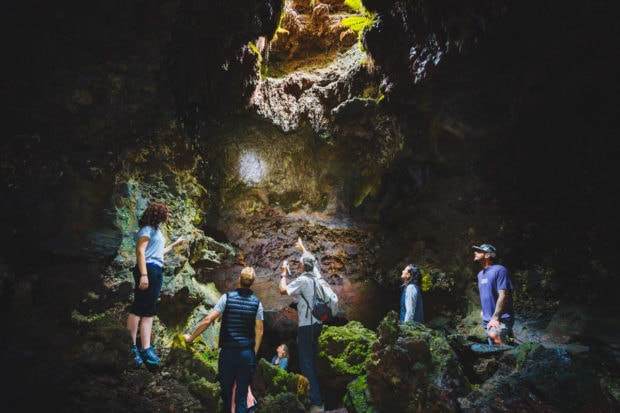
Hidden Crater Hike (Cloud Forests + Lava Tube)
Volcano and Cloud Forest hiking tour. Explore the untouched cloud forest of the Hualalai Volcano with incredible vistas of the Kona coast up to volcanic craters and climb through a segment of a lava tube.
from:
$190
What is a suggested tour?Our suggested tours are hand-picked tours that receive consistent good reviews, give back to the community, and work hard to minimize their impact on the environment. Read more about these tours on our website.Huehue Lava Tube (Kailua Kona, currently closed to visitors )
The Huehue lava tube sits about 2 miles north of Ellison Onizuka Kona International Airport and was created during the 1801 Huehue flow from Hualālai. It’s visible from Hwy 19, but access has been blocked since 2019, when no-parking signs and concrete barriers were installed at the entrance. A no-trespassing sign is posted at the tube entrance.
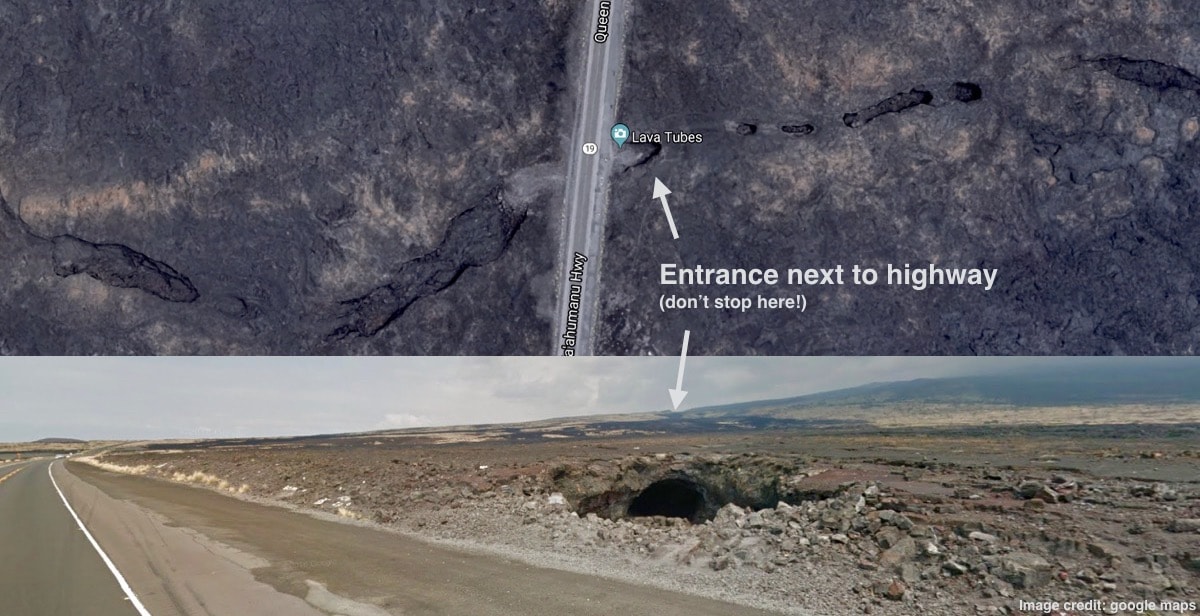
The Huehue lava tube is located about 2 miles north of Ellison Onizuka Kona International Airport. Image credit: Google Maps
As of early 2026 there is no public access and no announced timeline for reopening. You can catch a glimpse as you drive past on the highway, but don’t stop.
- Entrance fee: Free (if access is ever reopened)
- Getting there: Highway 19, approximately 2 miles north of Kona International Airport.
Learn about Lava Tubes
Lava tubes are windows into how volcanic eruptions move across a landscape. Here’s what’s happening geologically, what you’ll see inside, and what to bring.
How Lava Tubes form
Lava tubes are natural conduits through which lava travels beneath the surface and can form during the eruption of a volcano in two possible ways. Lava almost always leaves the crater in channelized flows and the first and most intuitive way of lava tube formation is when the surface of such a lava channel cools down and crusts over:
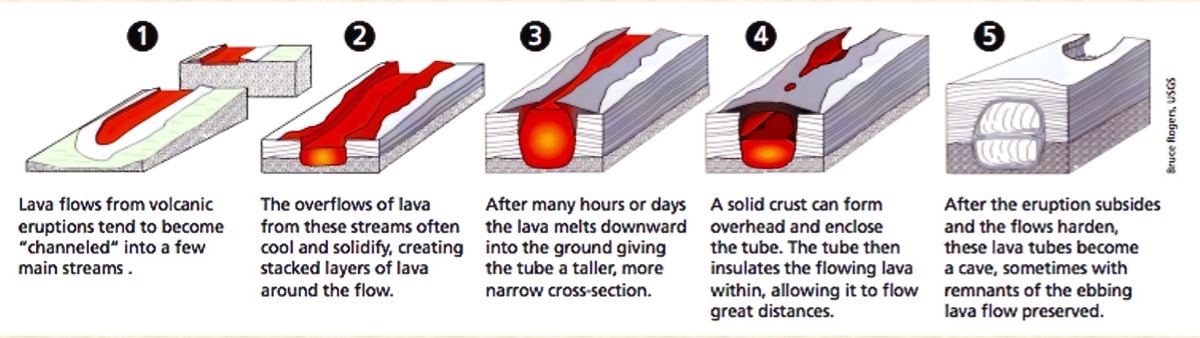
Simplified diagram showing how a lava tube forms by the crusting over of a lava channel. (source: Bruce Rogers, United States Geologic Survey)
The second lava tube formation mechanism happens at the front of a Pahoehoe lava flow. These flows often progress in an ongoing series of small breakouts of lava ‘toes’ that quickly build up multiple layers high. While the outside of these toes cools down and hardens, the lava continues to flow through earlier-formed toes, particularly those near the center of the flow field.
This continued flow causes the walls separating individual toes to become soft again and eventually the toes start to coalesce to form a lava tube. You can see this illustrated e.g. on this website.
All of this is also explained by ranger Dave in front of Nāhuku (the Thurston lava tube) in the following video:
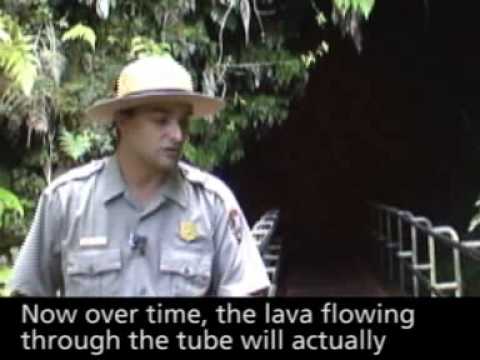
Extraterrestrial Lava tubes!
Because lava tubes are a natural consequence of volcanic eruptions, you can also find them on other moons and planets! Here are a few gems of (inter)planetary lava tube trivia:
- There is ample documentation of lava tubes on the moon. These lunar lava tubes are often revealed by satellite images through their sky lights (a collapsed part of the roof of the tube) and are possible locations to build human habitats.
- Similar to the lunar tubes, lava tubes on Mars are suggested as possible places to set up habitats in the future because they offer protection from the environment. This is highlighted in the very entertaining and educational National Geographic series ‘Mars‘ (IMDB).
- The longest lava tubes we have found in our solar system are on Venus, and are more than 4,200 miles (6,800 km) long!
Lava Tube features:
Lava tubes offer a close-up view of geology through many different lava formations, including: lavacicles (stalactites made of lava), lava roses, shark tooth stalactites, lava balls, crusted over lava lakes, lava falls, and many more!
You can learn more about all these features on the “virtual lava tube website” from which we have reproduced the following image:
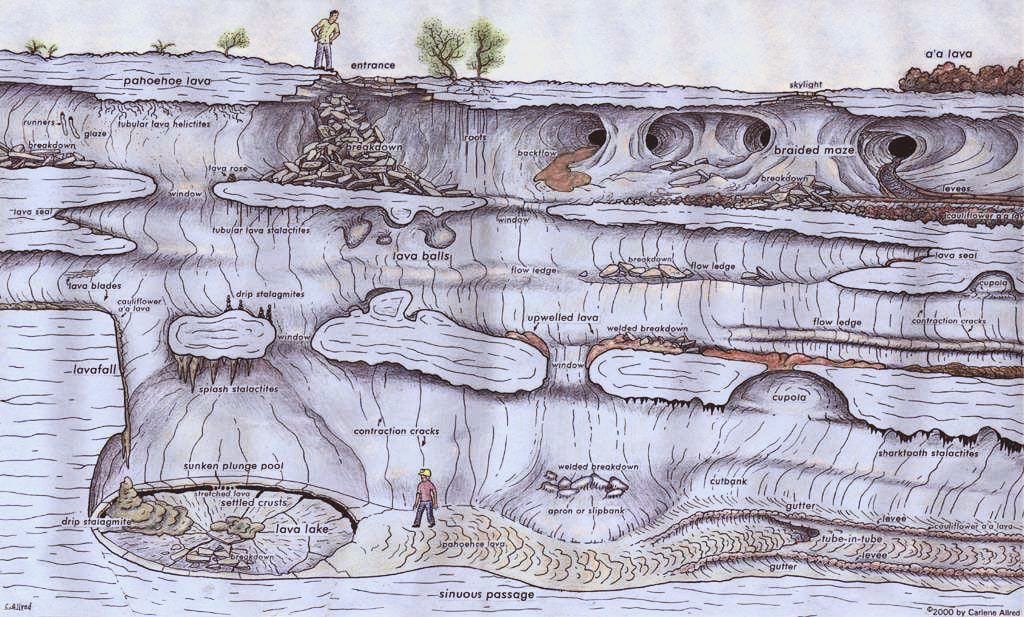
Map showing different features you can find in lava tubes. Image credit: Carlene Allred / the Virtual Lava Cave website.
Safety (or what to bring into lava caves and tubes):
Lava tubes are dark, have uneven flooring and ceilings, and can be slippery. Make sure to never explore one on your own, let someone that stays behind know where you are going, and always bring the following items:
- Sturdy hiking boots that will support you on wet and uneven surfaces that could crumble.
- At least two flashlights with full batteries (one for backup).
- Enough water to keep you hydrated.
- Long pants to protect your legs from scraping.