Anyone can drive to the Mauna Kea Visitor Center at 9,200 ft: no reservations or 4WDare needed. Twice a month, the visitor center halfway to the summit also runs free stargazing events with telescopes and staff, though those require advance reservations and fill up fast.
Getting to the summit is a separate decision. You either join a guided tour (from $259) or drive yourself in a 4WD vehicle. Tours are the easier option for most people: no rental sourcing and no altitude logistics to manage on your own.
One thing worth knowing: the summit is not the best spot for naked-eye stargazing. The thin air at 13,796 ft impairs your vision, so you actually see more stars from the visitor center. The summit is worth it for the sunset and the scale of the observatories.
Table of contents
- Mauna Kea FAQ
- Stargazing Tours
- How to visit Maunakea yourself
- Getting to the MaunaKea Visitor Center (MKVIS)
- How to drive to the Maunakea summit
- Seeing the sunset: from the visitor center and from the summit.
- Learn about MaunaKea
- List of observatories on the MaunaKea summit
- What’s in a name: Mauna Kea or MaunaKea?
- Health hazards associated with being at high elevations
Table of Contents
- Mauna Kea FAQ
- Stargazing Tours
- How to visit Maunakea yourself
- Getting to the MaunaKea Visitor Center (MKVIS)
- How to drive to the Maunakea summit
- Seeing the sunset: from the visitor center and from the summit.
- Learn about MaunaKea
- List of observatories on the MaunaKea summit
- What’s in a name: Mauna Kea or MaunaKea?
- Health hazards associated with being at high elevations
This guide covers all seven permitted tour operators, the free visitor center program, and everything you need to know if you want to drive up yourself.
Frequently Asked Questions about visiting MaunaKea
Our MaunaKea guide is quite extensive so to save you time we have summarized the most frequently asked questions (with their answers) below:
Q: Can you drive up to the MaunaKea summit?
Yes, but not with any car and only during daylight hours. On the road from the visitor center to the summit only 4WD vehicles are allowed, and the summit is off-limits from half and hour after sunset. Read more about driving to the summit here.
Q: Is the free stargazing program at the visitor center still running?
The free stargazing program at the Mauna Kea Visitor Center is now a monthly event and reservation are required. Read more about the free stargazing events and how to reserve here.
Q: Is going to the MaunaKea visitor center worth it?
Yes! At 9,200ft (2,800m) elevation the visitor center is a great place for stargazing, especially if you visit during the free monthly stargazing events. The drive over Saddle Road and up to the visitor center is also highly worth it, and shows a beautiful side of Hawaiʻi. Scroll down to read more about going to the visitor center.
Q: What car rental companies let you drive their car to the MaunaKea summit?
Only a handful of local car rental agencies specialized in 4WD rentals let you take their cars up to the Maunakea summit. Examples are Big Island Jeep Rental (which requires a 4 day minimum rental period) and Hawaii Lifted Jeep Rentals (1 day rentals available for the price of a normal 3-day rental period). None of the established car rental agencies allow for their cars to be taken up the mountain higher than the visitor station. The easiest and safest way to go to the summit is to join a tour.
Q: Is the Maunakea summit the best place to go stargazing?
For astronomers yes, but for the general public the summit is strangely enough not that good. Human vision does not work that well at the high elevation of the summit, and you can see the stars better with the naked eye from the visitor center. See our list of favorite stargazing locations on all Hawaiian islands for more good stargazing spots.
Q: I love sunsets! Is it better to see the sunset from the summit or from the visitor information station?
Seeing the sunset from the summit is hands down the most spectacular spot on the island to see the sunset. Click here for more information on how the see the sunset from both locations.
MaunaKea Stargazing Tours
Tours going up Mauna Kea have several advantages over planning a visit yourself. For example, no organizing is needed from your part, tours often pick you up at your hotel, and knowledgeable guides add value with many astronomy-related facts and knowledge of the scientific and cultural significance of the summit.
Depending on your preferences there are several ways you can visit MaunaKea as part of a tour:
- Maunakea Summit + Stargazing Tours
- Maunakea Stargazing Tours (that don’t go to the summit to see the sunset)
- Stargazing Tours at sea level from the grounds of the Westin Hapuna Beach Resort.
- Summit tours for Hawaiʻi residents (once/month, free)
- Stargazing events at the Visitor Information Center (twice/month, free)
- Maunakea Summit + Stargazing Tours
Maunakea Summit + Stargazing Tours
There are currently seven tour operators that are permitted to take people to the MaunaKea summit. These operators are guaranteed to employ knowledgeable guides and bring their own portable telescopes. This means that you will get to experience a personal lesson in stargazing from a seasoned expert, next to a visit to the summit during the sunset.
Tours typically supply arctic parkas and thick gloves to keep you warm, snacks, and water. Depending on the tour you choose, dinner can also be included. Expect the tour to last an average of 8 hours.
Our favorite tours are organized by the professionals of Hawaii Forest and Trail because they employ knowledgeable and interpretive guides and respect the local customs and habits:
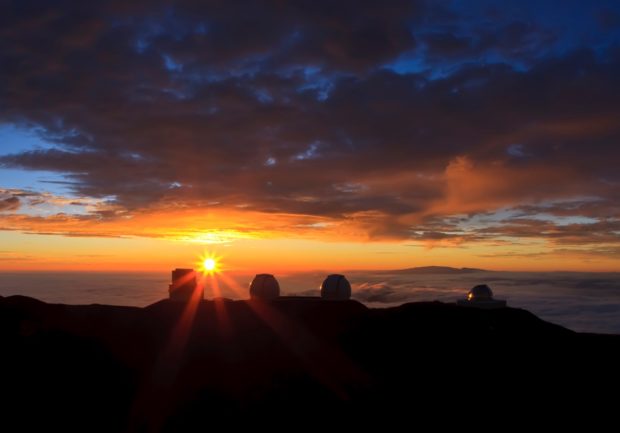
Maunakea Summit, Sunset, and Stargazing Tour
A small-group tour from Kona to the 13,796-foot summit of Maunakea: dinner at 9,200 feet, sunset above the cloud layer, and a private star show with an 11-inch telescope. Saturn, Jupiter, and the Milky Way on a clear night. 8 to 9 hours.
from:
$315
What is a suggested tour?Our suggested tours are hand-picked tours that receive consistent good reviews, give back to the community, and work hard to minimize their impact on the environment. Read more about these tours on our website.The complete list of permitted commercial tour companies is (last updated: May 2026 from source):
- Hawaii Forest & Trail (more information on our website)
- Mauna Kea Summit Adventures (website)
- Arnott’s Lodge & Hiking Adventures (website)
- Hawaiian Haoles, inc. dba Hawaiian Eyes Tours (website)
- Robert’s Hawaii Tours (currently not organizing their own tours)
- Taikobo Hawaii (English and Japanese language tours)
- Super Vacation Hawaii LLC (LA based travel agency and wholesaler) – currently selling their tour as Hawaii Island Holidays (booking link), also reachable by email at [email protected].
Good to know: children under the age of 13 cannot take a summit tour
Summit tours do not allow children under 13 years of age on their tours because they have a much higher incidence of high altitude problems. Consider stargazing tours that do not go to the summit (see below) if there are young stargazers in your group.
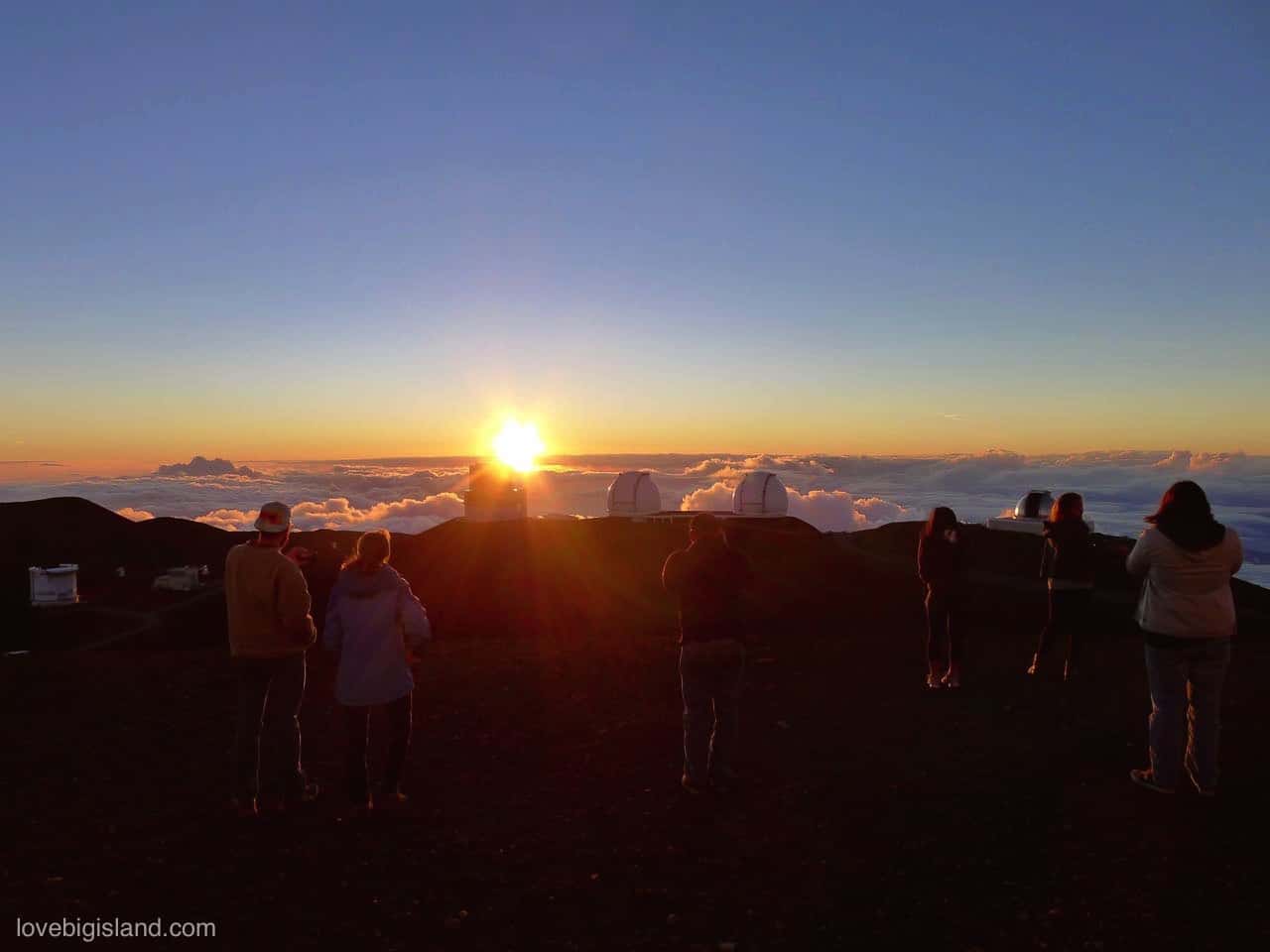
The sunsets from MaunaKea are out of this world, making a trip to the summit even more attractive
Stargazing tours that don’t go to the summit
A stargazing tour does not need to include a visit to the summit. While a summit visit obviously offers added value, including it in a tour is also a trade-off with tour duration.
For both types of tours the stargazing itself happens at comparable elevation (so the quality of the night sky is the same), but tours that go to the summit must leave there within 30 minutes after sunset, and thus their stargazing always happens early in the night.
Tours that don’t go to the summit do not have the sunset constraint and can organize our tours late at night which is good because it helps to:
- See many interesting night sky objects and,
- Avoid almost all of the other tour companies, giving you a more private and unique experience.
- Another advantage of not going to the summit is that all ages are welcome. Tours to the summit in comparison only allow 13+ year olds.
We highly recommend the following 2-hour long small group tour that gets GREAT reviews from all of their customers. Happy customers often comment on the storytelling aspect of the tour, and on the knowledgeable explanations of objects in the sky and photographic expertise.
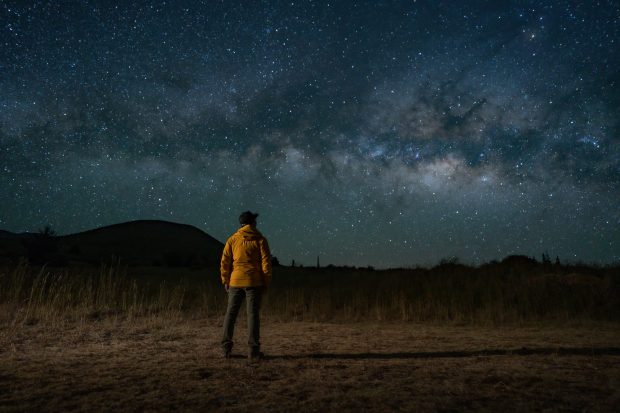
Mauna Kea Stargazing Experience with Free Milky Way Photos
Skip the summit crowds for dark skies below 9,000 feet, a smart telescope on deep-sky objects, and free photos within 24 hours.
from:
$259
What is a suggested tour?Our suggested tours are hand-picked tours that receive consistent good reviews, give back to the community, and work hard to minimize their impact on the environment. Read more about these tours on our website.Daytime tours to the MaunaKea summit for Hawaiʻi residents
The Kama‘āina Observatory Experience is a free monthly community event that provides local residents with an opportunity to visit the summit, see world-class telescopes, and learn about the mountain in a holistic manner. It is organized by the Maunakea Observatories and the ‘Imiloa Astronomy Center.
Tours are scheduled every first Saturday of the month. Guests must be at least 13 years of age and anyone under 18 must be accompanied by an adult. You will need to show your valid Hawaii state ID or drivers license on the day of the tour.
Reservations are required and will be available on a first come, first served basis, with a maximum of 12 to 14 available reservations per tour date (depending on the telescopes being visited). See if there are available spots for the upcoming month and/or add your name to the wait list for upcoming tours on the Kama‘āina Observatory Experience.
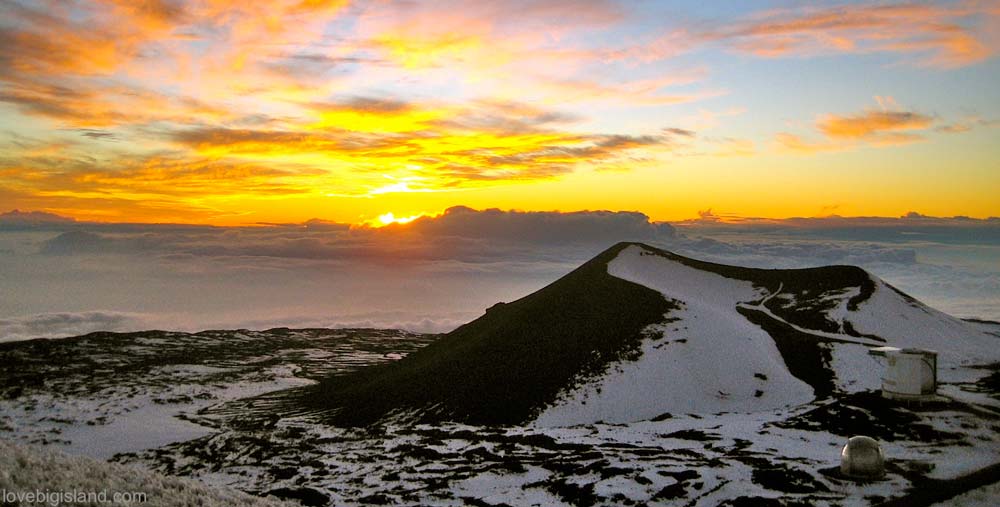
Sunsets from the MaunaKea summit are among the best on the island. Here you can see the JCMT and (now decommissioned) CSO telescopes, a snowy cinder cone and the sun setting below the clouds (not the ocean!)
Free Stargazing Program at the Visitor Center
What changed? As of 2023 the free stargazing program has resumed with some important changes. It now is a monthly event and reservations are required.
Twice a month staff member at the VIS organize a free stargazing event. One of these events is open for everyone, and one is reserved for Kamaʻaina (in possession of a valid state ID), These events are free to attend for locals and visitors alike, but reservations are required and availability is limited.
What happens during the free stargazing program?
The program starts with a check-in with visitor center staff just before sunset. This gives you enough time to enjoy the sunset from Puʻukalepeamoa – a hill close to the visitor center and a GREAT viewpoint for sunsets.
After enjoying the sun set on top of the clouds, you’ll meet a staff member back at the visitor center and take a short walk to a private stargazing location where the telescopes will be set up. You’ll enjoy two hours of viewing with knowledgeable staff and volunteers enjoying galaxies, nebulae, planets, constellations and more!
How to register
Signing up is easy – just fill out the web form here. Reservations can only be made for the next stargazing event, and open on noon of the day of the current event.
- The Kamaʻaina Stargazing Event is typically held on the 3rd Saturday of each month
- The General Stargazing Event is typically held on the 4th Monday of each month.
Each adult may register up to two children under 18, and children under 18 do not count against the registration cap. Individual registrations are restricted to once/3 months.
Upon signing up and securing your reservation, you’ll receive a confirmation email with more details about the event. You will need your ID in order to check in at the VIS. At night, local volunteer astronomers set up telescopes outside of the station and let visitors use them under supervision as part of their free stargazing program (website).
Did you know: that you can actually see more stars from the visitor station than from the Maunakea summit? Your vision at the summit is less acute because of the lack of oxygen there, meaning you can see less stars even though your are at higher elevation. Telescopes are obviously not bothered by a lack of oxygen so the summit *is* the best place for them.
How to visit the MaunaKea summit yourself
There are two logical destinations on MaunaKea if you want to visit for stargazing: the visitor station halfway up the volcano and the telescopes at the summit. You can reach the visitor station with any car. To get all the way to the summit you need a 4WD vehicle with good brakes to navigate the steep and winding gravel road to the summit.
In this section we discuss:
- How to get up to the MaunaKea Visitor Center (MKVIS)
- How to drive up to the Maunakea summit
- Seeing the sunset: from the visitor center and from the summit.
- The free stargazing program at the VIS (once a month, advance reservations limited and required)
Ps. going to the summit yourself requires a 4WD car and good driving skills, so many people prefer joining a tour to the summit.
How to drive to the MaunaKea Visitor Information Station (MKVIS)
To reach the visitor station (website) follow Saddle Road (Hwy 200) until you get to the Mauna Kea access road (around mile marker 28, across the street from the Puʻu Huluhulu Cinder cone parking lot) and follow that road up. The visitor center is located ~halfway up the volcano at 9,200 ft elevation. Make sure that you have a full tank of gas before you start the ascent, as the nearest gas station is ~35 miles (50 km) from the visitor station.
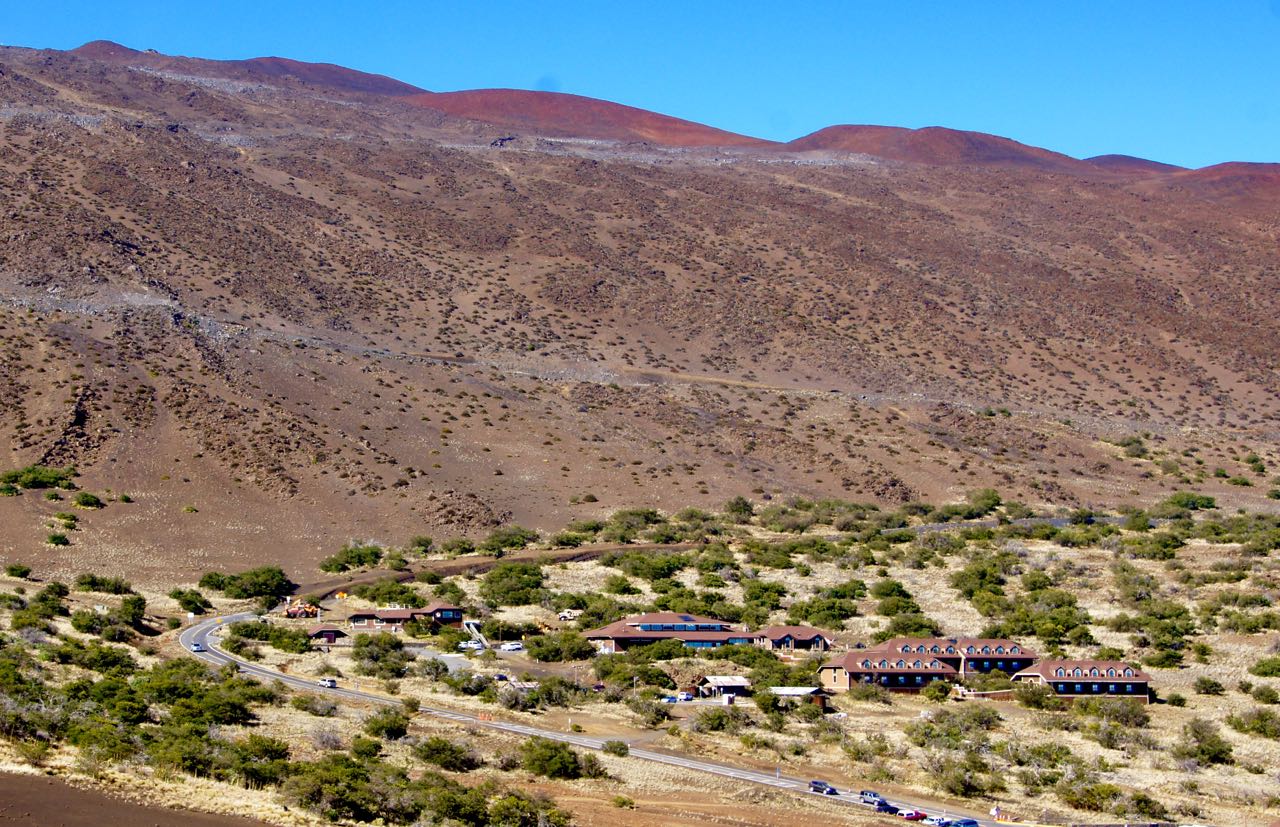
A view of the Onizuka Center for International Astronomy Visitor Information Station on the ascent of MaunaKea, taken from a Puʻu at the 9300 ft. level. Credit: Madereugeneandrew – Own work, CC BY-SA 4.0
Did you know? The visitor information station is officially called the “Onizuka Center for International Astronomy Visitor Information Station”. It was named after the Hawaiʻi-born astronaut Ellison Onizuka who died in the Space Shuttle Challenger disaster in 1986.
The purpose of the visitor center is to educate the visitors on the cultural importance of the mountain. You can also watch a video about astronomy in the center, and find a small shop where you can buy souvenirs, hot and cold drinks, and snacks.
Please be aware of the possibility of long lines and scarce parking at the Visitor Information Station (VIS) on these evenings until ~1.5 hours after sunset. Parking at the VIS is available for up to 115-vehicles on a first-come, first-served basis. Once the parking lots are full, all vehicles will be turned away.
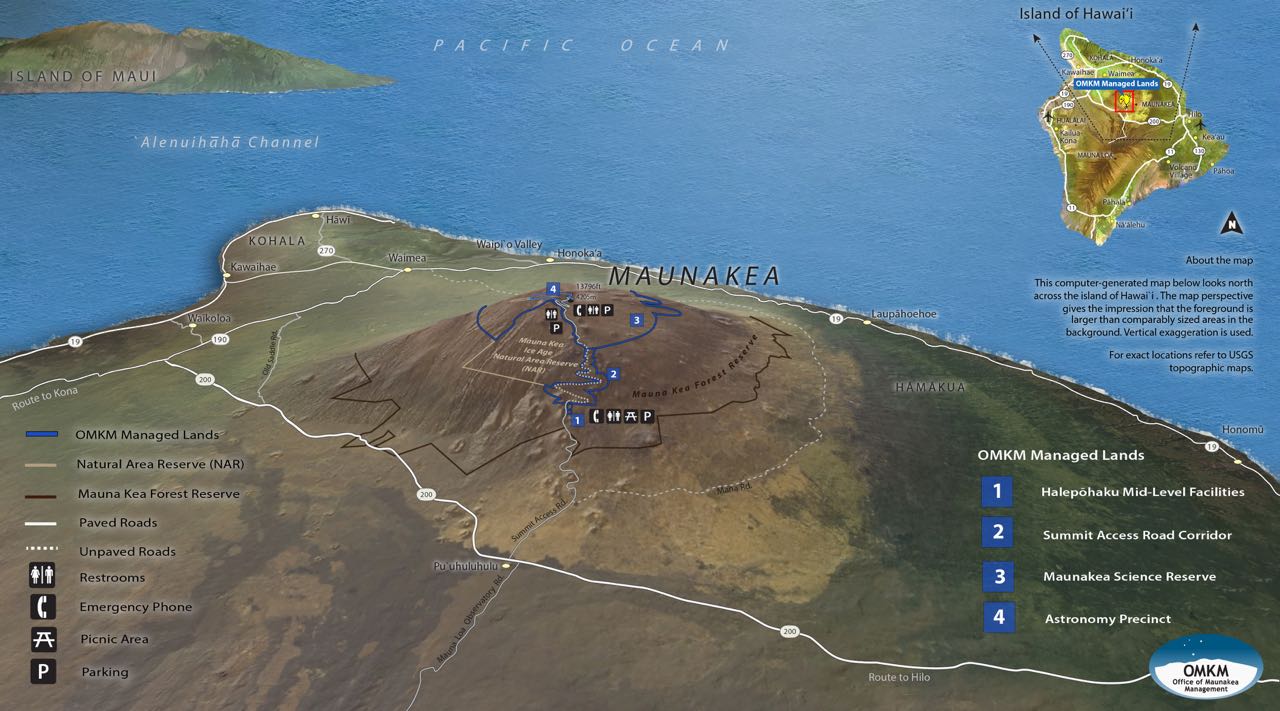
Directions from Kona (64 mi) and Hilo (43 mi) to the summit of MaunaKea. Be aware that you need to stop at the visitor center for a while to help your body acclimatize to the large altitude difference between Kona/Hilo and the summit (13,796 ft). Image credit: OMKM
How to drive to the MaunaKea summit yourself: important things to know
You can visit the summit and see the telescopes during daytime and stay for up to 30 minutes after the sun has set. Take the following things into account when doing so:
- Please be respectful. To Hawaiians the summit of MaunaKea is sacred: it is the place where Poli‘ahu (the goddess of snow) lives.
- Make sure to fill up your car beforehand. Rangers will not let you drive to the summit if you do not have at least half a tank left at the ranger station at the Visitor Center.
- Stop for at least half an hour at the visitor station to acclimatize to the altitude. The summit is at 4,205 m (13,796 ft) elevation and high altitude carries serious health risks, most of which can be mitigated by a short stop.
- Sometimes the summit road is closed due to bad weather. The observatories at the Mauna Kea summit maintain a website showing the conditions of the road up to the summit. Please have a look here to see if the road is open and to find out what conditions you can expect. High winds, ice, and snow on the road are all within the realm of possibility.
- You cannot use the telescopes on the summit or to enter the buildings. ~30 minutes after sunset the summit becomes off-limits and visitors are expected to drive down.
- Scuba diving and high altitude visits are extremely incompatible. Wait at least 24 hours before going to the summit after you have been scuba-diving. Snorkeling is no problem.
- Dress warm! After the sunset temperatures can drop as low as 30-40 degrees F (between -1 and +4 Celsius). Also, make sure to bring enough snacks, sunscreen, and water.
You need a 4WD vehicle to drive up to the Maunakea summit.
Rangers at the Visitor Center only allow 4WD vehicles with at least half a tank of gas to continue on to the summit.
None of the (inter)national rental car agencies let you take their cars up to the summit, so you have to rent local if you want to drive to the summit yourself. Examples of local agencies that let you take their cars up to the summit are Big Island Jeep Rental (which requires a 4 day minimum rental period) and Hawaii Lifted Jeep Rentals (1 day rentals available for the price of a normal 3-day rental period). Another option is renting through the Turo website as some advertisements specifically allow for the cars to be taken up to the summit.
Clint from the Not Lost Nomad youtube channel shares how to drive your own 4WD to the Mauakea summit in the following 11-minute video:
Seeing the sunset from Maunakea (from the summit vs. from the visitor center)
If you are looking for an epic sunset spot Maunakea should definitely be on your list. The best sunset viewing is from the summit but getting there is difficult because you need to either have a 4WD vehicle or join a tour. A good alternative to the summit is to see the sunset from the visitor center.
We discuss both options below.
Seeing the sunset from the Maunakea summit
The Maunakea summit is in our opinion one of the best places to see the sunset on Hawaiʻi, and considering the competition that says a lot! You can see the sun dip below the clouds in a spectacular explosion of color, framed by (snowy) peaks, old volcanoes, and futuristic world class telescopes.
To get to the summit you either need to join a tour (see below) or drive a 4WD vehicle. The 4WD requirement is for good safety reasons (brakes overheating on the way down) and park rangers often check the cars on the summit road. Scroll up for 8 tips on how to drive to the summit yourself.
Make sure to dress warm (many layers) and bring a good camera because it gets really cold up there as soon as the sun is gone.
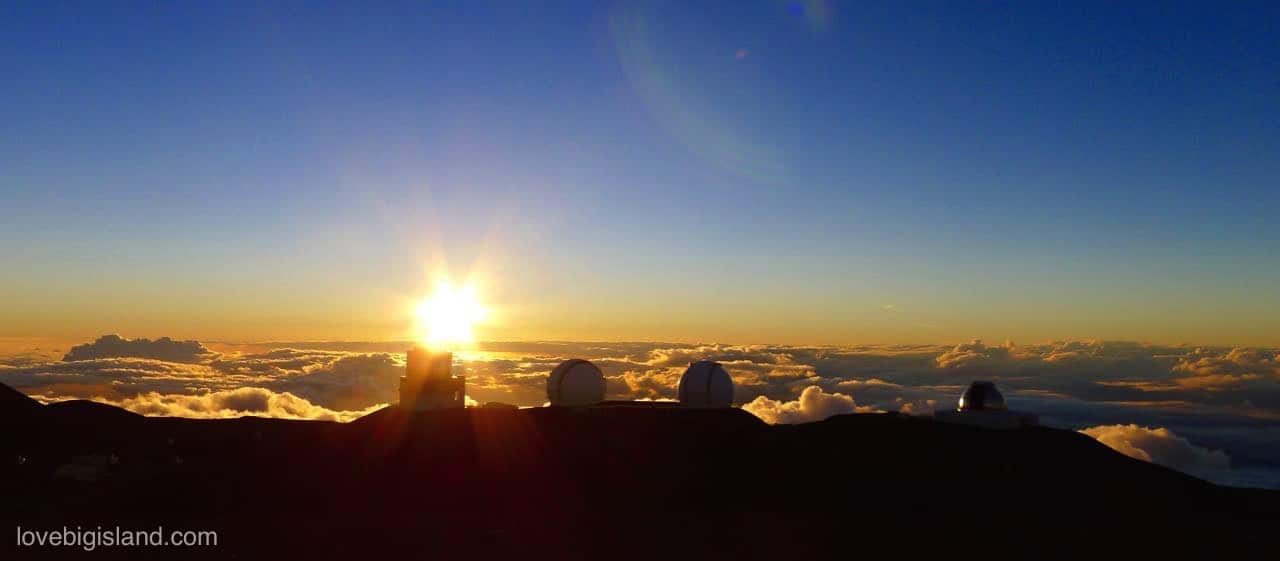
Telescopes of the MaunaKea Observatory, Hawaii. From left to right: the Subaru Telescope, the W. M. Keck Observatory (2 domes), and the NASA Infrared Telescope Facility
Seeing the sunset from the Mauna Kea Visitor Information Station (VIS)
Seeing the sunset from the Mauna Kea visitor center is a good alternative is you do not want to go all the way to the summit. There are cinder cones that block the view of the sunset from the visitor center itself, but you can get to a good sunset viewing spot close-by with an easy hike.
Parking at the visitor center is limited and it gets busy here around sunset, so make sure to arrive early. Make also sure to bring warm clothes and a windbreaker to stay comfortable as it can get cold and windy.
MaunaKea facts and trivia
MaunaKea last erupted more than 4,000 years ago and is no longer considered an active volcano. The MaunaKea summit is the highest point of the state of Hawaiʻi at 13,796 ft above sea level. There have even been glaciers on the volcano during past colder periods (source).
If you like stargazing you should definitely have a look at our astronomy calendar for Hawaiʻi to see if there is a meteor shower or any other good excuse to make looking up at the stars special during your stay.
The story of Maunakea gets better. Because the volcanoes on the Big Island are so heavy and because large parts of them are under water, MaunaKea is actually higher than Mount Everest. Measured from the base on the ocean floor, MaunaKea rises over 10,000 m (33,000 ft) high!
If you are in for a hike at high altitude, you can also make a short excursion to the highest lake in the state at 1,3020 ft: Lake Waiau.
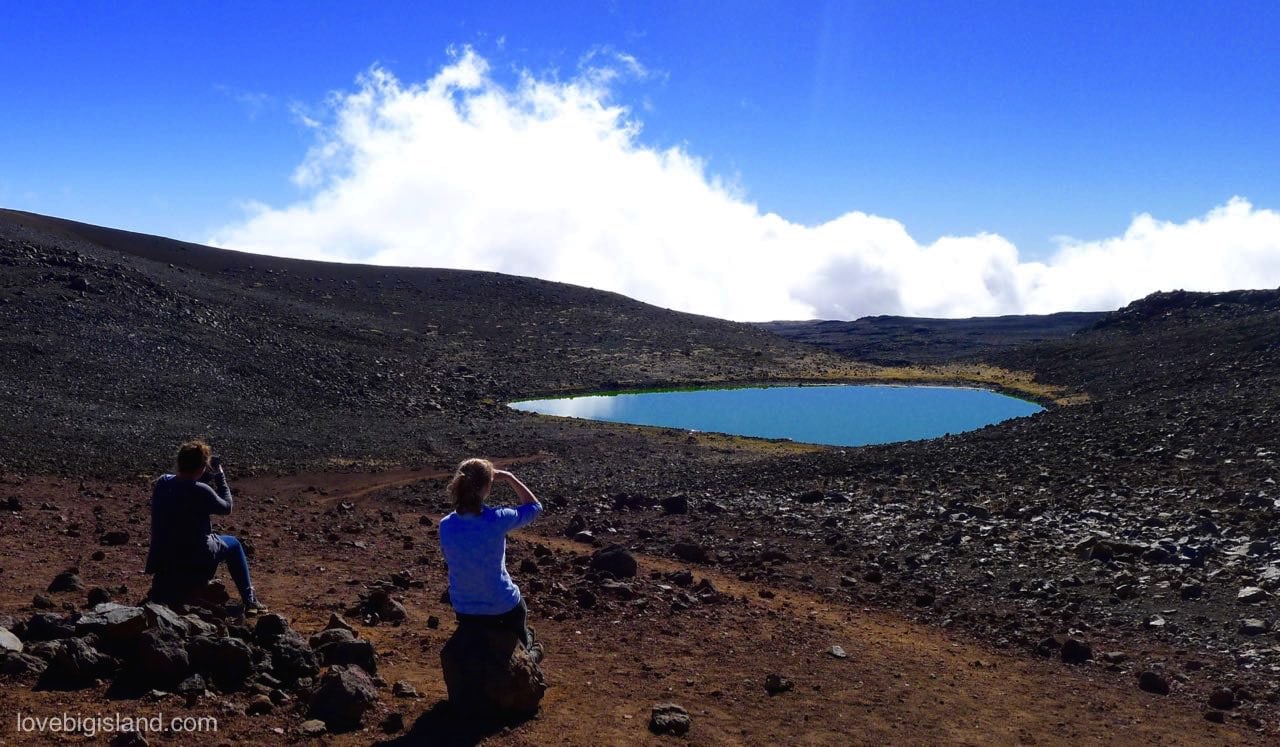
Lake Waiau is located on Mauna Kea, more than 13.000 ft above sea level. It is one of very few lakes in the state of Hawaiʻi
Which spelling is correct: Mauna Kea or MaunaKea?
Both Mauna Kea and Maunakea refer to the same place on the Big Island. Regardless of the spelling people will know what you mean by using either of the two versions.
According to the University of Hawaii at Hilo College of Hawaiian Language and following traditional Hawaiian values and the Hawaiian language, MaunaKea (one word) is the correct designation. Maunakea is a proper noun—the name of the mountain on the Island of Hawaii. “Mauna Kea” spelled as two words refers to any white mountain—it is a common noun (vs. the proper noun) [source].
Safety tips for visiting MaunaKea
The MaunaKea summit at an elevation of 13,796 feet (4205 meters) is an extreme environment with an atmospheric pressure 40 percent lower compared to sea level. People visiting the summit may experience altitude sickness, which is triggered by rapid exposure to lower oxygen levels.
Good to know: a 1-hour stop at the visitor center halfway up the mountain will let your body acclimatize and greatly decreases the chance that you’ll experience altitude sickness while going to the summit.
Altitude sickness
Symptoms of altitude sickness include: headaches, drowsiness, nausea, shortness of breath, and poor judgment. Your age, gender, or physical fitness do not affect your likelihood of getting altitude sickness, and altitude sickness can become a medical emergency if ignored. If you are experiencing any symptoms of altitude sickness you should stop and rest where you are to acclimatize to the altitude. See this resource to learn more about the symptoms, treatment, and prevention of altitude sickness.
High altitudes can also cause the life-threatening conditions pulmonary edema (fluid in the lungs) and cerebral edema (fluid on the brain). Descend immediately if you experience any of the following symptoms:
- severe headaches,
- vomiting,
- breathing difficulties,
- coughing,
- blue lips or fingernails,
- disorientation,
- extreme drowsiness that may lead to coma.
Other hazards
At the summit the radiation from the sun is stronger and the air dryer. This means that dehydration, sunburn, and eye damage are all possible especially when you spend more time at the summit (for example when hiking to lake Waiau). Bring plenty of water and protect your skin and eyes against the intense UV radiation at the summit with sunscreen and sunglasses.
1. We are part of the hawaiiactivities affiliate program. Read more about our participation. ↩