Stand up paddle surfing (or SUP) is an emerging global sport with a Hawaiian heritage. It is called Hoe heʻe nalu in the Hawaiian language and is an ancient form of surfing that allows for a good view on the ocean, the incoming waves, the shoreline, and, if you are in the right place, the reef and ocean life below you.
Our Big Island SUP guide includes the following information:
Table of contents
- What is SUP?
- SUP Rentals + Classes in Hilo, Kona, south Kona and Waikoloa
- SUP Tours
- Paddle Tips + instruction video.
Table of Contents
- What is SUP?
- SUP Rentals + Classes in Hilo, Kona, south Kona and Waikoloa
- SUP Tours
- Paddle Tips + instruction video.
What is SUP and why do we like doing it?
A SUP board is larger than a surf board and measures between 9 and 12 feet or more in length. It has features such as a padded deck that make it easier to stay standing up and a concave hull. Because it is so large you can stand on the board without sinking, and you move yourself through the water with a paddle.
Stand-Up Paddling is a great way to leisurely explore the coastal waters around the Big Island, to look down at the colorful fish and corals, or to relax while checking out the tropical shoreline.
Finding and keeping your balance on a Stand-Up Paddling board is not trivial and gives a good core-body workout, but once you learn, the rewards are great!
SUP Lessons and Rentals on the Big Island
SUP is not as popular as surfing and your SUP rental options on the Big Island are still somewhat limited. We list here a few good surf shops that also rent SUP boards, and that can provide you with lessons and instructions.
- In Hilo
- The resort coast (Waikoloa / Waimea / Kohala coast)
- In Kailua Kona
- South of Kona
SUP rentals and classes in Hilo
Hilo Ocean Adventures offers both SUP rentals and lessons at Reeds Bay.
- Rentals are available for three hours, daily, 3 days, or weekly. See their current rates on their booking website.
- Classes: if you want to learn how to SUP you can learn the basics of stand up paddling in the calm, protected waters of Reeds Bay ($75 for one hour, ages 8 and up). Classes include the use Stand up paddleboard, paddle, and life jacket(website).
- SUP Tours that explore the calm Wailoa River are also available at a slightly higher hourly cost than the lessons. More information on those here.
SUP rentals and classes in Waikoloa / the Kohala coast
If you are staying at one of the resorts on the Kohala coast your SUP options are easy: most of the resorts have a concierge desk that allows you to rent SUP boards or their use is complementary with your stay.
Otherwise, Hulakai at the King’s Shops in the Waikoloa Beach Resort is the place to go. All SUP related things here happen at A Bay (more specifically, at the Anaehoʻomalu Bay Canoe Club, next to Lava Lava Beach Club). Morning lessons are recommended as there often are breezy conditions in the afternoon.
- Rentals: are available for at least a day (starting at $84/day) up several weeks (website).
- Tours: 1.5 hour guided tours exploring the Kohala coast are available through Hulakai (website).
- Classes: are unfortunately currently not available.
Hawaii Ocean Sports,
SUP rentals and lessons in Kailua Kona
In downtown Kona (at the pier) KonaBoys are a trusted choice for SUP.
- Rentals are only available directly from the beach shack at King Kam beach.
- Lessons (group or private) last 1.5 hours and include all material (more information + booking info here).
SUP rentals and lessons South of Kailua Kona
South of Kona there are 2 bays that offer calm water and good SUP conditions: Kahaluʻu Bay and Keahou Bay.
SUP at Kahaluʻu Bay
- SUP rentals can be secured at Kahaluʻu Bay Surf and Sea ,where you can rent SUP boards starting at $35 for 2 hours. Unfortunately the have stopped their SUP classes, but they still run their surfing classes.
- SUP classes at Kahaluʻu Bay are offered by HYPR, and start at $145 for a 1-hour lesson (website).
SUP at Keahou Bay
Ocean Safaris is the only outfit providing SUP related activities in Keahou Bay. They offer 2-hour tours starting at $89/person (website).
Paddle Board Tours
Guided SUP tours last a few hours and typically include SUP instruction (no experience needed!) and a snack or lunch. Tours often take you to special places with great views of fish, coral reefs, sea caves, and of course the shoreline.
If you are interested in a special SUP tour you should check out what LightSUP (based in Puako, close to Waialea beach) has to offer. Their boards have a large viewing window in front that acts as a kind of snorkeling mask which makes it really easy to see the reef and fish below the surface. To make it even better they have installed lights on each board so you can illuminate the ocean floor which makes for great views once the sun has set.
Good to know: booking through their website is currently (January 2026) not possible but they are still operating as usual. So if their website doesn’t allow you to book please give them a call or email through the contact information listed on their website.
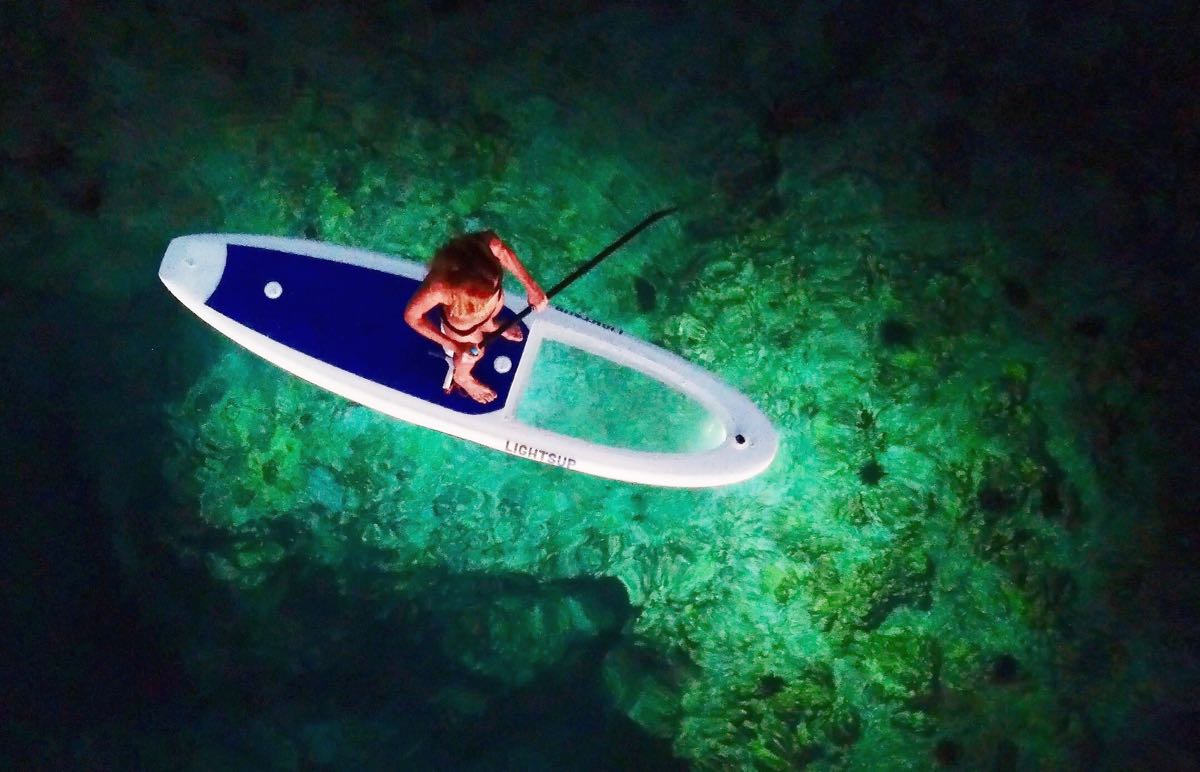
The SUP boards used for the tours organized by lightSUP have a large viewing window and lights installed making it really easy to see the reef and ocean life below you. Image credit: LightSUP
How to SUP? Tips + Instruction Video
If you have never stood on a SUP board before but want to try, out best advice to you is to pick a calm day and go on the water! You should get at least some instruction from your rental place of choice but we give you some good tips just we found helpful in case:
- Paddle with your core body, not with your arms! You have far more muscles in your core than in your arms, so using your body properly will let you SUP longer without getting tired.
- Falling is OK: We can guarantee you with 100% certainty that you will fall often when learning to SUP, and that’s OK! Learn how to fall properly (when in deep enough water!) to make sure you don’t bang the wrong parts of your body on the board to make the learning process easier. For example, fall away from and to the side of your board.
- Look at the horizon for best balance. Looking down will change the distribution of the weight on your board which makes it more difficult to stay standing up.
- Get away from the shore, but not too far! Close to the shore there are breaking waves, rocks close to the surface and other people: 3 thing you don’t want to be in/on with your SUP board. However, going *too* far out also isn’t a good thing: wind and ocean conditions can change rapidly and especially when you are a novice you don’t want to get in over your head. In summary: use common sense.
You can also have a look at the following video to understand the basics of Stand-Up Paddling: