
Kaʻawaloa Cove has the best snorkeling at Kealakekua Bay, across the water from the parking area, below the 27-foot white obelisk marking where Captain Cook was killed in 1779. You get there by boat tour, by guided kayak tour, in a permitted rental kayak, or on foot: a 3.8-mile round-trip hike with 1,300 feet of climb on the way back up. Every vessel on the bay needs a State Parks permit, and the tour and rental fleets already hold theirs.
Skip all four and you snorkel from the shore-side dock at Nāpōʻopoʻo, where the road ends. That lot holds 20 to 30 cars. It fills by mid-morning on weekends, and by midday the Kona breeze chops the surface, so we get in the water before 10 a.m.
Table of contents
For deeper background, the National Park Service published a 1993 history of Kona’s archaeological and historical sites that is worth a read: Kona historical sites study.
About Kealakekua Bay
Kealakekua Bay has two designations in one mile-wide inlet: a marine life conservation district underwater, and a state historical park along the shore. The reef is among the densest on the island and the center of the bay runs deep. A resident pod of spinner dolphins rests here (read more on how to behave around wild dolphins).
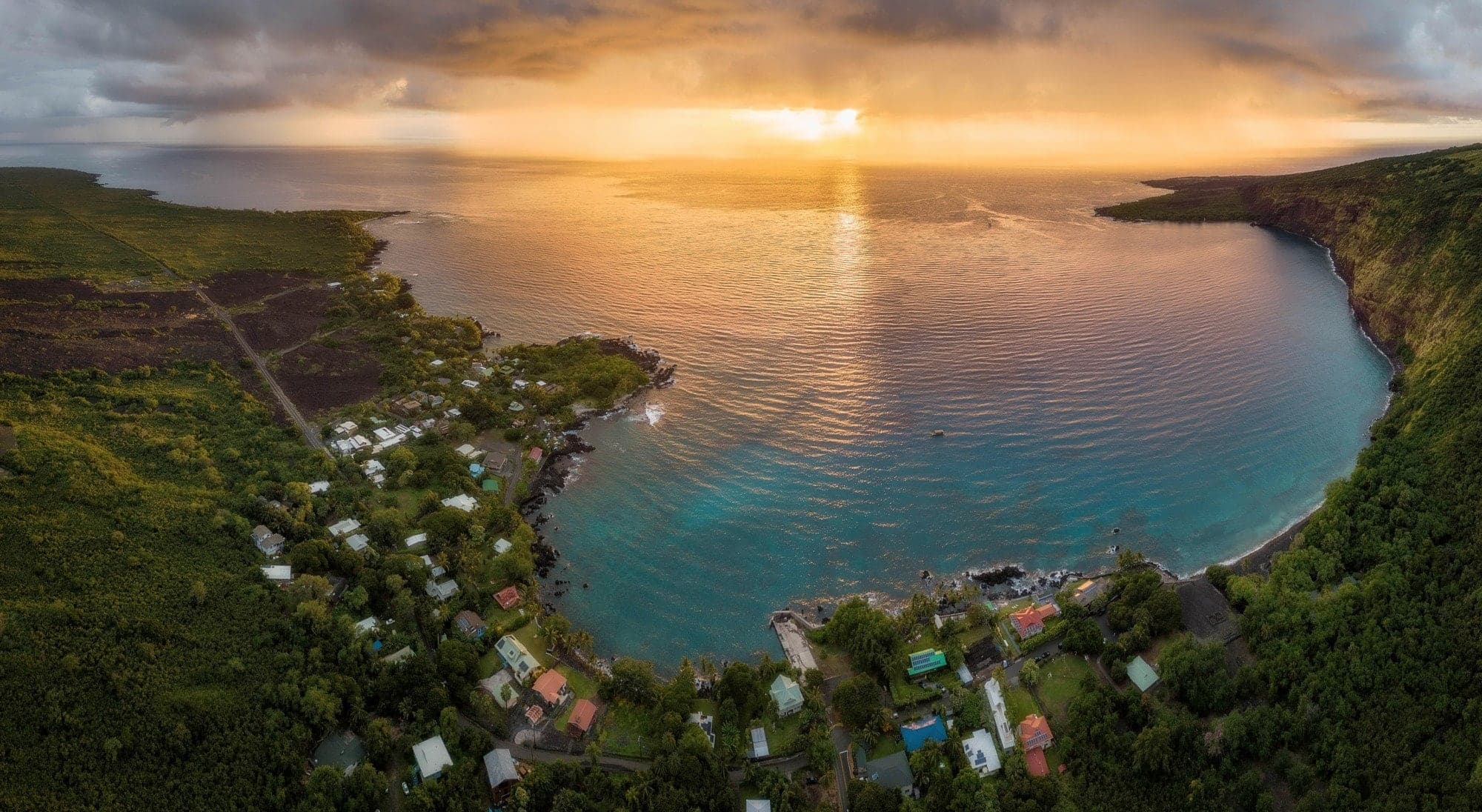
Kealakekua Bay sits in the middle of south Kona’s coffee country and has some of the best snorkeling on the island. Image source: @TioLuz on instagram
Kealakekua Bay is a Marine Life Conservation District
Hawaiʻi has 11 Marine Life Conservation Districts (MLCDs), 5 of them on the Big Island. The Kealakekua Bay MLCD covers 315 acres.
An MLCD is a stretch of ocean where the state protects the reef and the fish living on it. Fishing and other consumptive uses are banned or tightly limited, so aquatic life can grow and reproduce. Fish density is high. The fish are used to people and show little fear of a snorkeler.
The district is split in two. A line from Cook Point to the north end of Nāpōʻopoʻo Beach divides it into Subzone A, to the north, and Subzone B, to the south. Fishing is allowed only in Subzone B, and only by hook-and-line or thrownet.
In both subzones you cannot take or injure marine life, take or alter sand, coral, or any other geological feature, or feed the fish. DLNR also prohibits anchoring in Subzone A. In Subzone B, anchors may only be dropped onto sand.
DLNR publishes the full rules for each MLCD on its website.
Kealakekua Bay State Historical Park (and Nāpōʻopoʻo Beach Park)
The state historical park covers the bay’s shoreline except for the south-eastern stretch. The most accessible part of it is along the bay’s eastern shoreline, at Nāpōʻopoʻo Beach Park, which has a parking area, a picnic pavilion, restrooms, showers, and a water fountain. Park opening hours are from 7:00 am to 8:00 pm (daily).
The small beach next to the pavilion is Nāpōʻopoʻo Beach. Hurricane Iniki stripped its sand in 1992 and left rock behind, so it is fine for a quick swim or snorkeling, not for lounging. There is no lifeguard on duty.
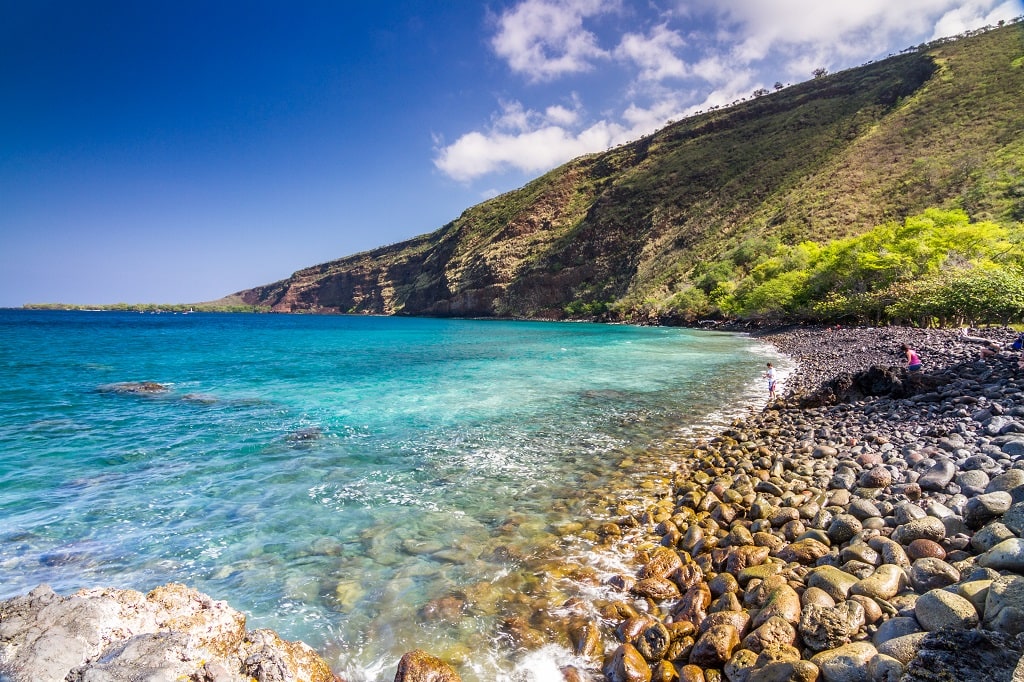
Nāpōʻopoʻo Beach is a small rocky beach in the Kealakekua Bay State Historical Park. Image credit: Nnachappa64 – Own work, CC BY-SA 4.0, Link
Hikiau Heiau is in this park too. This heiau is a well-preserved ancient temple dedicated to the Hawaiian god Lono, and it was a site of human sacrifice.
Read more about the state park on the official state park website.
The Captain Cook Monument
Kealakekua Bay is where Captain James Cook first set foot on Hawaiʻi Island in 1778, and where he was killed a year later, on February 14, 1779, during his third visit to the islands. There is a well-written account of those events, “the demise of Captain Cook,” on the Coffeetimes website.
The monument itself is a 27-foot white obelisk, built in 1878 on the Kaʻawaloa Flats at the northern end of the state historical park.
You cannot reach the monument by car. You get there on foot, by guided kayak tour, in a permitted rental kayak, or on a boat tour.
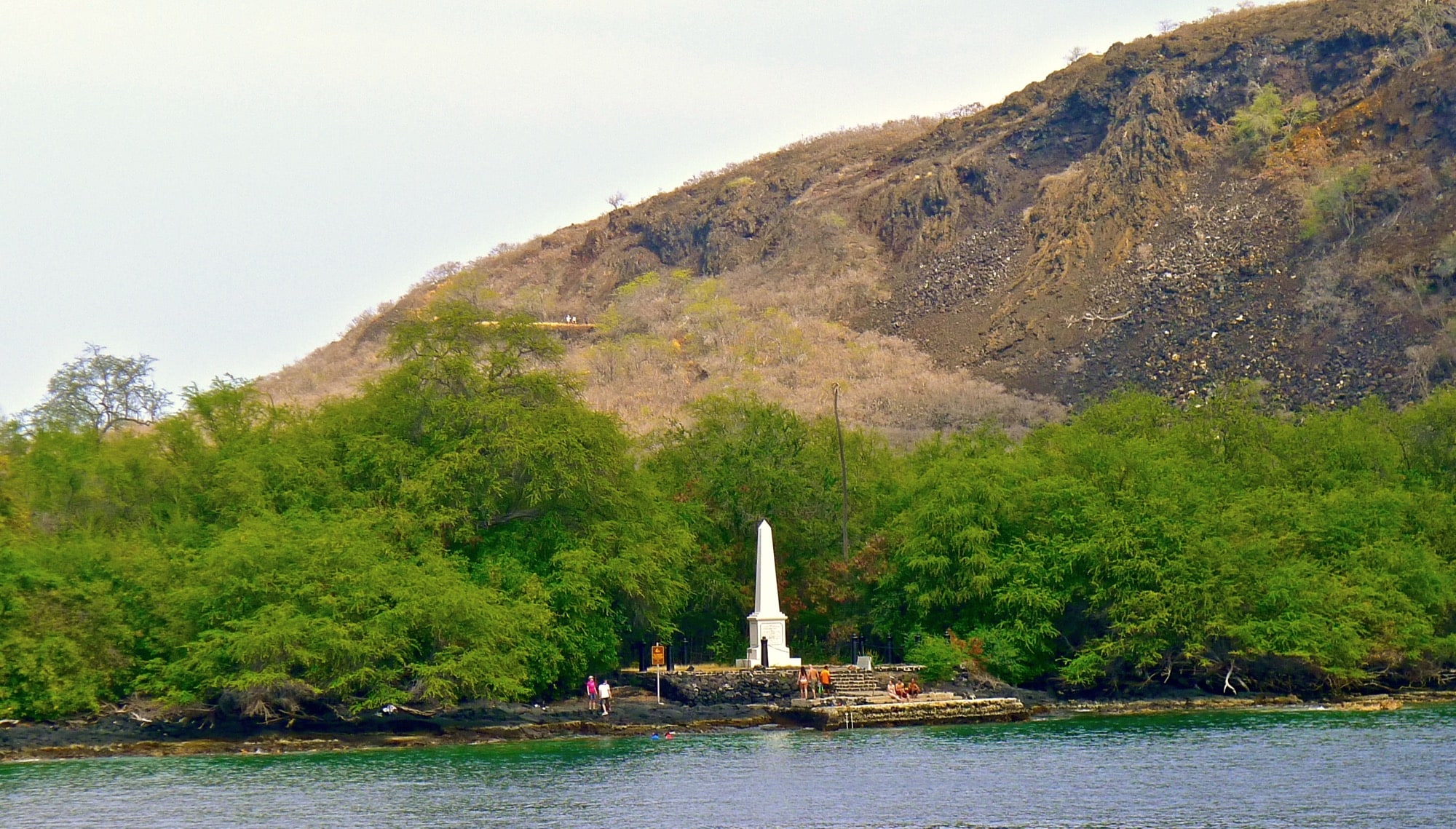
The Captain Cook Monument is a 27 ft. tall white obelisk commemorating the explorer on the western shore of Kealakekua Bay
Water activities at Kealakekua Bay
The bay holds coral and schools of tropical fish over a reef that drops off fast, and spinner dolphins rest here most mornings.
These are the ways to get in:
- Snorkeling
- Hiking
- Kayaking
- Boat tours
- Scuba diving
- Important note on how to behave around the wild dolphins
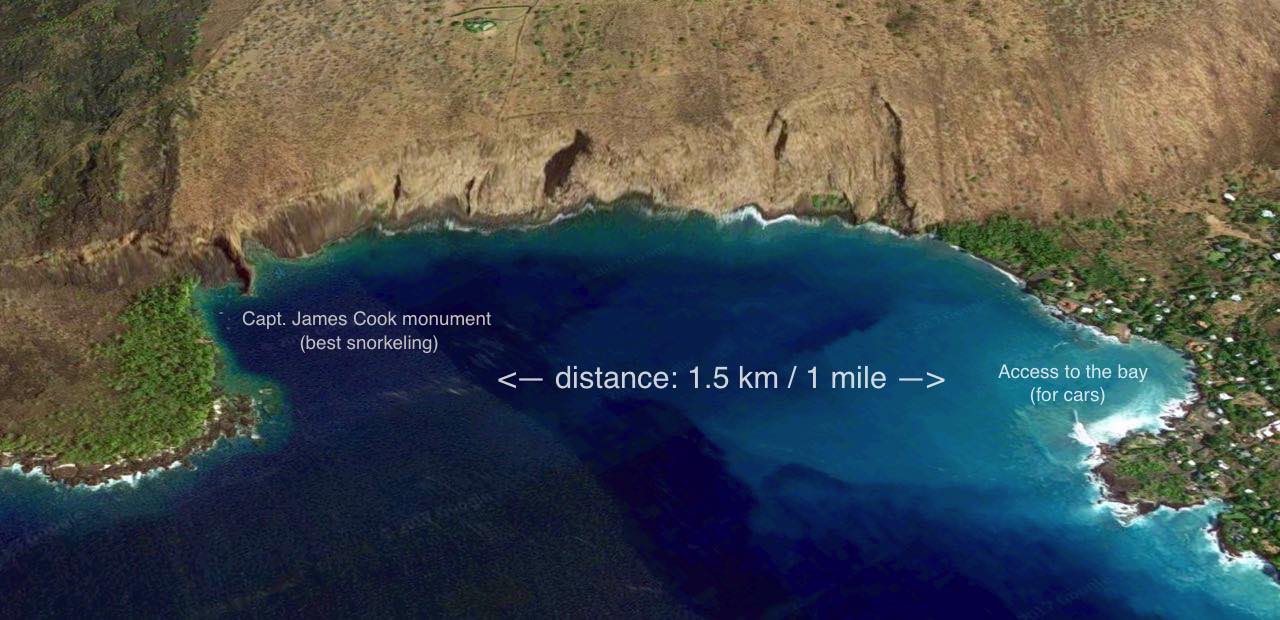
Kealakekua Bay is a 1-mile wide bay close to the town of Captain Cook on the Big Island. The best snorkeling is on the northern (left on the picture) side of the bay. Image credit: Google Maps
1: Snorkeling in Kealakekua Bay
Fish swarm over a well-developed reef that slopes steeply from the shore into deep water, so you see several kinds of reef in a short swim.
The water at the Nāpōʻopoʻo dock, where you will most likely park, is shallow with little coral. It gets better going south a few hundred feet toward the southern tip of Manini Beach Point. Encrusting coral, caves, crevices, and ledges all show up in these waters down to about 30 feet deep.
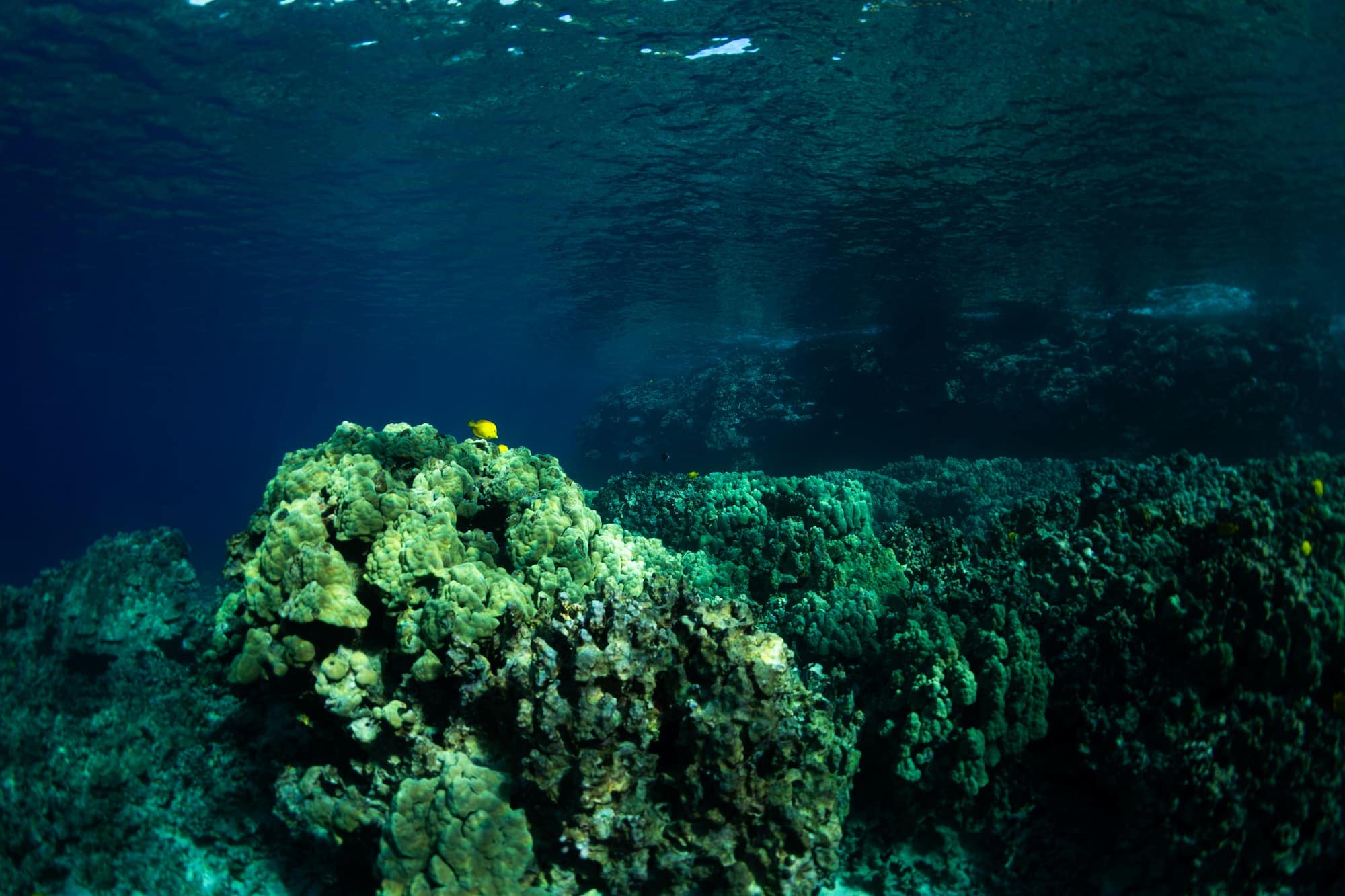
One of the many coral formations within Kealakekua Bay on the Big Island of Hawaiʻi. Photo by Sarah Lee on Unsplash
Going north from Nāpōʻopoʻo, the waters below the pali (cliff) on the bay’s northeastern side are good for snorkeling during calm conditions. Abundant coral growth and marine life show up in water about 5 feet deep.
The best snorkeling is on the opposite side of the bay from the parking area, in front of the Kaʻawaloa Flats where the Captain Cook monument stands. There is no parking anywhere near it.
Morning is the better time to snorkel on the east side of the bay. The afternoon Kona breeze chops up the surface by midday, cutting visibility near the Nāpōʻopoʻo entry points, so from shore you want to be in the water before 10 a.m. Kaʻawaloa Cove, on the north side of the bay, is more sheltered and less affected by wind chop.
There are four ways to reach the best snorkeling at Kaʻawaloa Cove.
Prices and details below last verified June 2026.
| Name | Effort and time | Cost | Best for |
|---|---|---|---|
| 1Hike (Details ↓) | Hard. 3.8 miles round trip, 1,300 ft of climb on the way out, full sun | Free | Fit hikers on a budget |
| 2Rent a kayak (Details ↓) | Moderate; 15 to 25 minute paddle each way | $70/day | Independent paddlers |
| 3Guided kayak tour (Details ↓) | Moderate paddle; state permit included | $80 to $250 | Paddlers who want the cove without the permit hassle |
| 4Boat tour (Details ↓) | Easiest. Gear, guide, and shade included; 3 hours to half a day | From about $120 | Most visitors and families |
2: Hiking to the Captain Cook Monument (3.8 miles round trip)
The hike down to the Captain Cook monument is a 1,300 ft climb on the way back out, and it is not particularly scenic. It is the way to reach the Kaʻawaloa Flats without renting a kayak or paying for a boat tour.
The trailhead is on Nāpōʻopoʻo Road just past the Hwy 11 intersection; there is a small pull-off with space for a few cars. From there you hike 1.9 miles to the water entry point, losing 1,300 ft (400 meters) in elevation along the way.
After you are done snorkeling you have to make up that elevation again. Almost all of the trail is exposed to full sun, and the surface is mostly loose lava rock and compacted dirt. There is no cell signal for the final mile.
There is no drinking water, no toilet, and no shelter at the Kaʻawaloa end. The nearest facilities are back at Nāpōʻopoʻo, across the bay. Bring a hat, sunscreen, more water than you think, closed-toed shoes, and your snorkeling gear.
BigIslandHikes has turn-by-turn directions and trail photos.
3: Kayaking to the monument
Kayaking from the Nāpōʻopoʻo landing to the monument takes between 15 and 25 minutes one way. Bring water, sunscreen, and your snorkeling gear.
Landing is for commercial groups only. The permitted operators hold separate written approval from State Parks to land at ʻĀwili, the storm beach on the Kaʻawaloa shoreline. On a private or rental kayak you cannot land at Kaʻawaloa at all: with the vessel permit you can swim and snorkel there but not go ashore.
Kayaking permits
Crowding damaged the bay, so the Division of State Parks now requires a permit for every vessel that goes on the water. You only need a permit in your own name if you bring your own vessel. State Parks takes the application by email at [email protected] and asks for up to 14 days to process it.
On a rental the permit belongs to the kayak, not to you, so ask the vendor to confirm theirs is current before you pay. That leaves two routes onto the water without your own permit: a guided kayak tour, or a permitted rental kayak you paddle yourself.
Guided kayak tours
Only two companies hold permits from the Division of State Parks to run guided commercial kayak tours to the Captain Cook Monument: Adventures in Paradise and Kona Boys (last verified May 2026, source). Between them they run three tours, and all three include the kayak, the snorkel gear, a guide, and the landing approval for Kaʻawaloa.
The cheapest is the Adventures in Paradise kayak and snorkel tour at about $80. It runs three hours from a 10 a.m. launch. You need intermediate paddling skills and the ability to self-rescue. Paddlers must be 10 to 60 years old and under 250 lb, and the booking is non-refundable. You get water and snacks, not a meal.
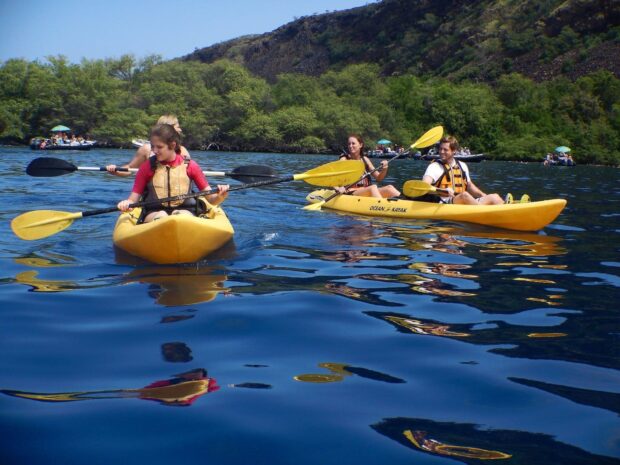
Kealakekua Bay Kayak and Snorkel at the Captain Cook Monument
A state permit grants access to Kaʻawaloa Cove at the Captain Cook Monument, an area closed to self-guided kayakers. Spinner dolphins appear on more than half of tours.
from:
$80
What is a suggested tour?Our suggested tours are hand-picked tours that receive consistent good reviews, give back to the community, and work hard to minimize their impact on the environment. Read more about these tours on our website.Kona Boys runs two longer tours with more included and a friendlier cancellation policy (full refund with 48 hours’ notice). The afternoon tour is about $170 for four hours, launching around 11:30 a.m. with light snacks onshore. The 11:30 a.m. launch puts you on the water as the midday Kona breeze picks up, so expect a choppier surface.
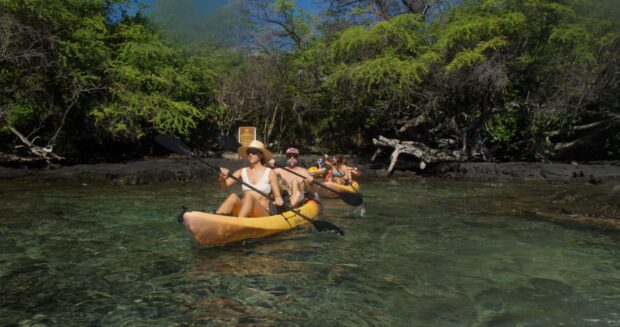
Midday Meander: Kealakekua Bay Kayak and Snorkel Tour with Kona Boys
The sleep-in, lower-priced way to reach the Captain Cook Monument. Self-guided rentals can't land at Kaʻawaloa; this guided tour does. Paddle across Kealakekua Bay, walk to the monument, and snorkel a Marine Life Conservation District.
from:
$170
What is a suggested tour?Our suggested tours are hand-picked tours that receive consistent good reviews, give back to the community, and work hard to minimize their impact on the environment. Read more about these tours on our website.The morning “Magic” tour is about $250 for the longest trip, starting at 7 a.m. when the bay is calmest, with a full lunch from the Coffee Shack included. You drive yourself to the launch.
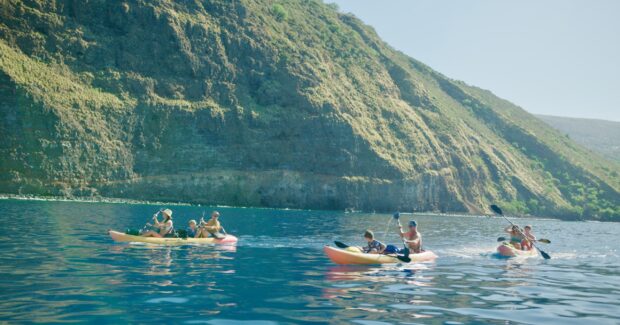
Morning Magic Kealakekua Bay Kayak & Snorkel Tour with Kona Boys
A 7 AM start puts you at the Captain Cook monument with the clearest water and the fewest boats of the day. Self-guided rentals can't land at the monument; this guided tour can. Best odds on spinner dolphins, plus a reef holding 200-plus fish species.
from:
$250
What is a suggested tour?Our suggested tours are hand-picked tours that receive consistent good reviews, give back to the community, and work hard to minimize their impact on the environment. Read more about these tours on our website.Renting a kayak yourself
If you want to make the trip yourself you can rent a kayak online here or find vendors offering rentals on the side of Hwy 11 and along the road down to the bay (route 160). The list of permitted vendors changes often, so ask the vendor whether their commercial use permit is current before you pay.
A permitted kayak carries a State Parks decal on both sides of the bow. Look for it yourself.
A rental permit covers the vessel, not a landing. You swim and snorkel at Kaʻawaloa. You do not go ashore.
4: Boat tours to Kealakekua Bay (snorkeling & scuba diving)
A boat tour needs no permit and no 1,300 ft climb back out.
Trips run from 3 hours to half a day and include snorkeling gear, snacks, and commentary on the bay’s history. Some include lunch in the price.
Tour operators that follow the Sustainable Tourism Association of Hawaiʻi (more info) guidelines include Sea Paradise and Fair-Wind (both departing from Keauhou Bay). Body Glove cruises (departing from Kailua-Kona) runs dinner cruises to the bay without snorkeling.
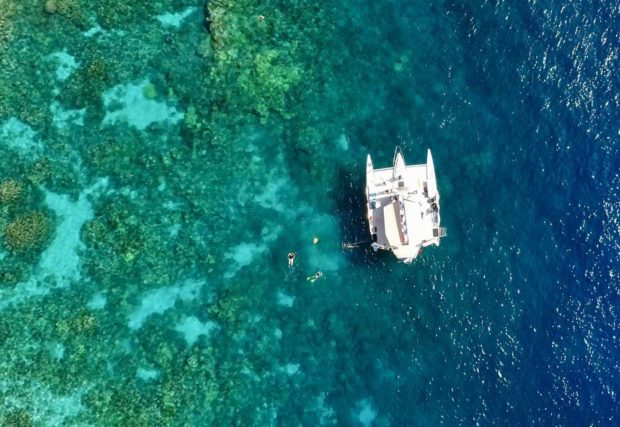
Afternoon Sail & Snorkel at Kealakekua Bay
You reach the reef below the Captain Cook Monument at Kealakekua Bay only by boat or a two-mile paddle from Nāpōʻopoʻo. Sea Paradise’s afternoon catamaran drops you there with crew who stay in the water for the whole snorkel.
from:
$125
What is a suggested tour?Our suggested tours are hand-picked tours that receive consistent good reviews, give back to the community, and work hard to minimize their impact on the environment. Read more about these tours on our website.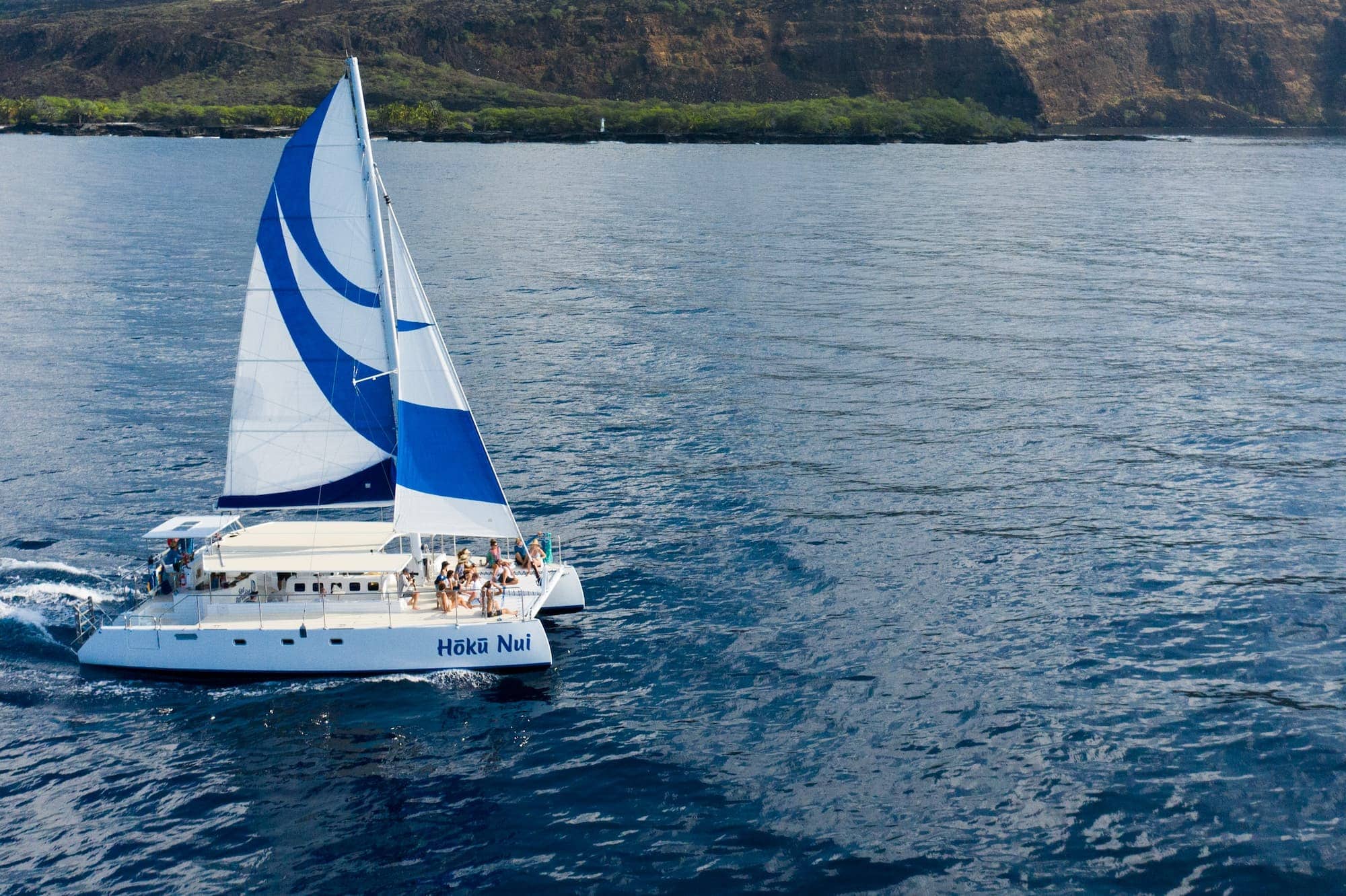
The Hoku Nui, Sea Paradise’s boat, off Kealakekua Bay. Their snorkeling tours depart from Keauhou Bay.
5: Scuba diving
Visibility at Kealakekua Bay runs 60 to 100 feet on calm mornings. Depths at Kaʻawaloa Cove range from 5 to 120 feet, with the most interesting coral and fish density in the 30-to-60-foot range along the cove walls.
The stretch between the Nāpōʻopoʻo landing and Manini Beach Point is exposed to north and northwest swell. When surf is up, surge over the ledges makes this entry unsafe. Check conditions before getting in, and skip this entry if there’s any wave action. Kaʻawaloa Cove on the far side is more protected and stays diveable in a wider range of conditions.
Most divers reach Kaʻawaloa by boat: the same operators running snorkel tours out of Keauhou Bay also offer dive charters, and several Kailua-Kona dive shops include Kealakekua on their regular schedule. You can bring your own gear or rent from the operator.
See our scuba diving guide for current operators, pricing, and certification requirements.
6: Spinner Dolphins: NOAA Rules and Guidelines
The spinner dolphins use the bay to rest. Swimming toward them cuts that rest short, even when it looks like play on both sides.
Their peak resting period runs roughly 10 a.m. to 2 p.m. Keep your distance during those hours.
Since 2021, NOAA federal rules prohibit approaching within 50 yards of Hawaiian spinner dolphins, by any means: boat, kayak, or swimmer. The rule applies to everyone. You can find more information at the NOAA “protect dolphins campaign”.
More on dolphins on the Big Island.
Getting to Kealakekua Bay
Take the Nāpōʻopoʻo turnoff onto Nāpōʻopoʻo Road, which meets Highway 11 near the 111 mile marker, about 13 miles (20 km) south of Kona. The trailhead for the hike to the monument is only a few hundred feet past this intersection, while the eastern shoreline of the bay is another 4.5 miles (7 km) down Nāpōʻopoʻo Road, at its end.
The lot at Nāpōʻopoʻo holds roughly 20 to 30 cars and fills by mid-morning on weekends. Street parking on Nāpōʻopoʻo Road is limited. On weekday mornings you will usually find a parking space.
Nearby: coffee, a refuge, and a sunset point
South Kona is coffee country, green and cloudy, and a good base for a full-day loop.
- Sunset watching
- South Kona road trip
- Kona Coffee tours
- The Puʻuhonua o Hōnaunau National Historical Park
Sunset Watching at Manini Beach
Manini Beach, halfway down the bay’s eastern shore, is one of the better sunset spots in south Kona.
The small rocky beach (no sand) sits in front of Nāpōʻopoʻo park at the end of Manini Beach Rd, 0.4 miles from the Kealakekua Bay State Park. There is a large lawn and a point that extends into the bay, with a clear view of the setting sun.
Parking is sparse here, especially in the hour before sunset.
Related: more sunset spots
Check out our 16 favorite sunset spots on Hawaiʻi, 4 each on the Big Island, Maui, Kauaʻi, and Oʻahu.
South Kona Road Trip
You drive through dry lava fields, forest, and coffee farms, with snorkeling spots and scenic pullouts along the coast down to the national park.
You can combine all of it (and more) into a road trip by following our 12-mile “Coffee Country” scenic drive.
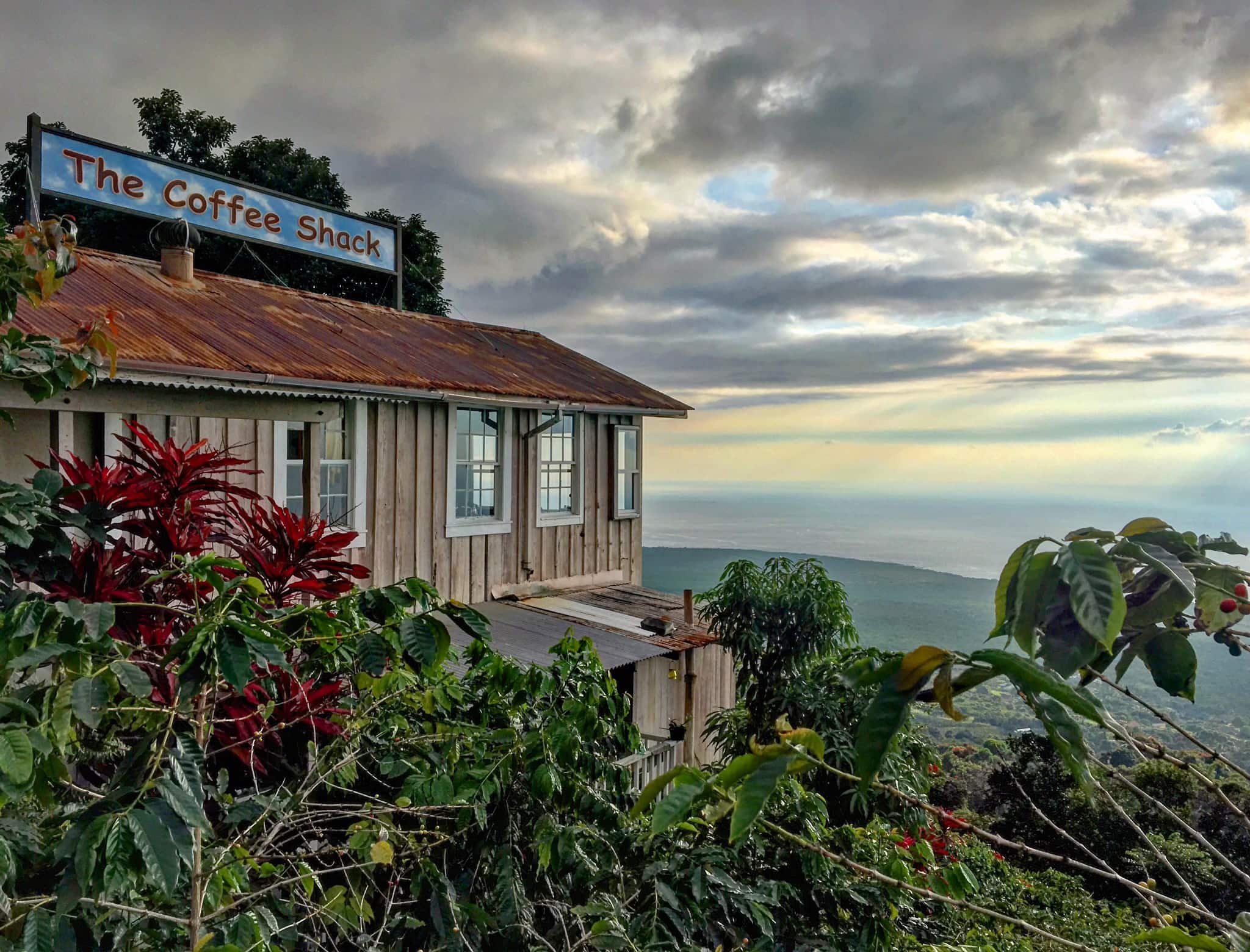
The Coffee Shack overlooks Kealakekua Bay from the slope above, and supplies the lunch on the Kona Boys morning kayak tour.
Kona Coffee Farm Tours
Kona coffee grows on a narrow elevation band a few miles uphill from the bay. Farm tours usually run 45 minutes to an hour.
On a Kona coffee tour a guide shows you around the plantation to see the coffee growing in the field, then walks you through the steps that turn a coffee cherry into a cup: drying, processing, and roasting. Many tours end with a free tasting near a showroom or visitor center where you can buy the local coffee to take home.
See our roundup of Kona coffee farms to pick one close to the bay.
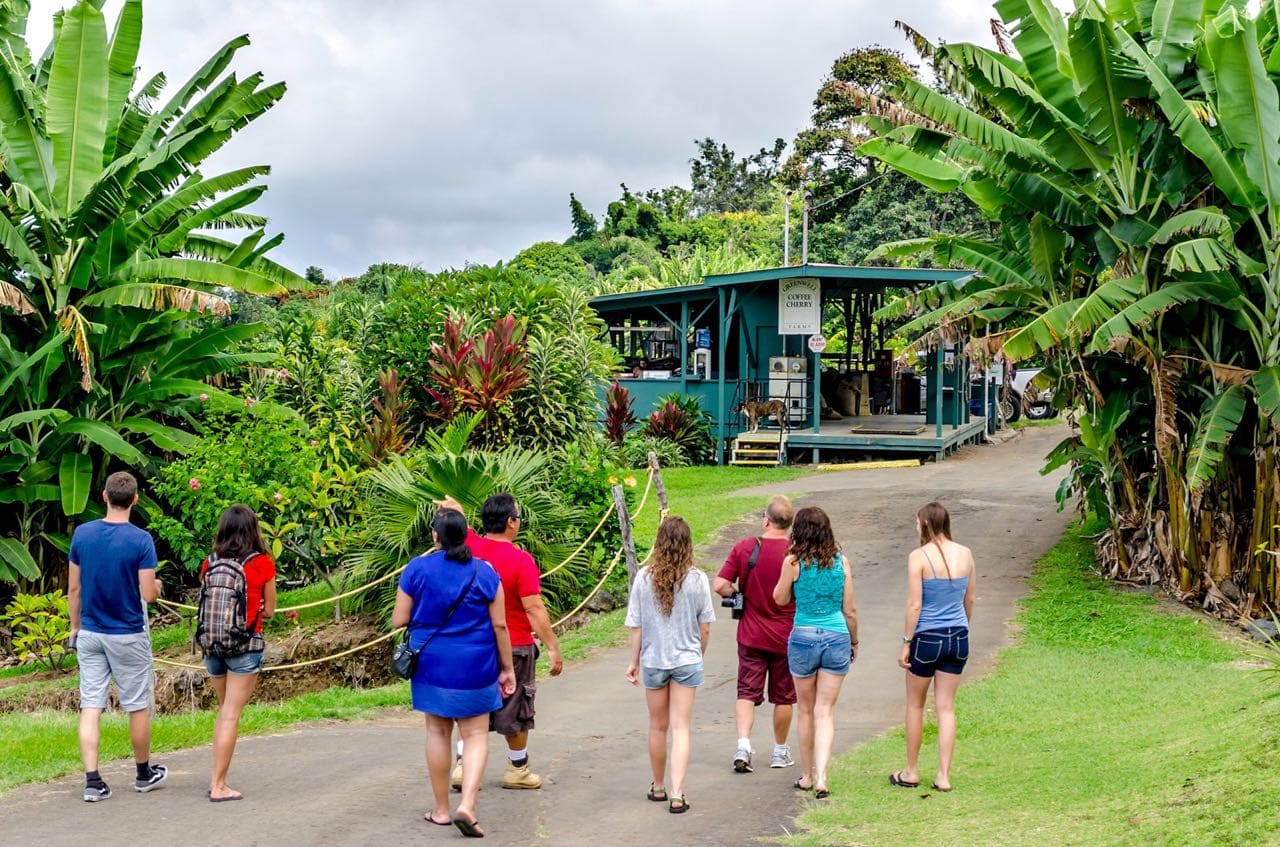
Kona Coffee Farm Tour at the Greenwell farm, close to Kealakekua Bay. Source: here by user horspowr1001 under a CC BY-NC 2.0 license
Puʻuhonua o Hōnaunau National Historical Park
Puʻuhonua o Hōnaunau National Historical Park is 3.7 miles from the Kealakekua Bay State Historical Park, about 9 minutes by car. It is one of our favorite places on the island to learn about Hawaiian cultural history.
Puʻuhonua o Hōnaunau, the ‘place of refuge,’ sheltered those who broke kapu, the sacred laws of ancient Hawaiʻi, an offense punishable by death. If you reached the Puʻuhonua, you would be pardoned and given a second chance at life.
Count on at least one hour for a quick look around the park (preferably 2 or 3 hours), and another one or two hours for the snorkeling at Hōnaunau Bay (a.k.a. two step).
Read more in our Puʻuhonua o Hōnaunau guide.
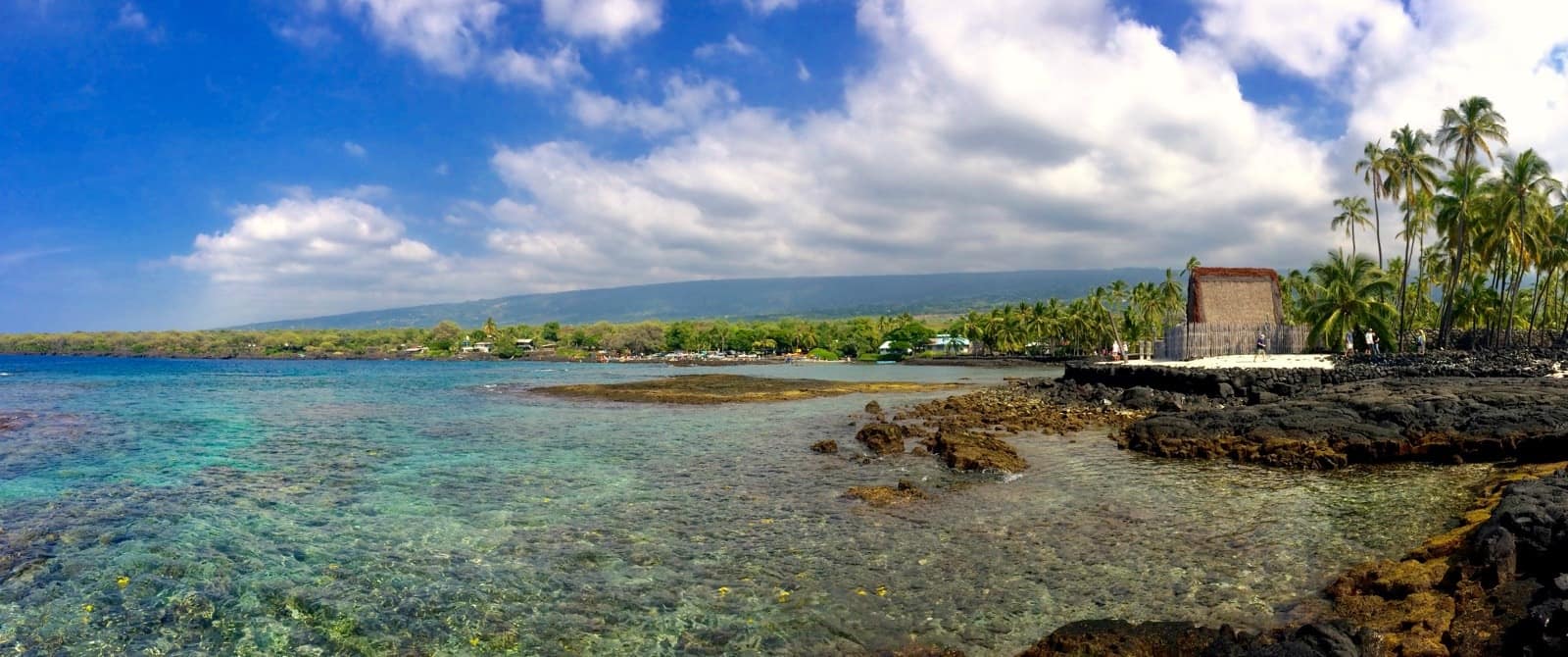
Two-step, one of the island’s best shore-entry dive spots, is a 2-minute walk from the Puʻuhonua o Hōnaunau park entrance.