• Skip to main content
  • Skip to primary sidebar
  • Skip to footer
Love Big Island
Tours
Home » Hawaiʻi Blog » Haumea: Goddess and Planet

Haumea: Dwarf Planet and Hawaiian Goddess

By Gerrit van der Plas | updated July 31, 2026

Haumea is a dwarf planet in our solar system named after the Hawaiian goddess of fertility and childbirth. Haumea was first discovered by the Keck Telescope, one of the world’s best optical telescopes located on Mauna Kea on the Big Island (see: stargazing on the Big Island), in 2004.

Table of contents
  • Haumea, the dwarf planet
  • who is Haumea? Hawaiian mythology
  • Planet or dwarf planet, what is the difference?

pluto no planet

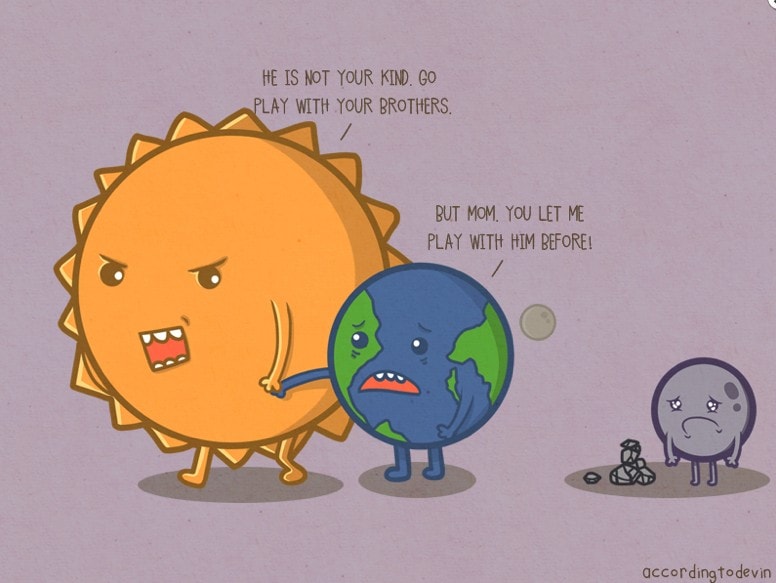
Pluto got demoted from “planet” to “dwarf planet” because of the discovery of more and more Pluto-like-objects like Haumea. Now, Pluto is not a planet anymore. Cartoon by accordingtodevin on tumblr.

Haumea, the dwarf planet
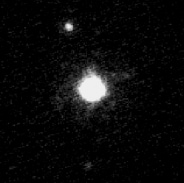
Haumea with moons

Keck image of Haumea and its two moons. Hiʻiaka is above Haumea (center), and Namaka is directly below. Image credits: M. Brown et al. (2006)

The discovery of Haumea is shrouded in controversy. There are two teams of scientists claiming the discovery: an American team and a Spanish team. As of now (2022), neither team is officially credited with the discovery but the discovery location is listed as the Sierra Nevada observatory in Spain. Read more about this controversy.

There are official rules about the naming of objects like Haumea. Haumea is a “classical Kuiper belt object“, and such objects are given mythological names that are associated with creation. Because the Keck Telescope was instrumental (for the American team) to the discovery, the name of the Hawaiian goddess “Haumea” was chosen. The Spanish team had suggested a different name: Ataecina (the Iberian goddess of the underworld).

The shape of Haumea is somewhat extreme. Astronomers found out that it is an ellipse with a size of 1920 x 1540 x 990 km (Lockwood et al. 2014). This shape is consistent with a *very* rapidly rotating object, where the rotation elongates the body.

More solar system objects with Hawaiian names

Haumea is orbited by at least two small icy moons. These moons are called after two daughters of Haumea:  “Hiʻiaka” (the patron goddess of the Big Island of Hawaii) and “Namaka” (the goddess of the sea).

Another dwarf planet discovered in 2005 was names after the Rapanui god of fertility, Makemake. It has a day length of 22.5 hours, similar to that of earth and mars, but takes 305 years to orbit the sun.  More on Makemake.

If you think that 305 years is a long “year” (one orbit around the sun), then hold onto your hats for the fwarf planet that was named “Leleakūhonua” in 2020. Leleakūhonua has the largest orbit of any dwarf planet or trans-neptunian object in the solar system, and it takes 32,000 years for the object to complete one full orbit around the Sun! It was first discovered in 2015 and will make its closest approach to the Sun in 2078.

Who is Haumea? Hawaiian mythology

Haumea is the guardian goddess of the island of Hawaiʻi. She is identified with Papa, the goddess of the earth and wife of Wākea (space). She is also the goddess of fertility and childbirth, and the mother of Pele, a popular goddess in the Hawaiian mythology [see: mythology of the Big Island].

Myths told of Haumea center about themes concerned with food supply for the life of man and marriage and birth for the increase of the family stock. By rebirths she changes herself from age to youth and returns to marry her children and grandchildren. She lives as a woman in Kalihi valley and transforms herself into a growing tree in which she conceals her husband from those who are leading him away to sacrifice. She secures for a chiefess a painless delivery in childbirth and receives in reward “the tree of changing leaves” out of which gods are made (source). Martha Beckwith has summarized the many stories about Haumea in her excellent book: Hawaiian Mythology (pages 276 – 290. Read online in the Hawaiian electronic library or buy the book on amazon)

Planet or dwarf planet, what is the difference?

Dwarf planets are a pretty recent ‘invention’. Problems in planet-land started when astronomers were finding more and more objects that were very much alike Pluto. Should these new objects also be called a “planet”? If so, estimates are that we would soon have to add up to 50 new planets to our solar system.

In 2006, the International Astronomical Union decided on a new classification scheme: Solar system bodies large enough to have cleared their orbit are defined as planets, while those that have not cleared their orbit (but that are massive enough to be rounded by their own gravity) are dwarf planets.
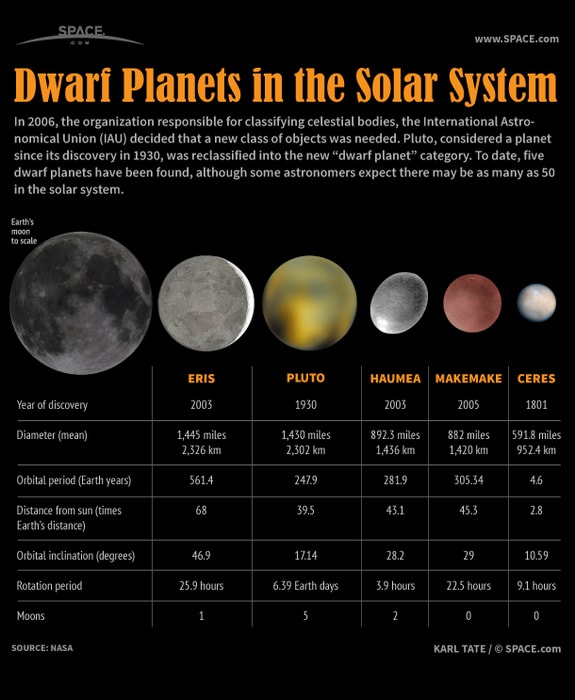
Dwarf Planets in our solar system

List of Dwarf Planets in our solar system as per 2012. source.

This also means that Pluto got demoted from planet to dwarf planet.

A sad piece of trivia: between the time Pluto was discovered and its declassification as a planet, it had not even completed one revolution around the sun! (one revolution about the sun of Pluto would be one year on/for Pluto)

Filed Under: Astronomy

Primary Sidebar

Written by:

Gerrit van der Plas

Last updated:

July 31, 2026

Browse topics:

  • Astronomy (4)
  • Big Island (20)
  • City Guides (4)
  • Island Comparisons (6)
  • Kauaʻi (16)
  • Maui (18)
  • Nature & History (6)
  • Oʻahu (16)
  • Quiz (2)
  • Things to Do (19)
  • Trip Planning (20)
  • Volcanoes (5)
  • Whales (2)

On this page

  • Haumea, the dwarf planet
  • Who is Haumea? Hawaiian mythology
  • Planet or dwarf planet, what is the difference?

Share with friends:

Footer

Love Maui

1: Maui Overview
2: Things to Do
3: Where to Stay
4: Popular Sights and Destinations
5: Road to Hana (Maui)
6: Maui Itinerary
7: Maui blog posts

The second-biggest island in the chain, much of Maui’s appeal comes from its natural landscape and biodiversity, including its two massive volcanoes, whale watching and marine ecosystems

Love Oʻahu

1: Oʻahu Overview
2: Things to Do
3: Where to Stay
4: Popular Sights and Destinations
5: Oʻahu Beaches
6: Oʻahu Itinerary
7: Oʻahu blog posts

Oʻahu is the busiest and most visited of the Hawaiian Islands, with the widest range of things to do: nature, culinary discoveries, historic landmarks, shopping, nightlife and festivals.

Love Kauaʻi

1: Kauaʻi Overview
2: Things to Do
3: Where to Stay
4: Popular Sights and Destinations
5: The Nāpali Coast
6: Kauaʻi Itinerary
7: Kauaʻi blog posts

With a population of less than 75,000, Kauaʻi is truly a small-town island, littered with open space, protected preserves, and old plantation history.

Let’s connect

Facebook
Pinterest
X
Instagram
Subscribe to our Newsletter

Made with by Love Big Island


© 2011–2026 lovebigisland.com | About Us | Contact | Sitemap (xml)/(html) | Privacy Policy

  • Book Tours
  • Planning a trip? Start here!
    • 1: Calculate your trip costs
    • 2: When should you go?
    • 3: Flying to Hawaii
      • 3a: Interisland Flights
    • 4: Get a Rental Car
    • 5: Find Accommodations
  • Regions
    • Kailua-Kona
      • Accommodations
      • 5 Highlights
      • Things to Do
      • Kona Beaches
    • Hilo
      • Accommodations
      • Highlights
      • Things to Do
    • Volcano Village
      • Accommodations
      • Highlights
      • Things to Do
    • Waimea
      • Accommodations
      • Highlights
      • Things to Do
    • Puna
    • Kaʻu
    • Kohala
  • Things to Do / Activities
    • ATV
    • Beaches
      • ʻAnaehoʻomalu Beach
      • Carlsmith beach park
      • Hapuna beach
      • Kaimu beach
      • Kahaluʻu Beach Park
      • Kamakahonu (King Kam) Beach
      • Kaunaʻoa (Mauna Kea) Beach
      • Maniniʻowali beach (Kua Bay)
      • Papakolea (Green sand beach)
      • Pohoiki Beach
      • Punaluʻu
      • Richardsons’ (Hilo)
      • Waialea Beach (Beach 69)
    • Biking / Cycling
    • Botanical Gardens
    • Camping
    • Chocolate and Cacao Farm Tours
    • Dolphins!
    • Farm Tours (BIG list)
    • Farmers Markets
    • Golfing
    • Hawaii Volcanoes National Park
    • Helicopter Tours
    • Hiking
    • Horseback Riding
    • Hot ponds
    • Kona Coffee Tours
    • Lava Viewing Guide 🌋
    • Lava Tubes
    • Luau and Hula
    • Manta Ray night dive / snorkel
    • MaunaKea Summit + Stargazing
    • Road Trips!
    • Scuba Diving
    • Snorkeling
    • Stand Up Paddle boarding (SUP)
    • Surfing
    • Be a Volunteer
    • Waterfalls
    • Waterfall Rappelling
    • Whale Watching
    • Ziplining
  • Six full Itineraries
    • One Day (day trips)
    • Two Days
    • Three Days
    • Five Days
    • Seven Days
    • For Cruise Ship Visitors (shore excursions)
  • Highlights
    • Annual Events
    • Museums
    • History and Culture
    • 4 National + 14 State Parks
      • Hawaii Volcanoes National Park
      • Puʻuhonua o Hōnaunau National Park
    • Local food & produce
      • Macadamia Nuts
      • Kona Coffee
      • Chocolate
    • Nature and Wildlife
    • Hawaii Trivia: 40+ fun facts
      • Pineapple History, Facts and Trivia 🍍🍍🍍
      • The opposite of Hawaii
      • The longest Hawaiian name
      • Hāpuʻu: the Hawaiian tree fern
      • Endemic and Native Species
      • Kahili Ginger
      • Pāhoehoe and ʻAʻā Lava
      • Lake Waiau on MaunaKea
      • Pele’s Hair (volcanic glass)
      • Green Sand Beach Trivia
    • What is Big Island weather like?
  • Favorite Sights and Destinations
    • Hawaii Volcanoes National Park
    • MaunaKea
    • Pololū Valley
    • Waipiʻo Valley
  • Oʻahu
  • Kauaʻi
    • Sights and Destinations
      • The Nāpali Coast
      • Waimea Canyon
    • Trip Planning Resources
      • 7 day itinerary
      • Getting Around
      • Where to Stay
    • Things to Do
      • Air Tours
      • Beaches
      • Culinary Tours and Activities
      • History and Cultural Activities
      • Land Activities
      • Water Activities
  • Maui
    • Things to Do
      • Air Tours
      • Beaches
      • Culinary Tours and Activities
      • History and Culture
      • Nature and Wildlife
      • Land Activities
      • Water Activities
    • Sights and Destinations
      • Haleakalā National Park
      • Road to Hana
    • Trip Planning Resources
      • 8 day Itinerary
      • Getting Around
      • Where to Stay
  • Free Newsletter