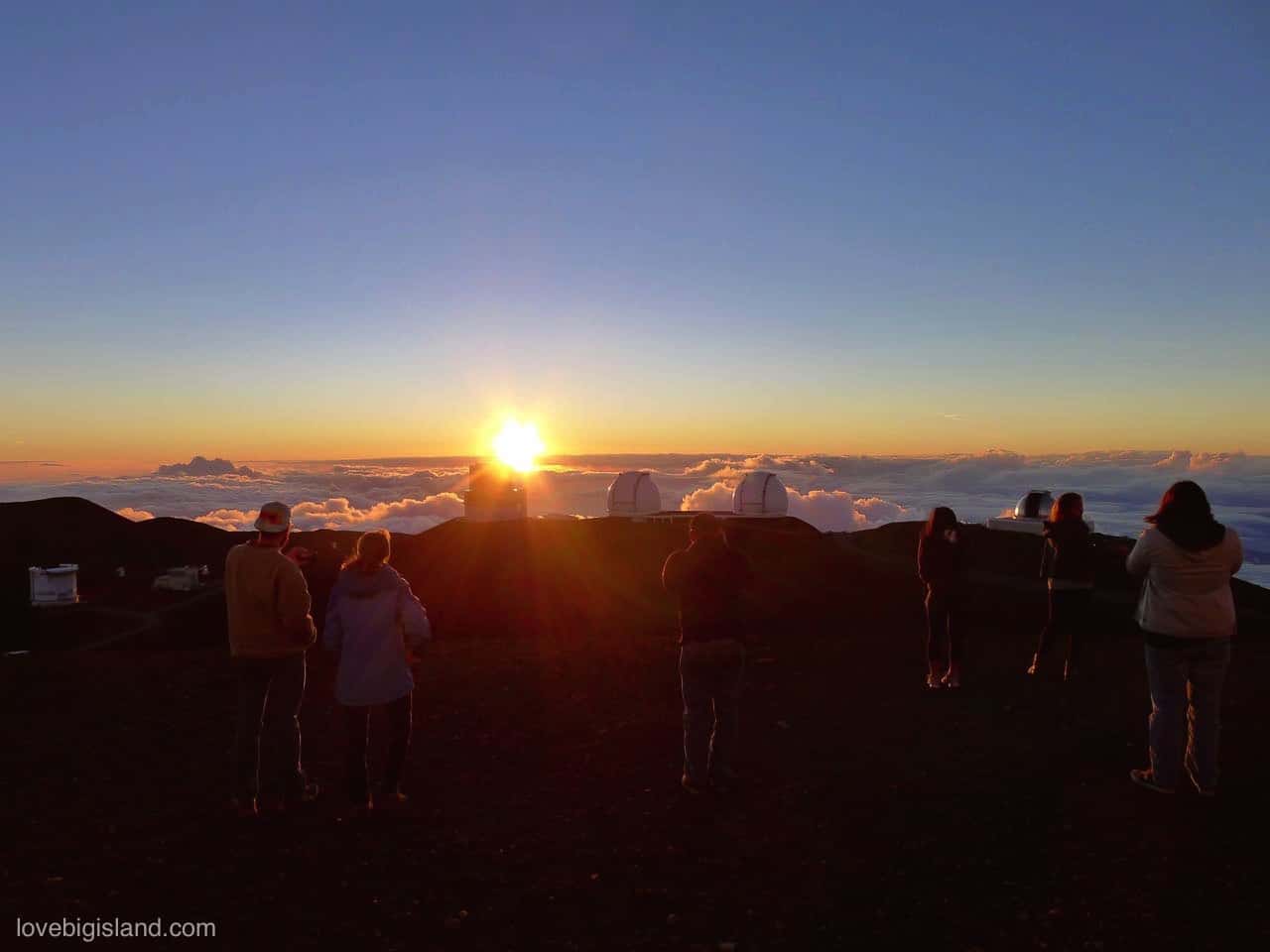
Eta Aquarids meteor shower (and a super moon) on May 5th 2012: Hawaii viewing tips

The Eta Aquarids in 2012 are a meteor shower for the early (Hawaiian) birds. Because the peak of the shower is only one day before the largest full moon of 2012, stargazers have to wait for the early morning when the moon sets in the West while the meteor shower radiant rises in the East. The best time to see the Eta Aquarids from Hawaii in 2012 is between 04:00 and 05:00 a.m. on May 5th.

This page is about the 2012 Aquariids meteor shower. Are you looking for information on the Eta Aquariids in 2013?

The large full moon of May 5th is called a “Super Moon” because it coincides with the closest approach the Moon makes to the Earth on its elliptical orbit, and it provides plenty of light for other nightly escapades besides counting shooting stars. Why not get our some binoculars and a camera to look at the “Sea of Rains” (Mare Imbrium, wikipedia) on the moon? This “sea” was formed when lava flooded one of the largest craters on the moon long ago.

Don’t miss any of the 2012 astronomical fireworks in the Hawaiian sky and bookmark our Hawaii 2012 Astronomy calendar. We will send you Astronomy Alerts for all future Hawaiian astronomy events showers if you subscribe to our blog.

If you are planning to watch this years Eta Aquarids meteor shower, we recommend that you have a look at our meteor shower guide for viewing tips and meteor background information specifically tuned for Hawaii! You can also have a look here if you want  to find out more about stargazing on Hawaii.

Eta Aquarids Trivia

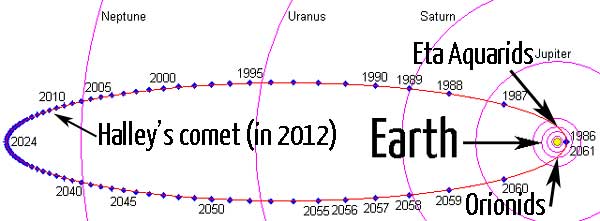
Did you know that the Eta Aquarids have a sister? The Eta Aquarids meteor shower happens when earth passes through the space-debris left by Halley’s Comet. There is another point in space where earth crosses the rubble from Halley’s Comet, and when this happens, we see the meteor shower the Orionids (and not the Delta Aquarids as people often think).

Halley's comet Orbit

Current position and orbit of Halley’s comet around our solar system. Every blue dot shows you where the comet is in that year. You can see the comet passes twice (in 1986 and 2061) close to earth, leaving enough space-debris to cause two meteor showers: the Eta Aquarids (early May) and the Orionids (late October). Image adapted from http://www.uwgb.edu/dutchs/PLANETS/Comets.HTM

Halley’s Comet is the most famous short period comet of our solar system, and returns every 75 or 76 years. The last time it flew by was in 1986, the next time will be in 2061. Right now Halley’s Comet is deep in the outer solar system (beyond Neptune!) but you will still be able to see little particles of it burn up into earths atmosphere twice a year during the Eta Aquarids and the Orionids meteor showers.

Each time it swings by the sun, solar heat vaporizes about 6(!) meters of ice and rock from the nucleus. The debris particles, about the size of sand grains, spread along the comet’s orbit, filling it with tiny meteoroids.

The Eta Aquarids peak at 09:00 a.m. Hawaiian time in 2012, but this meteor shower has a relatively broad peak that lasts about 12 hours before and after this time making the pre-dawn hours of May 5th the best time to watch.

When and where can you see the Eta Aquarids?

The best time to see the Eta Aquarids from Hawaii in 2012 is between 04:00 and 05:00 a.m. on May 5th. Look towards the East and find the constellation Aquarius. This is where you will see most shooting stars.

Best viewing times

Aquarius rises over the Eastern horizon around 02:00 a.m. on May 5th, while the moon sets in the West-southwest at 05:24  and the sun rises at 05:53 (both Hawaii local time).  Because you are looking for the darkest possible sky you want to wait until the moon has (almost) set, but the dawn has not arrived yet. The best viewing from Hawaii thus is in the early hours before dawn between 04:00 and 05:00.

Sky map for the Eta Aquarids

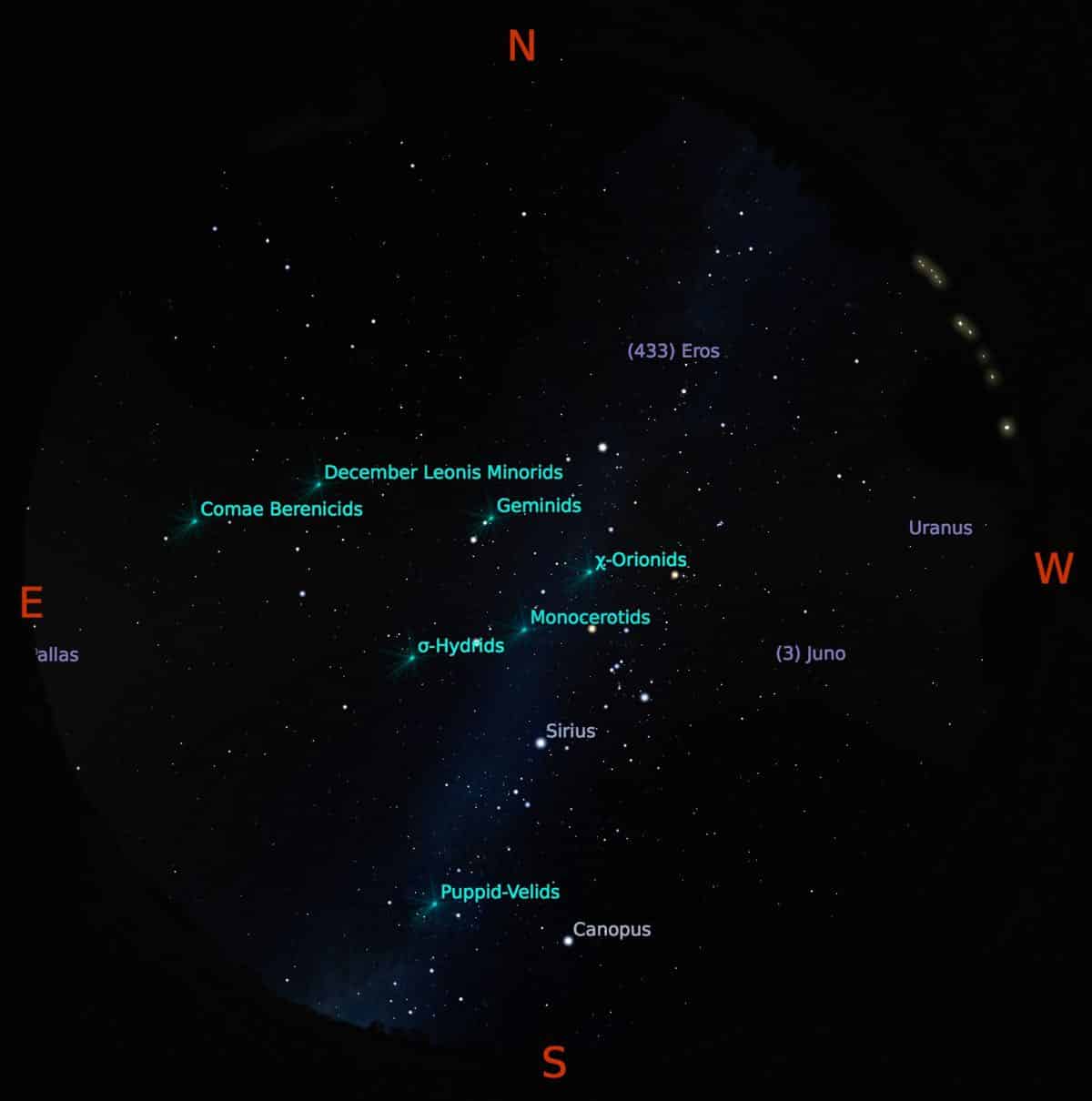
The radiant (or place where the shooting stars seem to come from) of the Eta Aquarids, is located in the “water jar” of the constellation Aquarius. We show two sky maps below to help you find the radiant yourself. One of the Hawaiian sky on 02:00 a.m. May 5th as the radiant rises in the East, and another of the Hawaiian sky at the best time (04:34 a.m.) to view the Eta Aquarids this year from Hawaii.

Eta Aquarids sky map may 5th 2012 Hawaii

Sky map to find the 2012 Eta Aquarids meteor shower radiant from Hawaii. This map shows the sky above Hilo at 02:00 a.m. on may 5th, as the radiant of this meteor shower rises in the East. It has been made with the (free) planetarium software stellarium (www.stellarium.org)

Eta Aquarids sky map may 5th 2012 Hawaii

Sky map to find the 2012 Eta Aquarids meteor shower radiant from Hawaii. This map shows the sky above Hilo at 04:34 on may 5th – the best time to see the Eta Aquarids this year. It has been made with the (free) planetarium software stellarium (www.stellarium.org)

Print out this sky map and take it with you to easily find the radiant of the meteor shower. You can see the shooting stars in a large area around the radiant, so don’t focus you attention to much at a small patch of sky.

The largest full moon of 2012 on May 5th

Have you ever noticed that sometimes the moon appears to be larger than other times? This effect is often caused a visual illusion connected to how we perceive the sky,  but part of it is also rooted in reality as the distance between the earth and the moon varies.

apogee perigee nasa 2011

Size difference for the moon during her closest approach (perigee) and farthest passing (apogee). The diameter of the moon during perigee is 14% larger. Image credits: NASA

Because the orbit of the moon is elliptical, and because of its many other (small) irregularities, the distance between earth and the moon always changes. During each lunar orbit there is a point of closest approach (“perigee”) and largest distance (“apogee”).

The closest perigee of 2012 is on May 5th at 17:34 p.m., when the distance between the center of the earth and the center of the moon is “only” 356953 km. Compared the the farthest apogee 0f 2012 (at 406450 km, May 19th), the width of the moon will look 13.8% larger and be about 30% brighter.

This large full moon is obviously bad for meteor shower watching, but does represent a great lunar photo-opportunity. For the best results, let illusion and reality combine and photograph the moon as it is close to the horizon. The best time for this is just after moonrise on May 4th at 17:49, or shortly before moonset on May 5th at 05:24.

Where will you watch the Eta Aquarids?

The best places to watch a meteor shower are the ones that have dark skies and little light pollution. Luckily Hawaii is full of such places, and while there are many good places to watch, it is often more fun to watch the meteors together.

Do you know of a great destination with little or no light pollution in your area to view meteor showers? Is there a confirmed meet-up? Feel free to leave the address in the comments section below!

2 thoughts on “Eta Aquarids meteor shower (and a super moon) on May 5th 2012: Hawaii viewing tips

  1. Pingback: Orionids meteor shower (October 2012) - Hawaii viewing tips

  2. Pingback: Hawaii 2012 Online Astronomy Calendar

Leave a Reply

Your email address will not be published. Required fields are marked *

You may use these HTML tags and attributes: <a href="" title=""> <abbr title=""> <acronym title=""> <b> <blockquote cite=""> <cite> <code> <del datetime=""> <em> <i> <q cite=""> <strike> <strong>